SI
SI
discoversearch

We've detected that you're using an ad content blocking browser plug-in or feature. Ads provide a critical source of revenue to the continued operation of Silicon Investor.  We ask that you disable ad blocking while on Silicon Investor in the best interests of our community.  If you are not using an ad blocker but are still receiving this message, make sure your browser's tracking protection is set to the 'standard' level.
Strategies & Market Trends : 2026 TeoTwawKi ... 2032 Darkest Interregnum -- Ignore unavailable to you. Want to Upgrade?


To: ggersh who wrote (203050)12/10/2023 8:01:58 PM
From: TobagoJack  Read Replies (1) | Respond to of 219610
 
Re <<WWIII about to begin?>>

might, but if so, unclear whether happening in ME or SEAsia first, and is why Russia / China working over time to enable China w/ surge-dose of weapons grade material so that China can come to parity with Mother Russia in nukes and participate in the greatest struggle on par with the rest of the boyz combined.

It is what comrades do.

I do not get what, if anything, Team Biden is trying to do.

getting ready against enablers of Philippines


Getting ready for 2027 ...

scmp.com


Russia confirms enriched uranium supplies to China
Published: 1:00pm, 5 May, 2023


The CFR-600 reactor is due to start operating this year. Photo: CNNC

Russia has confirmed it is supplying highly enriched uranium to two Chinese reactors.

TVEL, a subsidiary of the state atomic energy corporation Rosatom, will be allowed to export the fuel to China over the next three years, Sputnik News reported on Wednesday.

It will be sent to the CFR-600 power plant at Xiapu in the southeastern province of Fujian. The project has two fast-neutron reactors, both with the capacity to produce 600 megawatts of power, the first of which is expected to connect to the grid later this year.

World Nuclear News reported in January that three batches of fuel had been transported by rail from TVEL to the plant since September.

However, Sputnik’s report revealed that the supplies are highly enriched uranium, with a concentration of just over 30 per cent of uranium-235 – which is found in less than 1 per cent of naturally occurring uranium.

Fast reactors require a concentration of over 20 per cent of uranium-235, while nuclear weapons usually contain about 90 per cent uranium-235 and plutonium.

The United States has become increasingly concerned about nuclear energy cooperation between China and Russia.

In a letter sent to US National Security Adviser Jake Sullivan in March, leading Republicans in Congress said the cooperation was “a direct threat to US security” and called on the Biden administration to “stop Rosatom and the PRC’s dangerous cooperation”.

John Plumb, the Pentagon’s assistant secretary for space policy, told a hearing the same month that “it was very troubling to see Russia and China cooperating on this”.

He also warned that Russia’s supply of enriched uranium could lead to China expanding its nuclear arsenal, according to Nikkei.

The Chinese foreign ministry has previously said the two countries carry out “normal civilian nuclear cooperation within the framework of international obligations”.


China sets new world record in development of ‘artificial sun’

The fast reactors are part of China’s plan to develop a closed nuclear fuel cycle, which reprocesses the remaining uranium and plutonium isotopes in spent fuel, as a way of reducing the risk of shortages.

During Chinese President Xi Jinping’s visit to Russia in March, Rosatom and China’s Atomic Energy Authority signed a comprehensive long-term cooperation deal on fast-neutron reactors and closed nuclear fuel cycle development.

In fast reactors, uranium-238 – the most commonly found isotope – can be used to generate plutonium-239, which can in turn be used as nuclear fuel or in nuclear weapons.

“But the risk is it uses liquid sodium as the reactor coolant. Liquid sodium easily catches fire both in air and in water, and it can leak easily,” Tian Li, vice-president of the nuclear power branch of the China Electric Power Promotion Council, said.

He added that the Fujian reactor was built to generate electricity, and it would not be used for military purposes.


To: ggersh who wrote (203050)12/10/2023 8:05:48 PM
From: TobagoJack  Read Replies (2) | Respond to of 219610
 
mentioning in passing

warriormaven.com

China Will Have 1,000 Nuclear Warheads by 2030

The Chinese nuclear buildup, according to the former Commander of US Strategic Command, Admiral Charles Richard, is both “breathtaking” and “accelerating
Peter Huessy - Warrior Senior Nuclear Weapons Analyst
Dec 7, 2023

By Peter Huessey, PhD, Warrior Senior Nuclear Weapons Analyst

The Chinese nuclear buildup, according to the former Commander of US Strategic Command, Admiral Charles Richard, is both “breathtaking” and “accelerating.” It poses a new and unique danger to the US, requiring the nation to simultaneously deter two nuclear-armed peer adversaries.

Detractors raise three challenges to the Admiral’s concerns. First, the Chinese buildup is not extensive. Second, the Chinse cannot technically build such a big force in the projected timeframe. Third, there is nothing the Chinese threaten that justifies the level of concern. Let’s examine each concern in order.

The Chinese Buildup

According to a new Department of Defense (DoD) report on the military power of China, the People’s Republic of China (PRC) nuclear arsenal grew from 200 to over 500 warheads in just the past four years and will hit 1,000 and by 2030 and 1,500 by 2035. The 150 percent growth since 2020 is thus in the books and unprecedented.

As for the future, the key driving factor is the 300–360 new intercontinental ballistic missile (ICBM) silos that were built over the past few years. The silos are able to hold either the DF-31 or the DF-41 ICBM—capable of carrying three to ten warheads, respectively.

The additional major factor is the four new strategic nuclear-armed submarines (SSBN) projected to be fully operational by 2030, each with 20 missiles and three to six warheads per missile. The US Pacific Command says the submarines already in the Chinese fleet are currently being fitted with multiple warheads.

When combined, a reasonable estimate could project a Chinese nuclear arsenal significantly larger than the 1,500 projected for 2035. This is well above the US day-to-day operationally deployed strategic nuclear deterrent, especially given the shaky assumption that new Chinese ICBM silos will largely be filled with single warhead DF-31 missiles.

Do the Chinese have the technical capacity to build sufficiently to soon exceed the US nuclear force balance? Chinese state-run media claims that the DF-41 can carry up to ten warheads and, as James Howe explains, the PRC published a schematic of a DF-41 with ten warheads launched from a railcar.

The DF-41 has a payload of 2,500 kilograms. If one assumes this weight is split between ten warheads at 175-225 kilograms per warhead, which is feasible for a light re-entry vehicle, and reflects the Chinese trend to deploy smaller and more accurate warheads, then such an option is certainly possible.

The DoD, in the 2019 Chinese Military Power Report (CMPR), estimated that the DF-41 can carry six to ten warheads, while the 2023 CMPR now estimates the DF-41 can carry upwards of six warheads. China launched a DF-5 ICBM with ten re-entry vehicles in 2017, proving a technological capability to deploy ten warheads per ICBM.

What would the Chinese do with such a force if they built it? The United States is clearly the intended target. Critically important, as Admiral Richardtold Congress, “The breathtaking growth and strategic nuclear capability enables China to change their posture and their strategy and execute any plausible nuclear employment strategy—the last brick in the wall of a military capable of coercion.”

The newly released report on the Strategic Posture of the United States concurs, noting that China and Russia repeatedly threaten the US with coercive nuclear strikes, while becoming closer allies with nuclear-armed North Korea and nuclear-aspiring Iran.

Chinese General Secretary Xi Jinping designated 2027 as the year when China should have the military capability to resolve the “Taiwan” question. That could very well mean, as Admiral Richard warned, that China is seeking to coerce or blackmail the US to stand down over any conflict involving Taiwan, believing that a significant nuclear capability gives them the leverage to do so.

America’s Response

As the Strategic Posture Commission recommended, it is not that the US must match warhead for warhead the combined force of Russia and China. But as many of the Commission members emphasized, the US needs a greater nuclear deterrent capability because the program of record is not sufficient.

A quick increase in warheads carried by the Minuteman III ICBM and Trident D-5 sea-launched ballistic missile was recommended. They also suggested acquiring more Columbia-class submarines and some mobile Sentinel ICBMs. A sea-launched nuclear-armed cruise missile capability was highly recommended as well.

A robust missile defense of the US homeland, protecting against limited nuclear coercion, is also an excellent remedy. The new strategic environment is highly dangerous because of the significant and historically unprecedented growth in Chinese nuclear forces. To sustain deterrence, the US must add credible military capability to its nuclear forces in a series of planned, serial additions while finally deploying integrated air and missile defenses protecting the US homeland.

Kris Osborn is President of Warrior Maven – Center for Military Modernization. Osborn previously served at the Pentagon as a Highly Qualified Expert with the Office of the Assistant Secretary of the Army—Acquisition, Logistics & Technology. Osborn has also worked as an anchor and on-air military specialist at national TV networks. He has appeared as a guest military expert on Fox News, MSNBC, The Military Channel, and The History Channel. He also has a Masters Degree in Comparative Literature from Columbia University.


To: ggersh who wrote (203050)12/10/2023 8:08:00 PM
From: TobagoJack  Read Replies (1) | Respond to of 219610
 
am reasonably sure that as each month roll by, the probability of WWIII reduces

and probability reduces to 1/10 of current probability by 2030, and to -0- by 2035

12 years is not long

scmp.com

China’s rivals warn of nuclear build-up, but analysts say Beijing seeks quality over quantity | South China Morning Post
Published: 7:00pm, 4 Aug, 2023
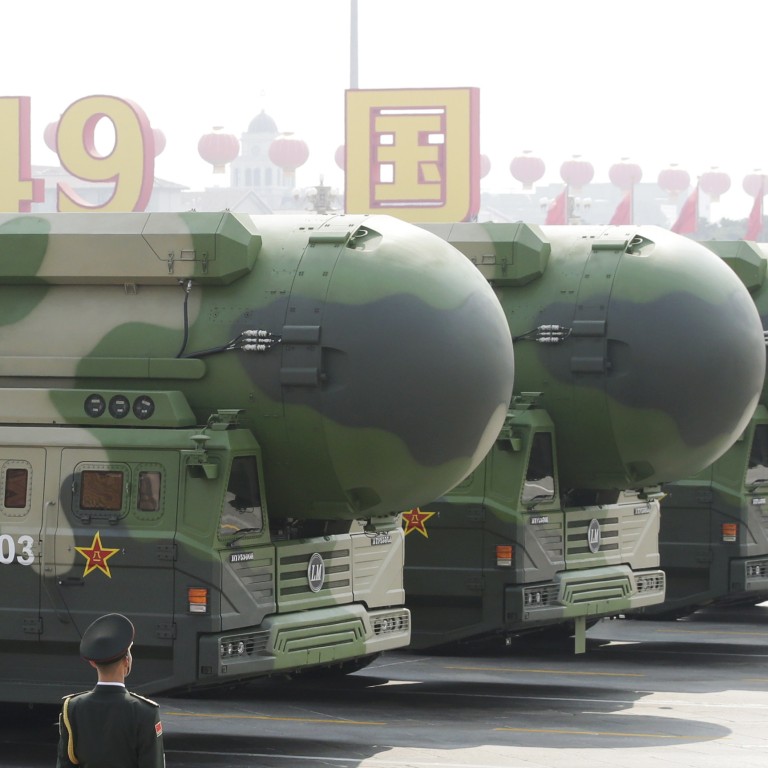

Defence experts say China will continue to improve its ICBM technology, such as its DF-41 missiles, to upgrade its air, ground and sea-based nuclear delivery systems. Photo: Reuters
China’s military is focusing its nuclear programme on quality rather than quantity when it comes to warheads, Chinese defence analysts have said, dismissing suggestions that the PLA is embarking on a massive build-up.
The assessments follow the release last week of a Japanese defence ministry white paper that said Beijing could quadruple its arsenal to 1,500 warheads by 2035, echoing estimates by the Pentagon in October.

Tokyo estimated the People’s Liberation Army had 350 nuclear warheads as of last year, while an earlier report by the Federation of American Scientists’ Nuclear Information Project estimated Beijing had roughly 410 nuclear warheads and more in production.

“China has been extensively and rapidly enhancing its military capability in a qualitative and quantitative manner, with focuses on its naval and air forces as well as its nuclear and missile forces,” the white paper said.

But Zhou Chenming, a researcher with the Yuan Wang military science and technology think tank in Beijing, said China’s national policy was based on “maximising nuclear deterrence”.


China unveils new PLA Rocket Force chief in wake of corruption scandal

31 Jul 2023

Nuclear deterrence refers to being prepared to use nuclear weapons as a way of discouraging enemies from launching a nuclear attack first.

Zhou said that, since the 1950s, Beijing had invested “tremendous resources” in maximising nuclear deterrence, including precise strike technology, penetration and destructive capability.

Zhou added that China had promised to maintain its “no first use” policy, and that its existing nuclear warheads were enough to hit 90 per cent of the major defence industry centres and key enterprises in the southwestern US.

Read key economic stories from China, including the US-China trade war, sanctions, and economic developments.

Zhou said Japan’s estimate of 350 warheads referred to ready-made nuclear weapons that could be fixed to intercontinental ballistic missile (ICBM) bodies – giving Beijing extensive long-range strike capability to hit anywhere in the US.
Song Zhongping, a former PLA instructor, said the Chinese strategy “is entirely different from the Western thinking”. While Western nuclear powers viewed having more warheads as more powerful, China focused more on the quality, not just the quantity, he said.



02:26

‘Oppenheimer’ sparks debate in Japan ahead of 78-year anniversary of Hiroshima atomic bombing

‘Oppenheimer’ sparks debate in Japan ahead of 78-year anniversary of Hiroshima atomic bombing

In his work report during the Communist Party’s national congress last year, President Xi Jinping, who is also chairman of the Central Military Commission, set a goal of “establishing a strong system of strategic deterrence” over the next five years, which many consider to be a reference to upgrading China’s nuclear arsenal and technology.
Song said it was unlikely that China’s nuclear development would follow the old path set out during the Cold War.

“It doesn’t mean China will follow its US and Russian counterparts to greatly increase its nuclear warheads as the outside world imagines,” Song said.

Russia has 5,977 nuclear warheads while the US has 5,428, according to estimates by the Stockholm International Peace Research Institute.

“What Japan and the US are worried about is whether China will follow Washington to develop a low-yield nuclear weapon as a countermeasure to deal with the challenges posed by the Americans,” Song said.

Low-yield nuclear warheads are used for precision strikes – not for the purpose of causing massive casualties.


US general’s nuclear deterrence comments ‘may spur China to boost its arsenal’

17 Sep 2022

In 2021, the US Congressional Budget Office estimated that Washington would spend US$634 billion over the next decade to upgrade its nuclear arsenal, a 28 per cent uptick compared with a previous 10-year projection.

This includes the development of a new W76-2 low-yield nuclear warhead for submarine-launched ballistic missiles and development of a new nuclear submarine-launched cruise missile.

Last year’s Pentagon report to Congress said the PLA would probably develop its DF-26 intermediate ballistic missile to field a lower-yield warhead in the near term, citing Chinese official media commentaries calling for proportionate response capabilities if the US were to use low-yield weapons against the mainland fleet in a conflict over Taiwan.

The DF-26 missile has a range of 4,000km (2,485 miles) and can be used in nuclear or conventional strikes against ground and naval targets, including the US naval base in Guam.

Zhou and Song agreed it was possible the PLA could use the DF-26 missileas a platform for tactical nuclear arms, but stressed that China would only do so if it were hit first.
“China still sticks to its policy of ‘no first use’ of nuclear weapons, including tactical nuclear bombs,” Song said. “However, the PLA will definitely strike back in retaliation if the US dares to use them against the Chinese military.”

Zhou reiterated that Beijing would still put most of its resources towards developing powerful ICBMs, not low-yield bombs.

He said China would continue to focus on improving ICBM technology, such as the DF-31 and DF-41 missiles to upgrade its air, ground and sea-based delivery systems.

“It may increase its stockpile, but not as rapidly as the outside world has estimated.”


To: ggersh who wrote (203050)12/10/2023 8:43:50 PM
From: TobagoJack  Read Replies (1) | Respond to of 219610
 
curation

after a few days of curation, back in biz

first, madness, surely, and no, I do not know how it was done, and I do not want to know


Back to main programming

