Extreme Temperature Diary- Tuesday March 19th, 2024/Main Topic: Americans Are Paying a Very High Price for Weather Disasters – Guy On Climate
Dear Diary. Climate disasters since I have started this blog in 2017 have really been taking a toll on Americans in harm’s way, especially in areas susceptible to wildfires and along our coasts. A new study confirms that insurance prices have risen to the highest levels worldwide except for the Philippines. These costs for property owners will only increase as the world grows hotter and warmer. Our only recourse is to stop emitting carbon pollution. By doing so eventually the planet will cool, but at this point that may take centuries even if humanity behaves.
Here are more details from the Washington Post:
Why the US has the second-highest weather damages in the world – The Washington Post
Why Americans pay so much more than anyone else for weather disasters
A new report from the insurance giant Swiss Re shows that the U.S. follows only the Philippines in weather damages. By Shannon Osaka By Shannon Osaka
March 16, 2024 at 7:00 a.m. EDT
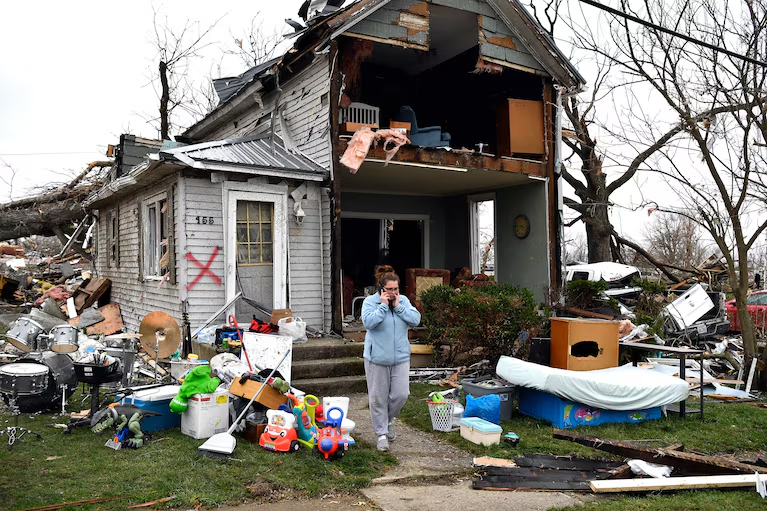 Brittany Oakley outside what is left of her home in Lakeview, Ohio, on Friday. (Timothy D. Easley/AP) Brittany Oakley outside what is left of her home in Lakeview, Ohio, on Friday. (Timothy D. Easley/AP)
The United States suffers the world’s second-highest financial toll from major weather disasters when the numbers are adjusted to reflect the nation’s wealth, according to a new analysis, and pays more in absolute terms than any other country on Earth.
The report released late last month by Zurich-based reinsurance giant Swiss Re, whichanalyzed the vulnerability of and damage in 36 different countries, suggeststhat weather disasters may become a heavy drag on the U.S. economy — especially as insurers increasingly pull out of hazardous areas. Those disasters are driving up insurance rates, compounding inflation and adding to Americans’ high cost of living.
Property damage from hurricanes, severe convective storms, flooding and winter storms cost nearly 0.4 percent of U.S. gross domestic product every year, the study found. That’s almost double the GDP-adjusted damage faced by China and almost quadruple that of Canada. The only country in the study identified as facing a bigger share of property damage was the Philippines, which suffers yearly losses of about 3 percent of GDP.
The report released late last month by Zurich-based reinsurance giant Swiss Re, which analyzed the vulnerability of and damage in 36 different countries, suggests that weather disasters may become a heavy drag on the U.S. economy — especially as insurers increasingly pull out of hazardous areas. Those disasters are driving up insurance rates, compounding inflation and adding to Americans’ high cost of living.
Jerome Haegeli, the chief economist of Swiss Re, says the United States is unusually exposed to many different types of weather disasters — from severe thunderstorms to floods and hurricanes. But the country’s wealth also means it has a lot to lose when hurricanes or floods hit home: “The U.S. has the highest economic losses from weather events in the world in absolute terms,” he said.
Last year, the United States experienced 28 billion-dollar disasters, according to the National Oceanic and Atmospheric Administration, including the wildfire in Lahaina, Hawaii, and severe hailstorms in Texas. All 28 disasters combined cost an estimated $93 billion.
Jesse Keenan, a professor of real estate and urban planning at Tulane University, said the result shows how disasters may soon cut into economic growth. “If we think that in the future we’ll have relatively modest forms of growth — 2, maybe 3 percent growth in GDP — and here we’re at 0.4 percent of GDP losses with just these storms and just this one sector, that really starts to cut into our growth,” he said. “It could really become something that reduces our economic prowess.”
Keenan noted that the Swiss Re report didn’t capture the full scope of climate-related losses, because it only included property damage. “Particularly in floods, we’ve had auto damages that are close to parity with property losses,” Keenan said.
Americans face another challenge when it comes to severe weather events: getting compensated for their losses. Only about half of the property damage from recent severe weather events in the United States was insured, the study said, and at the same time, large insurers have started halting policies on properties that are in flood- or wildfire-prone areas. Some insurers have stopped offering home insurance policies in California, which has seen numerous large wildfires in the past few years. Others no longer offer coverage for areas that are within a certain distance of the coastline.
The insurance policies that remain have become more expensive. During congressional testimony last week, Jerome H. Powell, the chair of the Federal Reserve, pointed to rising automobile and property bills as driving up overall prices. “That’s been a significant source of inflation over the last few years,” he said.
The average home insurance policy increased 21 percent between May 2022 and May 2023, according to the insurance analysis group Policy genius. Some homeowners have begun forgoing insurance altogether — adding to Americans’ overall disaster risk.
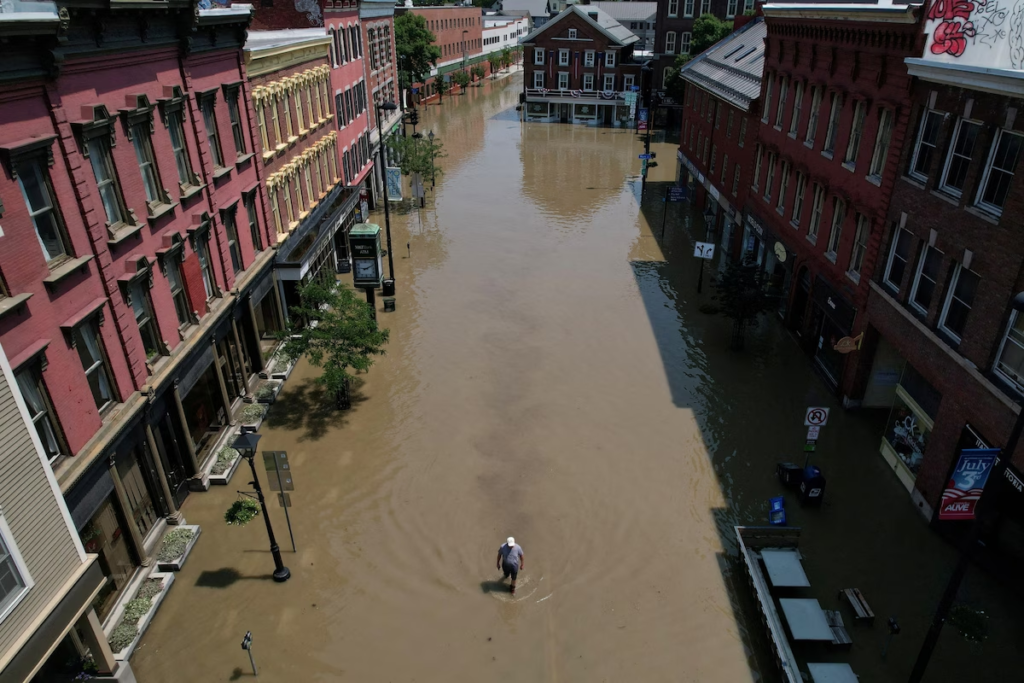 A street flooded by recent storms in Montpelier, Vt., in July. (Brian Snyder/Reuters) A street flooded by recent storms in Montpelier, Vt., in July. (Brian Snyder/Reuters)
Part of the problem is that there aren’t national requirements to prevent building in disaster-prone areas. At the same time, high housing prices and limited stock push Americans to live wherever they can find affordable options. That means funds for infrastructure and housing are being poured into areas that may later be destroyed by wildfire, floods or hurricanes.
“We’re setting ourselves up for a fiscal disaster,” Keenan said. “It’s going to be a burden on public debt no matter what way you look at it.”
The report also highlights how adapting to climate change now will prevent damage later on. A dollar invested to align construction with new building codes to better withstand floods or hurricanes can save between $6 and $10 down the road, the study shows. But only 31 percent of jurisdictions in the United States have adopted updated building codes, Haegeli said — leaving many more areas vulnerable.
Haegeli said that while the United States and the Philippines came in at the top, every country is being affected. “There is no country — whether you are in Switzerland, whether you are in the U.S., whether you are in China — that is not exposed,” he said.
By Shannon Osaka Shannon Osaka is a climate reporter covering policy, culture, and science for The Washington Post. Before joining The Post, she was a climate reporter at the nonprofit environmental outlet Grist. Twitter
Here are more “ET’s” recorded from around the planet the last couple of days, their consequences, and some extreme temperature outlooks, as well as any extreme precipitation reports: |



