Farm Switches From American Workers to Migrants
Published Jun 06, 2024 at 2:18 PM EDTUpdated Jun 06, 2024 at 2:47 PM EDT
By Nick Mordowanec
Staff Writer
A Vermont dairy farm owner said that her business is excelling due to the hiring of numerous migrant workers.
The 160-year-old Sprague Ranch in Brookfield, Vermont, is in a town of about 1,200 people and continues to succeed after hiring nine migrant workers along with a statewide dairy farm loan program.
"The employee situation we had prior to hiring migrant farm workers was in a cycle of constant training, i.e., we would hire a worker, train them, and then they wouldn't work out for various reasons," Chelsea Sprague told Newsweek via email. "So, we would start over. We were in a constant cycle of hiring and training. This made it tough for us to make progress and manage ahead."
The farm hired its first two Hispanic workers in 2013.
"They were amazingly dedicated to their work life here and enabled us to really take a look at our farm business and focus on larger management, rather than smaller items like the schedule and if protocols were being followed," Sprague said. "It was the start of strategic planning for our farm and looking forward to how we wanted it to be."
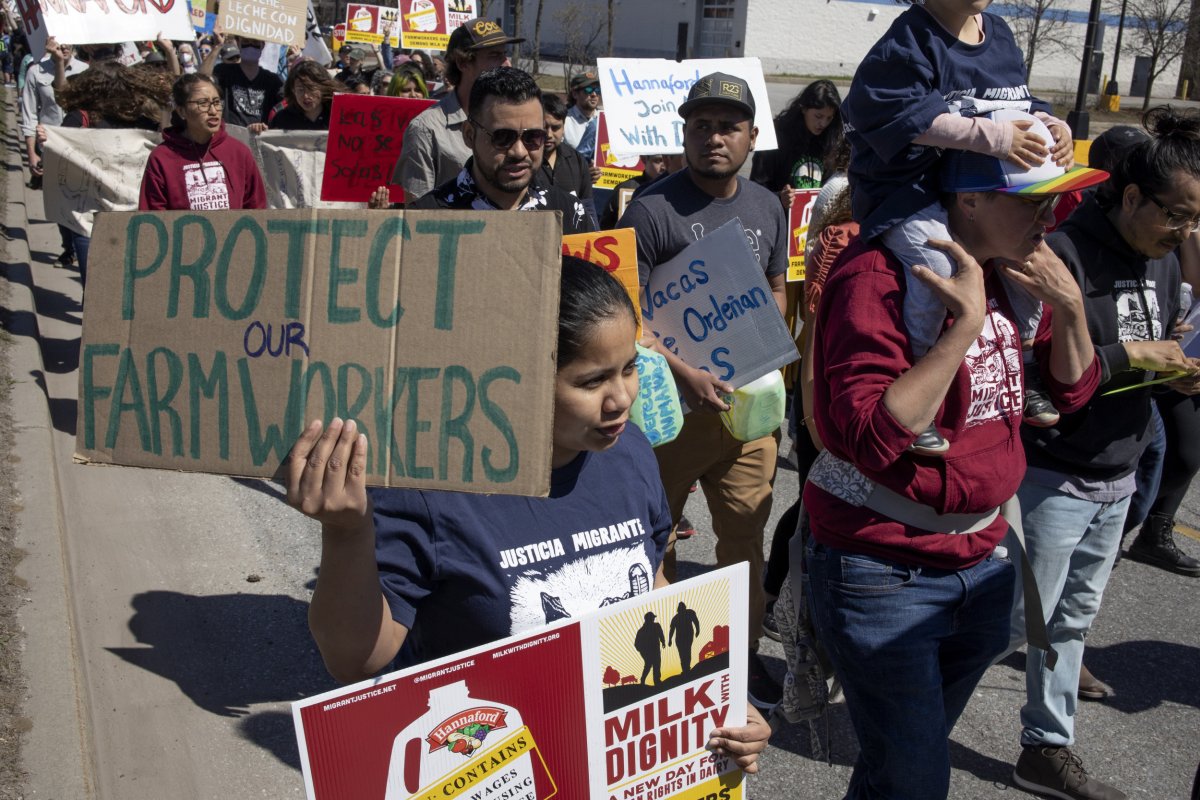
Farm workers march to a Hannaford supermarket to protest the chain's refusal to purchase milk from dairy suppliers who have committed to a set of fair labor practices, May 1, 2022, in Burlington, Vermont. One... More ANDREW LICHTENSTEIN/CORBIS VIA GETTY IMAGES
The workers are all Mexican, according to the Burlington Free Press.
The state offers aid to myriad farms and for other housing assistance intended "to help improve the health and welfare of the farm workforce."
Sprague said she has either offered or ensured that her employees have transportation, health care, and good wages, and made sure they are safe, which she described as "a huge part of the quality of life for farmworkers in general."
The Vermont Farmworker Housing Repair Loan Program (FWH) was launched in 2022 and offers farms like the Sprague Ranch 10-year forgivable loans of up to $30,000 to improve farmworker housing conditions, with the loans at 0 percent interest. The loan is offered through the Champlain Housing Trust, with funds appropriated by the Vermont Legislature and doled out by the Vermont Housing & Conservation Board.
Julie Curtin, director of homeownership at Champlain Housing Trust, told Newsweek via phone that there are currently 45 projects, with some completed, others in the process, and others just getting set up with cost assessments.
"It has to be a substantial enough farm business," Curtin said of the applicants.
While an applicant can apply for up to $30,000 per dwelling, one farm might be able to get two $30,000 loans with two units. Applications are accepted on a rolling basis, continuing as funding is approved.
"When we initially launched the program, we had more applications than the funding we originally got," she added, with the available funding amount at roughly $500,000. "At this point it's not a competitive process. The project just needs to be eligible."
Units eligible to receive loans also include manufactured homes, stick-built houses, and apartments in barns or other outbuildings. Repairs and improvements translate to wastewater systems, air sealing and insulation, HVAC, noise mitigation measures, overcrowding relief, food preparation and storage, mold remediation, electrical and plumbing upgrades, and roof replacements.
Newsweek reached out to the Vermont Agency of Agriculture, Food and Markets via phone and email for comment.
In 2018, 30,813 immigrants comprised 5 percent of Vermont's population, according to a 2020 report published by the American Immigration Council. Fewer than 5,000 undocumented migrants comprised roughly 4 percent of the state population in 2016.
As of 2018, roughly 10 percent of all migrants in Vermont worked in the farming, fishing and forestry fields.
Sprague said that the housing situation on farms is "important for both farmer and farmworker," with two farmworker houses on her property due to one house not fulfilling all the needs.
"After we purchased the second house we luckily were able to move the entire group to the new house while we renovated the first house," she said. "During the first renovation, which we did not receive aid for, the farmworker housing grant opened and we applied, because the second house needed as much work as the first and we just wouldn't be able to cash flow that in a timely way."
They invested $80,000 in the first house through an internal capital improvement budget, and the second renovation total was $67,000—though $26,000 was covered by the grant.
"This program really helps the farm dedicate enough money to make important improvements to insure a habitable and comfortable place for farmworkers to live while they are here," she added.
Farm Switches From American Workers to Migrants - Newsweek |



