SI
SI
discoversearch

We've detected that you're using an ad content blocking browser plug-in or feature. Ads provide a critical source of revenue to the continued operation of Silicon Investor.  We ask that you disable ad blocking while on Silicon Investor in the best interests of our community.  If you are not using an ad blocker but are still receiving this message, make sure your browser's tracking protection is set to the 'standard' level.
Strategies & Market Trends : 2026 TeoTwawKi ... 2032 Darkest Interregnum -- Ignore unavailable to you. Want to Upgrade?


To: bull_dozer who wrote (207632)9/3/2024 12:18:13 AM
From: TobagoJack1 Recommendation

Recommended By
Pogeu Mahone

  Respond to of 219931
 
nothing looking good

no blue sky

only monetary collapse to look forward to

received way too many phone calls from folks from all over the f*cking planet, here there everywhere, wishing to engage with doom / gloom discourse re real estate, stocks, bonds, currencies / cash, gold, silver, crypto, whatever

I think my heart must have grown hair out of alarm

I am thinking very fortunate that the mrs and i off loaded important pieces of real estate, one at 2X peak market value under special circumstances Message 34605208 last year - not brilliance, completely fortuitous Message 34200103

I believe HK banks shall be expanding margin calls (a feature of HK real estate mortgage contracting) on real estate mortgages. My traditional avoidance of debt is showing merit. Holy moly.

Know the below mall next to Peninsula Hotel on Kowloon side, and just saw the photo-ed current circumstance. Ouchie.

For the normal real estate, irrespective of nature (office, retail, residential, whatever) believe the transaction pricing now at 2008 level, assuming one wishes to transact.

In circumstances as now, gold might fall and hard, before going higher. Just saying. And yet cannot sell the physical, because might not be able to buy back. Nuff said.

bloomberg.com

Li Ka-shing’s Luxury Mall Sits Empty as Chinese Spending Plunges

Hong Kong’s prime shopping districts once commanded the highest rents in the world. Now they’re hollowing out as Chinese consumers disappear.

By Shirley Zhao

3 September 2024 at 07:00 GMT+8

In Hong Kong’s Tsim Sha Tsui district, the mock-classical 1881 Heritage mall used to lure queues of mainland Chinese tourists eager to shop at boutiques operated by brands such as Tiffany, Cartier and Chopard. Now it attracts neither crowds nor brands. Only three of the more than 30 units at the mall owned by billionaire Li Ka-shing’s CK Asset Holdings Ltd. are occupied, and its colonnaded courtyards are quiet.

On nearby Canton Road, a shop previously rented by Swatch Group AG’s Omega for about HK$7.5 million ($962,000) a month is leased to a bank for 80% less, according to real estate agents familiar with the deal. Over in Causeway Bay’s Russell Street, a Transformers-themed fast-food restaurant has taken the place of Burberry Plc. Its rent is 89% below the HK$8.8 million the British firm was forking out in 2019, the agents said, declining to be identified because the matter is private.

China’s collapse in high-end spending has shaken investor confidence in luxury brands across the globe as companies from LVMH to Richemont and L’Oreal report falling sales in the region. Nowhere is the scale of that decline in demand more evident than Hong Kong, which was for many years the favored destination for China’s nouveau riche to splurge on designer handbags and Swiss watches.

"Hong Kong's luxury market was once a paradise, but now it's fallen into the abyss," said Edwin Lee, founder of Bridgeway Prime Shop Fund Management Ltd., which owns a portfolio of retail properties across Hong Kong. "The days when tourists came to Hong Kong to buy luxury products without thinking are gone."

A spokesperson for CK Asset said the 1881 Heritage mall is revamping its retail mix and plans to offer more casual F&B outlets as well as brands targeting Gen Z shoppers. The owner of the Canton Road shop couldn’t be reached for comment, while the landlord of the Russell Street unit previously occupied by Burberry, Soundwill Holdings Ltd., declined to comment.
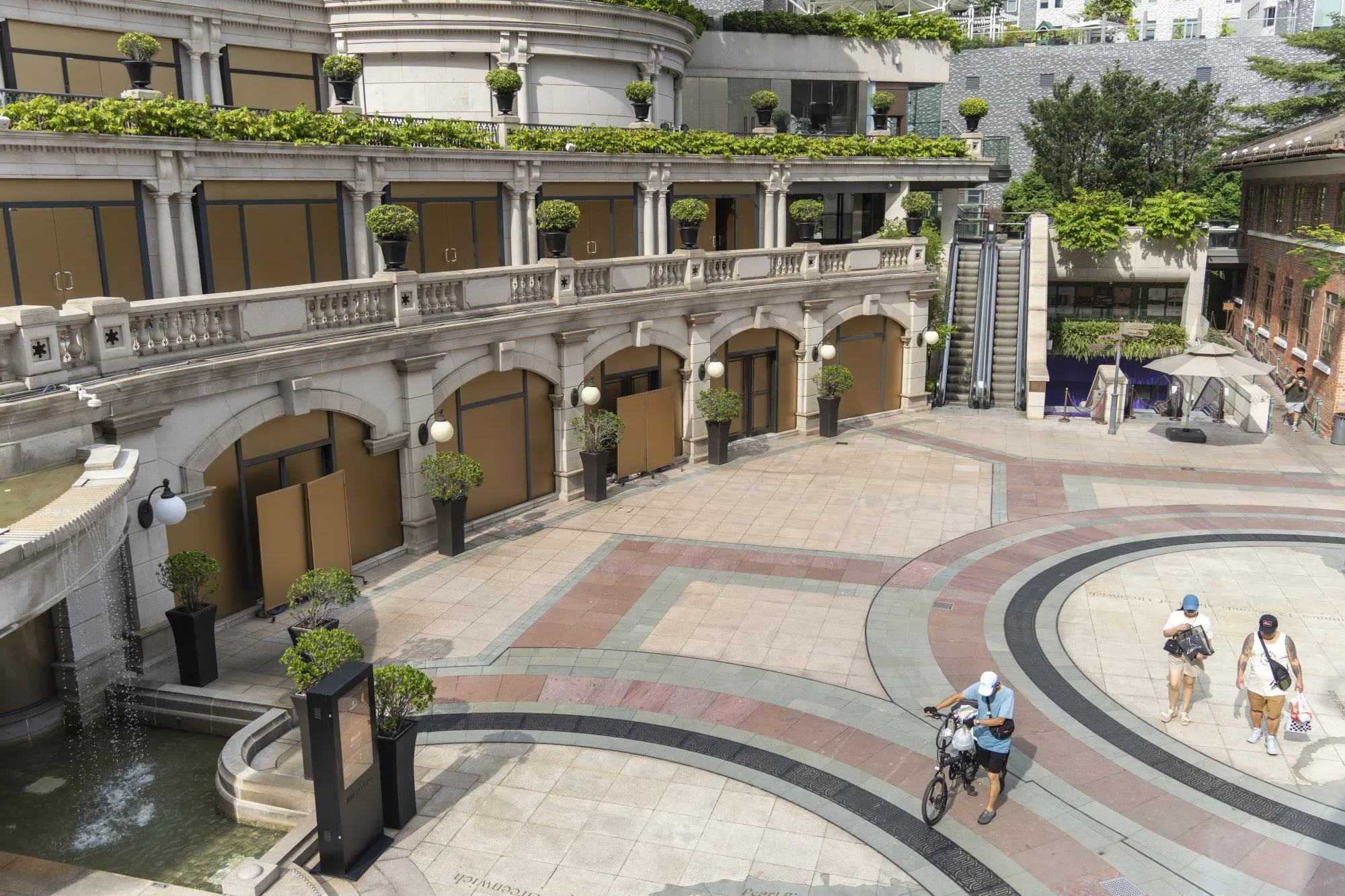

Shuttered stores at the 1881 Heritage shopping mall in the Tsim Sha Tsui area of Hong Kong in July.
Photographer: Chan Long Hei/Bloomberg

Official figures show fewer Chinese tourists are visiting the city than before the pandemic, and those who are coming spend on average only half of what they used to. The hoped-for recovery when the border between the city and the mainland reopened at the start of 2023 hasn’t materialized. In the first seven months of this year, sales of luxury goods — which includes items such as jewelry, watches and department store receipts — were 42% below 2018’s level.

The subdued spending and shuttered stores are adding to a deepening sense of malaise in Hong Kong. Home prices are at an eight-year low, office vacancies are near a record high and the benchmark stock index is among the world’s worst performing. The city’s aging problem has been accelerated by an exodus of younger residents, while the government’s crackdown on dissent has shaken international confidence in the city. Squeezing businesses further, borrowing costs have surged due to a currency peg with the greenback, which forces the city to import US monetary policy.

In a sign of weakening confidence, household spending fell in the three months to June for the first time since the third quarter of 2022, while analysts project economic growth will slow next year from 2023.

Companies are suffering too. Last week, New World Development Co., one of the city’s biggest property developers which also operates malls, warned it will post a HK$20 billion full-year loss. The company’s shares plunged, taking their decline this year to 44%.
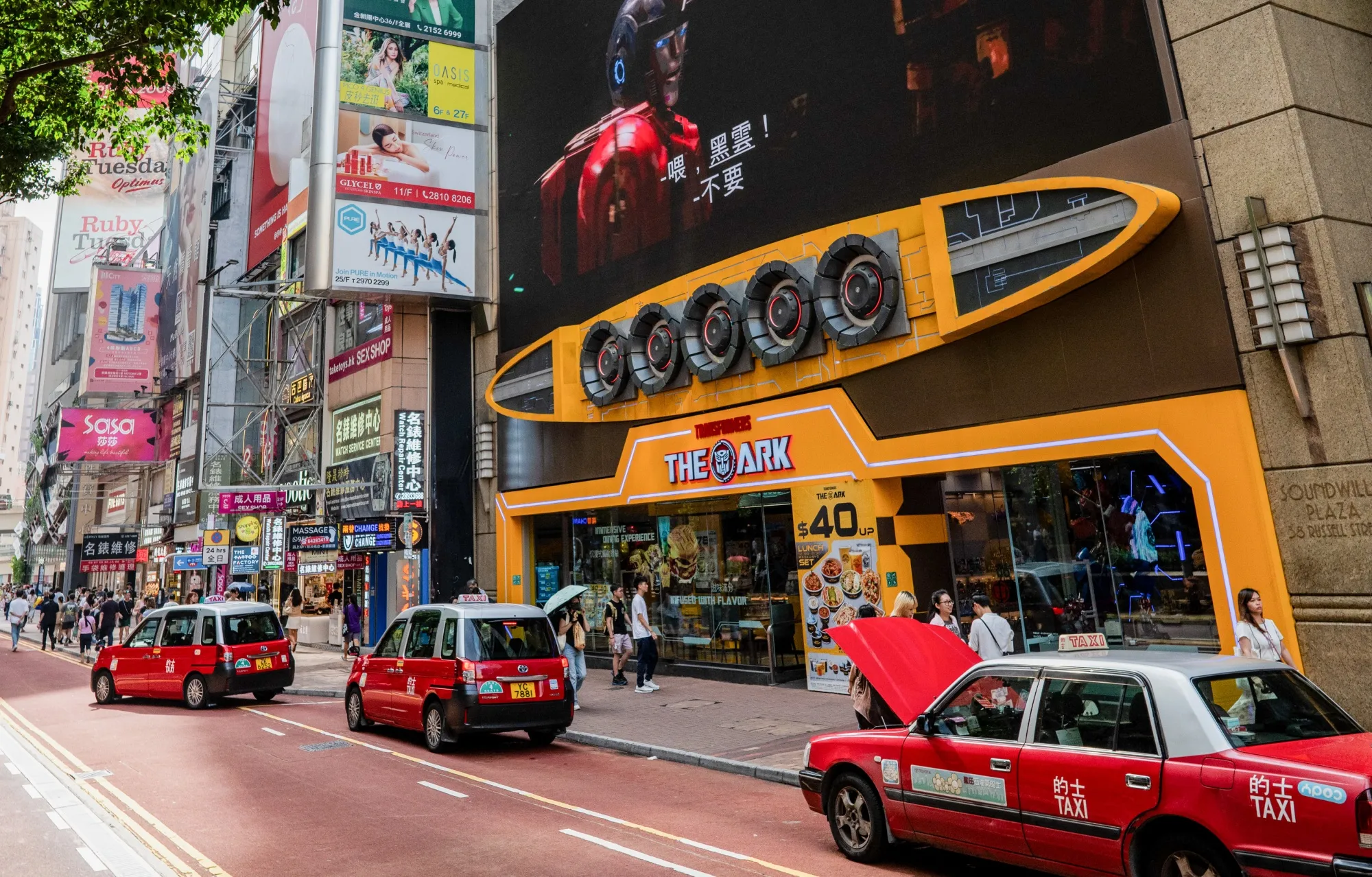

A Transformers-themed fast-food restaurant replaced Burberry on Causeway Bay’s Russell Street.
Photographer: Billy H.C. Kwok/Bloomberg

“The decline of Hong Kong’s luxury sector is a symptom of the present economic challenges, which can also contribute to slower growth and employment,” said Gary Ng, a senior economist at Natixis SA. “This means the virtuous circle of higher income, wealth effect and corporate profits feeding into consumption no longer works well.”

Some of the areas worst affected by the withdrawal of luxury brands are those that were most sought after at the height of the boom due to their popularity among mainland Chinese shoppers — Tsim Sha Tsui in Kowloon and Causeway Bay on Hong Kong Island. In 2018, landlords in Causeway Bay demanded $2,671 per square foot in annual rent, the highest in the world, according to Cushman & Wakefield Plc. Rents in that area have since fallen below Tsim Sha Tsui, where asking prices averaged $1,493 in 2023. That’s less than New York’s Upper 5th Avenue and Milan’s Via Montenapoleone.

Such gloom is a far cry from earlier this century, when the former British colony was perfectly placed to benefit from China’s emerging wealth due to its proximity and lack of goods or services taxes. At the peak in 2013, luxury sales totaled about HK$165 billion, accounting for a third of the overall retail market, as an average 112,000 mainland tourists poured into the city every day, according to official figures.

Adding fuel was a rapidly appreciating yuan, which briefly roseto a roughly two-decade high against the Hong Kong dollar. While spending slowed in the following years, it remained elevated until city-wide protests in 2019 deterred travelers. Soon after, the border with mainland China closed due to Covid, and would only openalmost three years later.
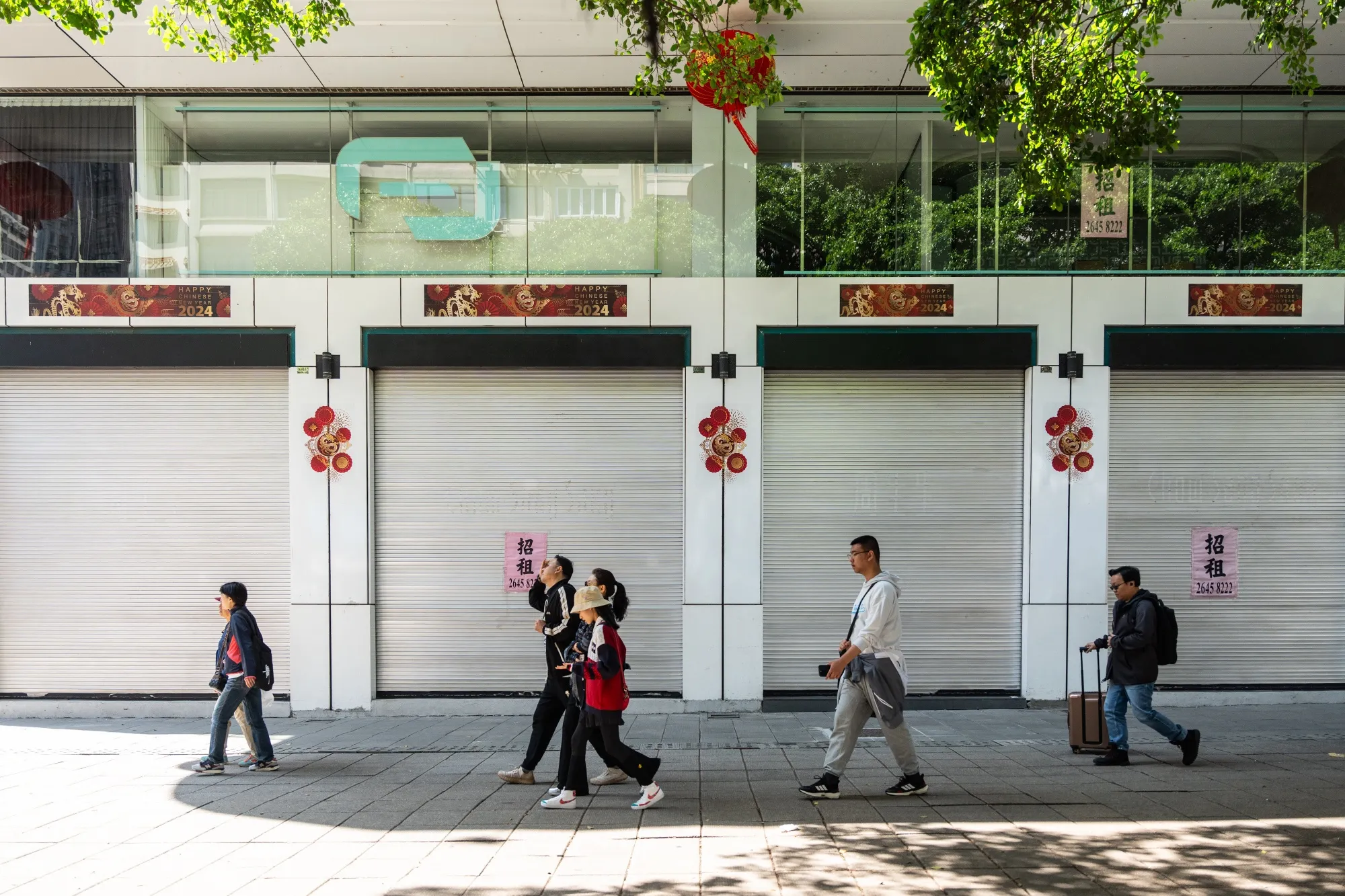

Vacant retail spaces on the Park Lane Shopper's Boulevard in Tsim Sha Tsui.
Photographer: Chan Long Hei/Bloomberg
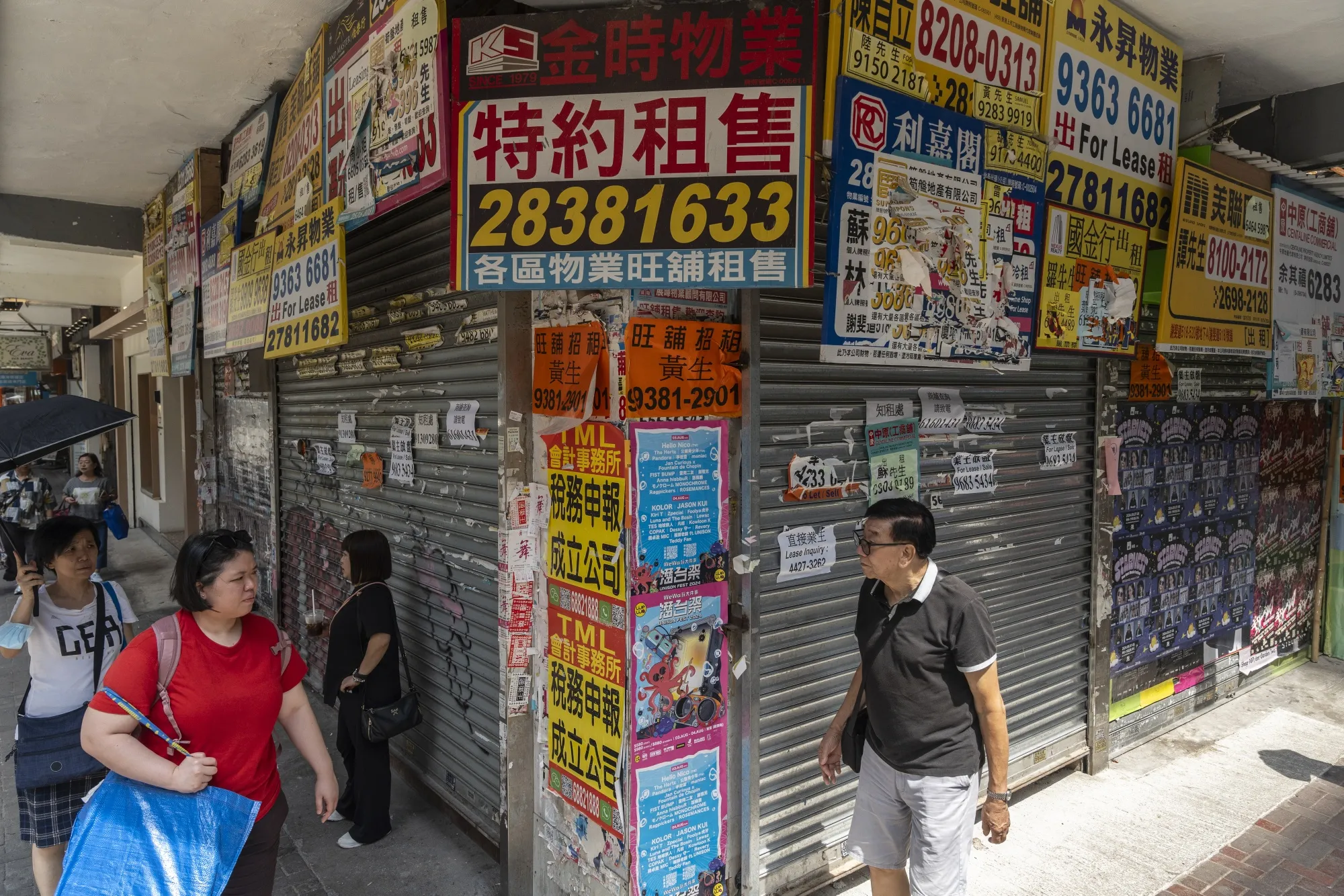

Empty stores in Causeway Bay.Photographer: Chan Long Hei/Bloomberg

The luxury market may never recover its glory days, said Lee, the investor in retail properties.

“Don’t even think about going back to where we were in 2013 and 2014,” he said. “It’ll probably take four to five years to get back to 2018 and 2019.”

His fund, which managed about HK$1.4 billion in assets as of the end of June, saw its net asset value fall 9.7% over three years. That’s dented sentiment among investors, some of whom wanted to leave early, adding to pressure on selling some properties to cash out, he said.

Lee is far from the hardest hit in the retail slump, thanks to his focus on buying neighborhood stores that cater largely to domestic demand. The family of the late Tang Shing-bor, known as the “King of Shops” in Hong Kong, has been looking to sell properties worth billions of dollars since 2020 due to high borrowing costs and plunging rents. Creditors have sued Tang’s family members for outstanding loan payments.

To be sure, luxury brands aren’t altogether abandoning Hong Kong. The city has no shortage of wealthy individuals, even if their fortunes have been eroded. Brands are also being aggressively courted by the big mall landlords, who are able to offer more flexibility over floor area than main street landlords.

Prada SpA, for instance, is taking on an 8,000-square-foot store in New World’s K11 Musea mall, where rent is likely to be partly based on store sales, Bloomberg News reported in July.

In Central’s Landmark mall, landlord Hongkong Land Holdings Ltd. and tenants including Hermes International SCA and LVMH are jointly investing $1 billion to revamp the retail area to increase shop space. The Landmark is more resilient to changes in tourism patterns because 80% of its customers are local residents, according to Alexander Li, chief retail officer at Hongkong Land. The mall’s top 70 shoppers spent a combined HK$1 billion in 2023, Li said.
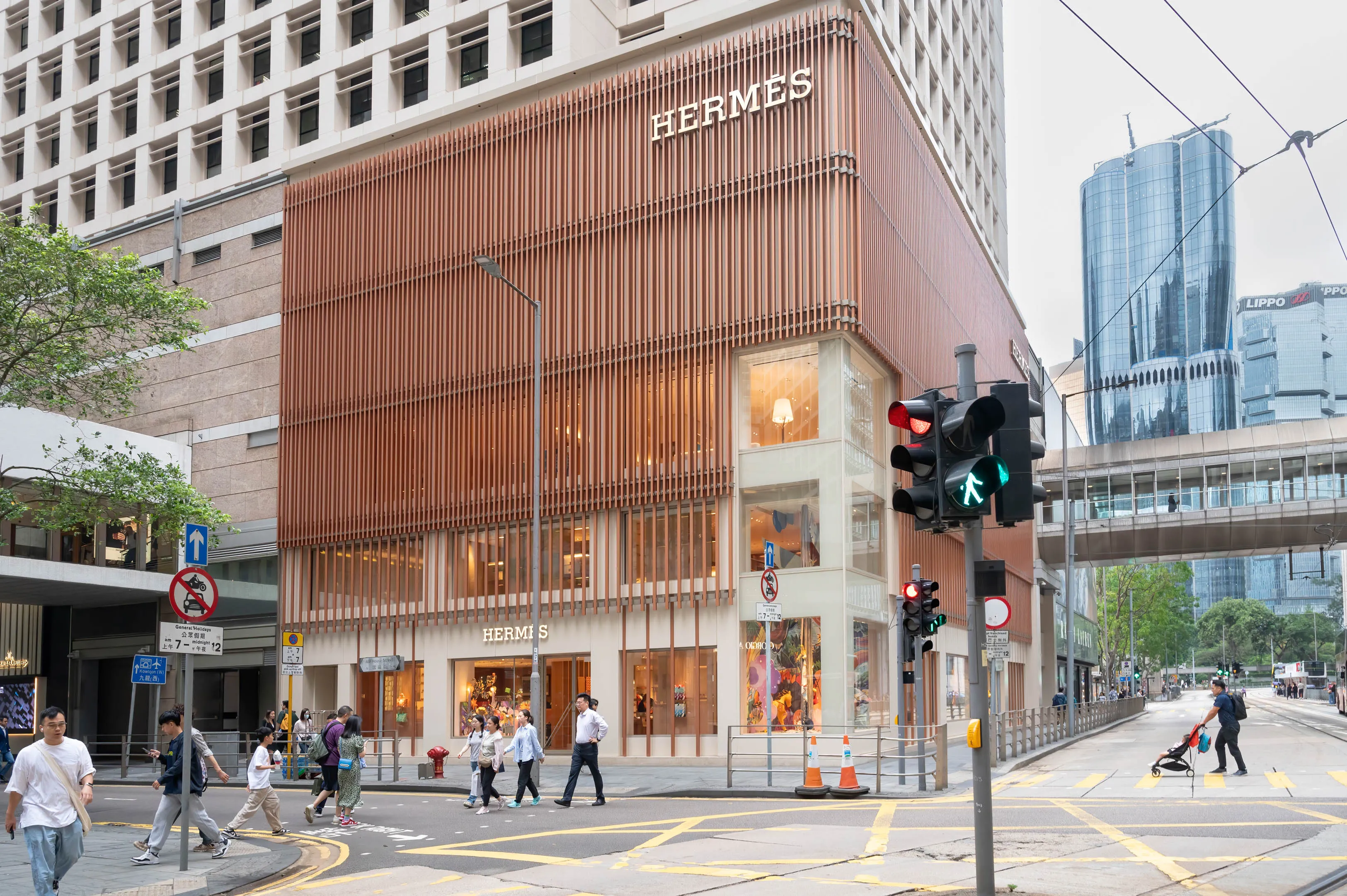

Hermes store in the Landmark Prince’s mall.
Photographer: Sebastian Ng/SOPA Images/Getty Images

Still, taking on bigger stores may prove a risky strategy given the depressed outlook and still-expensive rents, according to Angelito Perez Tan, Jr., co-founder and CEO of RTG Group Asia, whose businesses include a luxury consultancy.

"Larger floor areas inevitably lead to higher rents, which could be a significant disadvantage in a sluggish retail environment," said Tan.

To lure visitors and boost spending, local authorities have been hosting large-scale events such as conferences, exhibitions and carnivals, with more than 100 plannedfor the second half of this year. In February, the government said it would allocate HK$1.1 billion to bolster tourism. City leader John Lee also suggested residents smile more to make tourists feel welcome.

The Chinese consumer could do with some cheer. Retail sales in the country are forecast to rise just 4% this year, down from a previous projection of 4.5%, according to the median estimate of economists surveyed by Bloomberg this month. That would be the slowest increase barring pandemic years since government data became available in 1999.

Even sellers of low-end goods are struggling in China, showing that this depression affecting Chinese consumers is casting a deep shadow. In late August, online retailer PDD Holdings Inc. stunned investors when it warned of declining profit and revenue, triggering a record 29% plunge in its shares.

The glum projection was the latest in a series of shocks that’s intensifying concern about the health of China’s economy. The country’s biggest bottled water producer Nongfu Spring Co. reported the slowest half-year profit growth since its listing in 2020, while dumpling chain Din Tai Fung — long one of the most popular restaurant brands in the country — revealed it was shutting more than a dozen outlets.

This sharp shift from extravagance to frugality has undermined the outlook for global luxury brands. Like Hong Kong, these firms had bet on China for future growth.



LVMH triggered alarm among stock traders when it revealed a 14% drop in sales in the region that includes China last quarter. Burberry and Hugo Boss AG have issued profit warnings. Cie Financiere Richemont SA, which owns high-end jewelry brands Cartier and Van Cleef & Arpels, was hit by a 27% drop in Greater China sales during the last quarter, with its watchmaking division posting a 13% slump. L’Oreal SA reported a fourth straight quarter of falling sales in North Asia, which accounts for about a quarter of its revenue.

“Over-reliance on any single market can expose the sector to vulnerabilities, as seen with the current shifts in consumer behavior,” said RTG’s Tan.
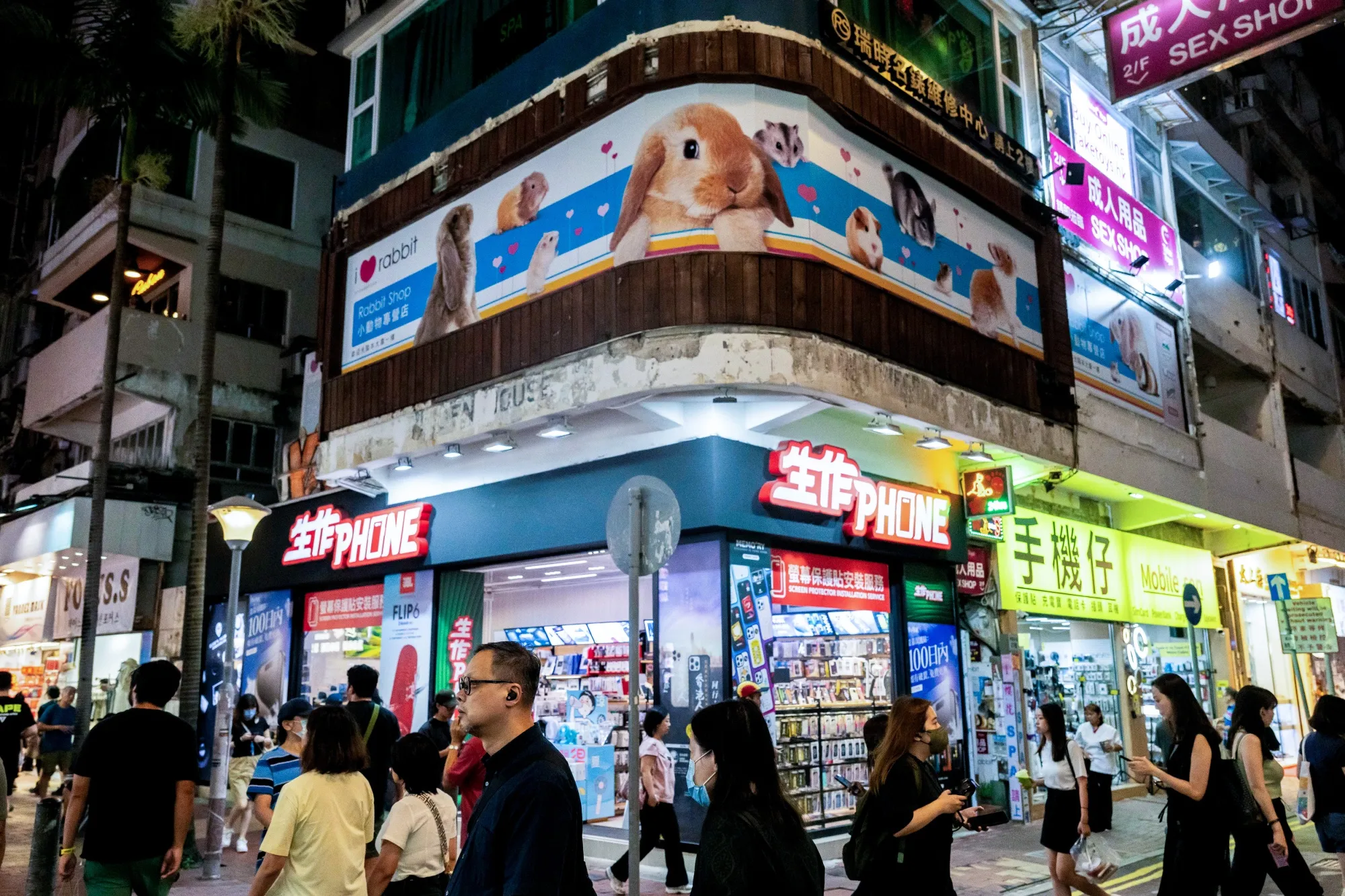

Hong Kong's changing landscape: A phone accessories store replaced Tissot on Russell Street.
Photographer: Billy H.C. Kwok/Bloomberg
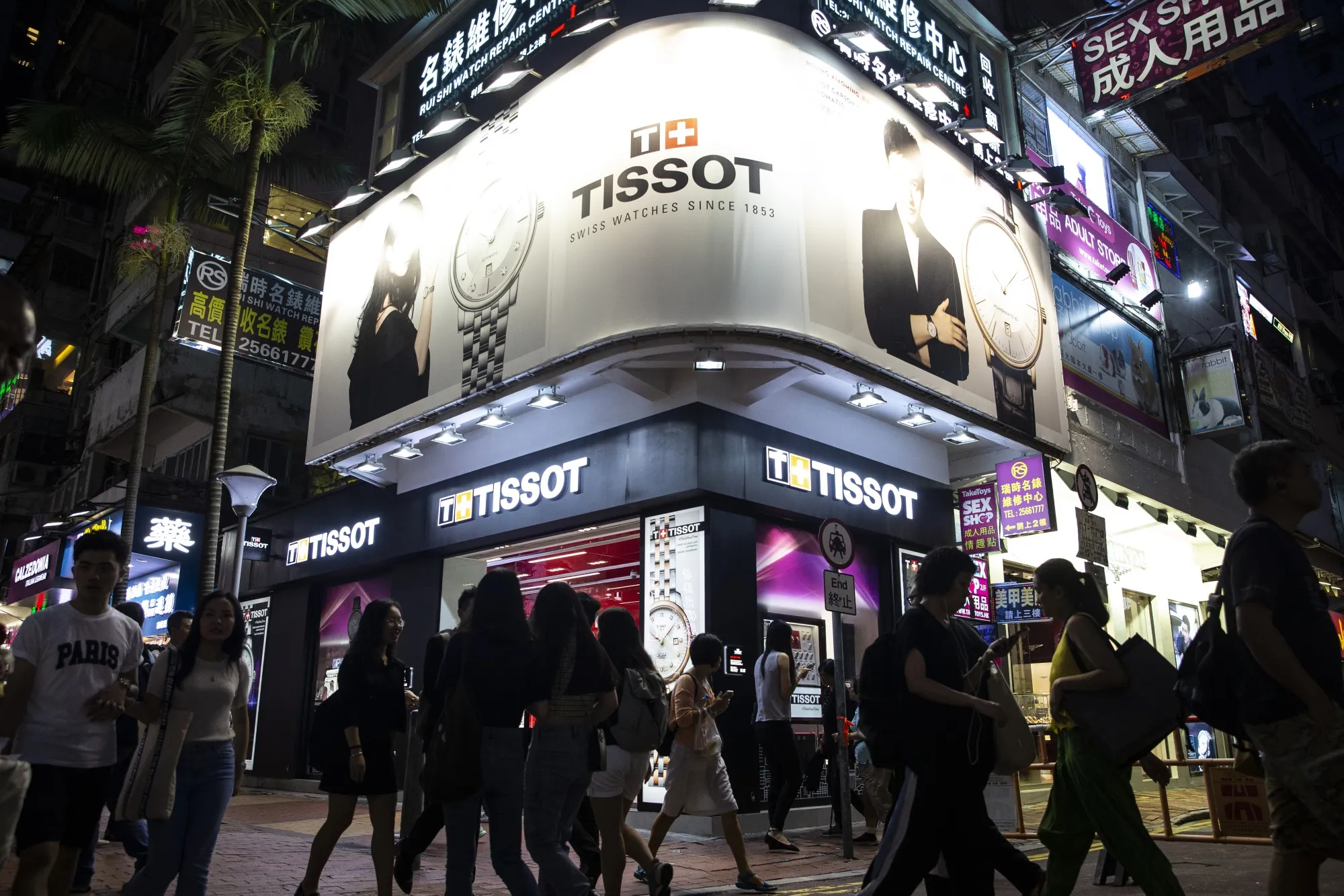

The Tissot store in 2019.
Photographer: Chan Long Hei/Bloomberg

Back in Hong Kong, the fallout continues, as demand for consumer goods dwindles and the city’s shopping districts revert back to what they looked like before China’s boom this century.

The latest data showed retail sales in July plunged 12 % from a year earlier, worse than analysts had forecast. Sales of jewelry, watches and clocks sank 25%.

“The global luxury market is becoming increasingly difficult to navigate,” Tan said. “I see it a fool’s errand for Hong Kong to simply hope to return to its previous retail heyday.”


To: bull_dozer who wrote (207632)9/3/2024 12:20:58 AM
From: TobagoJack  Respond to of 219931
 
scary

bloomberg.com

T. Rowe Manager Who Predicted Yen Shock Sees Another One Coming
- ‘Scapegoating’ of yen carry trade ignores bigger, deeper trend
- BOJ hikes and impact on global capital far from simple: Husain
By Ruth Carson
3 September 2024 at 09:51 GMT+8

Arif Husain says he was early in sounding the alarm on Japan’s rising interest rates last year, which he described as the “ San Andreas fault of finance.”

The head of fixed-income at T. Rowe Price warned that investors have “just seen the first shift in that fault, and there is more” market volatility ahead after the nation’s rate hike in July helped trigger a violent reversal of the yen carry trade.

While a hawkish Bank of Japan and jitters around slowing US growth helped trigger voracious demand for the yen on Aug. 5, investors may be ignoring a deeper root of the global swoon that cascaded across stocks, currencies and bonds, Husain wrote in a report. This includes a mountain of Japanese money invested offshore that risks getting shipped back home as rates march ever higher in the world’s fourth-largest economy.

“The scapegoating of the yen carry trade ignores the start of a bigger and deeper trend,” according to Husain, whose firm oversees about $1.57 trillion in assets. “BOJ monetary tightening and its impact on the flow of global capital is far from simple, and it will have a large influence over the next few years.”


The sudden abandonment of the yen carry trade, which involves selling Japan’s currency to invest in higher yielding assets, helped sink the Nikkei 225 Stock Average by the most since 1987 and fueled a surge in the VIX index of stock market volatility. Economists briefly predicted the Federal Reserve would need to swoop in with half-point cuts or act between meetings — the kind of step usually reserved for a crisis.

While the yen has settled in a mid-140s trading range against the dollar, volatility remains elevated. The Fed’s anticipated rate cuts and further BOJ tightening could jolt markets again sooner rather than later.

Husain, who has nearly three decades of investing experience, favors an overweight allocation to Japanese government bonds on the view capital is likely to flow back to the nation as yields climb. He also likes an underweight position in US Treasuries — securities he sees potentially coming under pressure as Japanese institutions move out of the US for home.

Yields on Japan’s 10-year government bonds rose one basis point to 0.915% on Tuesday, the highest since Aug. 6.

“At some point, higher Japanese yields could attract the country’s huge life insurance and pension investors back into JGBs from other high-quality government bonds,” Husain wrote. “In effect, this would rearrange demand in the global market.”


To: bull_dozer who wrote (207632)9/3/2024 12:27:12 AM
From: TobagoJack  Respond to of 219931
 
comforting, but might be numbingly so

bloomberg.com

Gold Is Rising Because of Demand for ‘Fallback Money’
The yellow metal’s strong performance may be down to its more fundamental properties.


Gold bars stored inside the gold vault at The Reserve vault, operated by Silver Bullion Pte Ltd., in Singapore.

Photographer: Ore Huiying/Bloomberg

By John Stepek

2 September 2024 at 19:56 GMT+8

What’s really driving the record gold priceGold is having a moment. A fairly quiet one, given its performance this year (it’s beaten all the major stock markets in the year to date, measured in US dollar terms), but a moment nonetheless.

The very rich are fuelling a run on storage vaults to hold their gold bars. The price has hit a fresh record in any major currency you care to name at some point this year. A standard gold bar saw its value rise to more than a million dollars for the first time.

There are a few interesting things about this bull run. One is that gold has displayed a surprising level of indifference to both the US dollar and US interest rates. Right up until Covid, one of the most important drivers of the gold price was “real” (inflation-adjusted) US interest rates. That’s not currently proved to be the case.

Another interesting element is that while gold has made record highs, assets typically deemed to be “high-beta” gold (i.e. gold with turbo-boosters strapped to it) have not done as well.

Silver (“gold on crack”, in the memorable words of one fund manager acquaintance) can’t quite break the $30-an-ounce barrier, while gold miners, having acquired a reputation as the stock-market sector where money goes to die, have lagged behind the price of the metal they mine.

So what’s going on? What’s driving this bull market in gold?

What Is the Point of Gold?

I suspect this is something quite fundamental, and so it’s useful at this point to return to the question: what is gold for?

In short, gold is the element on the periodic table which is best suited to being used as physical money, should you have need of a bearer instrument that does not depend on the creditworthiness of any other entity to retain its value.

Gold is durable (so you can hoard it and it won’t rust away). Gold is fungible (one bit is the same as another bit). Gold is divisible (if you make a bit of an effort). And the amount of gold being dug up — mostly — grows slowly enough that it won’t be devalued purely by a gush of fresh supply. (Some of you youthful Bitcoiners out there might recognise these traits.)

One thing gold is not, however, is convenient, compared to other types of money and credit. That’s why we don’t use it as money anymore, and, when you look at the history of money, gold is far from the only substance that has been used for the purpose. Money is a social technology, and like any technology, it advances.

But if your monetary system fails, gold’s intrinsic properties make it a valuable fallback. And it doesn’t have to be the global monetary system. This is a crucial point: gold isn’t necessarily an “end of the world” asset.

There’s an association between gold and apocalyptic thinking, but not every country enjoys the institutional stability that the likes of the US and the UK have taken for granted for decades, if not centuries in some areas.

For example, if you have to flee Venezuela, say — or try to ride out hyperinflationary collapse — then doing so with some gold in your luggage or buried in your back garden, rather than bolivars, will mean at least you get to preserve some of your wealth.

Gold Is Fallback Money

OK, so we agree (I hope) that gold is “fallback money”. What’s interesting to me now is that this bull market was kicked off by central banks. The exchange-traded funds (ETFs) and trend followers are on it now, but the earlier buyers were the big beasts of the financial system.

Why’s that interesting? Well, if you look at gold’s nadir (in the post-Bretton Woods era, after 1971), it came as UK Chancellor Gordon Brown decided to sell off about half of Britain’s gold reserves between 1999 and 2002. Brown gets a lot of flak for this, but while I’m no fan of his, his decision at least makes more sense when you consider the politics of it.

This was the period when the euro was launched. About 40% of the money raised by selling the gold went into the new currency. In other words, Britain swapped its “fallback money” to instead show support for and hold a new-fangled, radical monetary experiment.

This leap of faith encapsulates the era of peak post-Cold War 1.0 hubris in the West. The problems of economics were largely solved, we’d reached the end of history, and while John Maynard Keynes’ “barbarous relic” quote referred to the gold standard, the metal itself was now deemed to be an asset suited only for the irredeemably paranoid.

Obviously, the world has steadily grown more geopolitically complicated since then. Hopes that China and Russia would become our pals because free-market capitalism was demonstrably better than centrally planned communism didn’t turn out as hoped, for a wide range of reasons.

Now we’re at a point where the global hegemony of the US dollar is being questioned by at least some participants. Not so much because the US dollar is deemed at risk of collapse (though massive government debts are probably a worry too), but because of the risk of being actively cut off from the US dollar system, as Russia has been.

If you fear that you might be cut off from the world’s monetary system, what do you need? That’s right — plenty of “fallback money”.

What This Means for Your Money

This state of affairs doesn’t look like improving in the near future. So what can you do about it in your own little corner of the world?

All of this is why I mostly view gold as portfolio insurance and entirely separate from any of its near relatives as an asset class. Basically, in my view, gold is a “forever” asset — you should have it as part of your core asset allocation and rebalance when you own too much or too little, whereas its offshoots are fair-weather friends.

If you struggle with this idea, look at it this way — central banks own gold and consistently have done so, even at the bottom of the market. If they still view it as an integral part of the monetary system, that’s probably something you should pay attention to.

If you do think that gold’s bull market could turn into a bubble — or you think that industrial commodities are going to make a comeback, which is a topic for another letter — then you could certainly look at other ways to play a gold mania. Silver is one option, gold miners are another.

But do just remember that — to my mind at least, not everyone will agree — these are not “buy and hold” investments. They’ll have their time in the sun, and then winter will return, and if you want to make money, you need to capture the sunshine and sell before it gets chilly again.


To: bull_dozer who wrote (207632)9/3/2024 12:27:58 AM
From: TobagoJack  Respond to of 219931
 
I suspect gold is of course a buy & hold asset, as opposed to what the Bloomberg rubbish article claimed, because stocks might well be cut in half whilst gold doubles from today's worth


To: bull_dozer who wrote (207632)9/3/2024 12:42:19 AM
From: TobagoJack  Read Replies (1) | Respond to of 219931
 
I am concerned because Boeing products all suspect

zerohedge.com

NASA Astronaut Says 'Strange Noise' Emitting From Troubled Boeing Starliner Docked At ISS

On Saturday, NASA astronaut Butch Wilmore noticed a speaker in Boeing's troubled Starliner spacecraft emitting bizarre noises.

"I've got a question about Starliner," Wilmore told Mission Control at Johnson Space Center in Houston. He said, "There's a strange noise coming through the speaker ... I don't know what's making it."
Wilmore is Starliner's commander. He asked Mission Control to analyze the audio inside the spacecraft. Minutes later, flight controllers in Houston told Wilmore the audio sounded like "pulsing noise, almost like a sonar ping."

This past weekend's sonar-like noises came days before the troubled Starliner spacecraft is scheduled to return to Earth on Friday. This flight will be uncrewed, leaving Wilmore and Sunita "Suni" Williams stranded on the International Space Station.

According to NASA, Starliner has sustained multiple helium leaks, and five of its "Reaction Control Systems" have unexpectedly malfunctioned. Last week, NASA Administrator Bill Nelson decided to tap Elon Musk's SpaceXto bring the astronauts home.

Former Canadian astronaut Chris Hadfield wrote on X, "There are several noises I'd prefer not to hear inside my spaceship, including this one that @Boeing Starliner is now making."

Musk commented on Hadfield's post with a "!"...

Ars Technica pointed out:
Astronauts notice such oddities in space from time to time. For example, during China's first human spaceflight int 2003, astronaut Yang Liwei said he heard what sounded like an iron bucket being knocked by a wooden hammer while in orbit. Later, scientists realized the noise was due to small deformations in the spacecraft due to a difference in pressure between its inner and outer walls.

It's time for NASA to undock the Starliner from the ISS before something catastrophically happens.

