Business
Live TV
Markets
DOW41,393.780.72%
S&P 5005,626.020.54%
NASDAQ17,683.980.65%
Fear & Greed Index
49
Business / Economy
The most well-known recession indicator stopped flashing red, but now another one is going off
By Elisabeth Buchwald, CNN
4 minute read
Published 6:00 AM EDT, Fri September 13, 2024
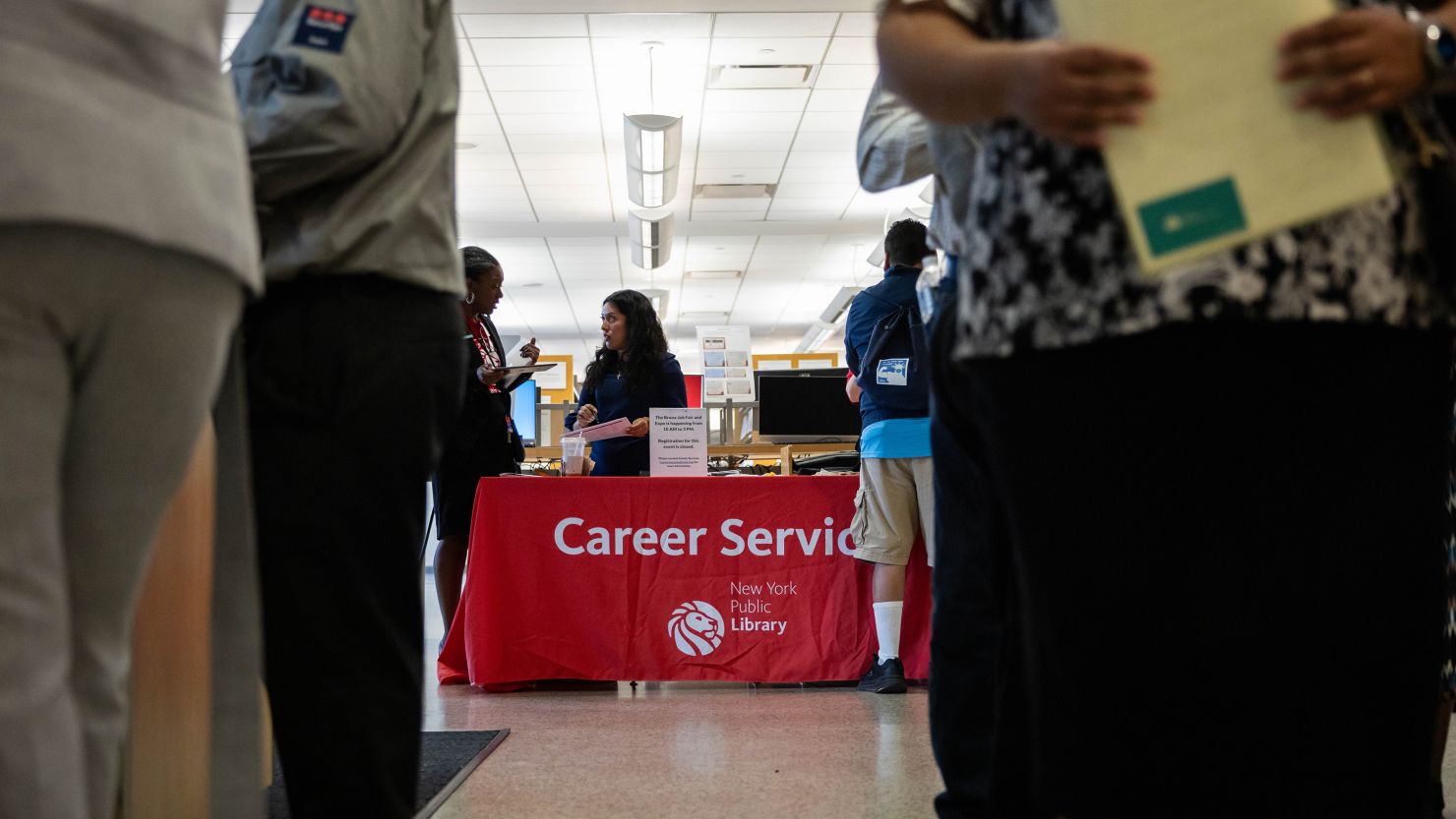
When this economic phenomenon happens at that same time as the Federal Reserve cutting rates, a recession tends to kick in not long afterward.
Yuki Iwamura/Bloomberg/Getty Images
New YorkCNN —
For much of the last two years, the 2-year US Treasury yield has traded above the 10-year yield. When that happens, it historically has meant a recession is looming. So you’d think that investors and economists would have celebrated last week when that warning sign stopped flashing.
Yet red flags are now being raised over the fact that Treasury yields are moving back in a direction that’s considered “normal.” (Yes, you read that correctly.)
When the 2-year Treasury yield trades above the 10-year, it’s a phenomenon known as an inverted yield curve, meaning investors see the more immediate future as more of a risk than farther out. That’s because, when risks are elevated, investors will demand a higher payout, or yield, to invest in US Treasury notes.
After Friday’s jobs report, which showed the unemployment rate edged down slightly in August and employers continued to hire fewer workers compared to the prior years, the 2-year yield fell below the 10-year, resulting in an “uninverted” yield curve. But that inflection point didn’t happen suddenly. The expectation of lower rates, which investors have been pricing in for months now, have caused shorter-duration yields like the 2-year to move down.
The jobs report, along with the release of mostly positive August inflation data this week, added more certainty that the Federal Reserve will start cutting interest rates at its meeting next week — and also raised the likelihood of further cuts at later meetings this year.
ADVERTISING
Ad Feedback
But there’s a problem with that. When the yield curve, which is the difference between the 10-year and the 2-year, turns positive, or uninverts, right before the Fed starts cutting interest rates, a recession tends to kick in not long afterward.
For instance, when the yield curve turned positive in December 2000, the Fed cut interest rates a month later. Two months after that, a recession began. A similar sequence of events happened in the lead-up to the Great Recession.
Still, there are plenty of instances when the yield curve uninverted and a recession wasn’t right around the corner. The most recent prior case of the yield curve uninverting was September 2019. Shortly after that happened, the Fed cut rates, but there wasn’t any recession until February 2020.
That’s why Marco Giacoletti, a finance and economics professor at the University of Southern California Marshall School of Business, said he takes the dis-inverted yield curve as “just one of the many signals of future economic activity available to economists.”
“I certainly would not dismiss the ‘disinversion’ of the yield curve,” Kristina Hooper, chief global market strategist at Invesco, told CNN. (Disinversion and uninversion are both used to refer to a yield curve that returns to being in positive territory.) But Hooper is not especially concerned about an imminent recession as a result.
One reason she isn’t on edge is because the yield curve was inverted for a much longer stretch of time compared to other recent recessions. Therefore, the uninversion could be signaling a recession that’s farther out than what it used to signal.

Related articlePowell just suggested interest rate cuts are coming. What everyone wants to know now
Additionally, there’s so much driving yield movements, including the government having to auction off a lot more debt to finance its spending, that has nothing to do with recession expectations, Hooper said. “So it’s hard to say that we absolutely believe this is going to happen exactly the way it’s happened historically.”
Kevin Flanagan, head of fixed income strategy at WisdomTree, said he’s paying much closer attention to labor market indicators for signs of a possible recession than the yield curve. “The labor market numbers are cooling, but they’re not weak. They’re not falling off a cliff.”
Still, the unemployment rate has risen high enough to trigger a separate recession predictor known as the “Sahm rule.” Named after economist Claudia Sahm who developed it, the rule posits that whenever the unemployment rate as a three-month average rises 0.5 percentage points from the lowest point in the past 12 months, a recession is imminent.
But Sahm herself said her rule was “meant to be broken,” and that it’s unlikely the US economy is on the verge of a recession right now.
One source of optimism for Flanagan is the four-week moving average of initial jobless claims, which is currently trending far below levels seen leading up to prior recessions, aside from the pandemic.
“That’s a better way of looking at things,” he told CNN.
Related
Consumer inflation slows to lowest rate since ...

Sign in
Live TV Listen Watch
Business
Follow CNN Business
Most stock quote data provided by BATS. US market indices are shown in real time, except for the S&P 500 which is refreshed every two minutes. All times are ET. Factset: FactSet Research Systems Inc. All rights reserved. Chicago Mercantile: Certain market data is the property of Chicago Mercantile Exchange Inc. and its licensors. All rights reserved. Dow Jones: The Dow Jones branded indices are proprietary to and are calculated, distributed and marketed by DJI Opco, a subsidiary of S&P Dow Jones Indices LLC and have been licensed for use to S&P Opco, LLC and CNN. Standard & Poor’s and S&P are registered trademarks of Standard & Poor’s Financial Services LLC and Dow Jones is a registered trademark of Dow Jones Trademark Holdings LLC. All content of the Dow Jones branded indices Copyright S&P Dow Jones Indices LLC and/or its affiliates. Fair value provided by IndexArb.com. Market holidays and trading hours provided by Copp Clark Limited.
Terms of Use Privacy Policy Cookie Settings Ad Choices Accessibility & CC About Newsletters Transcripts© 2024 Cable News Network. A Warner Bros. Discovery Company. All Rights Reserved.
CNN Sans ™ & © 2016 Cable News Network. |



