SI
SI
discoversearch

We've detected that you're using an ad content blocking browser plug-in or feature. Ads provide a critical source of revenue to the continued operation of Silicon Investor.  We ask that you disable ad blocking while on Silicon Investor in the best interests of our community.  If you are not using an ad blocker but are still receiving this message, make sure your browser's tracking protection is set to the 'standard' level.
Strategies & Market Trends : 2026 TeoTwawKi ... 2032 Darkest Interregnum -- Ignore unavailable to you. Want to Upgrade?


To: marcher who wrote (207909)9/18/2024 10:21:39 PM
From: Pogeu Mahone  Respond to of 218108
 
A very sophisticated "Art of War!" operation. How dare they cause widespread terror to their enemies?

I am sure every intell agency in the world is jealous of this.

Sinwar's number 1 demand for a cease fire is Isreal does not kill him. He must sleep well.

I hope all of the collages put in sprinkler systems.


To: marcher who wrote (207909)9/19/2024 7:33:32 AM
From: Pogeu Mahone  Respond to of 218108
 
The New York Times


How Israel Built a Modern-Day Trojan Horse: Exploding PagersThe Israeli government did not tamper with the Hezbollah devices that exploded, defense and intelligence officials say. It manufactured them as part of an elaborate ruse.

Listen to this article · 7:59 min
Learn more


To: marcher who wrote (207909)9/19/2024 8:36:38 AM
From: Pogeu Mahone  Read Replies (1) | Respond to of 218108
 
Israeli planes bomb southern Lebanon after radio blasts

By Walid Saleh and James Mackenzie
September 19, 20247:41 AM EDTUpdated an hour ago


Smoke rises from the southern Lebanese town of Khiam, amid ongoing cross-border hostilities between Hezbollah and Israeli forces, as pictured from Marjayoun, near the border with Israel, September 18, 2024.

REUTERS/Karamallah Daher/File Photo
  • Tensions high after attack on Hezbollah devices
  • Israel bombs southern Lebanon
  • Israel thwarts assassination plot
  • Lebanese prime minister calls on U.N. to end 'technological war'


BEIRUT/JERUSALEM, Sept 19 (Reuters) - Israel bombed southern Lebanon on Thursday and said it had thwarted an Iranian-led assassination plot, a day after explosions of Hezbollah radios that came on the heels of blasts in booby trapped pagers, setting the foes hurtling towards war.
The sophisticated attacks on armed group Hezbollah's communications equipment, which killed 37 people and wounded around 3,000 over two days, sowed disarray in Lebanon, with panicked residents abandoning their mobile phones.
"This isn’t a small matter, it’s war. Who can even secure their phone now?
When I heard about what happened yesterday, I left my phone on my motorcycle and walked away," said Mustafa Sibal on a street near central Beirut.
A distant roar in the skies could be heard in Beirut from what Lebanese state media said was Israeli jets breaking the sound barrier - a sound that has grown increasingly common in recent months.

Israel said its warplanes struck villages in southern Lebanon overnight, and a security source and Hezbollah's al-Manar TV reported airstrikes near the border resumed on Thursday just after midday.
Hand-held radios used by Hezbollah detonated on Wednesday across Lebanon's south. The Lebanese health minister raised the death toll, saying 25 people had been killed and 608 injured in the country's deadliest day since cross-border fighting erupted between the militants and Israel in parallel with the Gaza war last year.

Why won't you make an assessment whether these operations that we are seeing in Lebanon indeed are in accordance with international humanitarian law?

The previous day, hundreds of pagers - used by Hezbollah to evade mobile phone surveillance - exploded at once, killing 12 people including two children, and injuring more than 2,300.
In a post on X, Lebanese Prime Minister Najib Mikati called on the United Nations Security Council to take a firm stand to stop Israel's "aggression" and "technological war" against his country.
Israel has not commented directly on the booby-trapped walkie-talkies and pagers, but multiple security sources have said the attacks were carried out by its spy agency Mossad.

Israel says its conflict with Hezbollah, like its war in Gaza against Palestinian militant group Hamas, is part of a wider regional confrontation with Iran, which sponsors both groups as well as armed movements in Syria, Yemen and Iraq.
On Thursday Israeli security forces announced that an Israeli businessman had been arrested last month after attending at least two meetings in Iran, where he discussed assassinating Prime Minister Benjamin Netanyahu, the defence minister or the head of the Shin Bet spy agency.

Last week, Shin Bet uncovered what it said was a plot by Hezbollah to assassinate former Defence Minister Moshe Ya'alon.
Israel has been accused of assassinations including a blast in Tehran that killed the leader of Hamas and another in a Beirut suburb that killed a senior Hezbollah commander within hours of each other in July.
Despite the events of the past few days, a spokesperson for the U.N. peacekeeping mission in southern Lebanon said the situation along the frontier had "not changed much in terms of exchanges of fire between the parties".
"There was an intensification last week. This week it is more or less the same. There are still exchanges of fire. It is still worrying, still concerning, and the rhetoric is high," the spokesperson, Andrea Tenenti, told Reuters.
Israel and Hezbollah have been exchanging fire across the Israeli-Lebanon border in parallel with the war Israel has waged in Gaza against Hamas, the Palestinian militant group whose fighters attacked Israel on Oct. 7.
Tens of thousands of people have had to flee the Israel-Lebanon border area on both sides. Netanyahu vowed on Wednesday to return the evacuated Israelis "securely to their homes".
SHIFTING FOCUS
The Israeli military said its overnight air strikes hit Hezbollah targets in Chihine, Tayibe, Blida, Meiss El Jabal, Aitaroun and Kfarkela in southern Lebanon, as well as a Hezbollah weapons storage facility in the area of Khiam.
Israeli media reported that a number of Israeli civilians had been wounded by anti-tank missile fire from Lebanon, but there was no official confirmation.
On Wednesday, Israeli Defence Minister Yoav Gallant said the war was moving into a new phase, with more resources and military units now being shifted to the northern border.
According to Israeli officials, the forces being deployed there include the 98th Division, an elite formation including commando and paratroop elements that has been fighting in Gaza.
Hezbollah launched missile barrages on Israel on the day after the Oct. 7 attack by Hamas, and since then there has been a constant exchange of fire that neither side has allowed to escalate into a full-scale war.
However, tens of thousands have been evacuated on both sides of the border, and there has been mounting pressure in Israel for the government to get the evacuees back home.

Additional reporting by Tom Perry and Walid Saleh in Beirut Writing by Michael Georgy Editing by Peter Graff


To: marcher who wrote (207909)9/20/2024 10:09:33 AM
From: Pogeu Mahone  Read Replies (1) | Respond to of 218108
 
We don’t know if our phones are safe': Lebanon on edge after exploding device attacks

1 day ago

Hugo Bachega
Middle East Correspondent
Reporting fromBeirut
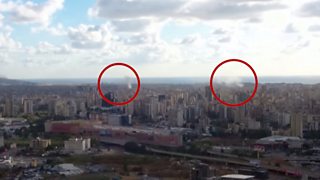


0:38

Watch: Moment explosions go off across Lebanon
Just as crowds had gathered to mourn some of those killed in Tuesday’s wave of pager-bomb attacks, an explosion sparked chaos in Dahiyeh, Hezbollah’s stronghold in southern Beirut.

In the surrounding area there was bedlam as the sound of the explosion echoed through the streets. The chants stopped. Those gathered looked at each other, some incredulous.

As reports spread that this was part of a second wave of explosions now targeting walkie-talkies, no electronic equipment was considered safe.

In Dahiyeh, Hezbollah supporters stopped our team several times, demanding we did not use our phones or our camera.

One of our producers received a message from a friend, who said she had changed her Lebanese SIM card to an international number, concerned that her phone could explode, too.

Many people here, and across the country, are inevitably wondering what will come next. Some even say they do not know if it is safe to walk next to other people, and are changing their plans.

"Everyone is just panicking… We don’t know if we can stay next to our laptops, our phones. Everything seems like a danger at this point, and no one knows what to do,” one woman, Ghida, said.

The confusion was made worse by rumours that spread on social media. One of them suggested that even solar panels were blowing up. "A state of panic overwhelmed people,” another woman said. “And frankly, this situation is very frightening”.

Wednesday’s attack, which killed 25 people, came as the country was still shocked and angered by what happened the day before, when thousands of pagers exploded in a synchronised attack, after users received a message they believed had come from Hezbollah.
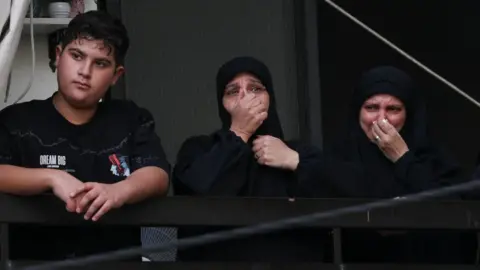
Reuters

At least 37 people including two children were killed by exploding devices on Tuesday and Wednesday

The devices detonated as people were in shops, or with their families at home, killing 12, including an eight-year-old girl who went to pick up the pager for her father, and an 11-year-old boy. Around 2,800 others were wounded, with hundreds needing surgery.

Treating some of the injured, Dr Elias Warrak said at least 60% of the people he had seen after Tuesday's blasts had lost at least one eye, with many also losing a finger or a whole hand. He described it as "the worst day of [his] life as a physician".

"I believe the number of casualties and the type of damage that has been done is humongous," he said. "Unfortunately, we were not able to save a lot of eyes, and unfortunately the damage is not limited to the eyes – some of them have damage in the brain in addition to any facial damage."


What we know about the Hezbollah walkie-talkie explosions


Bowen: Tactical triumph for Israel, but Hezbollah won't be deterred


The attacks are a humiliation for the Iranian-backed Hezbollah, and a possible indication that its entire communication network may have been infiltrated by Israel, the worst security breach in the group’s history.

Reports suggest a shipment of pagers may have been rigged with explosives, before being detonated remotely. Hezbollah had distributed the devices amid concerns that smartphones were being used by the Israeli military and intelligence agencies to track down and kill its members. It was still not clear how Wednesday’s attacks might have been carried out.

“The pain is huge, physical and in the heart. But this is something we are used to, and we will continue with our resistance," said a young man in Dahiyeh. A woman said: "This will make us stronger, whoever has lost an eye will fight with the other eye and we are all standing together.”

Hezbollah has vowed to respond, blaming Israel for the attacks. As usual, Israel has not commented. Fears are, again, rising that the current violence between the two rivals, which has led to the displacement of tens of thousands of residents on both sides of the border, could escalate into an all-out war.
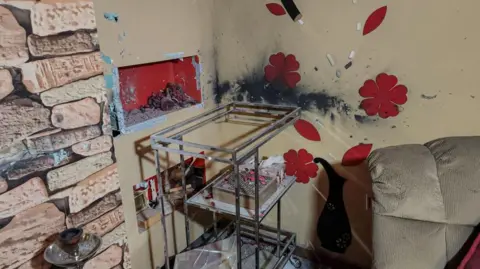
Getty Images

Exploding pagers and walkie-talkies caused damage in homes and injured thousands across Lebanon on Tuesday and Wednesday

Hezbollah says its attacks on Israel, which started almost a year ago, are in solidarity with Palestinians in Gaza, and that they will only stop with a ceasefire, an elusive possibility for now.

Hours after the latest explosions, the Israeli defence minister, Yoav Gallant, said his country was "at the start of a new phase in the war", as the 98th division of the Israeli army relocated from Gaza to the north of Israel.

Up until now, Hezbollah has indicated that it is not interested in another major war with Israel, as Lebanon struggles to recover from a years-long economic crisis. Many here say a conflict is not in the country’s interests. A damaged Hezbollah is not in Iran’s interests either, as the group acts as part of the country’s deterrence against Israel.

But some will certainly demand a strong response. An indication of what Hezbollah might be planning to do could come on Thursday, in the first public reaction by its powerful leader, Hassan Nasrallah.


Pager explosions will devastate Hezbollah's morale and manpower


Hezbollah pager explosions highlight shadow war


What we know about the Hezbollah walkie-talkie explosions


Hezbollah
Middle East
Lebanon
Israel

