SI
SI
discoversearch

We've detected that you're using an ad content blocking browser plug-in or feature. Ads provide a critical source of revenue to the continued operation of Silicon Investor.  We ask that you disable ad blocking while on Silicon Investor in the best interests of our community.  If you are not using an ad blocker but are still receiving this message, make sure your browser's tracking protection is set to the 'standard' level.
Strategies & Market Trends : 2026 TeoTwawKi ... 2032 Darkest Interregnum -- Ignore unavailable to you. Want to Upgrade?


To: Julius Wong who wrote (208032)9/26/2024 12:01:17 AM
From: TobagoJack  Respond to of 218160
 
re <<working>>

I am suspecting that Team China is looking for an excuse to boot out everything Windows by Microsoft, and TikTok be that excuse should that be the excuse

the difference being that Windows ban cannot be jumped by use of VPN whereas TikTok ban can be circumnavigated quite simply

bottomline, suspect Bloomberg might be wrong to very extremely wrong to fatally wrong

bloomberg.com

China’s Silence on US TikTok Ban Speaks Volumes

Washington seems more likely than ever to block the popular app. Beijing’s reserve exposes America’s weaknesses.
Catherine Thorbecke26 September 2024 at 03:00 GMT+8
TikTok ban’s collateral damage.

Photographer: Anna Moneymaker/Getty Images

Beijing has been rather quiet as TikTok, the first globally successful app born from its domestic tech sector, fights for its life in the US.

The debate over whether Washington will ban TikTok due to perceived national security concerns related to the Beijing base of its parent company, ByteDance Ltd., has simmered for years. In the past, Chinese officials haven’t shied from harsh rhetoric voicing opposition. But now, as a ban seems more likely than ever to take hold, Beijing is holding its cards close to the chest.

In the months since legislation that would force TikTok to divest from ByteDance has made its way through Congress and now the courts, spokespeople for China’s Foreign Ministry have demurred requests for comment, referring to previous remarks. (Namely, a March statement from commerce officials that China will resolutely “safeguard its legitimate rights and interests.”)

But it would be premature to interpret the recent silence as any sort of indication that Beijing will take this lying down. US firms with exposure to the world’s second-largest economy, from Apple Inc. to Tesla Inc., should brace for collateral blows if a tit-for-tat escalates. And policymakers would be unwise to underestimate the might Beijing may deploy in response to what it has previously decried as unfair “bullying.”

A high-stakes DC Circuit Court hearing last week did not go well for TikTok; The odds of it halting a ban plunged from 70% to 30%, according to Bloomberg Intelligence analysts. And if it fails to win this court battle, the likelihood of undoing that loss is 10%.

While government spokespeople have shown restraint, Chinese state-backed news outlets offered a window into official thought. Shortly after the Senate passed the ban legislation, the China Daily ran an editorial warning: “The century of humiliation won’t be repeated over TikTok.” It indicated that Beijing views the US attacks on the popular app as in line with anhistorical pattern of Western exploitation, dating back to when British armies forced Chinese people to buy opium. It warned that attempts to impose coercion and subordination will fail. Separate editorials in other outlets similarly accuse the US of trying to “plunder” ByteDance.

Even policymakers on the US-China Commission can’t seem to grasp that Beijing, and ByteDance, would never allow a forced sale of its crown jewel algorithm to a foreign buyer. China tweaked its export laws in 2020 to safeguard “national security and interests,” a move widely interpreted as a response to the first talks of a ban emerging. TikTok’s recommendation engine, which drives individualized content to users’ feeds to keep them scrolling and engaged, has long been cited as the secret sauce of the app’s success over rivals.

Some commentators argue that it won’t make sense — especially given the current macroeconomic woes — for Beijing to retaliate with sanctions or further policy signals that would discourage foreign investment amid a decades-low plunge. They claim blocking a sale would hurt ByteDance’s global investors. Yet this fails to acknowledge that Beijing has knee-capped its own tech sector in favor of broader policy goals with a brutal crackdown that has only recently eased. If the past few years have revealed anything about government priorities, it’s that investor returns and fast growth in the tech sector are no longer on top. President Xi Jinping’s mantra of “common prosperity” and high quality innovation that strengthens its tech independence has taken its place.

The US knows the game it’s playing with TikTok is unevenly weighted due to its own place in the global tech hierarchy, but this can also be a double-edged sword. As much as China risks turning away foreign investment by blocking a sale, it would be a win to broadcast to the world that any venture to make it in the lucrative US market isn’t safe.

Chinese officials may also be quietly considering options as they await the outcome of the presidential election. While Donald Trump kicked off this whole saga during his time in office, as a candidate he has since signaled that he would be against an outright TikTok ban because it would boost competitor Facebook-parent Meta Platforms Inc.

Lawmakers have been quick to fill the space left by Beijing’s silence. They are furiously defending the constitutional right of free speech, while trying to silence a platform that more than 170 million Americans use to express themselves. TikTok is painted as a national security threat, but not only has commander-in-chief Joe Biden’s team joined, it has become a major campaign tool for both presidential frontrunners. The coconut tree memes and “brat” vibes propelling Kamala Harris’ popularity in the polls originated on the app.

Get the Weekend Edition newsletter.

Big ideas and open questions in the fascinating places where finance, life and culture meet. Coming soon.

It’s ironic that the US is employing an undemocratic process to ban the app in the name of preserving its democracy. Around half of Americans use TikTok. Less than a third support a ban. Seven million US businesses are on TikTok. The supposed smoking-gun evidence that it is a real threat remains classified, kept from the eyes of not just the American public but TikTok’s own lawyers. The ban legislation was fast-tracked through Congress, attached to a foreign aid package meant to support Israel and Ukraine. Lawmakers worried about social media security risks should instead pass comprehensive laws to protect Americans’ data and safeguard users from threats across all apps.

Banning TikTok under these circumstances only gives China’s well-oiled propaganda machine the ultimate ammunition. Maybe Beijing is wise not to say much. America’s actions speak for itself.


To: Julius Wong who wrote (208032)9/26/2024 12:03:07 AM
From: TobagoJack  Respond to of 218160
 
Re <<working>>


To: Julius Wong who wrote (208032)9/26/2024 12:06:50 AM
From: TobagoJack  Respond to of 218160
 
re <<working>> ... not


To: Julius Wong who wrote (208032)9/26/2024 12:08:52 AM
From: TobagoJack  Respond to of 218160
 
re <<working>> by experimenting, all or nothing


To: Julius Wong who wrote (208032)9/26/2024 12:16:35 AM
From: TobagoJack  Respond to of 218160
 
re <<working>> by virtual travelling, and spot the freedom of religion, one that does not involve wars


To: Julius Wong who wrote (208032)9/26/2024 12:27:27 AM
From: TobagoJack  Respond to of 218160
 
re <<working>> success, one game, all or nothing, and winning, big, for one pedestrian sidewalk performer situated in the middle of nowhere, as in OMG, so excellent


To: Julius Wong who wrote (208032)9/26/2024 12:29:57 AM
From: TobagoJack1 Recommendation

Recommended By
Julius Wong

  Respond to of 218160
 
re <<working>> archeology ... neat stuff


To: Julius Wong who wrote (208032)9/26/2024 12:42:00 AM
From: TobagoJack1 Recommendation

Recommended By
Julius Wong

  Respond to of 218160
 
re <<working>> ... a puzzle ... and all done without tapping 'uge shale resource, as if discovered something somewhere, doubtlessly super ultra double secret ... makes me think carbon energy has little to do with dinosaurs and such


To: Julius Wong who wrote (208032)9/26/2024 1:02:33 AM
From: TobagoJack  Respond to of 218160
 
re <<working>> ... well


To: Julius Wong who wrote (208032)9/26/2024 1:36:06 AM
From: TobagoJack1 Recommendation

Recommended By
Julius Wong

  Respond to of 218160
 
re <<working>>

Jack looking forward to use his annual pass to visit Ocean Park say 30+ days from this day, that is about 10 drive from home, to check out new residents arrived in good order

scmp.com

Hong Kong’s 2 new giant pandas An An and Ke Ke touch down in city
Updated: 12:55pm, 26 Sep 2024

Bears get official welcome at ceremony attended by Chief Secretary Eric Chan and tourism minister Kevin Yeung at the airport


This story has been made freely available as a public service to our readers. Please consider supporting SCMP’s journalism by subscribing. Download our app to get faster notifications.

Hong Kong is rolling out the red carpet on Thursday for a much-awaited pair of adult giant pandas gifted by Beijing.

Chief Secretary Eric Chan Kwok-ki and tourism minister Kevin Yeung Yun-hung will welcome the bears at a ceremony at Hong Kong International Airport in the morning.

Male An An and female Ke Ke, as they are known in Sichuan province, are both aged five, the equivalent of 15 in human years.

They left the giant panda base in Dujiangyan at 3am, a day after Yeung, mainland Chinese officials and Ocean Park chairman Paulo Pong Kin-yee saw them off with much fanfare.

Follow our updates as we track the pandas from Hong Kong airport to their new home at Ocean Park in Southern district.

Reporting by Denise Tsang, Lo Hoi-ying, Leopold Chen and William Yiu.

VIP escortA convoy of three trucks and a coach are seen travelling slowly on North Lantau Highway near the airport and escorted by elite police motorcyclists.

Police have cleared traffic to make way for the convoy.

Fan-tastic

Panda fan Fu Fan-wan, 59, is among early birds waiting at Ocean Park hours before the arrival of the pair.

Armed with a selfie stick, Fu is dressed in a panda T-shirt, has two panda bags and is wearing a mask – with a panda pattern. She also has a card case with a panda picture.

The Ocean Park band, consisting of a guitarist, a snare drummer and a trumpet player, are ready to perform at the entrance of the theme park to welcome An An and Ke Ke.


Fu Fan-wan waits for the pandas to arrive outside Ocean Park. Photo: Sam Tsang
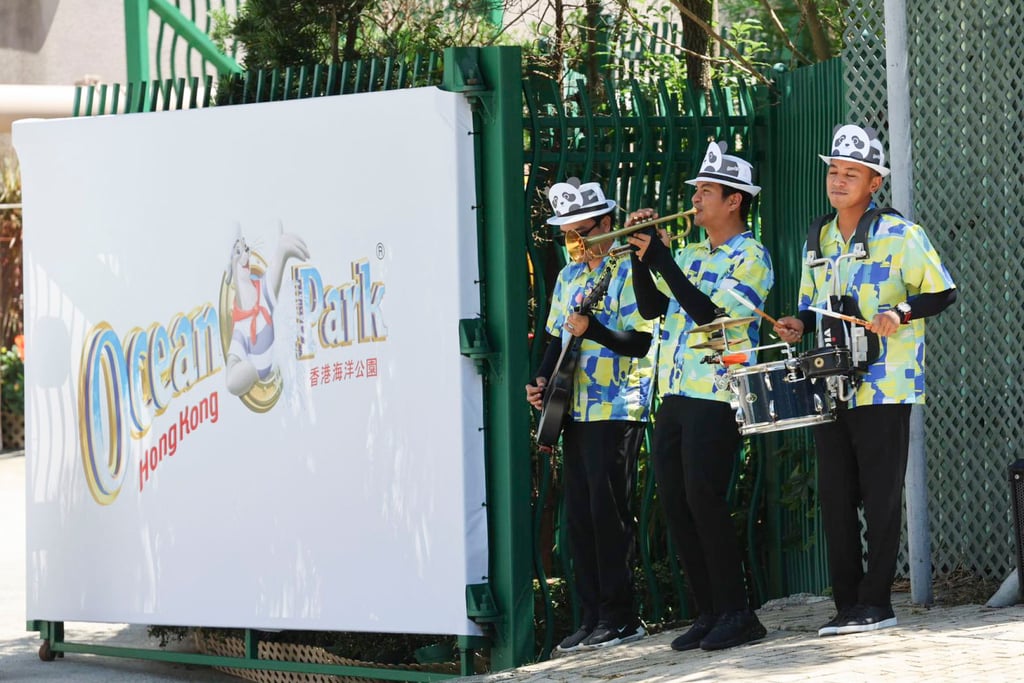

Ocean Park band are set to perform when the pandas arrive to Ocean Park. Photo: Dickson Lee

What’s next?

Ocean Park chairman Paulo Pong will meet the press at 2pm and update the public on the condition of the pandas. Stay tuned for the latest.
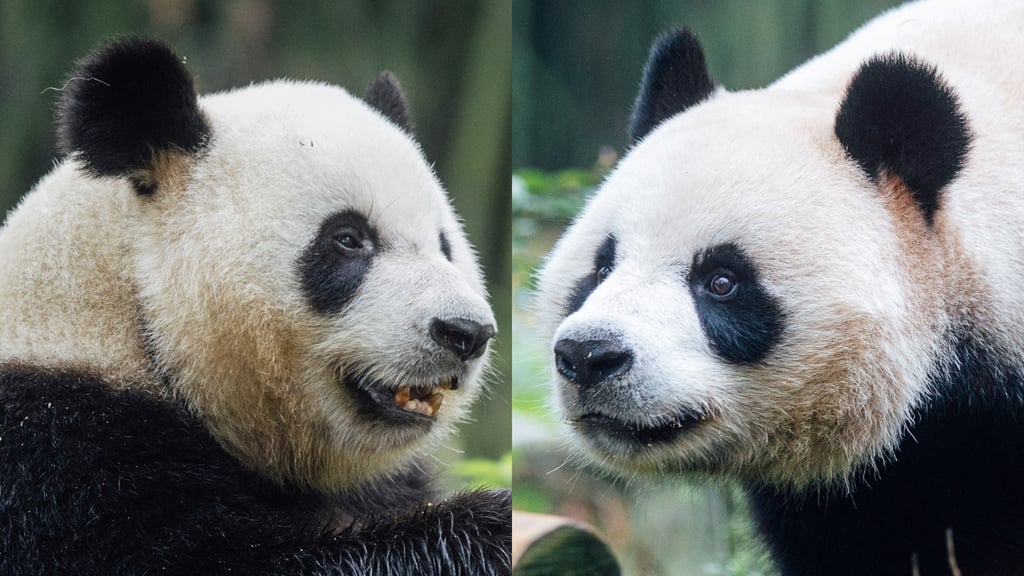

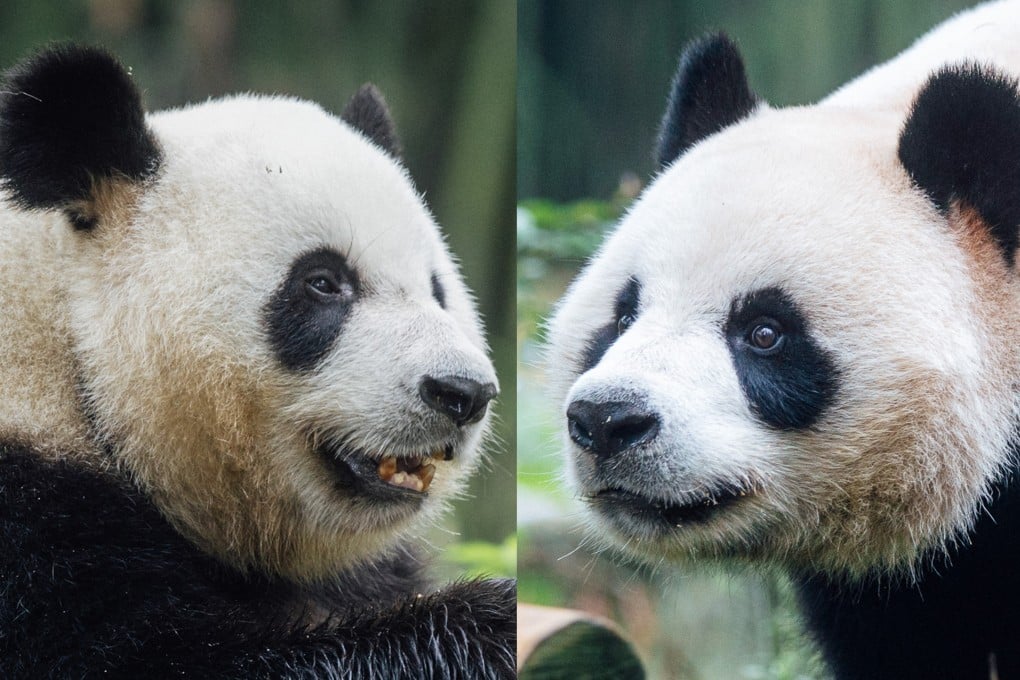
Giant pandas Ke Ke (left) and An An. Photo: Ocean Park

On the way to Ocean ParkThe pandas were offloaded from the cargo plane after about 20 minutes of inspection.

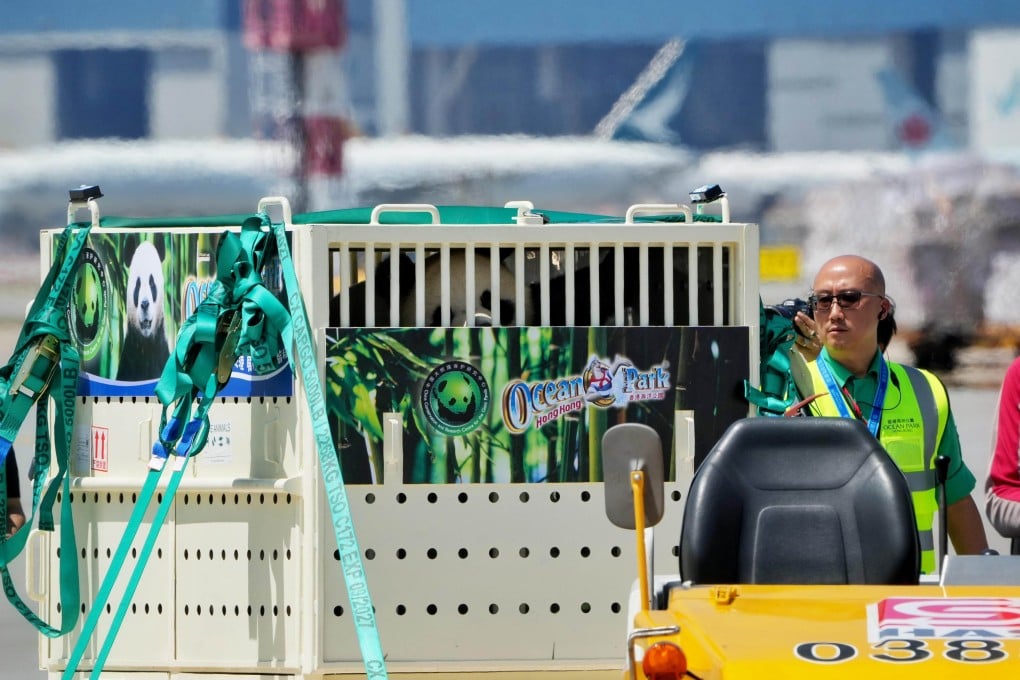
An An is seen peeking out of the cage on his way to a panda-themed truck.

They set off at around 12.30pm for Ocean Park, escorted by elite police motorcyclists.

A source said the truck would be driven slowly to the park in Wong Chuk Hang so that the pandas would not suffer motion sickness.

When will we see An An and Ke Ke?Chief Executive John Lee Ka-chiu earlier said the pandas would spend 30 days in quarantine at Ocean Park and be given another 30 days to adapt to the new environment.

Following that timetable, they will not be able to meet the public until mid-December at the earliest.


Ke Ke arrives at Hong Kong airport. Photo: Elson Li

‘Double happiness’: Hong Kong’s No 2An An and Ke Ke are welcomed at the airport by Chief Secretary Eric Chan, who says the pandas and the celebrations for the National Day period starting on October 1 will bring “double happiness”.

He thanked Cathay’s cargo services for sponsoring the transfer of the bears, the Hong Kong Jockey Club Charities Trust for a donation of HK$121 million to expand the panda infrastructure at Ocean Park and mainland authorities for the logistics and help.
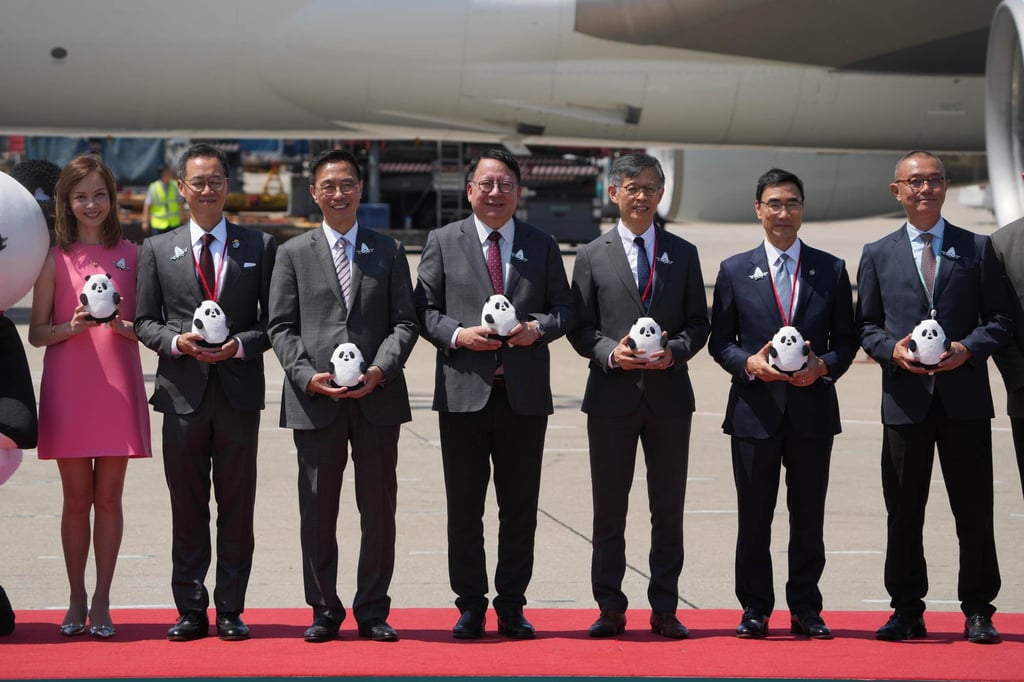

Hong Kong’s No 2 Eric Chan (centre) and other dignitaries welcome the two pandas at the airport. Photo: Elson Li

First important task: health checksAround two dozen staff from the Agriculture, Fisheries and Conservation Department and Ocean Park have boarded the aircraft to conduct health checks on the two pandas.


Staff board the aircraft to conduct health checks on the two pandas. Photo: Elson Li

Arrived!

Welcome to Hong Kong, An An and Ke Ke!

The CX2061 flight carrying the two pandas from Chengdu touched down at 11.06am after a two-hour trip.
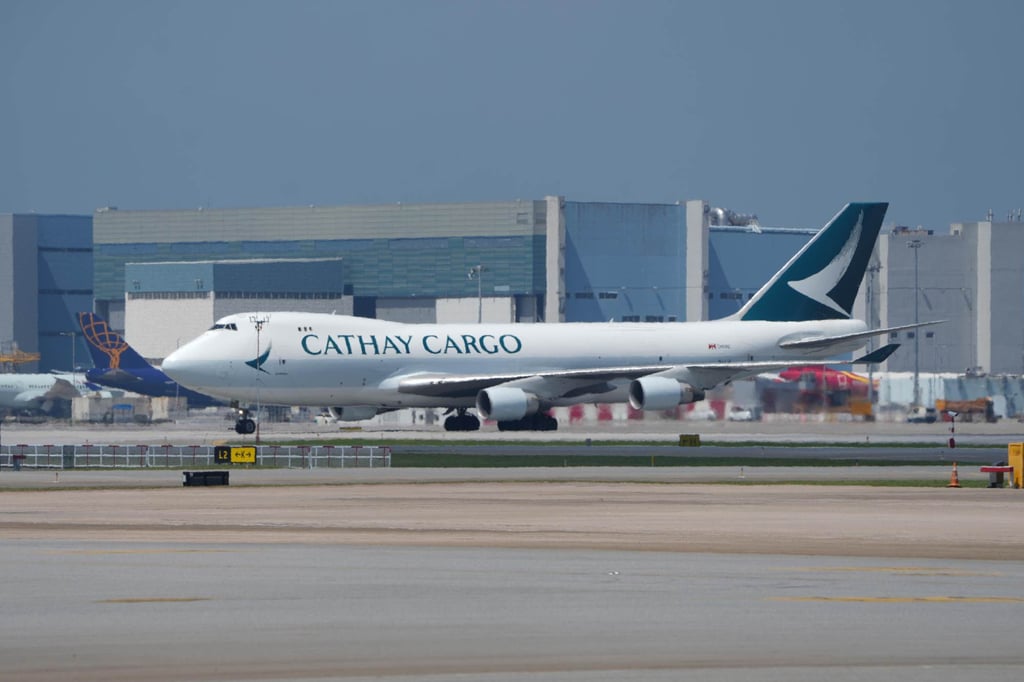

Two giant pandas gifted to the city by Beijing arrive at the airport. Photo: Elson Li

Buzz at Hong Kong airportAccording to online flight tracker Flightradar24, CX2061 took off at 9.04am and is estimated to touch down in Hong Kong at 11.06am.

Ground workers were racing to finish setting up a podium at around 10.30am on the apron of the airport in hot weather.

More than 100 people, including journalists, photographers and TV news crews, are waiting at the apron for the arrival of the giant pandas.
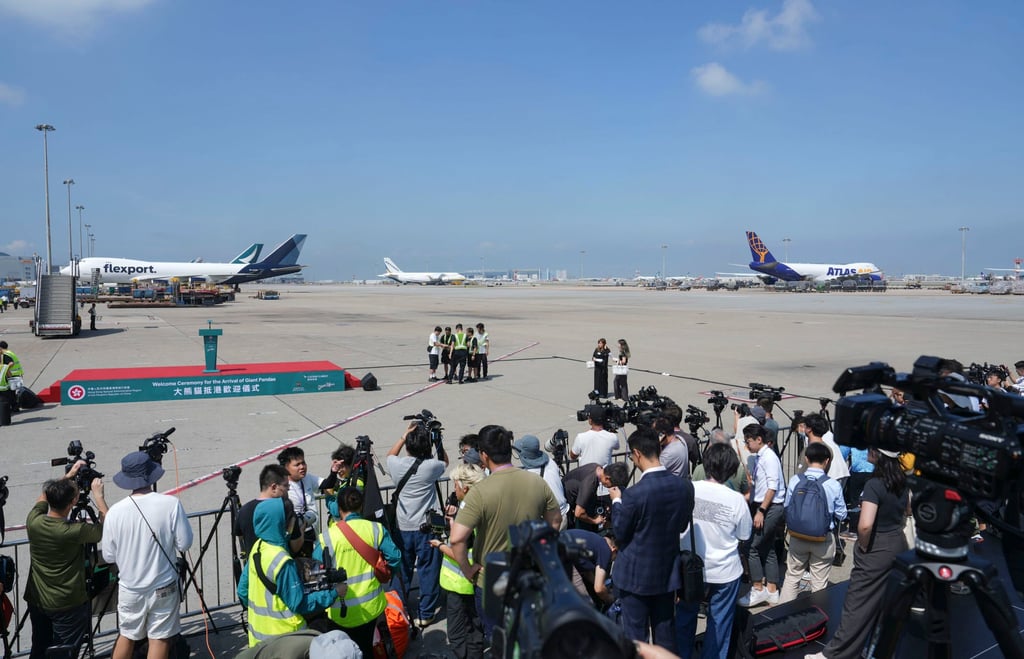

People wait for the pandas to touch down in Hong Kong. Photo: Elson Li

Ocean Park perks

To celebrate the pair’s arrival, Ocean Park is giving away free panda-shaped ice cream bars for its annual pass members from Thursday to Saturday.

The park is also offering a 15 per cent discount for visitors who buy two annual passes or more. Each annual pass costs at least HK$833.

Panda personalities

The pandas are being accompanied on the two-hour flight by Sichuan experts Dong Li and Cheng Yanxi, along with caretakers from Ocean Park.

Dong described male An An as “optimistic and active”, while Matt, a “panda nanny” from Ocean Park, said on social media he was “huge but gentle”.

“From my observation, he’s quite curious about things around him and often goes on adventures!” Matt wrote on Instagram.

However, Dong and Matt had different takes on Ke Ke’s personality.

Matt said Ke Ke was a “little princess”, who enjoyed eating alone. But Dong described her as “feisty” and a talented climber.

“Ke Ke is a relatively petite female, but her personality is quite outgoing and rather feisty. She’s like what we call a ‘tough lady’,” Dong said.
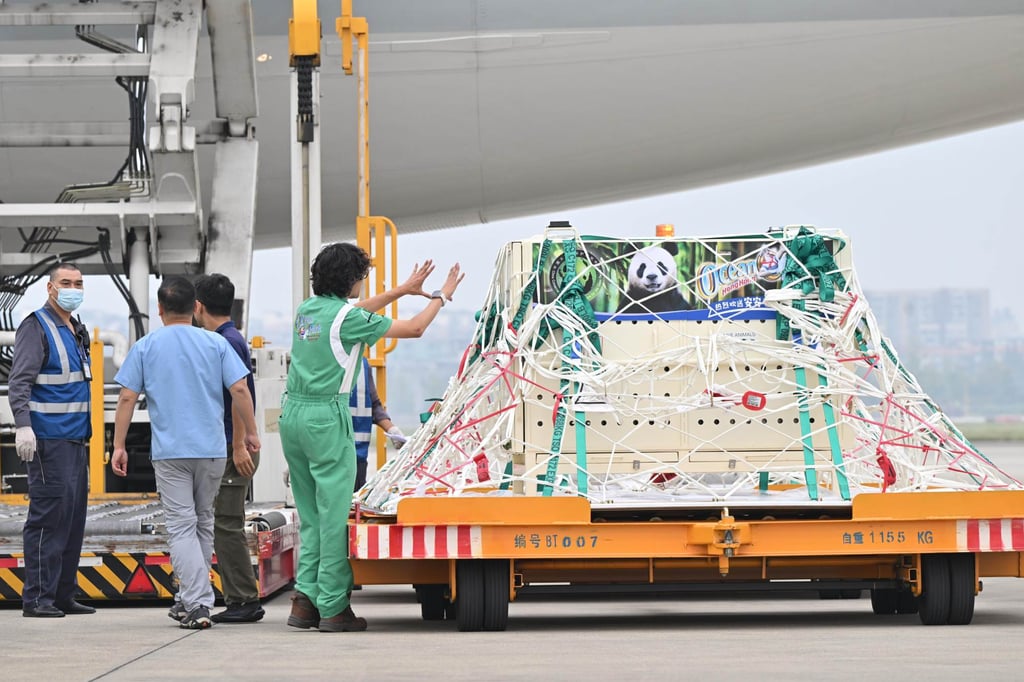

Ocean Park’s zookeeper “Matt” (dressed in green), interacts with An An shortly before the bear is lifted to the cargo plane. Photo: ISD

Panda economy

Simon Yim, founding chairman of the Hong Kong Panda Education Foundation, said Hong Kong now had “panda mania”.

“A photo featuring the baby pandas by Ocean Park could go viral and there are some restaurants launching some meals based on the theme of pandas, and now we even have panda glutinous rice balls and panda latte coffee,” he said.

He suggested the Hong Kong government follow Chengdu to launch a panda-themed post office in the city.

“The products, ranging from postcards to stamps, were all panda themed [in the Chengdu’s post office]. If we can have such a post office in a tourist spot or a shop selling cultural and creative products with a panda theme, it will be attractive for tourists,” he said.

Wrapping up in Chengdu

An An and Ke Ke are being transported in cages, and will have their favourite food, bamboo shoots and apples, for the journey.
Workers wrapped the cages with plastic before they were lifted into the cargo plane. The plastic wrappers showed the pandas’ pictures and Ocean Park’s name and logo.

The cages of An An and Ke Ke are decorated with blue and red ribbons, respectively.

Holes in the wrappers allow fresh air in but they are too small for the pandas to see out.

A source told the Post that the design of the wrappers aimed to minimise the chance of the pandas becoming agitated in an alien environment.
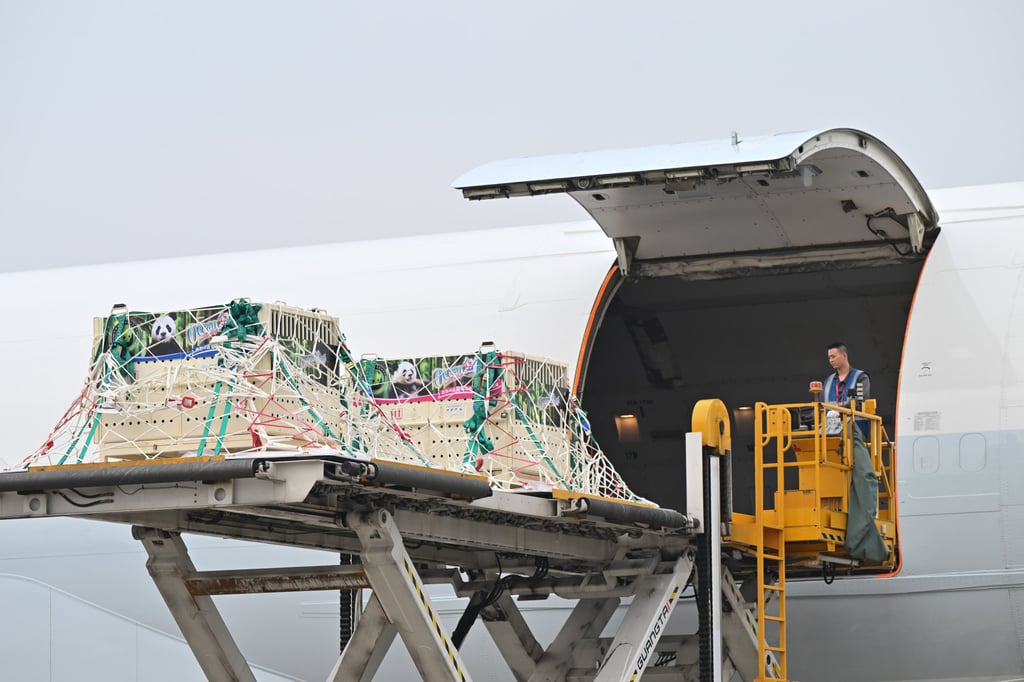

The two pandas left for Hong Kong from Sichuan on Thursday morning. Photo: Handout
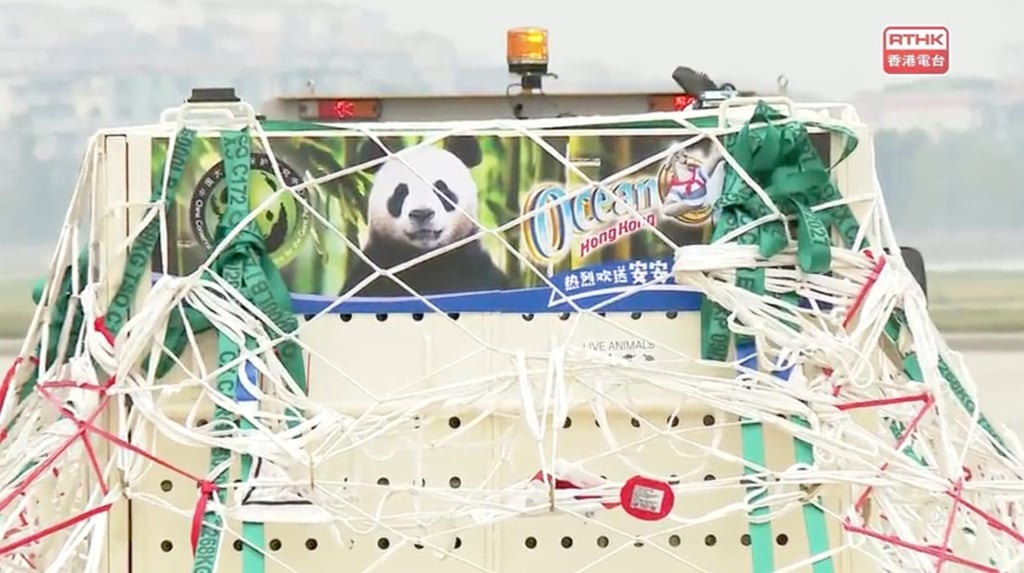

The cages are well wrapped for the journey. Photo: RTHK

Countdown to journeyOn Wednesday afternoon, Sichuan officials, Hong Kong tourism minister Kevin Yeung and Ocean Park chairman Paulo Pong held a large-scale farewell ceremony for the giant pandas.

They said they were grateful for Beijing’s decision to gift Hong Kong the bears and the workers’ hard work to prepare the pandas for their journey to the city.

A busy day of travellingThe bears headed for Chengdu airport at 3am on Thursday.

They are taking Cathay Cargo flight CX2061, which had been scheduled to leave Chengdu at 8.55am and arrive in the city at 11.35am.

Upon arrival, they will be transferred in their cages into a truck, which will bring them to their permanent home at Ocean Park.

Pandas Ying Ying and Le Le, and the couple’s newborn twins, are already in the park.

‘Sichuan-flavoured’ food to help Hong Kong’s 2 incoming pandas adjust to new home

Pandas will be met by city’s No 2 official in a welcoming ceremony at Hong Kong airport


Published: 4:00pm, 25 Sep 2024Updated: 12:22am, 26 Sep 2024

Hometown flavours will accompany Hong Kong’s two incoming pandas on their journey from Sichuan province, handlers have revealed, as officials gave the pair a send-off on Wednesday.

Pandas An An and Ke Ke, gifted by Beijing to Hong Kong, will be met by Chief Secretary Eric Chan Kwok-ki in a welcoming ceremony at the city’s airport on Thursday.

But a source said the two pandas would remain in their cages, which would be wrapped up throughout their journey to their new home at Ocean Park to prevent them from seeing outside and being scared by crowds.

Dong Li, who has taken care of An An and Ke Ke for 1½ years in Sichuan, said the pair, both aged five, had started to form a relationship with Ocean Park handlers, while he would bring “Sichuan-flavoured” food to Hong Kong to help the bears adjust.

“When they use Cantonese to call their names, [the pandas] demonstrate a clear reaction with their ears and hearing. This shows that they have established a preliminary relationship of trust,” Dong said in a media interview.


Young dancers perform at a farewell ceremony in Sichuan for the two Hong Kong-bound pandas. Photo: ISD

Dong will also fly to Hong Kong to take care of the pair for three to four months in their new home.

Veterinary surgeon Cheng Yanxi, who will also accompany the pandas, said the pair would have large amounts of food and sufficient water for the journey, while the cabin temperature would be controlled.

“We will also have some tranquillising drugs and anti-inflammatory drugs at hand. If the pandas react strongly, we will administer a small dose to calm them down,” Cheng said.

He said pandas could suffer from car-sickness, and that vehicles carrying them should avoid abrupt stops and turns. Their cages would be big enough to enable them to stand up, turn and roll around.

Another source said the bears would head for Chengdu airport at 3am on Thursday. They are scheduled to leave the airport on Cathay Cargo flight CX2061 at 8.55am and arrive in the city at 11.35am.

At Hong Kong airport, the two cages will be transferred directly to a truck, which will take the pandas to the theme park in Wong Chuk Hang.

“The driver will drive slowly all along the way to avoid the giant pandas feeling uncomfortable,” the source said. “But to avoid them being stimulated by what they see, they will not be able to see through the cages.”

That means the public will not be able to see the pandas on Thursday.

Elite police motorcyclists will be deployed to ensure the safe passage of the pandas.

Mainland caretakers and Ocean Park handlers who flew to Sichuan also offered a glimpse into the pandas’ personalities.

Dong described male An An as “optimistic and active”, while Matt, a “panda nanny” from Ocean Park, said on social media he was “huge but gentle”.

“From my observation, he’s quite curious about things around him and often goes on adventures!” Matt wrote on Instagram.

However, Dong and Matt had different takes on female panda Ke Ke’s personality.

Matt said Ke Ke was a “little princess”, who enjoyed eating alone. But Dong described her as “feisty” and a talented climber.

“Ke Ke is a relatively petite female, but her personality is quite outgoing and rather feisty. She’s like what we call a ‘tough lady’,” Dong said.
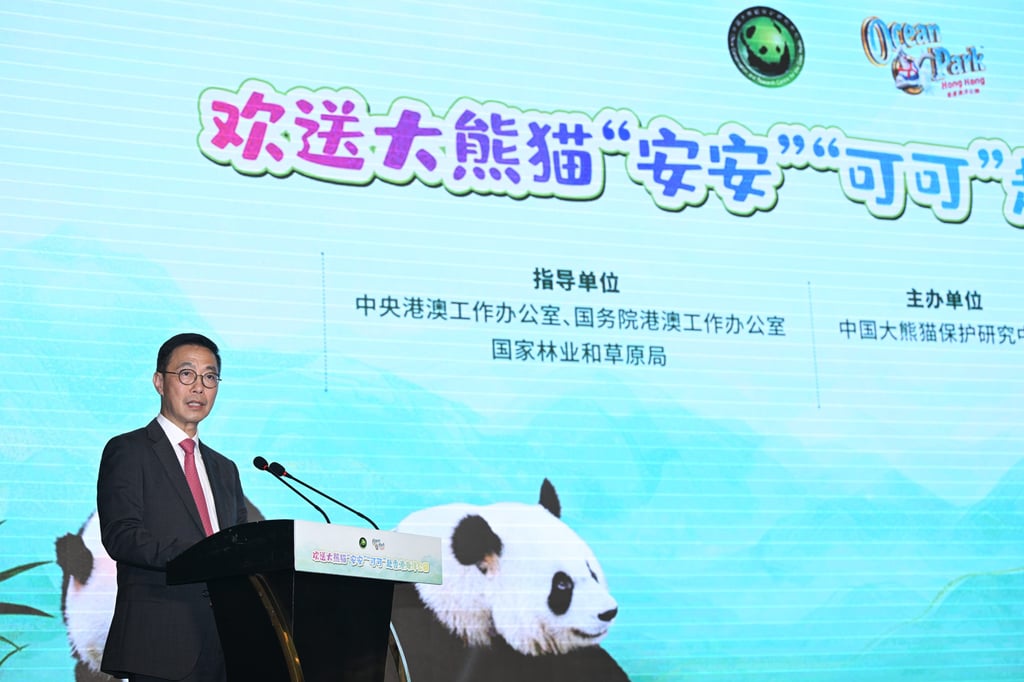

Tourism chief Kevin Yeung addresses the ceremony in Sichuan. Photo: ISD

Tourism chief Kevin Yeung Yun-hung was among those attending the ceremony at the giant panda base in Dujiangyan on Wednesday and thanked Beijing for gifting the two bears to Hong Kong.

Li Desheng, deputy director of the China Conservation and Research Centre for the Giant Panda in Sichuan, said the pair were in “good condition” and that Ocean Park would require retrofitting to boost the chance of successful mating.

The pair would need 30 days of quarantine upon their arrival and another month to adapt to the new environment before meeting the public in December, Chief Executive John Lee Ka-chiu said on Tuesday.

Lee said the city would hold a contest next month to name the two bears.

Beijing announced it was gifting the two pandas to Hong Kong on July 1 to mark the 27th anniversary of the city’s return to Chinese sovereignty. Both were born in June 2019.

With the arrival of the duo on Thursday, the number of pandas at Ocean Park will reach six after Ying Ying gave birth to a pair of twins, a male and a female, last month.


To: Julius Wong who wrote (208032)9/26/2024 1:43:15 AM
From: TobagoJack  Respond to of 218160
 
re <<working>>

seems Team USA loves messaging, and so best that Team China load up the pipeline with messages, faster, cheaper, and more plentiful the better, am guessing if am to believe Pentagon-Bloomberg take, so that there would not be any misunderstandings over any number of issues dearer to each side than to the other side

bloomberg.com

US Hails Early Notice of China ICBM Test to Avoid Miscalculation

By Natalia Drozdiak

26 September 2024 at 08:39 GMT+8


The Pentagon praised China for its transparency before the test launch of an intercontinental ballistic missile into the Pacific Ocean, in a sign that military communication between the superpowers is improving.

“We did receive some advanced notification of this ICBM test and we believe that that was a good thing,” Pentagon spokeswoman Sabrina Singh said on Wednesday. “It’s a step in the right direction and it does lead to preventing any misperception or miscalculation.”

She added that the US has pressed China for more regular notifications of ballistic missile and space launches.

China’s move “represents a common sense, confidence-building measure,” Singh said. “So we want to see these types of notifications continue.”

The communication between the militaries marks a turnaround from recent years, when China all but shut off such links after then-House Speaker Nancy Pelosi visited Taiwan. The People’s Liberation Army responded to Pelosi’s trip with large-scale military drills around the democratic nation of 22 million people, which Beijing has pledged to bring under its control eventually.

The US and China have been restoring communication links between their armed forces. Earlier this month, Chinese and American military commanders overseeing operations in the South China Sea had their first talks since Pelosi’s 2022 visit. That came shortly after National Security Adviser Jake Sullivan visited beijing and held rare talks with General Zhang Youxia of China’s Central Military Commission.

The militaries of China and those of the US and its allies come into close contact in the body of water over which Beijing makes vast claims. While China notified the US of the rare ICBM test into the Pacific on Wednesday, Japan has said it received no prior notice, calling the military activity a “serious concern.”

China’s nuclear threat has been a pressing worry of the US. The Pentagon said last year that Beijing had about 500 operational warheads and was looking to increase that to more than 1,000 by 2030 as part of Xi’s push to achieve a “world class” military by 2049.

The Asian nation’s Rocket Force has some 350 ICBMs, which are weapons with a range of more than 5,500 kilometers (3,420 miles), it added.


To: Julius Wong who wrote (208032)9/26/2024 2:00:47 AM
From: TobagoJack1 Recommendation

Recommended By
Julius Wong

  Respond to of 218160
 
re <<working>> and learning under I did not know category


To: Julius Wong who wrote (208032)9/26/2024 2:06:15 AM
From: TobagoJack  Respond to of 218160
 
re <<working>> ... not, surely CGI (computer graphics imaging) used ?

if not, then nuts, and best to lower tariffs on china camping gear

suggesting that Team USA might wish to consider re-engagement with Team China so as to re-industrialise (4.0), rejuvenate (2.0), by re-globalise (xx)

unless the video is fake news, in which case we ignore


To: Julius Wong who wrote (208032)9/26/2024 2:19:19 AM
From: TobagoJack1 Recommendation

Recommended By
Julius Wong

  Respond to of 218160
 
re <<working>>

... well, the bipartisan China Initiative


scmp.com

Nanotech pioneer Wang Zhonglin leaves US to work in China ‘full time’

The ‘father of nanogenerators’ and one of the most influential scientists in the United States, takes role at Beijing institute


Victoria Belain Hong Kongand Dannie Pengin Beijing

Published: 2:22pm, 24 Sep 2024Updated: 1:44am, 25 Sep 2024

A world-leading nanoscience and nanotechnology scientist – known as “the father of nanogenerators” – has left his decades-long career in the US to focus his research efforts in his native China.

Wang Zhonglin is credited with developing the field of nanoenergy. His work in developing nanogenerators and self-powered systems opened up the technological potential for wireless devices that can be self-powered without a battery.

Multiple Chinese media sources, as well as a professor at the Georgia Institute of Technology – Wang’s faculty since 1995 – confirmed that he had resigned from his position and is working “full-time” in Beijing at the institute that he helped to found.

The council of the Beijing Institute of Nanoenergy and Nanosystems, under the Chinese Academy of Sciences (CAS), held its first meeting in July to establish its board and charter, along with Wang’s official role as director and inaugural chief scientist.

Neither Wang nor Georgia Tech – where he served as Regent’s professor and Hightower chair for the school of materials science and engineering (MSE), and director of the Centre for Nanostructure Characterisation – responded before publication.

Wang took first place in this year’s Stanford/Elsevier ranking of the top 2 per cent of scientists – based on more than 40 parameters for millions of scientists worldwide – for the fifth consecutive time, but his listed affiliation switched from Georgia Tech to CAS in 2023.

The latest Stanford/Elsevier ranking also rates Wang – who was born in Shaanxi province, northwest China and became a US citizen – ahead of all other American scientists in terms of career-long scientific impact.

Wang is listed among emeritus and retired faculty on the Georgia Tech materials science and engineering website, where his profile describes him as “a pioneer and world leader in nanoscience and nanotechnology for his outstanding creativity and productivity”.

At time of publication, the link to Wang’s Georgia Tech research website was redirecting to the school’s homepage. His personal research homepage also did not load, although both were operational a week earlier and showed details of Wang’s research group.

Georgia Tech is one of the US universities scrutinised by Congress for its collaborations with Chinese entities that are alleged to have military links.

Earlier this month, it ended research ties with Tianjin University and the jointly established Georgia Tech Shenzhen Institute, because of their continuing inclusion on the US Commerce Department’s export restrictions list, Reuters reported.

Wang’s fellow nanoscientist, Charles Lieber – who was targeted by the Trump administration’s China Initiative in 2021 – also featured in this year’s Stanford/Elsevier ranking, coming in at 52nd place for career-long impact.

Lieber, former chairman of Harvard University’s chemistry and chemical biology department, was convicted for failing to disclose ties to a Chinese talent recruitment programme. Last month, he said he was exploring opportunities “in Hong Kong, mainland China and elsewhere”.

The China Initiative, which ended in 2022, left a lasting impact on the US research community, particularly on scientists of Chinese origin, and many have chosen to leave the country in its wake.

The fields of nanoscience and nanotechnology are of vital interest to both Beijing and Washington because of their wide applications in energy, medicine and industry, as well as military technology.

Both governments have identified them for research and development funding and the Beijing Institute of Nanoenergy and Nanosystems is one of several institutions established over the past decade to help China meet its development goals.

Robotic ‘swimmers’ being developed to deliver drugs in human blood vessels

Wang, who was born in 1961 and graduated from what is now Xidian University in Xian, moved to the US in 1982 when he was selected for the first international student exchange programme after China’s opening up.

He received a PhD from Arizona State University in 1987, as one of more than 900 students to take part in the China-US Physics Examination and Application Programme, initiated by Chinese-American physicist Tsung-Dao Lee.

Wang was attending a conference in China at the end of 2010 when Bai Chunli, then CAS vice-president, asked him if he would be interested in taking the lead on the setting up of an institute focusing on nanoenergy and nanosystems.

According to a China Science Daily report published in 2022, Wang did not hesitate and made a proposal to Georgia Tech soon after his return to the US. After receiving approval to work on the project in China, he began immediately, it said.

Construction started in 2012 and the Beijing Institute of Nanoenergy and Nanosystems is now an international leader in its field, with a number of its scientists featured in this year’s Stanford/Elsevier single year ranking alongside Wang.

According to the institute’s website, its total number of people had reached nearly 700 by the end of 2022, with 30 research groups and six major specialised research units established.

Wang mentored a large number of young scientists, many of whom returned to work in China, according to his Georgia Tech profile.

“Among those he has supervised, 10 of them are faculty in US research universities, 10 are faculty in Taiwan, and over 80 are faculty in China, four in Korea and one in Canada, and four in Europe,” it said.


To: Julius Wong who wrote (208032)9/26/2024 2:26:47 AM
From: TobagoJack  Read Replies (1) | Respond to of 218160
 
re <<working>> ... to be restarted, Project 2025, and Hong Kong stands at the ready
Fear about Trump’s return is heightened by Project 2025, a blueprint written by several former senior Trump officials for the next Republican president, which explicitly recommends “restart the China Initiative”.
scmp.com
Loss of top science talent by the United States is a gain for China
  • Thanks to paranoia and persecution, the mainland and Hong Kong can roll out the red carpet for world-renowned scientists like Charles Lieber


Alex Loin Toronto

Published: 9:30pm, 25 Aug 2024

The world of science was shocked when US authorities went after one of the greatest research chemists alive – Charles Lieber. Renowned as a leader in nanotechnology and its applications to biology and medicine, he was for a long time one of Harvard’s brightest scientific lights.

He was targeted under the now-defunct China Initiative, which went after science and tech researchers in the US with potentially compromising links to China, but particularly those of Chinese heritage. In the end, it was clear to everyone that the programme was nothing but a witch hunt. Now, at the end of his ordeal, Professor Lieber has told this newspaper that he is thinking of starting a new research career far away from the US.

“I am currently exploring … opportunities at several institutions in Hong Kong, mainland China and elsewhere,” Lieber told the Post in an email reply. Who can blame him?

His arrest in 2020 made headlines around the world. His crimes? Failure to disclose links to research institutions in China, and not paying his taxes for undisclosed payments from China.

Such lack of disclosure was, for a long time, routine among academics until the Donald Trump-era China Initiative. When FBI and Justice Department goons couldn’t find anything compromising on their targets, they resorted to such disclosure oversight to catch dozens of ethnic Chinese scientists with criminal prosecution. Lieber happened to be white but also very famous.

As for the tax evasion, if you read the financial press, every few months, some multimillionaire or billionaire is reportedly caught not paying taxes. Those cases are almost always punished with a fine; jail is rare.

But like other prominent names caught in the legal web, US authorities decided to make an example of Lieber. He fought his case but was ultimately convicted and sentenced. Freed from jail on time served, he is now finishing his home detention and supervision.

One supposes that like salesmen, US prosecutors have quotas to fill, especially under a politically sensitive programme like the China Initiative. Most of the prosecutions ended up having nothing to do with spying.

Hundreds of scientists who had collaborated with institutions in China were put under investigation, their lives and careers turned upside down even if they weren’t charged in the end. Others pleaded guilty just to end the nightmare. Nearly 90 per cent of those charged under the China Initiative were ethnic Chinese, including Chinese-Americans and immigrants from mainland China, Taiwan and Southeast Asian countries, according to a survey by the MIT Technology Review in 2021.

The chilly atmosphere has caused hundreds of ethnic Chinese scientists to switch their academic affiliations from American universities to institutions in China, with some of them being leading researchers in their fields with an international reputation.

But the persecution may return with Trump’s possible re-election in November, or perhaps the witch hunt never ended. Even though the China Initiative was formally halted by President Joe Biden, ethnic Chinese researchers continue to report harassment.

A late February edition of Nature, one of the world’s premier science publications, ran a news report titled, “Why the US border remains ‘a place of terror’ for Chinese researchers”, along with the summary: “Two years after the end of the controversial China Initiative, academics describe being treated like spies, a loss of talent and a chilling atmosphere that is stifling science.”

It began with an account of how an ethnic Chinese engineer was detained at a stopover in Chicago airport after attending a conference in Canada and was forced to give up passwords to his mobile phone and computer or else have them confiscated. It’s not an uncommon experience for many.

Fear about Trump’s return is heightened by Project 2025, a blueprint written by several former senior Trump officials for the next Republican president, which explicitly recommends “restart the China Initiative”.

Well, the US should deny and persecute its science talent. China will for sure welcome them with the red carpet.


To: Julius Wong who wrote (208032)9/26/2024 2:38:36 AM
From: TobagoJack1 Recommendation

Recommended By
Julius Wong

  Respond to of 218160
 
re <<working>> ... to be working better, persistence, perseverance, ... works better, arguably


scmp.com

China’s FAST radio telescope set for major upgrade to keep its place as world leader
An array of 24 radio telescopes will be built around China’s FAST to help boost the massive telescope’s resolution


Ling Xinin Ohio

Published: 1:00pm, 26 Sep 2024

China has launched the second phase of construction for its FAST radio telescope, as it aims to boost its observational power and maintain its global leadership in radio astronomy.

As part of the upgrade, two dozen fully steerable radio telescopes – each 40 metres (131 feet) across – will be constructed around the Five-hundred-metre Aperture Spherical Telescope (FAST), according to state broadcaster CCTV.

FAST is the world’s largest and most sensitive single-dish radio telescope, located in the southwestern province of Guizhou.

The new telescopes will be tuned to work in unison with FAST, forming an array that will be equivalent to that of a 10km (6.2-mile) diameter telescope, and will boost FAST’s resolution more than 30 times, CCTV reported on Wednesday.

This, in turn, will allow scientists to better understand phenomena such as gravitational waves, fast radio bursts and black hole events.

“There’s fierce international competition in radio astronomy, with multiple major projects like the Square Kilometre Array in the southern hemisphere and the Next Generation Very Large Array in the United States already under way,” senior astronomer Chang Jin told Xinhua news agency.

That competition saw Chinese scientists challenged with developing a long-term strategy to maintain FAST’s competitive edge in the low to mid-frequency range, added Chang, who also serves as vice-president of the Chinese Academy of Sciences in Beijing.

Although FAST is the most sensitive telescope of its kind, currently its resolution falls significantly short of top-tier telescope arrays, according to Jiang Peng, director of the FAST Operation and Development Centre.

For example, when observing a fast radio burst – a brief but intense flash of radio waves from a mysterious cosmic origin – “sensitivity determines whether you can detect it, while resolution defines how clearly you can see details, such as the precise location of the burst”, Jiang told CCTV.

World’s largest radio telescope detects mystery flashes 3 billion light years away from Earth

To enhance FAST’s performance and increase its resolution, Jiang and his team proposed a low-cost, rapidly deployable telescope array scheme, leveraging the 5km-radius radio silent zone around FAST.

However, Jiang noted, the team will face two critical technical challenges: developing high-performance, room-temperature receivers and advancing data processing technology for synthetic aperture telescopes.

The FAST upgrade plan was unveiled on Wednesday during a symposium in Pingtang, Guizhou, where over 100 researchers gathered to celebrate the telescope’s eighth anniversary and discuss its future.

Nestled in a natural depression in Pingtang’s karst landscape, FAST was completed and began operations on September 25, 2016. It has since become a leading tool for exploring the radio sky, particularly after the collapse of the 305-metre Arecibo telescope in Puerto Rico in late 2020.

In the past eight years, FAST has discovered over 900 new pulsars – extremely dense, magnetised and fast-rotating neutron stars that emit beams of radio waves. That is triple the number of pulsars found by other telescopes combined during the same period, according to CCTV.

FAST’s other major discoveries include the first detection of a black hole“heartbeat” in the radio wave band and the identification of a pulsar binary system with the shortest known orbital period.

More than a dozen papers based on FAST observations have been published in academic journals such as Nature and Science. FAST observes the sky for around 5,300 hours annually, with at least 10 per cent of that time available to international astronomers.


To: Julius Wong who wrote (208032)9/26/2024 3:01:01 AM
From: TobagoJack  Respond to of 218160
 
re <<working>>

