The History of Disaster Relief in America - HeinOnline Blog
5 MIN READ
The Atlantic hurricane season typically lasts from June 1 to November 30. As this year’s season comes to an end, we’ve already seen several disastrous storms hit U.S. territory, including Hurricanes Fiona and Ian. When these hurricanes hit land, they uproot lives and livelihoods, ripping apart buildings, flooding streets and homes, and killing the vulnerable. So, what is the federal government’s responsibility when a storm like this hits? Or when there’s another disaster, such as an earthquake, tornado, or wildfire? In this blog post, we are going to use various HeinOnline databases, particularly the United States Statutes at Large collection, to examine the history of disaster management and relief legislation in the United States.
The First Disaster Relief
The first attempt for the federal government to provide relief after a disaster was with the Congressional Act of 1803,[1] which provided support after a massive fire in Portsmouth, New Hampshire. For other subsequent disasters throughout the 1800s and early 1900s, the government provided relief on an ad-hoc basis. These disasters included the New York City and Chicago fires of 1835 and 1871, respectively, the 1900 Galveston, TX hurricane[2] (the deadliest natural disaster in U.S. history), and the San Francisco earthquake of 1906.
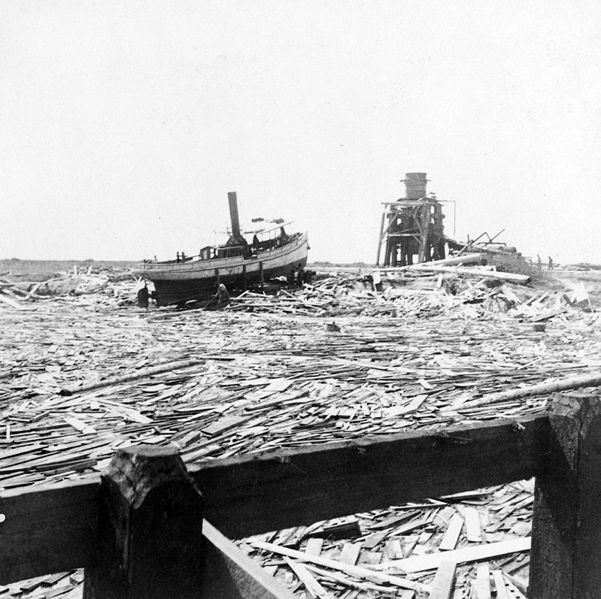 Wreckage from Galveston Hurricane Wreckage from Galveston Hurricane
During the Great Depression of the 1930s, the Reconstruction Finance Corporation[3] was established in part to provide federal funds in the wake of a natural disaster, making it the first federal disaster response agency. It was designed to provide funds for repairing public facilities, highways, and bridges. However, overall, the government took a reactive, rather than proactive, stance on disaster management until the mid-1900s.
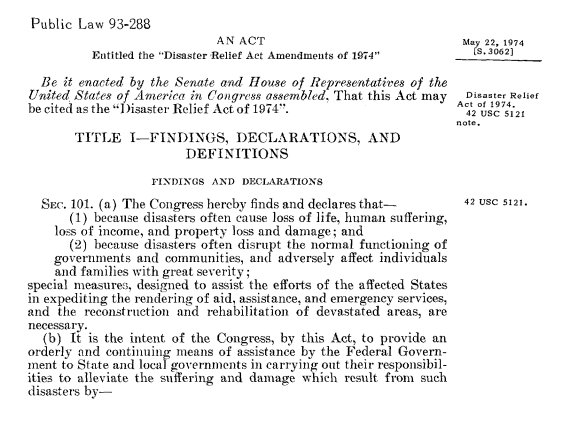
Pressure BuildsIn the aftermath of World War II, the fear of nuclear catastrophe inspired the passage of the Federal Civil Defense Act of 1950.[4] While this act did provide disaster relief, it did so with a major focus on nuclear warfare, as opposed to natural disasters. However, throughout the 1960s and early 1970s, several massive hurricanes and earthquakes devastated various parts of the United States, and the need for comprehensive disaster legislation became clear. This led to the passage of the Disaster Relief Act of 1974,[5] which officially established a process for the president to declare a disaster. However, some 100 agencies were involved in an uncoordinated effort to mitigate disasters. This would change with the establishment of FEMA.
The Federal Emergency Management AgencyIn 1979, President Jimmy Carter signed an Executive Order 12127 establishing the Federal Emergency Management Agency,[6] otherwise known as FEMA. The role of FEMA was to absorb the duties of various disconnected agencies, such as:
- Federal Insurance Administration
- National Fire Prevention and Control Administration
- National Weather Service Community Preparedness Program
- Federal Preparedness Agency of the General Services Administration
- Federal Disaster Assistance Administration in the Department of Housing and Urban Development
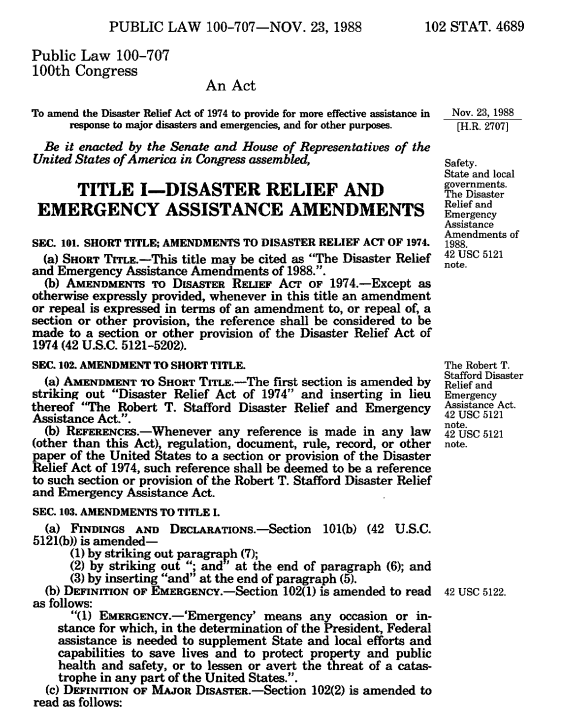
The agency was also given the authority to oversee civil defense initiatives. The Stafford Disaster Relief and Emergency Assistance Act of 1988[7] created a streamlined system to provide federal assistance to state and local governments, while requiring all states to create Emergency Operation Plans and tasking FEMA with creating a Federal Response Plan.
Some of the first disasters that FEMA responded to included the Three Mile Island nuclear power plant accident[8] in Pennsylvania in 1979, the aftermath of the toxic waste catastrophe of Love Canal[9] in Niagara Falls, NY, as well as the Loma Prieta Earthquake of 1989,[10] and Hurricane Andrew in 1992.[11] Over time, FEMA’s responsibilities grew to include dam safety, emergency food and shelter, earthquake hazard reduction, hazardous material containment, and counter-terrorism.
However, FEMA has not always been successful in responding to disasters. Federal response to disasters such as Hurricanes Andrew and Katrina highlighted the need for additional reforms for the agency.
FEMA was absorbed into the Department of Homeland Security with the Homeland Security Act of 2002,[12] following 9/11.
FEMA Reforms
In the wake of Hurricane Katrina, Congress passed the Post-Katrina Emergency Management Reform Act of 2006[13] to reorganize FEMA and fill the gaps that had become apparent during the federal government’s response to the disastrous hurricane. Similarly, in 2013, after Hurricane Sandy, the Sandy Recovery Improvement Act[14] was passed to reform how FEMA delivers federal disaster assistance to survivors. And in 2018, President Trump signed the Disaster Recovery Reform Act,[15] which provided further streamlining to FEMA and improved disaster response capacity.
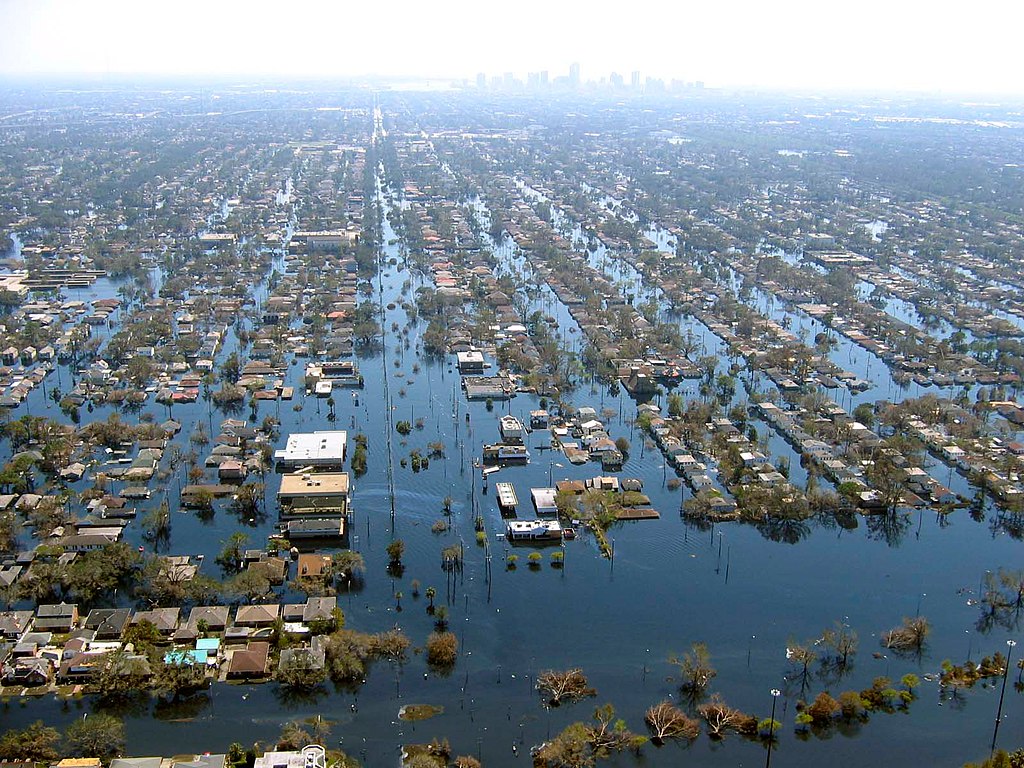 Flooding in New Orleans following Hurricane Katrina Flooding in New Orleans following Hurricane Katrina
FEMA has a list of historic disasters, meaning that they resulted in significant reforms to the way disasters would be handled in the future. Those of the 21st century include:
- Hurricane Katrina (2005)
- Hurricane Sandy (2012)
- California wildfires (2017)
- Hurricanes Irma, Maria, and Harvey (2017)
Declaring a DisasterAccording to the Stafford Act, “All requests for a declaration by the President that a major disaster exists shall be made by the Governor of the affected State.”[16] The Sandy Recovery Improvement Act also allowed for federally recognized Indian tribal governments to seek a presidential disaster declaration.[17] There are two types of disasters that can be declared: emergency declarations and major disaster declarations.
Emergency Declarations:An emergency declaration can be used at any time when federal assistance is needed to help protect lives, property, public health, or safety. The maximum assistance provided is typically $5 million, which can be used for debris removal and emergency protective measures, as well as, more rarely, individual assistance. Emergencies can also be declared in advance of a potential major disaster in order to decrease or eliminate health and safety threats.
Major Disaster Declarations: Major disaster declarations[18] can be used for any natural disasters, such as hurricanes, tornadoes, tsunamis, earthquakes, snowstorms, drought, and volcanic eruptions, as well as for massive fires, floods, or explosions. Assistance in these cases can include:
- Individual assistance, such as housing, unemployment relief, legal services, and food/nutrition
- Public assistance, such as debris removal; protective measures; road and bridge repair; and repair of parks, utilities, buildings, etc.
- Hazard mitigation assistance
Currently, FEMA is being utilized to provide relief in the wake of a variety of disasters, including Hurricanes Fiona and Ian, as well as severe storms in Alaska, Illinois, Kentucky, and Missouri.
|



