Regarding the president’s power to manage the government, the Supreme Court has spoken
By Andrea Widburg americanthinker.com
February 13, 2025
The Democrats claim that there is a constitutional crisis taking place because Donald Trump is exerting control over the federal government. To that end, they’ve turned to activist judges to issue emergency injunctions freezing all Trump’s actions to end waste, abuse, and fraud in the government. However, 157 years ago, the Supreme Court laid down the law: Managing the federal government is the president’s job, and courts may not interfere. The only option is impeachment, not legal action, for this is a political issue.
As a lawyer, you’d think I would have known about the Supreme Court’s 1867 decision in Mississippi v. Johnson, but I didn’t. Instead, I learned of it through my colleague JR Dunn. JR mostly works behind the scenes, which hides from you how extraordinarily brilliant and knowledgeable he is. Indeed, I’ve never met anyone else with such an encyclopedic brain.
(For those of you who would like to see more of JR’s insights, he submits a weekly column to our weekly members-only email digest. If you subscribe, you’ll get to read regular essays from all the American Thinker editors.)
In early 1867, Congress passed what are known as the Reconstruction Acts. The state of Mississippi was not pleased and moved to have the president—Andrew Johnson—enjoined from executing the Acts because, alleged Mississippi, they were unconstitutional.
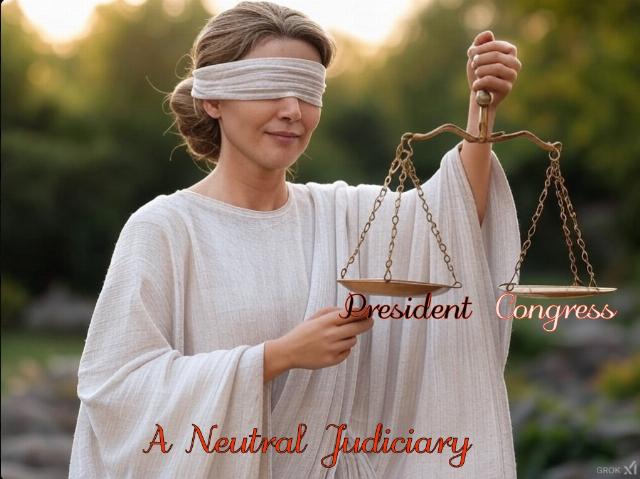
Image by Grok
The Court framed the question before it this way: “Can the President be restrained by injunction from carrying into effect an act of Congress alleged to be unconstitutional?” The Court’s answer: No.
We have a slightly different question before us today: Can lower court judges restrain the president from managing the day-to-day operations of the government, including how he interprets the laws controlling various administrative agencies?” Using the analysis in Mississippi v. Johnson, the answer to this modern question is the same: “No.”
The Mississippi court explained that the issue boiled down to the difference between ministerial and discretionary acts. The president has no latitude as to the former and broad latitude regarding the latter.
The seminal case defining ministerial duties is 1803’s Marbury v. Madison. That case is famous because Chief Justice John Marshall announced that the Supreme Court had the power to strike down laws it holds violates the Constitution. (The Constitution itself did not say that.)
However, the case details are often forgotten: When John Adams lost to Thomas Jefferson, he tried to fill federal offices with anti-Jeffersonians, and the Senate approved all of Adams’s nominations. The new commissions were written down, and Adams and his Secretary of State, John Marshall (who became the Chief Justice deciding Marbury v. Madison), signed them.
Marshall’s younger brother then hand-delivered all but a few of the executed commissions the day before Jefferson’s inauguration. Immediately after his inauguration, Jefferson instructed his new Secretary of State to freeze delivery of those last, undelivered commissions. Marbury’s commission became the test case.
John Marshall, despite his enormous conflict of interest, held that everything statutorily required to confirm Marbury’s status had been done. What remained—the mindless act of handing the document to Marbury himself—was a purely “ministerial” (i.e., non-discretionary) act that a court could order a reluctant president to perform.
However, 64 years later, the Supreme Court in Mississippi held that it’s different when discretion is involved:
Very different is the duty of the President in the exercise of the power to see that the laws are faithfully executed... The duty thus imposed on the President is in no just sense ministerial. It is purely executive and political.
And then, in language every activist judge needs to memorize, the Supreme Court stated,
An attempt on the part of the judicial department of the government to enforce the performance of such duties by the President might be justly characterized, in the language of Chief Justice Marshal, as “an absurd and excessive extravagance.”
This principle applies whether the request before the Court is one to force the president to act or to prevent him from acting. In the case of Mississippi, which wanted to restrain the executive from carrying out legislation it believed was unconstitutional, the Court said, “we are unable to perceive that this circumstance takes the case out of the general principles which forbid judicial interference with the exercise of Executive discretion.” (Emphasis mine.) The Court added,
The Congress is the legislative department of the government; the President is the executive department. Neither can be restrained in its action by the judicial department; though the acts of both, when performed, are, in proper cases, subject to its cognizance.
The impropriety of such interference will be clearly seen upon consideration of its possible consequences.
Suppose the bill filed and the injunction prayed for allowed. If the President refuse obedience, it is needless to observe that the court is without power to enforce its process. If, on the other hand, the President complies with the order of the court and refuses to execute the acts of Congress, is it not clear that a collision may occur between the executive and legislative departments of the government? May not the House of Representatives impeach the President for such refusal? And in that case could this court interfere, in behalf of the President, thus endangered by compliance with its mandate, and restrain by injunction the Senate of the United States from sitting as a court of impeachment? Would the strange spectacle be offered to the public world of an attempt by this court to arrest proceedings in that court?
In other words, President Trump’s discretionary acts are political. If Congress wants to stop him, it can, through impeachment. But the courts most certainly cannot.
And while the Nixon era saw the Supreme Court say that the judicial system’s duty “to do justice in criminal prosecutions” gave it the upper hand in the world of checks and balances, no decision has argued away the fact that judiciary cannot use nationwide injunctions to control the operations of the federal bureaucracy. |



