SI
SI
discoversearch

We've detected that you're using an ad content blocking browser plug-in or feature. Ads provide a critical source of revenue to the continued operation of Silicon Investor.  We ask that you disable ad blocking while on Silicon Investor in the best interests of our community.  If you are not using an ad blocker but are still receiving this message, make sure your browser's tracking protection is set to the 'standard' level.
Strategies & Market Trends : 2026 TeoTwawKi ... 2032 Darkest Interregnum -- Ignore unavailable to you. Want to Upgrade?


To: gg cox who wrote (211468)2/19/2025 10:11:45 AM
From: Pogeu Mahone  Respond to of 219872
 
Trump is/was 100% correct about UNWRA

UK said reconsidering UNRWA funding after released British-Israeli hostage told Starmer she was held in agency facilities


18 February 2025, 9:05 pm


Emily (right) and Mandy Damari on the phone to UK PM Keir Starmer, January 31, 2025. (Courtesy)

UK Prime Minister Keir Starmer’s office confirms to Channel 12 that it has formally decided to again reconsider its over $16 million in annual funding to the UN relief agency for Palestinian refugees UNRWA.

The decision comes after Starmer’s phone call with recently released British-Israeli hostage Emily Damari who told the premier that she was held during parts of her captivity in UNRWA facilities and that she did not receive necessary medical treatment


To: gg cox who wrote (211468)2/19/2025 11:46:47 AM
From: Pogeu Mahone  Respond to of 219872
 
I remember someone warning us that: "They are not sending their best."

===============================================

Sports
Chilean migrants charged in $2 million burglary spree targeting Patrick Mahomes, Travis Kelce, star athletes

By
Richard Pollina

Published Feb. 19, 2025, 7:46 a.m. ET

206 Comments

A gang of Chilean nationals has been charged with a string of robberies that stole millions in valuables from “high-profile athletes” across the U.S. — including the homes of Kansas City Chiefs stars Patrick Mahomes and Travis Kelce and Cincinnati Bengals quarterback Joe Burrow.

The seven illegal immigrants — Pablo Zuniga Cartes, 24; Ignacio Zuniga Cartes, 20; Bastian Jimenez Freraut, 27; Jordan Quiroga Sanchez, 22; Bastian Orellano Morales, 23; Alexander Huiaguil Chavez, 24, and Sergio Ortega Cabello, 38 — were all charged with conspiracy to commit interstate transportation of stolen property, a criminal complaint unsealed in Tampa, Fla., on Tuesday, revealed.

5
A photo from one of the alleged burglaries.U.S. Attorney's Office, Middle District of FloridaThe men are suspected members of a “South American Theft Group” who “targeted high-profile athletes in the National Football League (“NFL”) and National Basketball Association (“NBA”), all of whom were away or playing in professional games at the time of the burglaries,” prosecutors said.

Mahomes had his Belton, Mo., mansion robbed just after midnight on Oct. 6. and Kelce’s home was also broken into in the Kansas City area on Oct. 7, according to Cass County Sheriff’s Office.

The gang is suspected of breaking into the homes while the Chiefs were gearing up to face off against the New Orleans Saints in Kansas City.
A salad cost Dodgers pitcher his season — and almost his life

The Chilean nationals allegedly made off with “jewelry, watches, cash, and other luxury merchandise” during the Missouri burglaries, prosecutors revealed.

Two weeks later, the illegal immigrants allegedly struck again, but in Tampa.

“On October 21, 2024, the home of a Tampa Bay Buccaneers player was burglarized while the team played in Tampa. Jewelry, designer watches, a luxury suitcase, and a firearm were stolen,” the criminal complaint said.

5
Teammates Travis Kelce (l) and Patrick Mahomes( r) in 2023.Getty Images for NetflixThe Buccaneers were playing the Baltimore Ravens in Tampa around the time of the robbery.

The alleged gangbangers are also linked to a burglary at the home of a Milwaukee Bucks player during a game in Milwaukee on Nov. 2.

“A safe containing several watches, chains, personal items, jewelry, and cash was stolen, along with a designer suitcase and designer bags,” prosecutors said.

“The total value of property stolen was approximately $1.484 million.”

5
Kelce and Mahomes were not pleased after losing Super Bowl 2025.APDays later, the gang is suspected of breaking into the home of Cincinnati Bengals quarterback Joe Burrow on Dec. 9 while the team was in Texas to play the Cowboys.

The Chilean migrants made off with roughly $300,000 worth of his luxury possessions, including the NFL star’s personalized diamond-encrusted chains, federal prosecutors said.

Three of the suspects’ names in the charging documents — Quiroga Sanchez, Orellano Morales, and Ortega Cabello — brazenly posted photos with their stolen loot.

5
Joe Burrow’s Ohio home was burglarized in December.Sam Greene/USA TODAY Network via Imagn ImagesThe photos, laid bare in court documents, showed the alleged perps flashing Burrow’s watches, glasses, Louis Vuitton luggage and wads of cash.

Surveillance footage also captured at least one of the men carrying luggage through a wooded area behind the home after the break-in.

The trio was eventually nabbed on Jan. 10 near Fairborn, Ohio during a local traffic stop and indicted in federal court in Cincinnati earlier this month for the robbery. They have also been charged with falsifying records in a federal investigation.

5
Kelce and Mahomes are three-time Super Bowl champs.AP

Lastly, the complaint said in the “late afternoon on December 19, 2024, and the early morning of December 20, 2024, the Tennessee home of a Memphis Grizzlies player was burglarized while the team played in Memphis, Tennessee.

The brazen gang again made off with “jewelry, watches, and luxury bags valued at about $1 million.”

206What do you think? Post a comment.

In total, the alleged perps stole an estimated more than $2 million in valuables in the string of robberies.

If found guilty, the men could each face a maximum penalty of 10 years in federal prison.


To: gg cox who wrote (211468)2/22/2025 11:04:08 AM
From: Maple MAGA 1 Recommendation

Recommended By
Mick Mørmøny

  Respond to of 219872
 
Laurentian elite

The Laurentian elite, also referred to as the Laurentian Consensus, is a Canadian political term used to refer to individuals in the upper class of society who live along the St. Lawrence River and watershed in major Central Canadian cities such as Montreal, Ottawa and Toronto, an area which represents a significant portion of Canada’s population. The term has been used to describe the belief that a general governing political consensus existed in Canada due to the influence of the Laurentian elite from Confederation until the early twenty-first century.


Map of the St. Lawrence River watershed, which has over half of Canada's 338 ridings; this region is known to be influential in deciding federal election results

The term is generally attributed to John Ibbitson, who wrote extensively about the Laurentian elite following the 2011 Canadian federal election (though he has shared the credit for coining it with University of Toronto academic David Cameron). Ibbitson later expanded his coverage in the book The Big Shift: The Seismic Change in Canadian Politics, Business, and Culture and What It Means for Our Future published in 2013 by Darrell Bricker and Ibbitson, in which the authors argue that the Laurentian Consensus is on course to be replaced by a new political coalition consisting of Western Canada and suburban Ontario. The term has since been adopted by other journalists and political commentators as a shorthand for the Central Canadian establishment.

Ibbitson described the Laurentians as "the political, academic, cultural, media and business elites" of central Canada who were responsible for shaping Canadian identity. He argued that Laurentians viewed Canada as "a fragile nation" kept together by the federal government but protected from the United States of America. Ibbitson associated the Laurentian elite with the Liberal Party of Canada and sometimes politicians from the former Progressive Conservative Party of Canada while associating "The Conservative Coalition" with prairie populism that dominates Western Canada's politics. He believes polices such as the National Policy and the Charter of Rights and Freedoms were a result of the Laurentians.

Ibbitson points to the election of Stephen Harper and the Conservative Party of Canada with a majority government in the 2011 Canadian federal election without significant support in Quebec as a sign of the decline of the Laurentian Consensus. He suggest that this gradual decline was due to infighting within the Liberal Party, immigration into the 905 region that shifted "Ontario's orientation toward the West", rising oil prices fueling economic and population growth in Western Canada, a weakening Quebec sovereignty movement, and a growing sense of patriotism. However, Ibbitson cautioned against the idea that Canada was becoming conservative by arguing that the values of the people who rejected the Laurentians were instead "realistic, pragmatic, cosmopolitan, global, forward thinking" and that progressive politicians should tailor to them.

University of Toronto political scientist Andrew McDougall has identified the attributes of Laurentian rule as being in favour of "tariffs to support manufacturing [and] farming industries" (most evident in the National Policy) while being "tolerant to supportive of some internal trade barriers" and "generally pro-free trade" in the international context. With respect to the balance of power with the provinces, they are "supportive of cooperative federalism [and] shared cost programs" but still nonetheless hold a "bias towards federal power." Drawing on the work of Peter J. Smith and Donald Creighton, Michael Cuenco in American Affairs has traced the evolution of the Laurentian elite from the Confederation era to the present. Cuenco argues that they represent a distinct centralizing school of political economy, rooted in an early modern "court party" commercial liberal tradition, that carried over from the Conservative Party of Sir John A. Macdonald into the mid-century Liberal Party governments of William Lyon Mackenzie King and his successors.

Conversely, Jared Milne writing for iPolitics took issues with some aspects of Ibbitson's description of the Laurentian elite, questioned if the 2011 election results would make indigenous people and francophone Quebecers feel less alienated in this country. Milne suggested that Canada is composed groups that are a lot more similar than they realize.


To: gg cox who wrote (211468)2/22/2025 11:07:06 AM
From: Maple MAGA 1 Recommendation

Recommended By
Mick Mørmøny

  Respond to of 219872
 
Scorned Heritage: How the Laurentian Elite Erased English Canada


To: gg cox who wrote (211468)2/22/2025 11:09:32 AM
From: Maple MAGA 2 Recommendations

Recommended By
Mick Mørmøny
tntpal

  Read Replies (1) | Respond to of 219872
 
Meet the Laurentian Elite, the mediocre masters of Canada

Our self-declared social and political elite is like the air we breathe or the proverbial water around fish; it seems so natural as to be unnoticeable

John Weissenberger, National Post

Dec 05, 2019
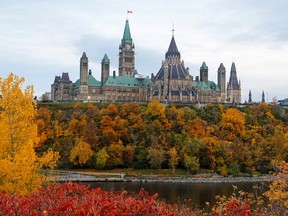


Parliament Hill is seen in Ottawa on Oct. 22, 2019, the morning after the federal election.

National institutions and dominant elites can fail when they don’t accommodate change, or become severely detached from the lives of average citizens. In Canada, this has been the rule rather than the exception for the past 50 years, and the Laurentian Elite is largely to blame.

But what is, and who are, the Laurentian Elite? How can they be so important if they don’t even have a Wikipedia page? Our self-declared, dominant Canadian social and political elite is like the air we breathe or the proverbial water around fish; it seems so natural as to be unnoticeable.

Journalist and author John Ibbitson coined the term in a seminal 2011 article, later expanded into a book, The Big Shift. He defined the “Laurentians” as “the political, academic, cultural, media and business elites” of central Canada. Ibbitson and co-author Darrell Bricker argued that the 2011 federal Conservative majority, achieved via the alignment of Western Canada and ex-urban Ontario, represented a major rearrangement of our electoral landscape. Subsequent events however, suggest that, if a shift is happening, it may be long and painful.

If a shift is happening, it may be long and painful

Ibbitson cites and credits the historical accomplishments of central Canada’s elites, from the National Policy and the St. Lawrence Seaway to what he terms the “national social security system.” He is unduly kind.

Beginning in 1968, coincident with the election of Pierre Trudeau, our elites adopted contemporary left-leaning economic and social policies. Federal government spending mushroomed from 16 per cent of the economy in 1967 to 25 per cent (of a much larger pie) in 1984 when Trudeau Sr. departed — a vast increase in dollar terms. Simultaneously, the Canadian public sector became almost 50 per cent of the economy, with the programs implemented and institutions created almost too numerous to mention. This is the point: a robust civil society and private-sector economy were being supplanted by an expanding state.

The reckoning came in the 1990s. Canada’s debt to GDP ratio approached 72 per cent and, in 1995, the Wall Street Journal called us “an honorary Third-World country.” After two credit rating downgrades, and prodded by the decidedly non-Laurentian Reform party, the Liberals acted. Laurentian patriarchs Paul Martin and Jean Chrétien are credited with righting Canada’s finances, but who cast us into the pit in the first place?
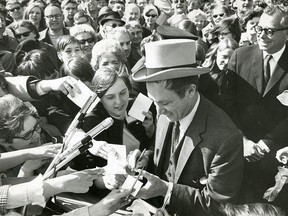


Pierre Trudeau signs autographs in Edmonton on May 12, 1968. Photo by Stan Fruet/Postmedia NewsFor decades, the Laurentian Elite grappled with an existential crisis: Quebec separatism. Confederation was, in their view, a compact between “two founding peoples” that would be blown apart if Quebec left. Shockingly, Laurentian Canada’s brokerage parties had no visceral understanding of the true-believing separatists, who viewed each federalist concession as incremental independence. So we had our near-death experience in 1995, allegedly saved only by “money and the ethnic vote,” to quote PQ leader Jacques Parizeau.

Overconfident federalist leaders — Laurentians all — fairly sleepwalked through the campaign, until they realized at the 11th hour that Quebeckers might actually vote to leave. A shaken Chrétien gave a pleading address five days before the vote and, interviewed years later, senior Liberal cabinet ministers still resembled deer in the headlights in contemplating the “unthinkable.” Of course Parizeau’s people had a detailed implementation plan ready to launch upon a favourable result.

Using the twin yardsticks of fiscal management and national unity, the Laurentian Elite’s tenure over the past 50 years has ranged from poor to passable. As the Laurentians presided, their worldview — Ibbitson’s “Laurentian Consensus” — ruled. Lack of competition from a rival elite or elites (excepting of course the separatists, and we saw how that turned out) increased their torpor and complacency. This, coupled with an increasingly arrogant detachment from many ordinary Canadians, particularly those outside central Canada, caused repeated social and political rifts.

The Laurentian Elite’s tenure over the past 50 years has ranged from poor to passable

Historically, the Laurentian Elite were Upper Canadian Anglo-Protestants and Québécois Patricians, and their descendants still dominate the upper strata of politics, the bureaucracy, Crown corporations and agencies, academia and media. Private-sector membership tends toward legacy industries (particularly banking/finance and manufacturing), often dominated by multi-generational families. The media, particularly the CBC, project the “consensus” across the country. As Diane Francis has observed, the elite’s members have remarkable mobility among the upper levels of Canada’s government, business and the bureaucracy.

Today’s Laurentian Elite is also arguably our franchise of the mobile, transnational professional class — the “Anywheres” as discussed in Stephen Harper’s 2018 book, Right Here, Right Now. They are, according to Harper, urban and university-educated professionals who “have become genuinely globally-oriented in their careers and personal lives.”

As “Anywheres,” the Laurentians largely reflect the universal, broadly-leftist monoculture. Their personal ethos is typically secular and socially “progressive.” Today this includes much of the post-modern canon: intersectionality, quantifying “privilege” and the seemingly incessant signalling of virtue. Economically they range from socialist to corporatist, businessmen who actively seek advantage from deals with government, while typically promoting the social-progressive agenda.
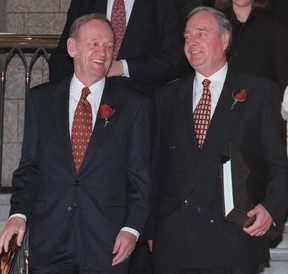


Then prime minister Jean Chretien, left, and finance minister Paul Martin arrive at the House of Commons for the1999 budget speech. Photo by Postmedia NewsAdopting globalism may actually have diluted the “Laurentian” nature of the class and boosted their disdain for national character. This may explain Justin Trudeau’s comments in The New York Times: “there is no core identity, no mainstream in Canada”; perhaps a riff on Paul Martin’s “country of minorities” or Yann Martel’s Canada as “the greatest hotel on Earth.”

Ironically the Laurentians consider themselves worldly, sophisticated and cosmopolitan, but are often remarkably parochial. The view from Toronto’s CN Tower seems to be our own version of Saul Steinberg’s classic cartoon — the world seen from 9th Avenue in Manhattan. One imagines reasonable clarity up to roughly Weber’s hamburger stand (near Orillia, Ont.) beyond which come fuzzy images of moose, muskeg, wheat, mountains and then the Pacific.

While 200 years ago, the periphery could be treated as a frontier to be managed, such an attitude today is fatal. The West now comprises almost a third of Canada’s population, compared with less than 23 per cent for Quebec, and the former is by far our most demographically dynamic region. Annual West-East fiscal transfers have run for decades and now total hundreds of billions of dollars. While Toronto finance is still formidable, and central Canada has more jobs in that sector (about 66 per cent) than its share of the population, corporate clout has shifted West, if slowed by the oil crash of 2014.

The West now comprises almost a third of Canada’s population

The Laurentian response to shifting population and money has been restrictive, envious and resentful, with ignorance and neglect replaced by targeted aggression. Under a cloak of green, the federal Liberals have written one generally supportive rulebook for economic development in the East, and a decidedly unfriendly one — including the West-Coast oil tanker ban and Bill C-69, the “no more pipelines” bill — for the West.

The burning question is whether the Laurentian Elite is confusing short-term tactical gain with strategic accomplishment. Is it really to the elite’s fundamental and long-term benefit to beggar the region that supplies the lion’s share of financial lubricant that powers the nation? The past several years show that, despite its electoral success, the Laurentian Elite simply does not possess the “life experience” to manage current regional tensions and basic national affairs.

Simply put, Westerners don’t need another round of condescension and contempt from the Laurentian Elite, nor its approval or affirmation. And what precisely do they think the West’s skilled workers and highly-educated professionals need to be educated about?

Westerners don’t need another round of condescension and contempt from the Laurentian Elite

Rather than comparing Quebec and Western separatism, perhaps the West is actually undergoing its own Quiet Revolution. Sixty-plus years ago, prominent Quebeckers like Gérard Pelletier, Pierre Trudeau and René Lévesque met regularly to debate their province’s future. Some became federalists, others separatists.

Right now, Westerners from all walks of life are grappling with their region’s future. The Laurentian Elite probably doesn’t know it, but their future and that of the West is at stake.

John Weissenberger is a Calgary-based geologist and a Montreal native with degrees from Ontario, Quebec and Alberta universities. An extended version of this article can be read at c2cjournal.ca.


To: gg cox who wrote (211468)2/22/2025 3:42:47 PM
From: Maple MAGA 2 Recommendations

Recommended By
longz
Mick Mørmøny

  Read Replies (1) | Respond to of 219872

