SI
SI
discoversearch

We've detected that you're using an ad content blocking browser plug-in or feature. Ads provide a critical source of revenue to the continued operation of Silicon Investor.  We ask that you disable ad blocking while on Silicon Investor in the best interests of our community.  If you are not using an ad blocker but are still receiving this message, make sure your browser's tracking protection is set to the 'standard' level.
Strategies & Market Trends : 2026 TeoTwawKi ... 2032 Darkest Interregnum -- Ignore unavailable to you. Want to Upgrade?


To: Box-By-The-Riviera™ who wrote (213091)4/9/2025 12:33:47 AM
From: Broken_Clock  Read Replies (1) | Respond to of 218152
 
Rectal Carnage


To: Box-By-The-Riviera™ who wrote (213091)4/9/2025 12:44:11 AM
From: TobagoJack  Read Replies (1) | Respond to of 218152
 
re <<meanwhile my time, off to bed LOL. I actually will sleep well.>>

nap first, you and I both, and I promised my spouse as well as friends and family to formulate a 10 + 10 stock portfolio good for at least the coming 5 years

in the meantime, now that we are done with "China 2025", Beijing teeing up "China 2035", through waypoint that is 2026 TeoTwawKi and going by the road marker that is 2032 Darkest Interregnum
Simmering trade tensions further complicate the picture. China’s industry policy drew the ire of Donald Trump during his first term, inflaming tensions that led to the first US-China trade war. Washington has since tried to curb China’s advancement in key technologies like semiconductors with export controls, sanctions and tariffs.

bloomberg.com

China Adviser Urges Boosting Consumption to 70% of GDP by 2035


Buildings in Pudong's Lujiazui Financial District in Shanghai.Photographer: Raul Ariano/Bloomberg

By Bloomberg News

25 March 2025 at 18:27 GMT+8
Updated on
26 March 2025 at 10:19 GMT+8

China should raise consumption to a level close to those of developed countries in the next decade, a government adviser said, adding to calls to rebalance the world’s second-largest economy away from investment and export.

Peng Sen, president of the China Society of Economic Reform, said Tuesday authorities should make efforts to boost consumption as a share of gross domestic product to 70% by 2035 from about 55% currently. Peng’s think tank is affiliated with the National Reform and Development Commission, China’s economic planner.

“Our fiscal system used to focus on investing heavily in projects, but now we need to shift to investing in people,” Peng, former vice chairman of the NDRC, said at the Boao Forum for Asia. “China needs to narrow that international gap,” he said, citing consumption levels as high as 80% of GDP in wealthier nations.

China's GDP Composition Skews Heavily Toward Investment
Private consumption commands less than half of the economy
Source: National Bureau of Statistics, Bloomberg

Note: "Social transfer in kind" refers to goods and services provided by the government to households at no cost, such as healthcare and education.

Peng’s remarks add urgency to calls for China to adjust its growth model as geopolitical tensions threaten to slow exports and returns on investment diminish. The Chinese government has made boosting domestic demand, particularly consumption, the top economic priority this year, although authorities didn’t put a number to that goal.

China’s economy expanded rapidly over the past four decades by increasing manufacturing and production, but that has had a side effect of repressing consumption, Peng said. To continue to grow, he said, consumption should increase by 5 to 8 percentage points as a share of GDP in the next five years, with the first step being boosting income and distributing more wealth to consumers.

It’s important to set such a target in China’s next five-year plan for economic development between 2026 and 2030, according to Peng, who is part of an expert committee advising the government’s drafting of the blueprint.

Chinese Consumption Is Still Relatively Weak
Household spending as a share of economy is lower than most OECD countries

Source: Organization for Economic Cooperation and Development, China's National Bureau of Statistics

Note: Figures are for 2022. Social transfers in kind refers to goods and services provided by the government at little cost, such as healthcare.

Made in China 2025

This proposed shift contrasts with the investment-heavy model that underpinned initiatives like “ Made in China 2025,” whose progress was also discussed at the event known as China’s Davos.

China has mostly accomplished that policy’s goal of turning the country into a technology leader since it was unveiled a decade ago, according to former Chongqing mayor Huang Qifan. Some 96% of the targets listed in the project have been met as of 2024, he said at the panel with Peng.

“If we continue to patch up the missing parts this year, I believe we will fully complete the goal of Made in China by the end of this year,” said Huang, academic adviser at the think tank China Finance 40 Forum.

A pivot toward consumption would likely require substantial policy efforts. The State Council, China’s cabinet, earlier this month published a report outlining plans to improve childcare and better enforce the country’s paid leave system.

Economists have long advocated for a stronger social safety net to reduce households’ need for precautionary savings, although government spending on public services has been limited by rising debt burden and declined income from land sales.

Simmering trade tensions further complicate the picture. China’s industry policy drew the ire of Donald Trump during his first term, inflaming tensions that led to the first US-China trade war. Washington has since tried to curb China’s advancement in key technologies like semiconductors with export controls, sanctions and tariffs.

Even though the government has downplayed the program in recent years to avoid further strains, China has kept investing in advanced manufacturing as policymakers seek new growth drivers following a property market crash. That led to explosive growth in sectors such as solar panels, batteries and electric vehicles.

Research by Bloomberg Economics and Bloomberg Intelligence last year showed that “Made in China 2025” has largely succeeded. Of 13 key technologies tracked, China has achieved a global leadership position in five of them and is catching up fast in seven others, according to the study.


To: Box-By-The-Riviera™ who wrote (213091)4/9/2025 4:40:50 AM
From: TobagoJack  Respond to of 218152
 
re <<10 year at 4.49 in the over nite so far.>>
... very interesting

bloomberg.com

Treasuries ‘Fire Sale’ Sends Long-Term Yields Soaring Worldwide

By Tian Chen and Ruth Carson

9 April 2025 at 13:24 GMT+8
Updated on
9 April 2025 at 14:57 GMT+8

  • A fire sale in US Treasuries accelerated on Wednesday, with yields surging to levels not seen since November 2023, amid concerns over Donald Trump's trade war and potential stagflation.

    Summary by Bloomberg AI

  • The bond slump spread to other developed markets, with benchmark yields in Australia, New Zealand, and Japan spiking, and European bond futures slipping, as investors turned to cash-like securities and haven currencies.

    Summary by Bloomberg AI

  • The yield surge was attributed to various factors, including dislocations in a popular hedge fund trade, speculation of foreign selling of US debt, and investors seeking safer assets amid rising volatility and trade war concerns.

    Summary by Bloomberg AI
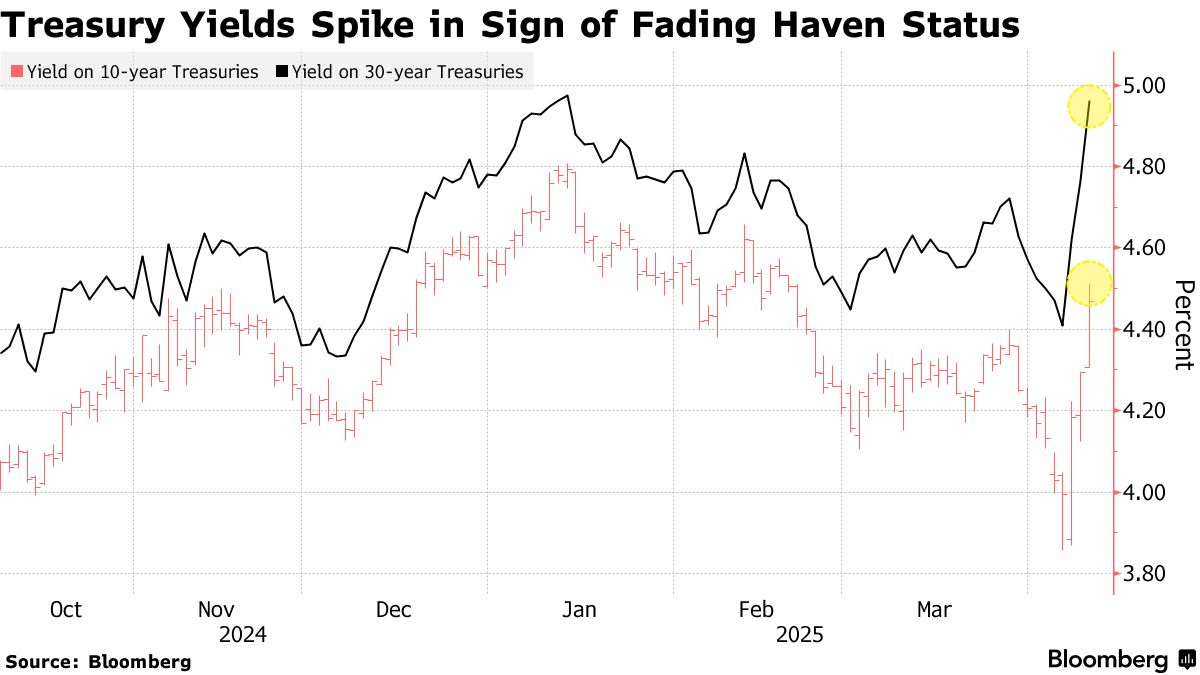
A vicious sell-off in what are supposed to be the world’s safest assets has investors grasping for reasons behind the steep declines in Treasuries which accelerated Wednesday.

US government bonds — traditionally counted as the primary haven in times of turmoil — looked to be losing this status amid concerns Donald Trump’s war on global trade will trigger stagflation that may prevent interest-rate cuts from the Federal Reserve.

But there were other reasons cited for why investors were turning their back on US sovereign debt. Dislocations in a popular hedge fund trade, speculation of foreign selling of US debt and investors just ditching whatever they could in favor of cash-like shorter-dated securities as risk-assets swooned were also cited as reasons behind the bond declines.

The magnitude of this week’s yield surge was reminiscent of one almost three years ago, when it became clearer to traders that a decades-long bond bull market was ending. It matched levels last seen during the market turmoil at the height of fears about the pandemic.

“This is a fire sale of Treasuries,” said Calvin Yeoh, portfolio manager at hedge fund Blue Edge Advisors Pte. who is selling 20 to 30-year Treasuries futures. “I haven’t seen moves or volatility of this size since the chaos of the pandemic in 2020.”
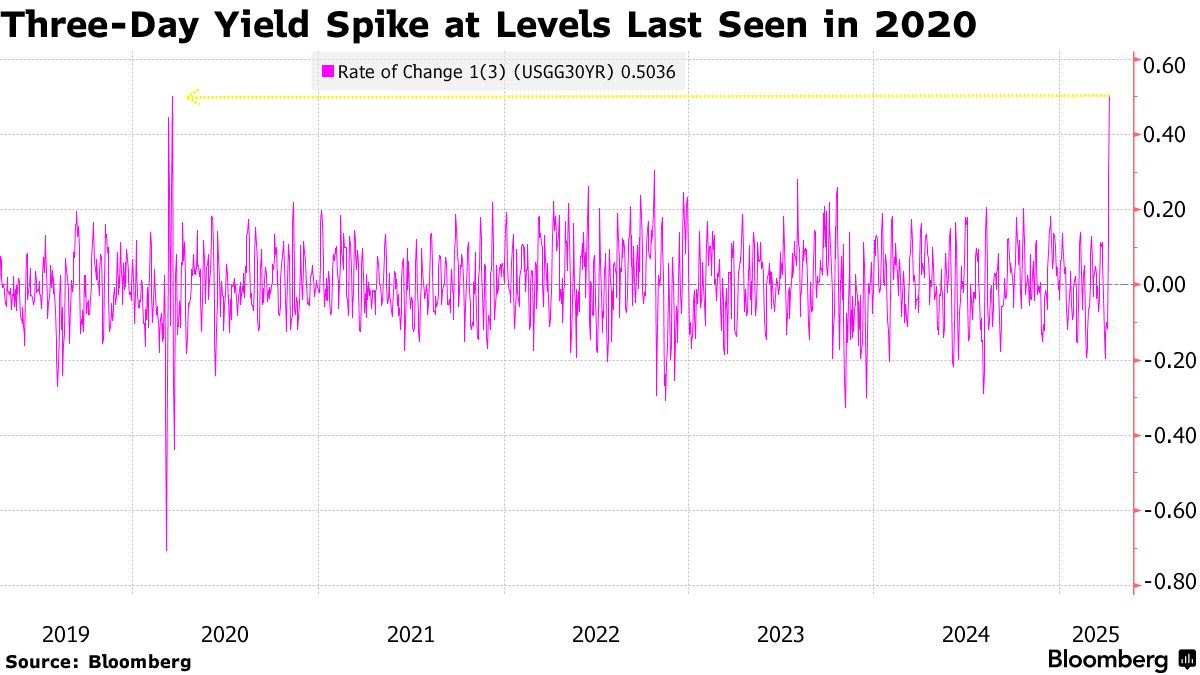

The yield on 30-year Treasuries surged as much as 25 basis points to a level unseen since November 2023, bringing the three day rise in yields at one point to the largest since 2020, according to data compiled by Bloomberg.

That US bond slump spilled over into government debt in many developed markets worldwide, with benchmark yields in Australia, New Zealand and Japan spiking and European bond futures slipping.

As the global bond benchmark, moves in Treasury yields often drive those in other markets. However, the spreading trend of curve-steepening, where longer-dated yields pull away from their shorter peers can also point to expectations of slower economic growth and faster inflation.

In other markets, US and European equity futures slid, haven currencies like the yen and Swiss franc jumped and crude oil retreated.

Trade War

Wednesday marked yet another milestone in the trade war, as President Donald Trump went ahead with his so-called reciprocal tariffs, raising the risk of a shock to the world economy. He is imposing levies on China as high as 104% along with import taxes on roughly 60 trading partners that run trade surpluses with the US.

Higher yields were often cited as a potential side-effect of US tariffs, although other wagers linked to so-called Trump Trades have come unstuck.

Some investors speculated that global reserve managers, for example China, could be re-evaluating their positions in US government debt given the seismic impact of Trump’s trade policies. Such a move would send a strong signal that Treasuries are no longer the haven of old, but such trading is rarely telegraphed in real time.

Both China and Japan have been reducing their Treasuries holdings for some time, at least according to official data.

“China may be selling them in retaliation for tariffs,” said Kenichiro Kitamura, general manager of Meiji Yasuda’s investment planning and research department in Tokyo. Treasuries “are moving due to political factors rather than supply and demand, so for the time being I will wait and see. It is difficult to get involved at the moment.”

Global Moves

Elsewhere, Japanese government bonds plunged, with the selloff concentrated in longer-dated debt, as elevated market volatility prompted investors to trim their exposure to fluctuating yields. Japan’s bond market has started to show some signs of dislocations with investors on the sidelines amid heightened uncertainty over the trade war and what it means for Bank of Japan policy.

And in an unusual move, another traditional US haven — the dollar — weakened, despite the rise in yields. That helped drive gains in other havens such as the yen and Swiss franc, which both strengthened more than 1%.

Still, other bond markets fared better — German bund futures edged higher Wednesday.

“The extremely hostile 100%+ tariffs on China may be causing great concern to reserve managers,” said Rajeev De Mello, global macro portfolio manager at Gama Asset Management. “European bonds are benefiting from this and the spread between the US and Germany has moved sharply over the past week.”

Not everyone thinks Treasuries have lost their haven appeal. Leah Traub, a money manager at Lord Abbett & Co. which oversees $217 billion in assets, remembers their negative correlation to stocks in March when markets were reacting to fears of a US growth slowdown.

“In the event of a US or global recession, we do still think investors will come back to Treasuries,” she said.

Basis Trade Blowup
Others are voicing concerns over the risks of a spike in Treasury yields of such a magnitude. The selloff was reminiscent of when a highly leveraged hedge-fund wager called the basis trade, which exploits gaps between cash Treasury prices and futures, was unwound in 2020. That caused the world’s largest debt market to seize up then.

The rise in longer-dated yields came alongside smaller gains in their shorter-term peers after a disappointing auction of three-year notes on Tuesday. That’s a sign traders are moving funds into cash-like positions.

A gauge of Treasuries’ implied volatility has soared to its most extreme level since October 2023. Currency fluctuations are the highest in two years, and the VIX index of equity volatility reached an eight-month high.

“There is a temporary ‘buyer’s strike’ in the US bond market,” said Homin Lee, a senior macro strategist at Lombard Odier Ltd. in Singapore. “If the situation becomes more worrisome the US Fed will have some tools it can utilize for market stability.”


To: Box-By-The-Riviera™ who wrote (213091)4/9/2025 5:32:43 AM
From: TobagoJack  Read Replies (1) | Respond to of 218152
 
re <<over nite>>

China-China-China holding fire, to see what, if anything happens, to then decide what, if anything to do as counter

In the meantime Team Trump bum-rushed into a tariff cul de sac of 100+% tariff regime

Given so, ambush ahead for global financial markets, and for Team US treasury refinancing

Let's see if Team USA needs to refund corporate taxes to limit damage, and should such be so, what be second-order consequences

The state of gaming is getting more nuanced, and cerebral

bloomberg.com

China Holds Fire on Immediate Retaliation Against New US Tariffs

By Bloomberg News

9 April 2025 at 13:03 GMT+8
Updated on
9 April 2025 at 15:56 GMT+8

  • China has not immediately responded to the new US tariffs, unlike in the last two episodes when Beijing retaliated within minutes.

    Summary by Bloomberg AI

  • Instead, China released a white paper on trade with the US and a question-and-answer document, reiterating its willingness to talk with the US, but also warning that it has the will and means to "fight until the end".

    Summary by Bloomberg AI

  • Beijing could still issue its response later, and has a range of options to hit back at the US, including banning US companies from purchasing Chinese-produced rare earths, weakening the currency, or selling off its holdings of US Treasuries.

    Summary by Bloomberg AI

China hasn’t immediately responded to the new US tariffs, a departure from the last two episodes when President Donald Trump hiked duties and Beijing hit back within minutes.

Nearly four hours after Trump’s so-called reciprocal tariffs went into effect on Wednesday, China hadn’t announced any retaliatory action. That’s in contrast with February and March, when China countered just minutes after earlier rounds of US tariffs began.

Instead, at around 3 p.m. local time, Beijing released a 28,000-character white paper on trade with the US. Accompanying it was a question-and-answer document in which the Ministry of Commerce reiterated China is willing to talk with the US.

In a less conciliatory note, it added China had the will and the means to “fight until the end,” warning the US will “reap what it sows.”

Until now, China and the US have been embroiled in a tit-for-tat cycle of tariffs since soon after Trump returned to the White House in January. The US president has yet to speak with his Chinese counterpart, President Xi Jinping, more than two months after his inauguration.

The apparent delay in response offered some respite to markets that suffered a selloff this week as the trade war escalated. The Hang Seng China Enterprises Index erased its losses after tumbling as much as 4.4% in early morning trading.

Beijing could still issue its response later. China’s top leaders plan to meet as early as Wednesday to discuss measures to support domestic consumption and capital markets after Trump’s tariffs, Reuters reported, citing people it didn’t identify.

China waited for more than a day before retaliating against last week’s tariff announcement by Trump, with the Chinese statement coming on a public holiday just after 6 p.m. local time on Friday.

Beyond tariffs, China has an increasingly large toolkit to hit back at the US.

Last week Beijing announced it would investigate a US firm and placed other US companies on its own “entity list,” which effectively bans them from buying from China. China also imposed licenses on exports of some rare earths, which will likely limit shipments in the short term and make it harder for US firms to buy them.

It could up that by banning US companies from purchasing Chinese-produced rare earths, as it did for some other critical minerals last year. China controls most of the production and processing of a whole host of critical minerals, and has shown over the past 15 years that it’s willing to use that power in disputes with other nations.

Two influential bloggers this week posted about other options, including banning imports of US poultry, curbing services imports and suspending cooperation on the fentanyl issue.

Beijing could also use other tools such as weakening the currency to make its exports cheaper, or sell off its holdings of US Treasuries, although both those actions would have serious negative consequences for China as well.

(Updates with details on China’s white paper on trade with the US starting in third paragraph.)

Up Next
China Vows ‘Fight to the End’ on Tariffs as It Props Up Markets


To: Box-By-The-Riviera™ who wrote (213091)4/9/2025 7:45:04 AM
From: TobagoJack  Respond to of 218152
 
Looking like 84% now and more later

Financial markets still at more risk, etc etc

