good timing. I'm thinking CNN read my post
China doing way better.. it all depends on increasing exports (excessive State- driven over production goals),
but China domestic: aging society (decreasing pop), weak elderly Social Programs, high unemployment, China covid protocol killed Chinese real- estate wealth.
How Trump’s tariffs forced China to pivot – and export more
edition.cnn.com
Analysis by
John Liu
Updated 6 hr ago

Cranes unload cargo shipping containers from the Evergreen Line Ever Mast container ship as seen from the Vincent Thomas bridge at the Port of Los Angeles in San Pedro, California, on April 15, 2025.
Patrick T. Fallon/AFP/Getty Images
Hong Kong —
Just a year ago, Chinese manufacturers, fearing a new trade war, rushed to push out exports following the election victory of US President Donald Trump, who had pledged to slap punishing tariffs on imports from China over America’s widening trade deficit.
A year later, Trump has delivered on his promise. But China has pivoted – and exported more.
In a striking display of resilience, the world’s second-largest economy notched a record trade surplus of $1 trillion in just the first 11 months of the year – a milestone no other nation has achieved.
The stunning outcome – underscoring that the American market is not entirely irreplaceable – has bolstered Chinese leader Xi Jinping’s confidence in taking a hardball approach with Trump throughout this year’s protracted trade war. While the two countries have dialed back tensions and returned to a fragile trade truce after Trump and Xi’s meeting in October, a final agreement remains nowhere in sight.
The key to China’s export success under Trump’s tariff pressure is straightforward — and not entirely driven from the top. Chinese exporters have doubled down on a strategy they began deploying during Trump’s first term: diversifying away from the United States, rerouting shipments, and leaning aggressively into markets hungry for cheaper goods.

People ride scooters past the Yantian port in Shenzhen, Guangdong province, China, on October 30, 2025.
Tingshu Wang/Reuters
In the first 11 months of the year, China’s exports surged 5.7% from a year earlier, according to customs data. Growth in exports to Europe, Southeast Asia and Africa – up 8.9%, 14.6% and 27.2% respectively – more than offset an 18.3% plunge in shipments to the US in the same period, customs data showed.
Still, China’s soaring trade surplus cannot obscure its underlying economic troubles. Its glaring export performance partly reflects deeper structural challenges — including lethargic domestic demand and weak consumer confidence.
China’s manufacturing prowess has cemented its position as the world’s factory, laying the foundation for its agile export pivot. But years of heavy investment in the manufacturing sector have also produced significant overcapacity in several sectors, pushing industries to chase overseas markets for growth while exacerbating price competition at home.
How it happened
Exports have long been a critical pillar of China’s economic growth.
Under Xi’s Made in China 2025 industrial strategy unveiled a decade ago, Beijing has pumped billions into strategic sectors with the aim of dominating high-tech supply chains on top of traditional industries.
The results of that ambition – advances in China’s already formidable manufacturing capabilities, coupled with a pandemic-driven demand boom – pushed up China’s exports by nearly 45% over the past five years, according to Nomura, a financial services firm.
Other manufacturing economies have struggled to keep pace with China’s high-volume, low-price output, and in recent years, some developing countries’ reliance on Chinese products and components has only deepened.

Employees work at the production line at an intelligent packaging workshop of Mengniu Dairy, in Suqian, Jiangsu Province of China, on December 2, 2025.
Wang Li/VCG/Getty Images
In a commentary published Monday by state-run media, Wang Jun, deputy head of the General Administration of Customs, credited China’s trade success to the country’s comprehensive industrial supply chain, momentum generated by higher-tech sectors, and the determination of exporters who press ahead despite challenges.
Hu Xijin, a former editor-in-chief of the state-run tabloid Global Times and prominent nationalist commentator, put it more bluntly.
“The competitiveness of Chinese products cannot be wiped out by trade protectionism. Their quality and low prices offer an irresistible appeal, and market forces determine that China’s supply chain is unmatched in today’s world,” he wrote on social media Monday.
Mounting concerns
But economists have pointed out that part of China’s export growth to other regions may simply reflect transshipments – goods routed through countries such as those in Southeast Asia where they undergo additional processing and assembly before being re-exported to the US.
The actual volume of these transshipments remains challenging for government officials and economists to quantify, complicating US tariffs enforcement, even though Trump has imposed additional levies on re-routed goods and struck deals on transshipment tariffs with countries like Vietnam.
Economists have also questioned whether such rapid export growth is sustainable. Many expect China’s exports to remain resilient next year, though the pace of expansion is likely to moderate from this year’s level.

Employees of Gstar Electronic Appliance Co., Ltd work to assemble air fryers in the factory in Ningbo, Zhejiang province, China, on May 19, 2025.
Go Nakamura/Reuters
Zichun Huang, China economist at Capital Economics, said in a Monday research note that she expected the country’s trade surplus to widen further next year, as trade rerouting buoys exports while imports are expected to decline amid weak domestic demand.
But further protectionist policies loom on the horizon. Even before this year, governments from the European Union to India and Brazil had raised concerns about Chinese “dumping” of goods into their markets. The expanded exports this year are likely to intensify such worries.
The EU has already imposed tariffs and other anti-dumping measures on Chinese electric vehicles and other exports.
During a visit to China last week, French President Emmanuel Macron highlighted the “unbearable” trade imbalances between European countries and China, warning in an interview with a French newspaper later that further tariffs could be imposed.
Weaknesses at home
Behind the impressive growth in exports, economic challenges linger within China.
The property sector, once another major growth pillar, remains in slowdown, now entering its fifth year. For many Chinese who have plowed their savings into real estate, the market’s collapse handicapped their ability to spend, driving down overall demand.
Still-high youth unemployment as well as weak social security systems further weigh on consumption. That is why for the first 11 months of the year, imports, a gauge of domestic demand, have risen only 0.2% compared with a year ago.
Adding to the mix of problems, deflation has clouded the economy for much of the year, driven by overcapacity and cutthroat price wars, particularly in sectors such as electric vehicles, e-commerce and construction materials. The race to the bottom has been so ferocious this year that Beijing stepped in to rein in manufacturers, though economists believe deflationary pressures are unlikely to ease soon.
Amid these challenges, exports have become an economic lifeline, one of the few reliable sources of growth at a time when Beijing remains reluctant to unleash a major stimulus program.
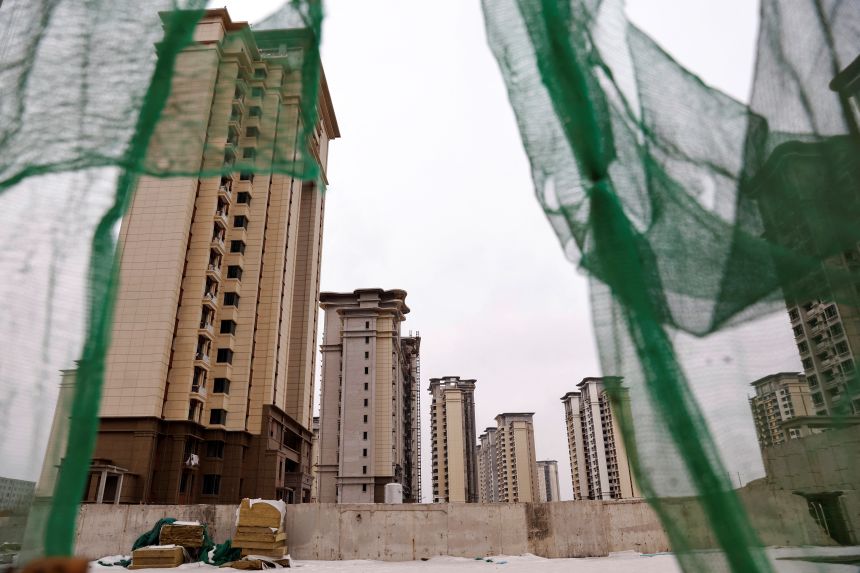
A view of unfinished residential buildings developed by China Evergrande Group in the outskirts of Shijiazhuang, Hebei province, China, on February 1, 2024.
Tingshu Wang/Reuters
All eyes will be on the Central Economic Work Conference (CEWC), a key annual meeting expected later this week that will set the economic agenda for the year ahead.
Economists and businesses will be particularly attentive to any signals regarding the country’s next five-year economic blueprint, which will guide China’s development strategy and priorities for the next half-decade. Full details of the plan will not be released until March next year.
At a Communist Party conclave in October, the officials emphasized increasing China’s “economic strength, scientific and technological capabilities, national defense strength” in a bid to accelerate development in “manufacturing, product quality, aerospace, transportation, and cyberspace.”
On Monday, Xi chaired a meeting in preparation for the CEWC, reiterating similar priorities as the October conclave. The meeting concluded that the “main goal of economic development will be achieved,” signaling that the 5% annual growth target is expected to be met this year.
“Over the past five years, we have effectively responded to a range of shocks and challenges,” the readout said. Looking ahead, “we will better coordinate domestic economic work with international economic and trade struggles, better balance development and security, implement more proactive and effective macroeconomic policies… and continue to expand domestic demand.”
Lisheng Wang, a China economist at investment bank Goldman Sachs, said the readout suggested Beijing is in no rush to roll out broad stimulus measures. It “appears somewhat disappointing, as evidenced by lowered growth concerns and no direct mention of consumption and the property sector, though we await the CEWC in coming days for more details,” he wrote in a Monday research note.
CNN’s Joyce Jiang contributed reporting. |



