If Canada truly stands in 'solidarity' with Iranians, concrete action must be taken
Opinion by: Avideh Motmaen-Far:
cial to National
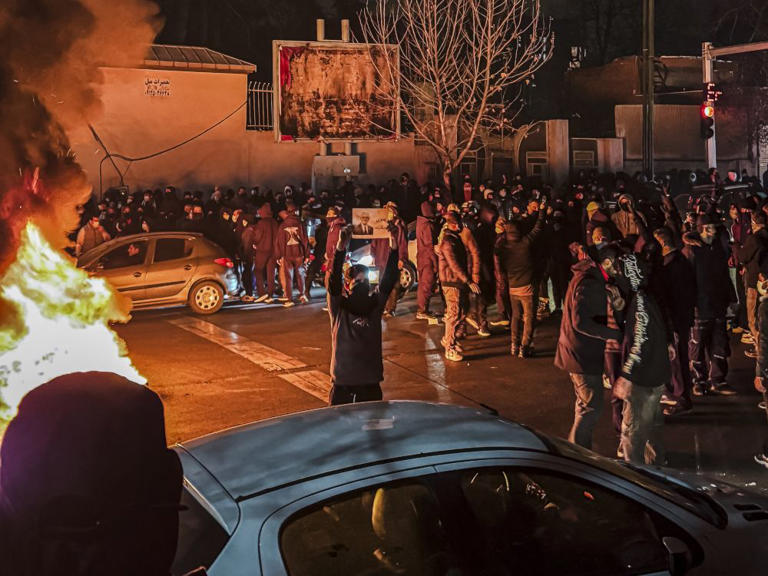
Iranians gather while blocking a street during a protest in Tehran on Jan. 9.
An eyewitness who escaped Iran told the British-based news outlet Iran International that the situation in the country is so dire, “every person is reporting the death of a family member, relative, neighbour or friend.” This is not an exaggeration.
When Bardia, an Iranian student based in Berlin, returned home to visit family in Rasht, a city in northern Iran, last month, he could never have anticipated witnessing a massacre. On the night of Jan. 8, he watched as commandos opened fire on unarmed protesters.
“They shot only at heads and hearts,” he told Iran International, from the safety of Germany. “Street cleaners were brought in the early hours to erase all traces. They swept the streets, collected shell casings and washed the blood away with fire trucks.”
In Tehran, morgues are overflowing. Families wander among rows of bodies wrapped in black bags, searching for their loved ones in the state-imposed digital darkness that prevents them from even making a phone call. The only voices the outside world hears are from videos smuggled out via Starlink. In one of them, a woman can be heard crying out: “Get up my love, get up for God’s sake.”
This is all happening as Canada issues statements about standing “in solidarity with the Iranian people.” But what does “solidarity” mean when the Islamic Republic is shooting civilians, burning protesters alive and executing dissenters?
The current uprising, which began on Dec. 28, has become the bloodiest crackdown in the Islamic Republic’s 47-year history. Some reports suggest the death toll may be as high as 30,000.
The scale of carnage defies comprehension. In Tehran, eyewitness accounts describe how the regime deployed military-grade weapons against civilians. When protesters set fire to a mosque to free detained friends, security forces blocked access routes and prevented fire engines from reaching the area — deliberately allowing the blaze to spread through 300 shops in the historic bazaar, destroying the livelihoods of the merchants who had joined the strike.
In the northwest city of Qazvin, a witness reported more than 1,000 people killed over three nights. The floors of some medical centre were covered in blood, he said.
In Karaj, security forces reportedly fired directly at protesters, shot the wounded and blocked others from reaching hospitals. In Gorgan, an eyewitness said that security forces fired from hospital rooftops, deliberately killing a 15-year-old girl.
Tehran’s Friday prayer leader, Ahmad Khatami, has called for the execution of all detained protesters, labelling them “servants of Netanyahu” and “soldiers of Trump.”
And yet, amid this horror, the Iranian people continue to resist. On Jan. 8 alone, at least 1.5 million people took to the streets of Tehran, according to European intelligence shared with Iran International. Despite the massacres, despite the complete internet blackout now entering its third week, Iranians continue to organize, to chant from their windows and refuse to submit.
Crown Prince Reza Pahlavi, who has emerged as a unifying figure for the democratic movement, has called for continued resistance through nightly chants and nationwide strikes. “The blood of the best and bravest children of our homeland does not allow us to remain silent or retreat,” he wrote on Twitter.
To its credit, Canada has not been entirely passive. The government has taken meaningful steps over the years that deserve recognition.
In 2024, Canada formally listed the Islamic Revolutionary Guard Corps (IRGC) as a terrorist entity — a major policy shift that allows for asset freezes and criminal prosecution of anyone providing financial or material support to the group.
Ottawa has imposed 18 rounds of sanctions against Iran since 2022, targeting over 215 Iranian individuals and 256 entities. In December, Foreign Affairs Minister Anita Anand announced sanctions against four additional senior Iranian officials, including those directly responsible for repressive policies and human rights violations.
Canada made it illegal for senior IRGC members who have served since June 2003 to be admitted to the country, to ensure we do not become a haven for regime members.
Our government has pushed back against the Iranian regime at the United Nations, championing the General Assembly resolution on human rights in Iran for 23 consecutive years and helping remove Iran from the UN Commission on the Status of Women.
On Jan. 14, Canada joined its G7 partners in expressing grave concern over the “brutal repression of the Iranian people,” condemning the deliberate use of violence, arbitrary detention and intimidation by security forces.
These are not empty gestures, but nor are they enough. Canada’s response, while well-intentioned, relies almost entirely on what international relations scholars call “soft power” — diplomatic statements, legal measures, sanctions and multilateral co-ordination.
These tools have a place, but they operate on timescales measured in years and decades. The Iranian people do not have years, or months. They have days, perhaps hours.
As retired United States army general and former CIA director David Petraeus observed recently: “This regime is dying. Essentially it’s fighting, it’s killing again, but it is also dying.… This regime has lost legitimacy. The problem is it hasn’t lost the capability to kill.”
The sanctions Canada has imposed, while significant, came too late to prevent the IRGC from establishing deep roots in this country. The terrorist designation, while historic, cannot undo years of infiltration. The diplomatic statements, while morally correct, do not stop bullets.
There is a fundamental asymmetry: Canada responds with words, while the Islamic Republic responds with military-grade weapons turned on its own people.
Many Canadians, and much of the Canadian media, have little awareness of what is taking place in Iran due to the government’s complete digital blackout, which treats its citizens’ ability to communicate with the outside world as an existential threat. According to digital rights monitors, the regime is likely implementing a permanent censorship system , moving toward total information control.
Meanwhile, according to the U.S. Treasury Secretary Scott Bessent, regime elites are moving billions of dollars out of the country in anticipation of its collapse. They are preparing their escape routes — many of which lead to western nations, including Canada.
The truth is that unarmed, or barely armed, opposition forces rarely succeed in overcoming well-armed forces by themselves. Revolutions succeed when those armed forces stop suppressing the opposition — through refusal to follow orders, internal splits or defections to the opposing side — or when there is outside support.
In this regard, there are a number of concrete actions that countries like Canada can take.
1. Provide Starlink technology and communications support: The regime’s digital blackout is designed to prevent Iranians from organizing, from documenting atrocities and from communicating with the outside world.
Canada should work with allies and private-sector partners to expand Starlink and alternative communications access for Iranians; fund and support technologies that help Iranians circumvent the regime’s internet controls; and help facilitate communications between Iranian-Canadians and their family members inside Iran.
2. Support surgical international action: Prince Reza Pahlavi has called for “surgical strikes” against IRGC infrastructure — not the Iranian people, but the instruments of their oppression.
While Canada may not conduct such operations itself, it can co-ordinate with its allies (particularly the United States and Israel) on targeted actions that degrade IRGC capacities without harming civilians; provide support for operations targeting IRGC command and control infrastructure; and support efforts to degrade the regime’s ability to manufacture and deploy weapons against its own people.
3. Demand media accountability: The coverage of Iran in many Canadian media outlets, particularly the CBC, has been inconsistent, usually minimizing the scale of violence and burying stories beneath other news.
The government should support the standing committee on foreign affairs in examining how Canadian media covers Iran; and ensure that publicly funded broadcasters like the CBC provide proportionate coverage of what may be the most significant pro-democracy uprising in the Middle East in decades.
4. Protect Iranian-Canadian activists from regime intimidation: Iranian-Canadians who speak out against the regime face physical and mental harassment, surveillance and threats — not just from afar, but from agents operating on Canadian soil.
Canada must provide enhanced security support for prominent Iranian-Canadian activists; investigate and prosecute any regime-linked intimidation occurring in Canada; and establish a dedicated reporting mechanism for Iranians experiencing harassment.
5. Prepare for regime flight: If the Islamic Republic falls — and multiple intelligence assessments suggest this is increasingly possible — senior regime officials and IRGC commanders will attempt to flee to the West, seeking to evade prosecution.
Canada must prepare now by reviewing and strengthening screening procedures for all immigration applications involving Iranian nationals with any government or IRGC connection; establishing protocols for rapid co-ordination with foreign law-enforcement agencies; ensuring that immigration pathways cannot be exploited by fleeing regime members; compiling evidence for future accountability proceedings; and lending support to the democracy movement by pledging co-operation on extraditing offenders.
6. Prepare for the day after: A post-Islamic Republic Iran will need international support to build democratic institutions.
Canada should begin by engaging with legitimate Iranian opposition figures, including Pahlavi; preparing technical assistance packages for a transitional government; and positioning Canada to be an early investor in a free Iran’s reconstruction.
Canada has a moral obligation to do more than issue statements and impose sanctions that arrive too little, too late. The Iranian people are fighting not just for themselves, but for the values that Canada claims to represent, such as freedom, democracy and human dignity.
Iranian leaders believe their survival is dependent on terrorizing their own population into submission. They have adopted a policy encapsulated in the Arabic phrase “al-nasr bil-ru’b” — victory through terror. This is what standing “in solidarity” must confront.
Solidarity without action is sympathy. But sympathy does not stop bullets. If Canada truly wishes to stand with the Iranian people, we must move beyond words to deeds: supporting the Iranian people’s ability to communicate, organize and ultimately prevail; protecting Iranian-Canadians from regime intimidation; investigating IRGC activities on Canadian soil; and preparing for regime collapse.
The evolving situation in Iran presents a historic opportunity. For the first time in decades, the end of theocratic despotism appears genuinely possible. The question is whether Canada will be a passive observer in this transformation or an active partner in helping the Iranian people achieve the freedom they are dying for.
National Post
Avideh Motmaen-Far is the president of the Council of Iranian Canadians. |



