SI
SI
discoversearch

We've detected that you're using an ad content blocking browser plug-in or feature. Ads provide a critical source of revenue to the continued operation of Silicon Investor.  We ask that you disable ad blocking while on Silicon Investor in the best interests of our community.  If you are not using an ad blocker but are still receiving this message, make sure your browser's tracking protection is set to the 'standard' level.
Strategies & Market Trends : 2026 TeoTwawKi ... 2032 Darkest Interregnum -- Ignore unavailable to you. Want to Upgrade?


To: Julius Wong who wrote (219165)1/10/2026 5:27:13 AM
From: TobagoJack1 Recommendation

Recommended By
Secret_Agent_Man

  Respond to of 219660
 
OhWhoaWeeGeeWhizBangGeeWhiz

interestingengineering.com

World’s first 2D-silicon hybrid flash chip achieves record speed and 94% memory yield
Neetika Walter


Detailed architecture of a computer chip nestled on a circuit board. (Representational image) Getty Images
The race for faster, more efficient chips has reached a new milestone. Scientists at Shanghai’s Fudan University have unveiled the world’s first full-featured 2D flash chip, an engineering feat that could revolutionize how future electronic devices store and process information.

The chip merges ultrafast 2D flash memory with mature silicon-based complementary metal oxide semiconductor (CMOS) technology.

The result is a hybrid system that bridges research innovation and large-scale industrial application, pushing data technology toward a new high-speed frontier.

The breakthrough device supports eight-bit instruction operations and 32-bit high-speed parallel operations with random access, achieving a 94.3 percent memory cell yield.

Its operation speed surpasses existing flash memory technologies, marking the first successful engineering integration of 2D materials with silicon.

In an age dominated by artificial intelligence, where data access speed is everything, this advancement addresses one of computing’s most pressing bottlenecks.

The limited speed and high power consumption of traditional memory architectures have long slowed the growth of AI systems. Fudan’s innovation may just unlock a faster future.

Blending two worlds

In April, the same team made headlines after developing the PoX 2D flash memory prototype, which achieved an extraordinary program speed of 400 picoseconds, the fastest semiconductor charge storage ever recorded. But industrializing such breakthroughs often takes decades.

“It took about 24 years from the first prototype semiconductor transistor to the first CPU. However, by integrating emerging technologies into the existing CMOS platform, the process in our research is significantly compressed. We can further accelerate the exploration of disruptive applications in the future,” said Liu Chunsen, first and corresponding author of the paper.

The researchers from Fudan University’s State Key Laboratory of Integrated Chips and Systems and the College of Integrated Circuits and Micro-nano Electronics aimed to overcome this time lag by embedding 2D flash technology directly into CMOS platforms.

This strategic integration offers a roadmap for turning experimental devices into commercial systems.

Zhou Peng, another corresponding author, said storage devices will likely be the first type of 2D electronic systems to reach industrialization because they have “modest demands on material quality and manufacturing processes, coupled with performance metrics that far exceed current technologies.”

Atomic-scale integration

Traditional chips rely on silicon wafers that are hundreds of micrometers thick, while 2D semiconductor materials are just a few atoms in thickness, less than one nanometer. Integrating such fragile materials onto rough CMOS surfaces posed a major challenge.

“This is like looking at Shanghai from space. It seems flat, but within the city, there are buildings of varying heights — over 400 meters, 100 meters, or just a few dozen meters. If you lay a thin film over the city, the film itself would not be flat,” said Zhou, illustrating the delicate process of merging two vastly different material worlds.

To address this, the team used flexible 2D materials and a modular integration approach, fabricating 2D circuits on CMOS substrates and connecting them via high-density monolithic interconnections. This atomic-level bonding process allows stable and efficient communication between the two technologies.

The chip has completed its tape-out phase, and the researchers plan to establish a pilot production line in the coming years, scaling it to a megabyte-level system within three to five years.

Experts say the achievement could help overcome the growing storage bottleneck in AI systems, which are increasingly data-heavy.

“This research represents a ‘source technology’ in China’s integrated circuit field, allowing the country to take the lead in next-generation core storage technologies,” said Zhou.

As the world pushes toward faster, smaller, and more energy-efficient computing, Fudan University’s 2D-silicon hybrid chip could become the cornerstone of the next digital revolution.

The study is published in the journal Nature.


To: Julius Wong who wrote (219165)1/11/2026 4:46:36 PM
From: TobagoJack  Respond to of 219660
 
<<2032>> can happen early, like now. Dunno, watch & brief
In the meantime Russia apparently sanctions … Japan semiconductors (to be confirmed)
In coincidence with China full-spectrum sanction … meaning effectively everything
Only so few days into 2026


To: Julius Wong who wrote (219165)1/11/2026 5:36:08 PM
From: TobagoJack  Respond to of 219660
 
<<2032>> happening started. Starts with apology to … Serbia, and does something about Kosovo (both require confirm reveals)


To: Julius Wong who wrote (219165)1/11/2026 5:51:17 PM
From: TobagoJack  Respond to of 219660
 
<<2032>> mentioned


To: Julius Wong who wrote (219165)1/12/2026 6:48:40 AM
From: TobagoJack  Read Replies (1) | Respond to of 219660
 
Liang of DeepSeek did well 2025

Not counting physical gold outside of the account I beat him by 4 points :0)
Counting physical gold performance better still, probably by another 4 points.
Not counting paper silver at bank; if count gets silly.


bloomberg.com

DeepSeek Founder Liang’s Funds Surge 57% as China Quants Boom


Liang Wenfeng in 2019.Source: VCG/VCG

By Bloomberg News

January 12, 2026 at 4:28 PM GMT+8

Takeaways by Bloomberg AI
  • DeepSeek founder Liang Wenfeng’s quantitative hedge fund generated returns of more than 50% last year.
  • Zhejiang High-Flyer Asset Management posted an average return of 56.6% across its funds in 2025, according to data compiled by Shenzhen PaiPaiWang Investment & Management Co.
  • The fund’s strong performance could boost the cash available for DeepSeek, the AI start-up which Liang also owns a majority stake in.
DeepSeek founder Liang Wenfeng’s quantitative hedge fund generated returns of more than 50% last year, boosting the potential war chest for a company that has already shaken up the global tech landscape despite spending far less than rivals.

Zhejiang High-Flyer Asset Management, which oversees more than 70 billion yuan ($10 billion), posted an average return of 56.6% across its funds in 2025, according to data compiled by consultancy Shenzhen PaiPaiWang Investment & Management Co.

That made it the second-best performer among Chinese quant funds managing more than 10 billion yuan, according to PaiPaiWang. It was beaten only by Ningbo Lingjun Investment Management Partnership, which led the country’s top quants with a gain of more than 70%.

High-Flyer has become a cash cow for Liang, who still holds a majority of the asset manager and stopped taking outside money for the funds a few years ago. Its strong performance could boost the cash available for DeepSeek, the AI start-up which he also owns a majority stake in — and which was incubated by High-Flyer in 2023.

“Liang now certainly has more money to support a bigger team and buy more computing power and hardware for DeepSeek,” said Li Minghong, investment director at Shanghai-based E Tiger Private Fund Partners LLC. “When your first startup is doing well, you can better incubate a second one.”

The fund’s blistering run last year could have generated it revenues of more than $700 million, reckons Li, who assumed a 1% management fee and a performance fee of 20%. That is orders of magnitude higher than the reported budget of less than $6 million DeepSeek required to develop its market-shaking AI model, although some rivals have cast doubts on those cost claims.

DeepSeek’s research was funded by High-Flyer’s R&D budget, Liang said previously.

Two products managed by Xu Jin, a co-founder of High-Flyer, rose by an average 58.6%, according to PaiPaiWang. The eight products run by Chief Executive Officer Simon Lu averaged 56%. Lu also ranked No. 1 among top quants by risk-adjusted returns for stock strategies last year, with a Sharpe ratio of 2.8% as of Dec. 19.

Those funds, which all seek to beat the underlying stock indexes, are now High-Flyer’s main product line, after it made an exit from market-neutral offerings in 2024 to go “all-in” on long-only strategies.

Read More: Chinese Quant Whiz Built DeepSeek in the Shadow of a Fund Rout

The gains underscored a bumper year for China’s quant funds, whose 30.5% average return last year was more than double their global rivals’, according to PaiPaiWang and data provider With Intelligence.

Chinese quants’ long-only strategies averaged a 35% return last year, beating their discretionary rivals by more than 10 percentage points, according to PaiPaiWang. The number of quants managing more than 5 billion yuan jumped to 91 as of Nov. 30, up from 63 at the end of 2024.

PaiPaiWang’s rankings are based on products for which fund management firms share data. The pool shrank last year after regulators tightened disclosure rules.


To: Julius Wong who wrote (219165)1/14/2026 3:46:24 AM
From: TobagoJack  Respond to of 219660
 
Interesting … researching


To: Julius Wong who wrote (219165)1/16/2026 10:19:37 PM
From: TobagoJack  Respond to of 219660
 
virtual tourism


To: Julius Wong who wrote (219165)1/17/2026 9:50:50 PM
From: TobagoJack  Respond to of 219660
 
interesting, and so 2032 starts, and the object best be kept in good form having been tee-ed up, and the move is pure / distilled ZUGSWANG

scmp.com

Chinese, Japanese groups issue joint call for Japan to return Tang dynasty stele
9.5-tonne stone slab shipped to Japan as ‘war trophy’ in 1908 is described as one of China’s most significant ‘lost national treasures’


Xinlu Liangin Beijing

Published: 8:30pm, 17 Jan 2026

Chinese researchers and Japanese activists have renewed calls for Japan to return a Tang dynasty relic looted over 120 years ago.

The effort to recover the Tang Honglu Well Stele comes amid rising regional tensions and Beijing’s ongoing national campaign to reclaim cultural heritage.

Shanghai University’s Research Centre for Chinese Relics Overseas and Japanese cultural groups issued a joint declaration on Friday urging Tokyo to “correct historical errors” and return the stone monument, Chinese state news agency Xinhua reported.

The massive 9.5-tonne stone monument was erected in 714AD, during the height of the Tang dynasty (618-907), regarded as a golden era of Chinese art and culture.

Standing nearly 1.8 metres (5.9 feet) tall and 3 metres wide, the carved stone relic bears inscriptions that researchers identify as a tangible testament to China’s early sovereignty over its northeastern territories, including the Liaodong peninsula, the southern extension of China’s Liaoning province today.


A close-up photo of the Tang Honglu Well Stele, released by the Imperial Household Agency of Japan. Photo: Handout

The 29-character inscription commemorates Tang envoy Cui Xin’s mission to northeast China, where he conferred titles on local tribal leaders to formally incorporate the region into the Tang empire.

Duan Yong, director of the Research Centre for Chinese Relics Overseas, said the monument “embodies the profound history of China’s ancient dynasties’ efforts to bestow titles upon border regions, uphold national unity, and promote ethnic cohesion”.

“For China, this relic holds irreplaceable political significance, deep historical value and unique cultural importance,” Duan wrote in a People’s Daily article published on Saturday, describing the stele as one of China’s most significant “lost national treasures”.

The significance of the relic extends beyond its archaeological value. It symbolises China’s long-standing territorial integrity and historical sovereignty over the Liaodong region, which remains a strategically vital area in northeast Asia.

It also reinforces Beijing’s territorial sovereignty claims as it clashes with Tokyo over Prime Minister Sanae Takaichi’s November remarks framing a potential People’s Liberation Army attack on Taiwan as a “survival-threatening situation” for Japan.

Following its victory in the Russo-Japanese war (1904-05), Japan occupied Russian-held Lushun, northeast China’s strategic port city then known as Port Arthur. In 1908, Japanese forces dismantled the monument and shipped it to Japan as a “war trophy”.

Since then, the stone has been housed within the Imperial Palace in Tokyo, becoming a symbol of unresolved historical grievances.

Duan described Japan and Russia’s wartime atrocities on Chinese soil as “blatant violations” of China’s sovereignty in pursuit of their own interests, while noting that the Qing government’s forced neutrality kept it sidelined from the conflict.

He wrote that the stone, “as an inherent Chinese cultural relic”, had no connection to defeated Russia “and Japan had no legitimate excuse to seize it as so-called spoils of war”.

He added that since the end of World War II, China and the international community had officially rejected all of Japan’s illegal occupation and rights in China.

Chinese authorities and academics have repeatedly called for the repatriation of the stone since 2014.

The China Cultural Relics Return Movement Promotion Association, a Japanese civil society group, held rallies in Tokyo in 2024 and 2025 demanding the return of looted wartime artefacts, including the Tang Honglu Well Stele.

The group has long been at the forefront of calls to return cultural relics to China, but it is not clear if it was a party to Friday’s joint declaration.

People’s Daily said in a report on Friday that the Compendium of Archival Documentsaimed to “build an irrefutable case” by compiling all existing photographs, rubbings and archival documents related to the monument.

This included images from the original site in Lushun, photographs of the stele in Japan and records of academic research over the past century.

The researchers said the book completed a “full chain of evidence” documenting the monument’s illegal removal and provides “a solid factual basis” for future efforts to reclaim the artefact, according to the report.

The issue aligns with President Xi Jinping’s broader mission to make China a “cultural superpower” and restore national confidence, which mirrors a growing global movement towards decolonisation and the restitution of stolen cultural property.


US returns 1000-year-old artefacts to Thailand after a three-year lawsuit

China has stepped up efforts to protect its cultural heritage and retrieve looted artefacts, using a dual strategy of bolstering domestic laws and advancing diplomatic initiatives to influence global standards.

The newly revised Cultural Relics Protection Law, which took effect last March, explicitly affirms for the first time China’s right to reclaim looted or illegally exported artefacts without any statute of limitations.

In May last year, China was elected for the first time as chair of the Unesco 1970 Convention, giving it greater influence over global heritage discussions.

In 2024, it spearheaded the “Qingdao Recommendations” with 18 other “source nations” – countries that have lost cultural properties – to create a framework for the return of historically looted artefacts not covered by existing international conventions.

Latest data from the National Cultural Heritage Administration shows that since 2012, China has repatriated 59 batches comprising more than 2,310 artefacts.

A landmark success was the return of the 2,300-year-old Zidanku Silk Manuscriptsfrom a US museum last year after 79 years abroad.


To: Julius Wong who wrote (219165)1/22/2026 8:19:58 PM
From: TobagoJack  Respond to of 219660
 
re <<How about>>

bloomberg.com

China’s AI Stocks With Killer Apps are Winning Investor Favor

By Jeanny Yu

January 23, 2026 at 7:50 AM GMT+8

Takeaways by Bloomberg AI
  • Investors are piling into shares of companies with AI applications in a hunt for earnings that justify surging valuations.
  • Kuaishou Technology and Alibaba Health Information Technology Ltd. shares have surged as their AI offerings gain traction with users.
  • China's tech sector has received strong backing from Beijing, with companies expected to see earnings improvement this year with help from AI-driven efficiencies.
As China’s homegrown artificial intelligence boom enters its second year, investors are piling into shares of companies with killer apps in a hunt for earnings that justify surging valuations.

Kuaishou Technology has seen its stock climb 24% so far this year as its AI video-generation tool Kling gains traction with global users. Alibaba Health Information Technology Ltd. shares have surged 33%, helped by enthusiasm for its AI offerings including a new chatbot aimed at helping doctors diagnose patients.

The pair rank among the top gainers on an index of Hong Kong-listed tech stocks, as investors hunt for new winners in the AI rally sparked by DeepSeek.

While drivers of the trade’s early stage included back-end tech firms like Semiconductor Manufacturing International Corp., the chase is now broadening to more specialized pockets focusing on user experience. Investors are also looking for companies that are making money.

“I think in 2026, the DeepSeek moment will be actually on applications,” said Gary Tan, a portfolio manager at Allspring Global Investments. He sees AI-driven productivity in fields such as internet, healthcare and software spurring earnings beats for Chinese companies this year.


Consensus earnings estimates for Alibaba Health have climbed 24% over the past six months, while those for Kuaishou are up 7%. That compares with a decline of 16% for the Hang Seng Tech Index, as price wars and AI spending weigh on the outlooks for large internet firms.

Both are still seen in growth mode, with AI creating new opportunities. Citigroup Inc. analyst John Yung sees Alibaba Health benefiting from higher online drug sales, as AI helps drive traffic from across the Alibaba ecosystem.

Read more: Kuaishou Rises as December Revenue Beats Estimates on Kling

Kuaishou’s Kling has been “well-received,” and the increasing usership is boosting the sales outlook, Jefferies Financial Group Inc. analyst Thomas Chong wrote in a note Tuesday. “Continued technological breakthroughs and innovation present upside to revenue,” he added.


China’s tech sector has received strong backing from Beijing in the wake of DeepSeek’s R1 model release just a year ago. A string of new listings has also helped drive excitement in the equity market.

Two more OpenAI challengers gained the spotlight with successful debuts in Hong Kong this month: shares of Minimax Group Inc. have climbed 139% while those of Knowledge Atlas Technology JSC Ltd. — better known as Zhipu — are up 74%.

DeepSeek’s open-source model produced at low costs “significantly lowered the barriers to building advanced AI applications and accelerated the development of China’s broader AI ecosystem,” said Ivy Ng, chief investment officer at DWS.

She notes that while the equity market boomed last year, the early stage of AI investment dragged corporate profits. But China’s companies are expected to see much-awaited earnings improvement this year with help from AI-driven efficiencies.

“We continue to see attractive bottom-up opportunities, particularly in China’s consumer technology sector, where fundamentals are improving and the monetization outlook for AI-enabled services is becoming clearer,” Ng said. “Select parts of the market still offer reasonable valuations, allowing for disciplined stock picking.”

Profitable app makers are trading more cheaply than some of the more overheated tech segments. Alibaba Health’s Hong Kong-listed stock is at 34 times estimated earnings for the next 12 months, while Kuaishou is at just 13 times. That compares with multiples of over 100 times for chipmakers Hua Hong Semiconductor Ltd. and Cambricon Technologies Corp Ltd.


To: Julius Wong who wrote (219165)1/22/2026 8:28:39 PM
From: TobagoJack  Respond to of 219660
 
re <<How about>> Alzheimer's ?

scmp.com

A mother’s mind appears restored: might ultrasound be a cure for Alzheimer’s?
After treatment for a separate condition, a Chinese neurologist noticed improvements in cognition


Shi Huang

Published: 9:00am, 23 Jan 2026

Neurologist Sun Bomin’s mother led him to believe that Alzheimer’s disease might not be incurable after all.

On January 21, Sun released a short video on China’s Yitiao.tv platform and an article detailing what he said was the world’s first effective treatment of Alzheimer’s disease using the high-intensity FUS procedure.

His mother, who appeared in the video but was not named, is aged in her nineties and had been suffering from the progressive brain disorder for around eight years.

According to Sun, the disease had erased memories, stripped her of any sense of time and left her in a state of passive silence – unresponsive even to the death of a close family member.

However, he said, in 2024, during a high-intensity focused ultrasound (FUS) procedure to treat another condition, her cognition was unexpectedly sparked and she began to recognise family members, do calculations, respond appropriately and express emotional needs.

He said she even showed she could start counting backwards from 100 by sevens – a standard diagnostic tool used in Alzheimer’s and dementia assessments.

Sun is carrying out further research following the anecdotal findings. Although he has not yet published his work on the possible Alzheimer’s treatment in a scientific paper, he is conducting a first clinical trial of high-intensity FUS on seven patients, with two patients reportedly showing rapid improvement.

“Overall, the results are still very encouraging,” he concluded in the video testimonial.

Sun is a professor and director of the functional neurosurgery centre at Shanghai Ruijin Hospital, and a vice-president of the World Society for Stereotactic and Functional Neurosurgery.

His career has focused on surgical interventions for neurological and psychiatric disorders. At the end of the 20th century, Sun began treating obsessive-compulsive disorder using lesion surgery and implanting brain pacemakers.

Later, he researched the use of brain-computer interfaces to treat severe depression and FUS to treat anorexia nervosa.

However, he said the use of FUS to treat Alzheimer’s disease was an unexpected discovery inspired by his mother who in 2024 had gradually developed dystonia, a disorder causing involuntary muscle contractions and movements, including tongue protrusion.


Professor Sun Bomin has built a career on surgical interventions for neurological and psychiatric disorders. Photo: Handout

He performed the FUS – commonly known as “magnetic wave knife” – procedure on her, reporting a 50 per cent improvement and decreased tongue protrusion.

A month later, a carer for Sun’s mother told the professor that she had noticed improved cognitive abilities. Over the next two to three months, relatives visiting Sun’s mother and carers reported a significant difference.

Sun said that a non-surgical intervention intended to treat movement disorders had unexpectedly shattered the long-held belief that “Alzheimer’s disease is incurable”.

He said he was thrilled after finding that FUS had improved his mother’s cognitive issues and had gathered his team to discuss further investigation. After more than a year of preparation and going through the hospital’s ethical review process, he officially began clinical research.

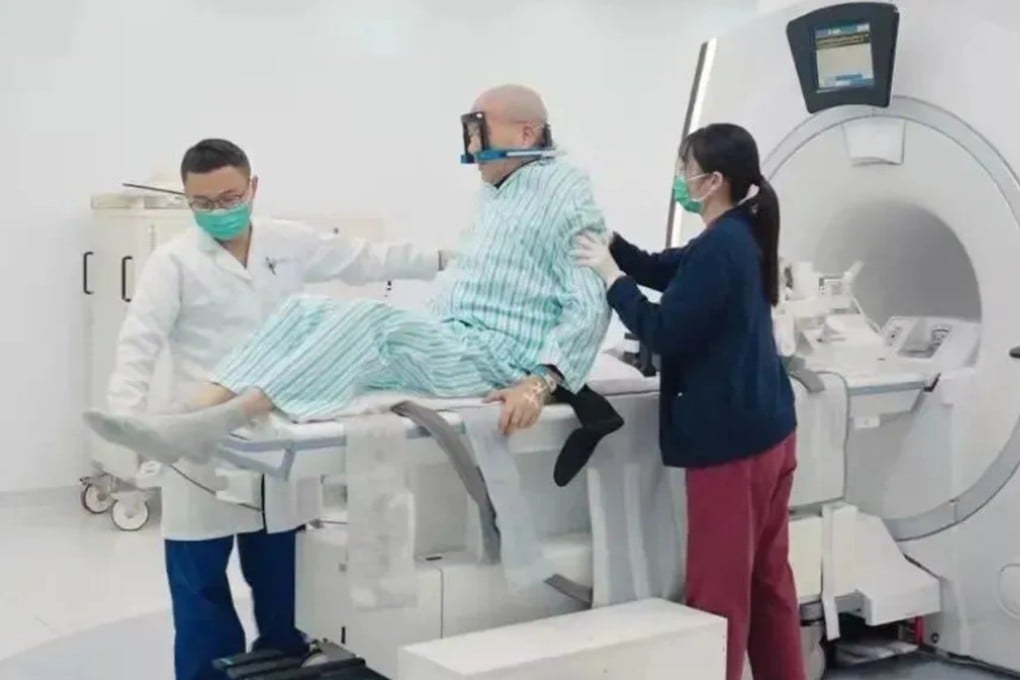
FUS has gained widespread attention as a promising new strategy in neurosurgery whose appeal lies in its non-invasive ability to directly apply multiple intersecting high-frequency sound waves for precise treatment or modulation of the intracranial environment.

Its principle is similar to that of a solar cooker, where multiple ultrasound waves from different directions are focused on a single point, allowing them to exert force or generate heat at that point.

Traditional ultrasound therapy can break down kidney stones externally or focus on a single point to heat and destroy tumours or uterine fibroids.

Sun’s clinical study of FUS for patients with Alzheimer’s disease was launched last year with seven patients in the first group.

“Two severely affected patients showed changes the day after [the non-invasive] surgery, but the effects gradually diminished later on. However, the remaining patients experienced varying degrees of improvement, with an average improvement rate of about 50 per cent,” Sun said.

According to his introduction in the video, the changes in a patient using the pseudonym Wang Guifang were stark. Sun said she had been a moderate to severe patient, suffering from memory loss and described as sitting idly all day with a vacant expression. He said changes after treatment were observed as gradual and comprehensive.

In an article published on the same account as the video, Sun said Wang’s daughter had documented her mother’s gradual progress, sending almost daily updates on changes she observed in her mother to Sun.

Her mother began to engage in family conversations and was taking the initiative to do household chores – washing clothes and folding quilts – things she had not done since becoming ill. She even reportedly revived her pre-illness hobby of singing, insisting that her family take her to karaoke every weekend.

Patients wear a helmet equipped with 1,024 miniature “transducers” which during treatment simultaneously emit high-energy ultrasound waves. Each ultrasound beam passes through the scalp and skull to reach nerves deep in the brain.

During treatment, the patient must undergo an MRI while wearing a helmet, enabling precise synchronised positioning.

Sun said he believed the shock effect it produced was key to improving Alzheimer’s symptoms.

“Just like shaking a winnowing basket to separate corn and rice – after the shaking, the original chaotic mess is transformed and restratified. This kind of ‘shaking’ may have cleared abnormal protein deposits, activated dormant neural circuits, or acted simultaneously at multiple levels. What exactly has been changed remains unknown at present,” Sun said.

In an earlier paper on FUS treatment guidelines, Sun said side effects from the treatment included mild oedema after focused ultrasound therapy, leading to headaches and dizziness, which typically subsided within a week.

In China, the number of dementia cases – including Alzheimer’s and other forms – has increased faster than anywhere else in the world.

Diagnosed cases have risen from around 4 million in 1990 to 17 million in 2021, according to a Fudan University study reported in May last year.

In China, non-pharmacological treatments for Alzheimer’s disease hold immense interest.

In 2021, a private hospital in Hangzhou, Zhejiang province, first performed a lymphatic-venous anastomosis surgery, claiming it could cure Alzheimer’s disease. By the end of 2024, nearly 400 hospitals across the country had carried out the procedure.

However, in July 2025, this surgical treatment for Alzheimer’s disease was prohibited from being promoted for commercial therapy, with only the possibility of re-evaluation after rigorous clinical trials were conducted.


To: Julius Wong who wrote (219165)1/22/2026 8:34:39 PM
From: TobagoJack  Respond to of 219660
 
re <<How about>> - China AI

economist.com

Chinese AI is a risk for Europe. So is shunning it

Especially now that America is becoming a less reliable partner

illustration: simon bailly

Jan 22nd 2026

On january 20th 2025 DeepSeek was an obscure hedge-fund-turned-tech-startup from Hangzhou. Within a week it had become the byword for a new wave of Chinese innovation, after launching an artificial-intelligence model as capable as Silicon Valley’s bleeding edge but much cheaper to build and run. Having slugged it out in China’s cut-throat domestic market over the past year, DeepSeek and its homespun rivals are looking abroad for profits. They will not find the largest ones in America, increasingly out of geopolitical bounds, or the poorer global south. That leaves Europe as the likely recipient of their attention.

To the old continent, new technology from China may seem like a curse. Chinese electric vehicles are already eating German and French carmakers’ Wurst and frites. Several eu countries have tried to restrict access to DeepSeek’s chatbot over fears that it might shunt data from European companies and citizens to China. No one wants to rely on a geopolitical adversary for what is fast becoming critical infrastructure. These worries are legitimate. But in the case of ai, China may, if embraced wisely, be a blessing for Europe.

There are three reasons why European firms should welcome this Chinese onslaught. First, Chinese models are nearly as good as the best that Openai, Anthropic and Google can offer—which for most users is good enough. Demis Hassabis, Google’s ai supremo, has said that Chinese ais are only “a matter of months” behind American ones. Like DeepSeek, most cost nothing to access and relatively little to operate.

This cost advantage comes from their openness—the second reason why they ought to appeal to European firms. In contrast to proprietary black boxes peddled by leading American firms, open models can easily be fine-tuned and run on local infrastructure. Using them averts the risk of being locked in to any one provider. If Openai or Anthropic went belly-up, their customers would be in a bind. If DeepSeek were to fold, users could keep running its models’ “weights”, the parameters learned during training, on their own data and their own servers—which also allays data-theft fears. American firms like Meta also offer open models. But China is leading the way.

There is one last reason why welcoming Chinese ai is in Europeans’ interest: it offers insurance against lock-out, as well as lock-in. Before Donald Trump took the oath of office for the second time, also a year ago, it would have been absurd to worry about European access to American technology. As he recklessly exploits the transatlantic alliance over Greenland, an executive order limiting American ai firms’ business in Europe no longer seems unthinkable. Some European restrictions on American technology, including the computing clouds where ais reside, are also plausible.

Although, in a fragmenting world, Europe’s best option may be to nurture its own ai industry, it is not about to become a model-building superpower. But it can still be a world leader in putting the technology to work. Already, 37% of eu businesses report using generative ai, on par with America. In manufacturing, European firms are ahead. Using open models, including from China, could further increase their lead.

Open road

Politicians in Europe appear to grasp this. With lots of interest and no voluble ai incumbents begging for protection, the early efforts to ban DeepSeek mostly fizzled out. In January the European Commission launched an effort to identify and remove barriers holding back open models. None of this will guarantee Europe’s techno-independence. Firms will still rely on American hardware, especially chips from Nvidia. Chinese software comes with all the old risks. But for Europe, the bigger one now is to spurn it.


To: Julius Wong who wrote (219165)1/23/2026 6:40:42 AM
From: TobagoJack1 Recommendation

Recommended By
Secret_Agent_Man

  Respond to of 219660
 
re <<How about>> ... energy

scmp.com

China’s analogue AI chip runs 12 times as fast on 1/200th the energy of digital rivals

Chinese scientists go back to the future for inspiration that could reshape the power-hungry artificial intelligence model


Ling Xinin Ohio

Published: 2:00pm, 23 Jan 2026Updated: 5:31pm, 23 Jan 2026

A radically different kind of chip created by Chinese researchers can now handle real-world data tasks, potentially reshaping artificial intelligence systems’ reliance on power-hungry digital processors, its developers said.

Building on work reported in October, the Peking University team’s ultra-fast, energy-efficient analogue chip has moved beyond solving basic mathematical problems and can now power applications such as personalised recommendation and image processing.

In a paper published on Monday by the journal Nature Communications, lead author Sun Zhong and his colleagues said the chip achieved a 12-fold speed increase over advanced digital processors, while improving energy efficiency by more than 200 times.

These results were based on the training of recommendation systems using data sets that were comparable in scale to those of Netflix and Yahoo, according to the peer-reviewed paper.

In image-compression tests, the system reconstructed images with almost the same visual quality as full-precision digital computing, while cutting storage requirements by half, the researchers wrote.

In a social media post, Sun wrote that the study “pushes the boundary of analogue computing one step further”. He added that the new chip had handled more complex tasks while retaining the speed and energy advantages of analogue computing.

A reviewer of the paper said the experimental results – particularly the “orders-of-magnitude improvements in speed and energy efficiency” – when compared with conventional digital chips, showed the technology’s potential for industrial applications.

The idea behind the chip, which performs calculations using physical signals rather than digital code, is not new. Scientists were exploring analogue computers decades ago, until the technology was sidelined as digital chips became faster, cheaper and more reliable.

Unlike digital computers, which process information step-by-step using binary code made of zeros and ones, analogue computing represents numbers as continuously changing physical signals, such as electrical currents or voltages.

In theory, this allows many calculations to happen at the same time, offering huge gains in speed and energy efficiency for certain tasks.

With AI systems heavily reliant on power-hungry digital processors, the cost of moving data between memory and computing units has become a major bottleneck.

Advances in materials, circuit design and algorithms have renewed interest in analogue hardware, which performs calculations directly where data is stored.

In a paper published last year, Sun’s team showed that analogue chips could dramatically accelerate basic mathematical operations – up to 1,000 times faster than top digital processors, such as the Nvidia H100 graphics processing unit – while consuming far less energy.

In the latest study, the researchers adopted a technique known as non-negative matrix factorisation (NMF), a powerful tool for data reduction that extracts underlying structures from vast and complex information, such as user behaviour or image pixels, Sun told Science Daily on Thursday.

The technique has been widely used in image analysis, data clustering and personalised recommendation systems, but as data sets grow to millions of entries, traditional digital hardware increasingly struggles with computational complexity and memory bottlenecks, he said.

To address these limits, the team built an analogue computing chip based on resistive memory and redesigned its core circuitry to carry out the most demanding part of the algorithm in a single step.

According to the Science Daily report, the researchers were able to achieve the same results with fewer computing units, significantly reducing the chip’s size and energy consumption.

“Our study opened a new path for solving complex data problems in real time and highlighted the huge potential of analogue computing for practical applications,” Sun said in the interview.

In a social media post, Sun noted that he had “loved” the NMF technique since it was first proposed in 1999 by two Korean-American scientists in a paper published by the journal Nature.

“It’s deeply rewarding to see it now brought into the realm of in-memory analogue computing, 27 years later,” Sun wrote.


To: Julius Wong who wrote (219165)1/23/2026 6:45:00 AM
From: TobagoJack  Read Replies (1) | Respond to of 219660
 
re <<How about>> ... 200 drones

scmp.com

1 soldier, 200 drones: China showcases rapid launch and agility in swarm warfare tactics

State broadcaster details how intelligent tech is used in the PLA’s ability to control masses of autonomous aircraft


Alcott Weiin Beijing

Published: 6:00pm, 23 Jan 2026

The People’s Liberation Army has released fresh details of its tests of AI-enabled drone swarm warfare, saying a single soldier can control a swarm of more than 200 drones.

In a defence news programme aired on Tuesday, Chinese state broadcaster CCTV released details of a drone swarm test conducted by the PLA-affiliated National University of Defence Technology.

Drone swarm warfare relies on artificial intelligence and data links to launch hundreds of drones in a short time. These drones could fly in precise formations and divide tasks via autonomous algorithms, allowing them to simultaneously conduct multi-target reconnaissance and strike operations, the report said.

CCTV reported that through extensive offline training using both simulators and actual flights, the drone swarm developed strong autonomous intelligence.

The footage showed researchers monitoring the live status of multiple drones from a screen, with each described as being able to switch between reconnaissance, distraction and striking tasks.


The drones can divide tasks between themselves, according to the CCTV report. Photo: CCTV

Xiang Xiaojia, a research fellow in the school of intelligent science at the National University of Defence Technology, told CCTV that “each drone is equipped with an intelligent algorithm. Through interconnection and autonomous negotiation, they can form a powerful, collaborative intelligent swarm.”

Xiang added that an autonomous anti-jamming algorithm had been developed and tested in an electromagnetic interference environment so that even when interfered with, drones equipped with this algorithm could autonomously plan flight paths and conduct swarm coverage searches.

In the footage, after electromagnetic interference knocked out the drone swarm’s ability to navigate and communicate, the drones entered autonomous mode for offline swarm searches for the enemy and to guide the launch of loitering munitions.

The programme highlighted China’s Swarm I land vehicle, known as a High Mobility Swarm Weapon System, as an important practical achievement in the field. CCTV said Swarm I could launch 48 fixed-wing drones as loitering munitions at once to operate in the air as a drone swarm.

According to the footage, the fixed-wing drones launched by Swarm I closely resemble American Switchblade drones.

The report said the new intelligent control module allowed drones launched by Swarm I to perform a precise division of labour and cooperation, with some conducting reconnaissance, some jamming and acting as decoys and others responsible for attack.

“Even a single person can control a swarm of more than 200 fixed-wing drones launched simultaneously from multiple vehicles,” CCTV reported.

Swarm I, a model that first appeared at the 2021 Zhuhai air show, is described by its manufacturer as containing tube-launched unmanned loitering munitions capable of autonomous flight with planned trajectories.

The Chinese military magazine Ordnance Science and Technology reported in 2023 that Swarm I could carry out wide-area reconnaissance and saturation strikes against multiple targets, improving the PLA’s ability to strike time-sensitive targets.

The newer variant, Swarm II, which debuted at the Zhuhai air show in 2024, can reportedly carry reconnaissance, munitions and relay communication payloads, has a speed of 100km/h (62 miles per hour) and can remain airborne for more than 60 minutes.

China’s first 076 ‘drone carrier’ amphibious assault ship begins sea trials

At the time, CCTV reported that the Swarm II drone could be operated by one person at a range of 150km (93 miles) and had already entered military trials. Its launch interval is reportedly less than 5 seconds, and the launch time for all 48 fixed-wing drones is less than 4 minutes.

The United States military is also pursuing drone swarm tactics, including in scenarios that may concern Taiwan that US military officials have dubbed a “hellscape” strategy to outnumber the PLA with drones.

According to a 2024 Associated Press report, a published Pentagon-backed study said that during an urban warfare exercise in Tennessee in late 2021, a single operator controlled a swarm of more than 100 drones.

Project coordinator Julie Adams, an Oregon State University robotics professor, was quoted as saying that the swarm commander in the exercise could coordinate the operations of up to 133 ground and air vehicles simultaneously.

These drones were preprogrammed to semi-autonomously execute a range of tactics, including indoor reconnaissance and simulated enemy kills.

