>> THE F*CKING F*CKS
... winning trade war is easy, POTUS Trump, doing great work and for good cause, am told, proven correct
I remain agnostic and wait to see by stretching out observation duration, objectively, and see where numbers trickle in
bloomberg.com
Xi Welcomes Stream of Leaders Shaken by Trump’s New World Order
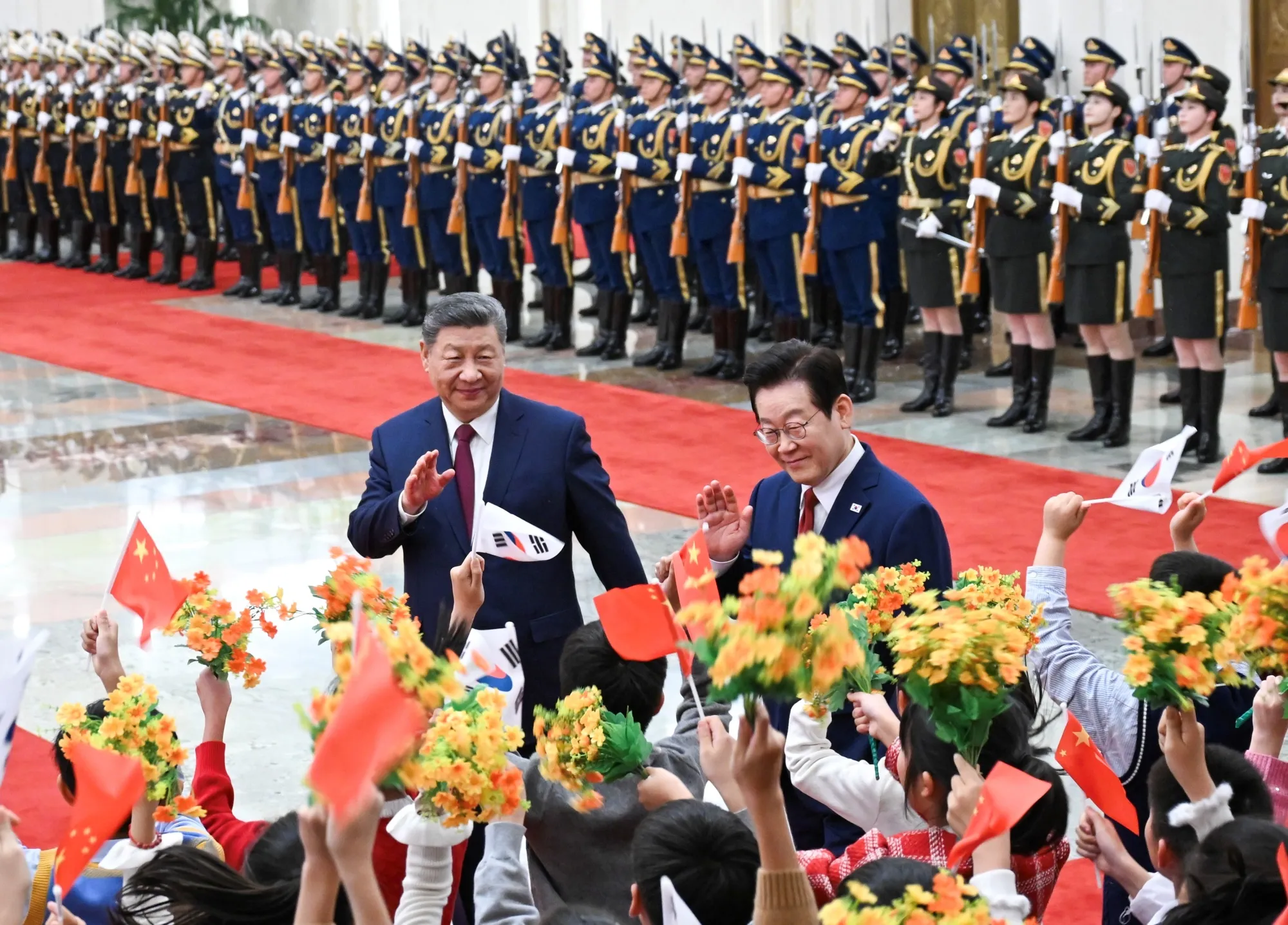
Xi Jinping holds a welcome ceremony for Lee Jae Myung in Beijing on Jan. 5.Photographer: Xie Huanchi/Xinhua/Getty Images
By Bloomberg News
January 14, 2026 at 6:30 PM GMT+8
Updated on
January 15, 2026 at 9:00 AM GMT+8
Takeaways by Bloomberg AI
- President Xi Jinping is welcoming a procession of leaders looking to mend fences with China, including South Korea's Lee Jae Myung, Canada's Mark Carney, and Britain's Keir Starmer.
- The visits come after Donald Trump sealed a tariff truce with China, and leaders are eager to engage with Xi so they aren't sidelined by US-China maneuvering, according to Neil Thomas.
- Foreign leaders are also visiting Beijing to discuss trade and secure access to critical minerals, such as rare earths, with China being the dominant global supplier.
Donald Trump’s tariff war occupied US allies for much of last year. Now, President Xi Jinping is welcoming a procession of leaders looking to mend fences with the world’s other major economy.
South Korea’s Lee Jae Myung kicked off the trend this month, cementing an improvement in ties by becoming his nation’s first president to visit China since 2019. Canada’s Mark Carney followed suit when he arrived late Wednesday, closing a near-decade gap in leader-to-leader diplomacy between Ottawa and Beijing in the Asian nation.
Days later, Prime Minister Keir Starmer is set to travel to the Chinese capital to buoy British business, marking a first since 2018. Germany’s chancellor, Friedrich Merz is also expected to visit next month.
The parade of politicians comes months after Trump sealed a tariff truce with China that tamped down tensions between the world’s largest economies. Xi Jinping and the US leader are slated to meet four times this year, with an April summit likely making Trump the fifth head of a Group of Seven country to visit China in half a year — if his latest tariff threats don’t blow up the detente.
“Trump is triggering diplomatic FOMO across the Western world,” said Neil Thomas, a fellow for Chinese politics at the Asia Society Policy Institute’s Center for China Analysis, using an acronym for “fear of missing out.” “His approach leaves leaders eager to engage Xi so they aren’t sidelined by US-China maneuvering.”
Underscoring the shift, the Trump administration this week moved closer to allowing Nvidia Corp. to sell more advanced chips to China, while still withholding top-tier goods. Previously, under Joe Biden the US had rallied partners to blunt Beijing’s access to cutting-edge semiconductors deemed crucial to its military goals.
Xi is seizing the opportunity to isolate Japanese Prime Minister Sanae Takaichi, whose comments suggesting Japan might deploy its military if China attempts to seize Taiwan have enraged Beijing. In a carefully choreographed move, China’s Commerce Ministry unveiled export curbs on Tokyo during the visit of South Korea’s Lee — who quickly clarified ties with Asia’s top economies were of equal importance.
“Beijing wishes to present itself as a predictable — if not always agreeable — great power in international affairs,” said Yu Jie, senior research fellow on China at Chatham House. “It also opens the opportunity for China in gauging how much it can do in isolating the Japanese prime minister’s move to irritate China over cross-strait matters.”
Foreign leaders have another reason to visit Beijing this year: Rare earths.
When Trump and Xi sealed a trade pact last October, Beijing agreed to a one-year suspension of tighter export controls on some critical minerals, of which China is the dominant global supplier. Trump hailed that pact as a win for the world, but leaders of Western economies are keen to make their case with Chinese authorities.
During his December trip, German Foreign Minister Johann Wadephul claimed progress in efforts to secure the metals, saying Beijing indicated it would be constructive in handling European orders.
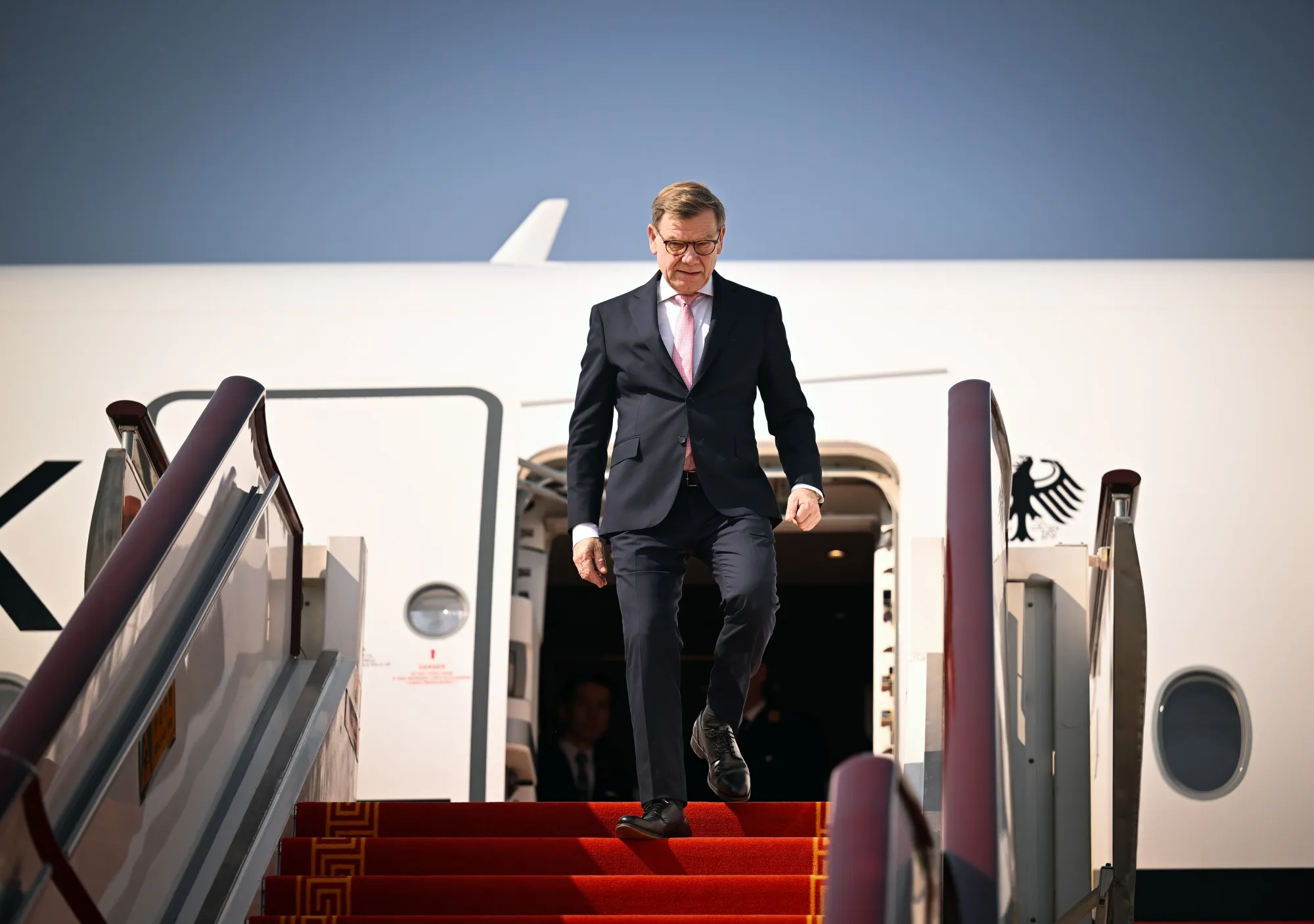
Johann Wadephul in Guangzhou in Dec. 2025.Photographer: Soeren Stache/picture alliance/Getty Images
Underscoring concerns about China’s chokehold, finance ministers from G-7 nations, along with officials from other countries, met on Monday in Washington to discuss ways to “address vulnerabilities in critical minerals supply chains,” the US Treasury said.
Overtures from US partners also come in the wake of Trump’s tariff war that last year pressured American allies into pledging billion-dollar investments. At the same time, the Republican leader has brought Vladimir Putin out of isolation, stunned the world by deposing Venezuela’s leader and made invasion threats toward Greenland, a semi-autonomousterritory of NATO member Denmark.
When it comes to repairing ties with China, “the reasons for not doing it have evaporated,” said Kurt Tong, a former senior US diplomat in Asia, noting the “less confrontational” relationship between Washington and Beijing.
“A lot of countries are concerned about their economic relations with China, want to try and shape them,” said Tong, who’s now a managing partner at The Asia Group. “It’s an important economy, and everyone needs to do business with China.”
China's Trade Surplus Hits New High Despite US Levies
Record $1.2 trillion goods trade surplus shows manufacturing prowess
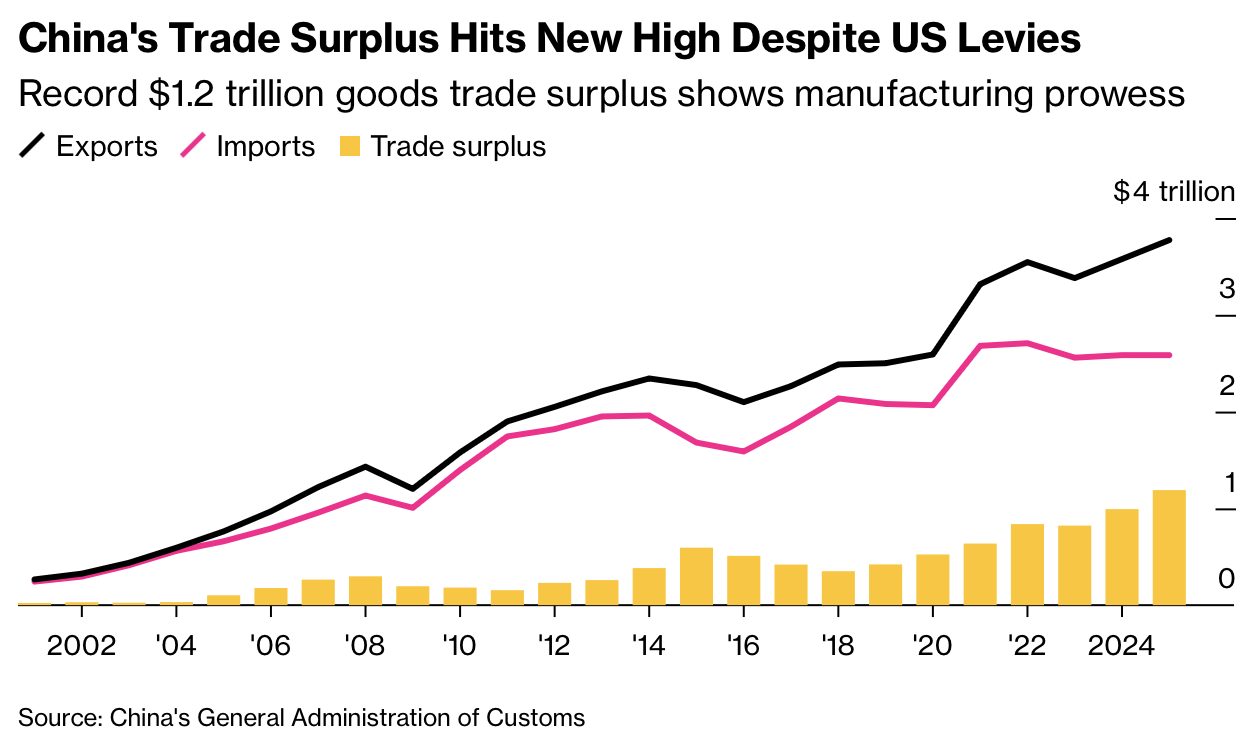
Source: China's General Administration of Customs
Many foreign governments harbor concerns about China flooding their economies with exports, with French leader Emmanuel Macron calling the situation “life or death” for European industry after his December visit to Beijing. But most are taking a pragmatic approach.
Australia’s Anthony Albanese gave an early template for balancing ties during his first term in office, where he largely played down anything security-related and focused on restoring trade. His visit to China in November 2023 helped close a tense chapter, after Beijing imposed punitive measures on some Australian goods. He visited the Chinese capital a second time last year.
Evidence of the shift was seen in the European Union’s decision this week to consider setting minimum prices to replace tariffs imposed against Chinese electric vehicles since 2024. Such a system could draw a line under a spat that saw Beijing retaliate by targeting European industries including dairy, pork and brandy.
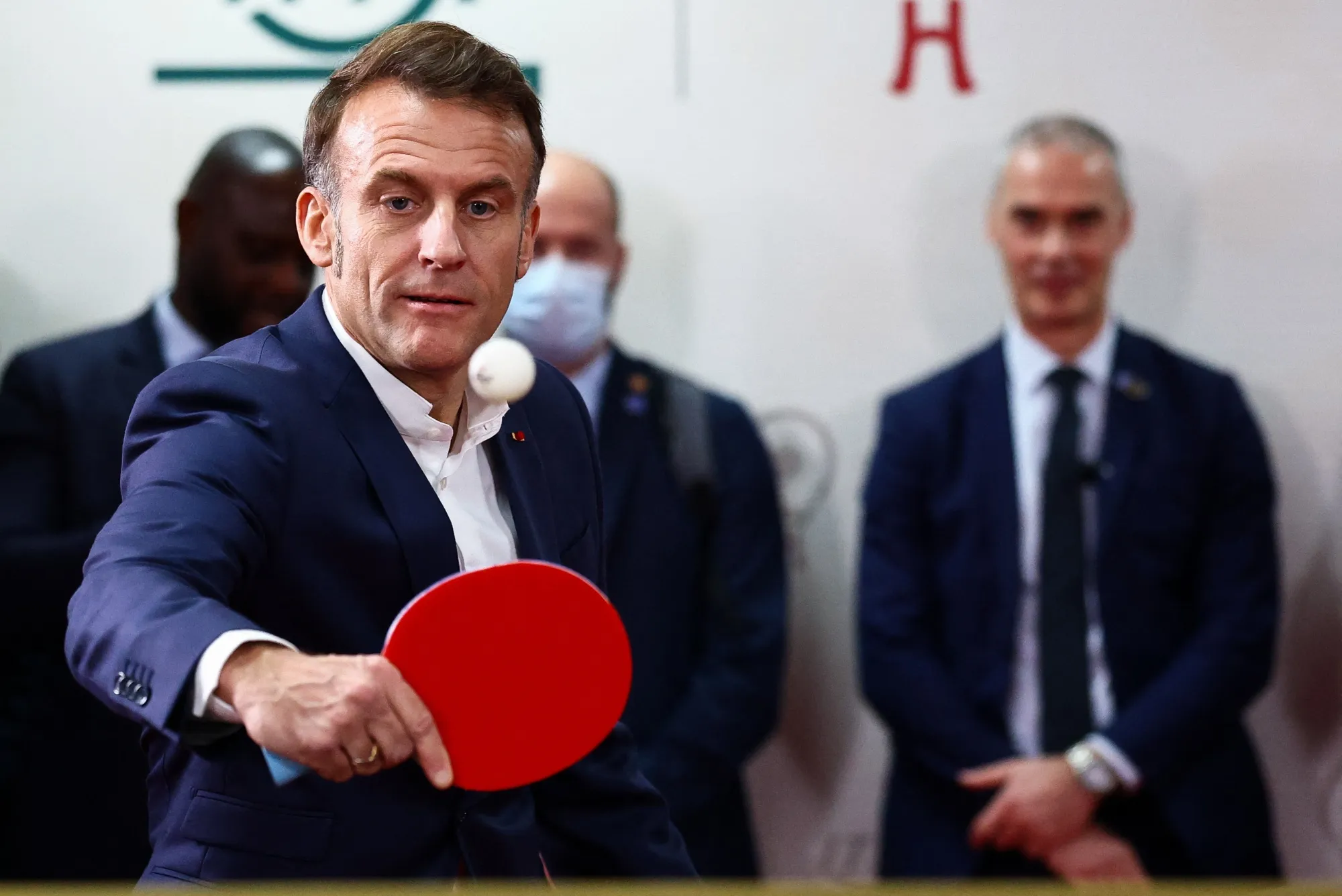
Emmanuel Macron plays table tennis at Sichuan University in Dec. 2025.Photographer: Sarah Meyssonnier/AFP/Getty Images
Similarly, China is hoping to press Carney to relax Canada’s 100% tariffs on Chinese-made electric cars — introduced to align with Biden-era levies — during his trip, according to people familiar with the matter. In return, Beijing will propose easing restrictions on Canadian rapeseed products.
Read more: Carney Lands in Beijing as China Urges Removing Tariffs
Britain’s Starmer will also be chasing deals to help his economy’s struggles with anemic growth, while juggling concerns over China as a national-security threat. A decision by the UK government on Beijing’s plan for a massive new embassy in London that’s due this month still has the potential to influence his plans.
Facilitating the shift is a change of guard in many nations. In Canada, Carney has taken over from Justin Trudeau, whose leadership was marked by an extradition spat with Beijing that soured ties — tensions caught on camera during a heated exchangewith Xi at a G-20 summit in 2022.
Canadian Canola Exports to China Plunge After Tariffs
China imposed latest tariffs after Canada hiked levies on Chinese EVs
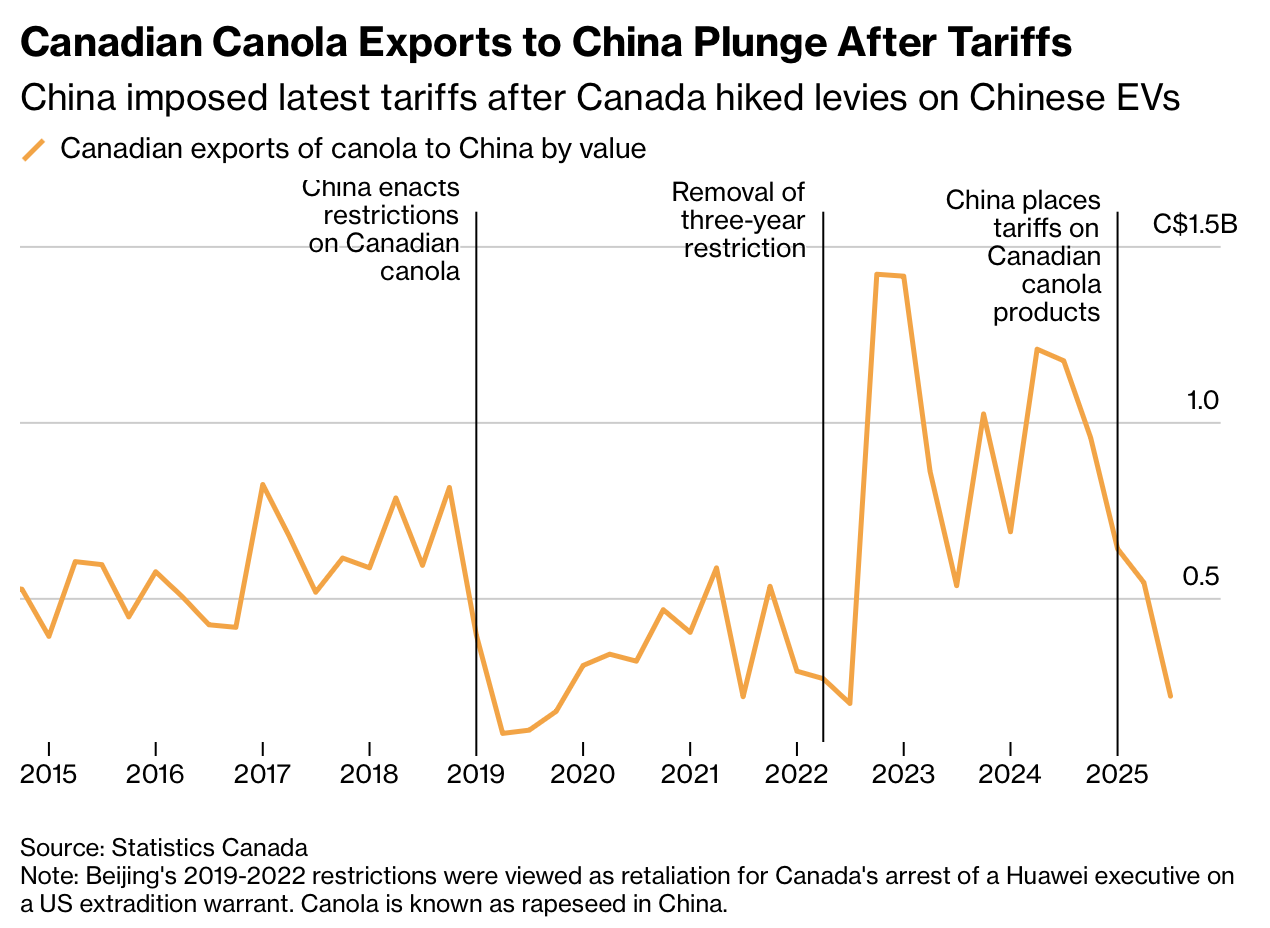
Source: Statistics Canada
Note: Beijing's 2019-2022 restrictions were viewed as retaliation for Canada's arrest of a Huawei executive on a US extradition warrant. Canola is known as rapeseed in China.
In the UK, the Conservative Party that had criticized Beijing over alleged human rights abuses in Hong Kong has been replaced by Starmer’s Labour Party. South Korea’s new leader has taken a more dovish approach than his predecessor, and pushed China to lift its de facto ban on K-pop entertainment.
With Xi, 72, traveling abroad less — he skipped the recent G-20 leaders’ summit in South Africa, for example — the impetus is on foreign leaders to subscribe to his home-court diplomacy.
“Faced with a US acting belligerent and erratic on the international stage, many leaders will conclude they need to be at least on decent terms with China,” said Alexander Dukalskis, associate professor in politics and international relations at University College Dublin.
For Xi, whose economy is also seeking growth drivers, that’s a win.
“When your enemy is engaging in self-harm, just sit back and enjoy the show,” Dukalskis added.
— Colum Murphy, Michael Nienaber, Allan Wan, Ben Westcott. |



