BTW, incoiming Demographic-flip, or what looks like one
bloomberg.com
Plunging US Birth Rate Leaves Too Many Colleges With Too Few Kids
By Elizabeth Rembert Amanda Albright Marie Patino
The Big Take
Trinity Christian College, Siena Heights University and Sterling College couldn’t pull through.
In 2025, they succumbed to a fundamental problem killing colleges across the US: not enough students. The schools will award their final degrees this spring, stranding students not yet ready to graduate and forcing faculty and staff to hunt for new jobs.
David Bergh knows this pain all too well. He was the final president of Cazenovia College, which held its last, bittersweet graduation ceremony in 2023. Tucked in a small upstate New York town, Cazenovia survived the Civil War and the Great Depression but couldn’t overcome the one-two punch of falling enrollment and the Covid-19 pandemic. The school shuttered just shy of its bicentennial.
“Closing Cazenovia was an incredibly heartbreaking experience. It was torturous,” Bergh said. “And unfortunately, there will be more of it.”
Even before President Donald Trump launched his campaign against America’s colleges and universities, the industry faced an existential threat.
The country’s tumbling birth rate is pushing schools toward a “demographic cliff,” where a steadily dropping population of people in their late teens and early 20s will leave desks and classrooms empty. Many smaller, lesser-known schools like Cazenovia have already hit the precipice. They’re firing professors, paring back liberal arts courses in favor of STEM — or closing altogether.
Others will likely reach the cliff in the next few years.
Number of High School Graduates Expected to Drop From Peak
Between 1980 and the early 2000s birth rates kept class sizes growing. That growth is ending, as future high school graduates are expected to decline.
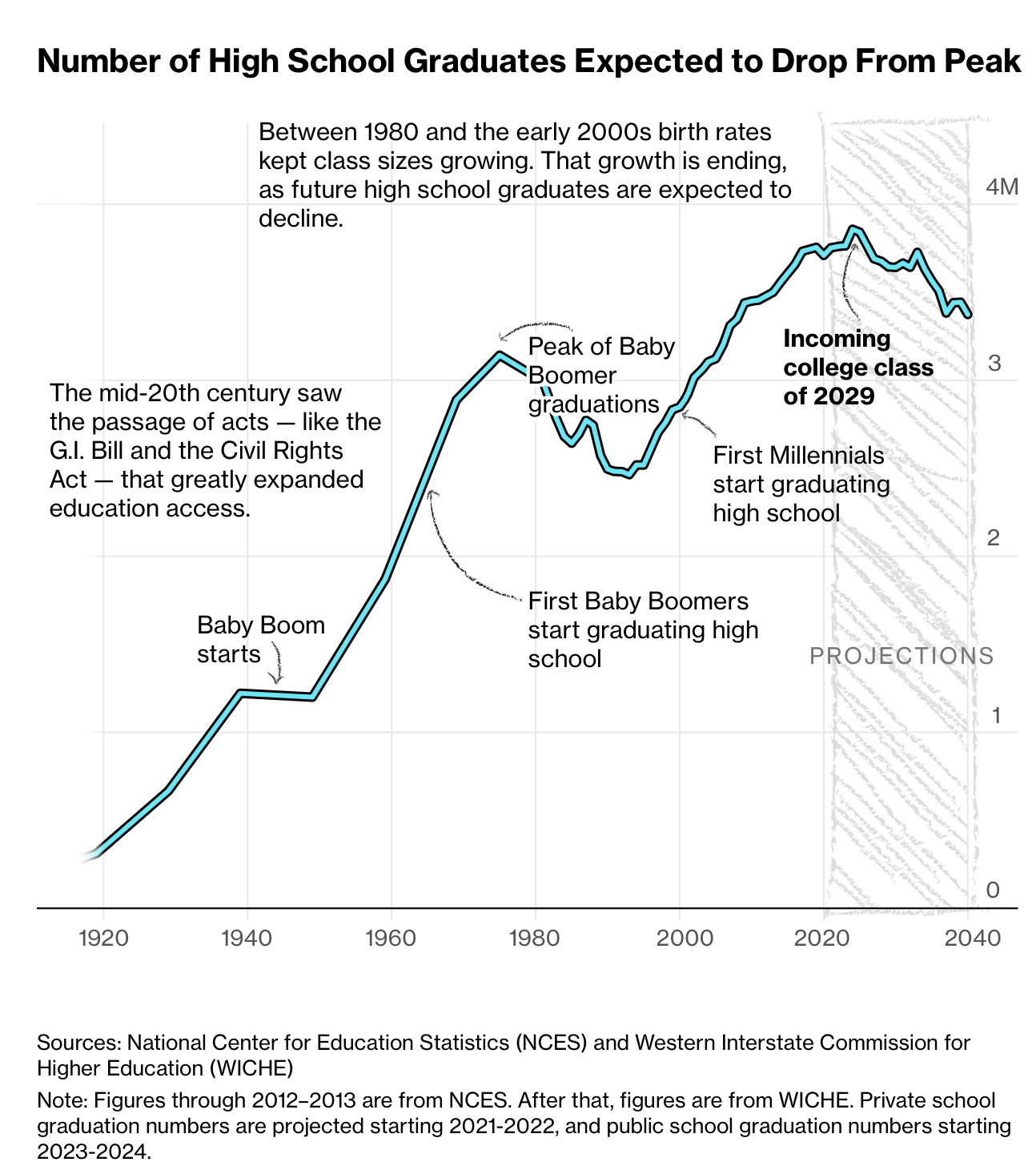
Sources: National Center for Education Statistics (NCES) and Western Interstate Commission for Higher Education (WICHE)
Note: Figures through 2012–2013 are from NCES. After that, figures are from WICHE. Private school graduation numbers are projected starting 2021-2022, and public school graduation numbers starting 2023-2024.
Although it has plunged since the 1950s, the US birth rate ticked upward slightly before the 2008 financial crisis, and that brief demographic boost has kept enrollment at larger schools afloat. But the nationwide pool of college-aged Americans is expected to shrink after 2025. Schools face the risk that each incoming class could be smaller than the last. The financial pressure will be relentless.
“If colleges were facing a stark decline in one or two cohorts, higher ed could likely say, ‘Well, we could admit a few additional students and tighten our belts to muddle through,’” said Nathan Grawe, an economics professor at Carleton College in Minnesota, who has written books about education and demographics. “But it’s one year after another of contraction, of ratcheting up the pressure.”
Since 2020, more than 40 schools have announced plans to close, displacing students and faculty and leaving host towns without a key economic engine. Trinity Christian College, a private institution outside of Chicago, announced in November it would shutter, driven in part by enrollment that dropped 18% from 2019 through 2024. Close to 400 schools could vanish in the coming decade, according to Huron Consulting Group. The projected closures and mergers will impact around 600,000 students and redistribute about $18 billion in endowment funds, Huron estimates.
The College Decline Is Here
For-profit colleges experienced a rise and fall as additional scrutiny, scandal and regulation brought many of them down.
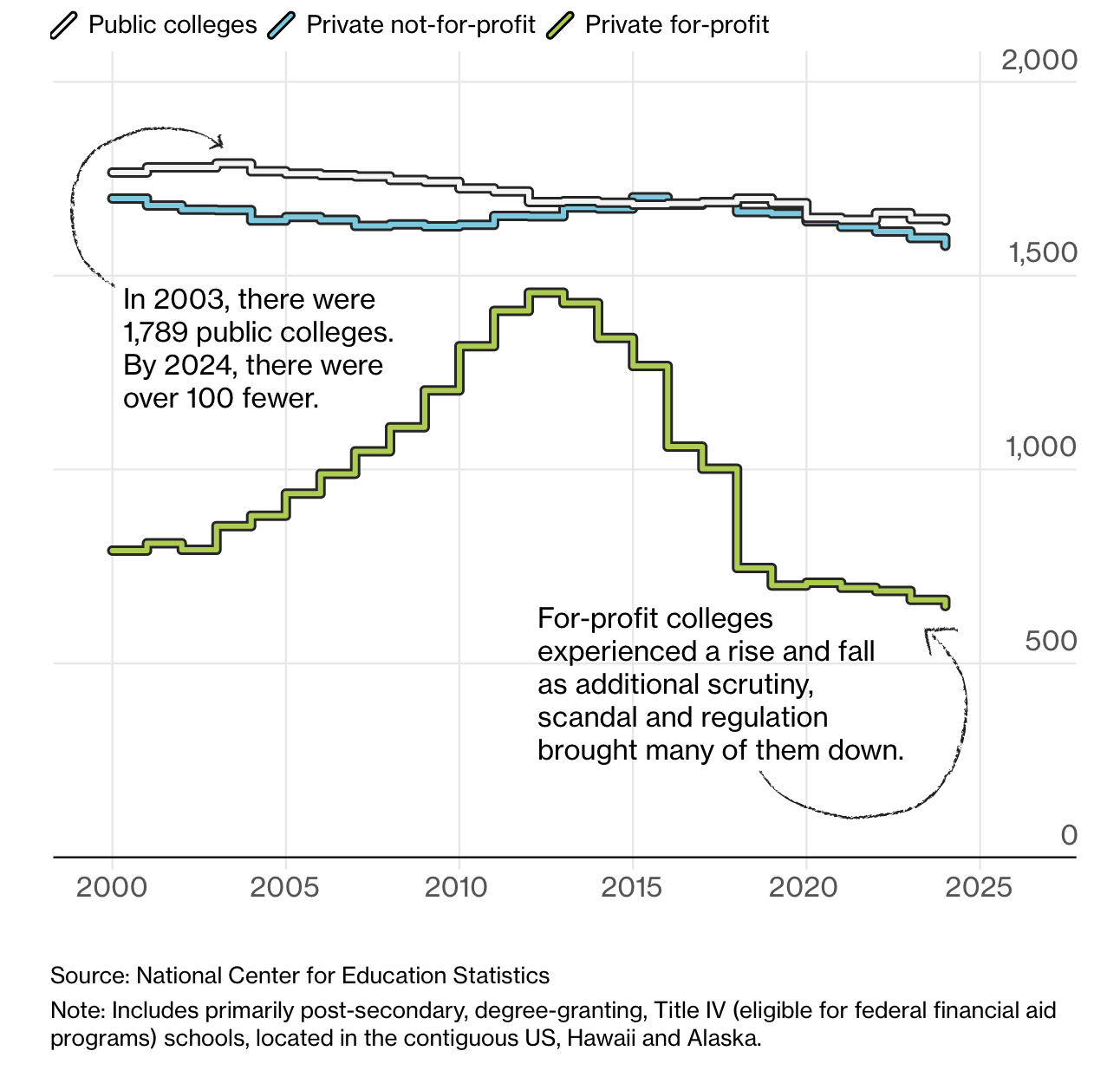
Source: National Center for Education Statistics
Note: Includes primarily post-secondary, degree-granting, Title IV (eligible for federal financial aid programs) schools, located in the contiguous US, Hawaii and Alaska.
Even a small school’s closure has big effects. Less than half of students whose schools shut down before they graduate re-enroll in another college or university, according to a 2022 study. And investors who hold a school’s debt have at times faced losses of 50% or more when the institution shutters.
“Over the next decade, we’re going to be going through a very painful but necessary rebalancing in supply and demand,” said Huron Managing Director Peter Stokes. While that process is common in other industries, like automobiles, this will be the first time it happens to higher education, he said. “It’s shocking and surprising to find out that you’re no longer valued the way you were,” Stokes said.
The shrinking supply of students has already sparked a frenzied competition for high school seniors — a radical departure for colleges and universities that once considered themselves gatekeepers, selecting only the best candidates. Some public institutions are letting seniors bypass traditional requirements like essays and letters of recommendation to gain entry automatically. The massive California State University system even reaches out to many prospective students while they’re still in high school to let them know they’re eligible to attend most CSU campuses if they keep up their grades.
Other colleges are offering new study programs and sports teams or trying to appeal to graduate students. Muhlenberg College, a liberal arts school in Pennsylvania that has seen enrollment declines, has launched six master’s programs since 2020 and will start a master of business administration program in the fall of 2026.

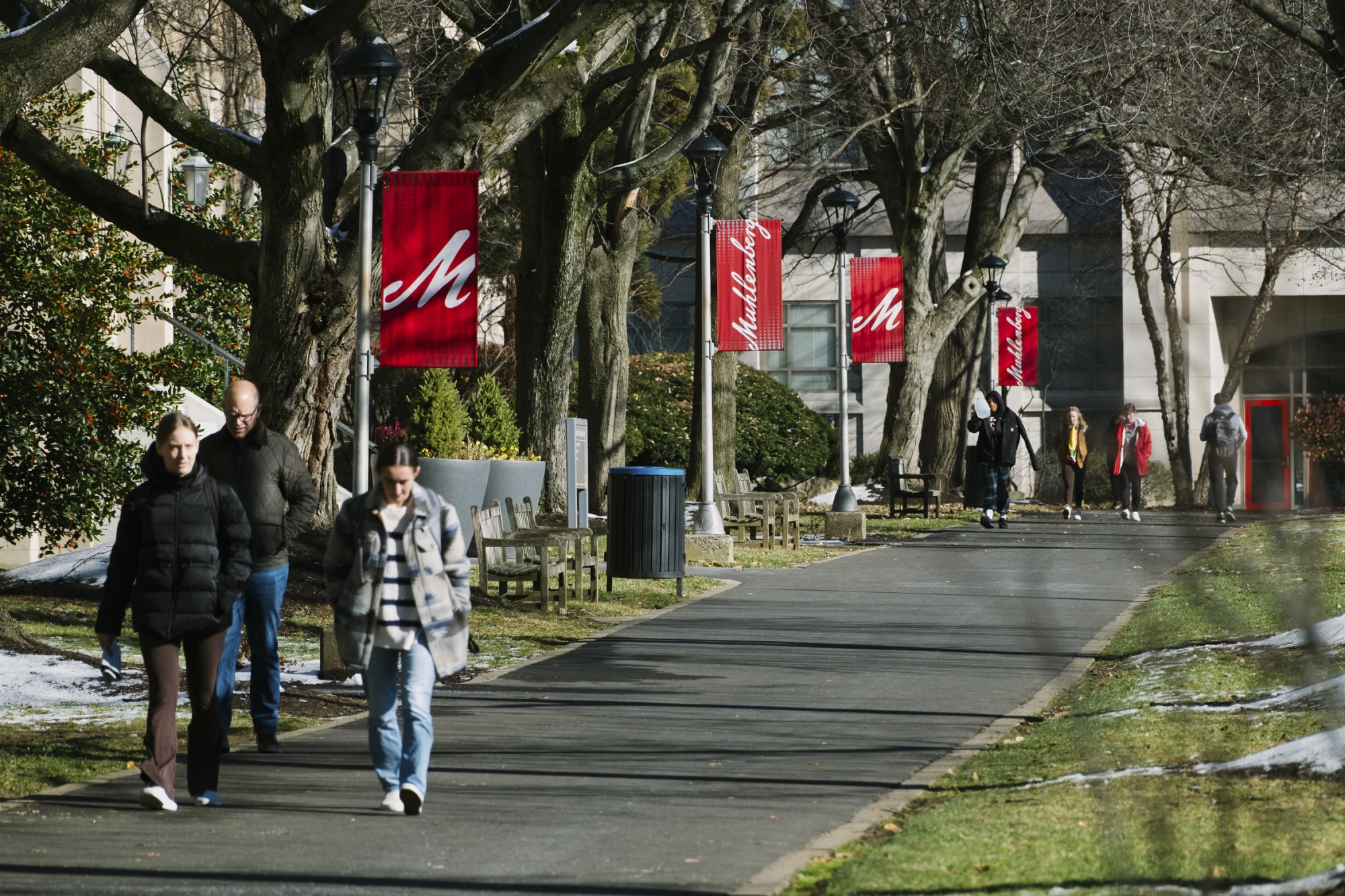
Left: Kathleen Harring, President of Muhlenberg College. Right: Muhlenberg College campus in Allentown, Pennsylvania. Photographer: Michelle Gustafson/Bloomberg
“We are being intentional about the size that we need to be in the context of the fact that the actual primary market — 18 to 22 year-olds — has been shrinking,” said Muhlenberg President Kathleen Harring. “If institutions think that they can continually grow in this type of landscape, I’m not quite sure that that is realistic for all institutions.”
Expanding offerings, however, carries its own financial risk. D’Youville University, located in Buffalo, is launching a medical school in 2026. Its debt will triple to about $200 million in the process, according to an estimate from S&P Global Ratings. The university was downgraded to a junk credit rating in October, with S&P analysts citing the “startup costs” involved.
Lorrie Clemo, president of D’Youville, said the program will strengthen the school’s financial profile as it grows. “The new College of Medicine represents a planned, long-term capital investment with significant start-up costs prior to the inaugural class in fall 2026, similar to a short-term mortgage taken on to build long-term strength,” she said, in a written statement.
A Good Century
It’s a brutal reversal for an industry that enjoyed more than a century of steady growth.
A rising US population, government incentives and social movements all ushered greater numbers of young Americans into college. Eight million veterans used the G.I. Bill immediately after World War II to pay for education beyond high school, and colleges and universities proliferated to meet the need. The women’s rights movement triggered a surge of female students, while a 1965 federal law established aid and loan programs for the poor and middle class.
“By the late ’60s, the front end of the Baby Boom was going to college,” said Kenneth Johnson, a professor who researches demography at the University of New Hampshire. “Everybody wanted to go to college — there was all kinds of motivation. The universities had to expand dramatically.”
The Post-2008 US Birth Decline
Number of births if fertility rate had remained at 2007 levels
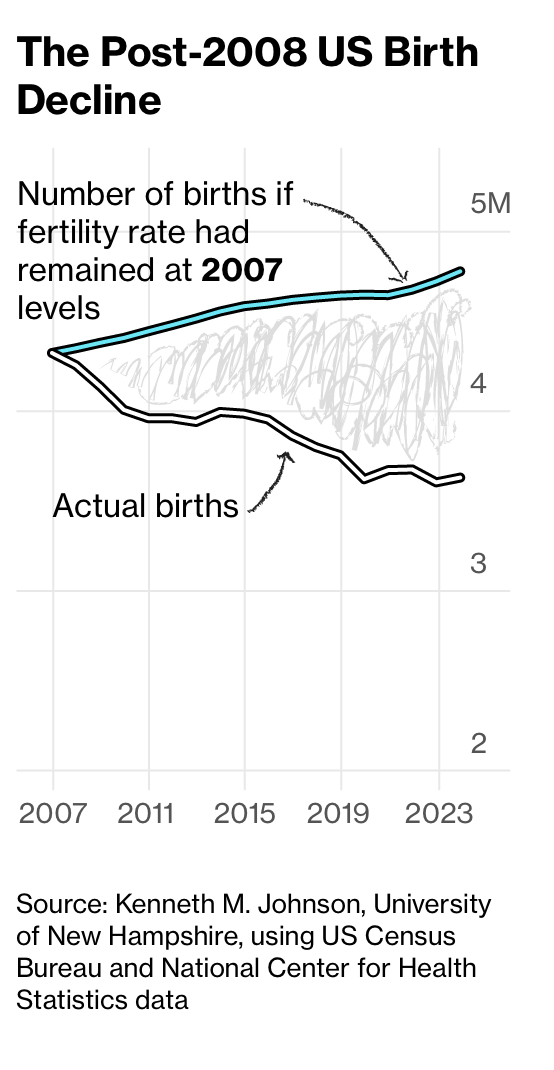
Source: Kenneth M. Johnson, University of New Hampshire, using US Census Bureau and National Center for Health Statistics data
Warning signs started flashing during the financial crisis. A two-year bump in the birth rate produced a record number of babies born in the US in 2007. Then, the rate began to decline, with the drop continuing even after the economy recovered, according to data from the Centers for Disease Control and Prevention.
Eighteen years past the peak, the demographic drought is hammering higher ed. The Northeast, Midwest and West are projected to be hit the hardest, according to the Western Interstate Commission for Higher Education. Five states in those regions — Illinois, California, New York, Pennsylvania and Michigan — account for three-quarters of the decline. The South, meanwhile, is a rare bright spot, with the region expected to see a 3% increase in high school graduates from 2023 to 2041, data from the commission show.
Schools struggling with enrollment have, for years, recruited international students to fill the gap — a lucrative strategy, since foreign students typically pay full tuition. But Trump dealt that tactic a blow last year, enacting travel bans, slowing the visa application process and threatening deportations for foreign student activists. International enrollment dropped by close to 5,000 students across the country last fall after years of steady growth, according to data from the National Student Clearinghouse Research Center.
Change in High School Graduates by State
Increase / Decrease from 2008 baseline
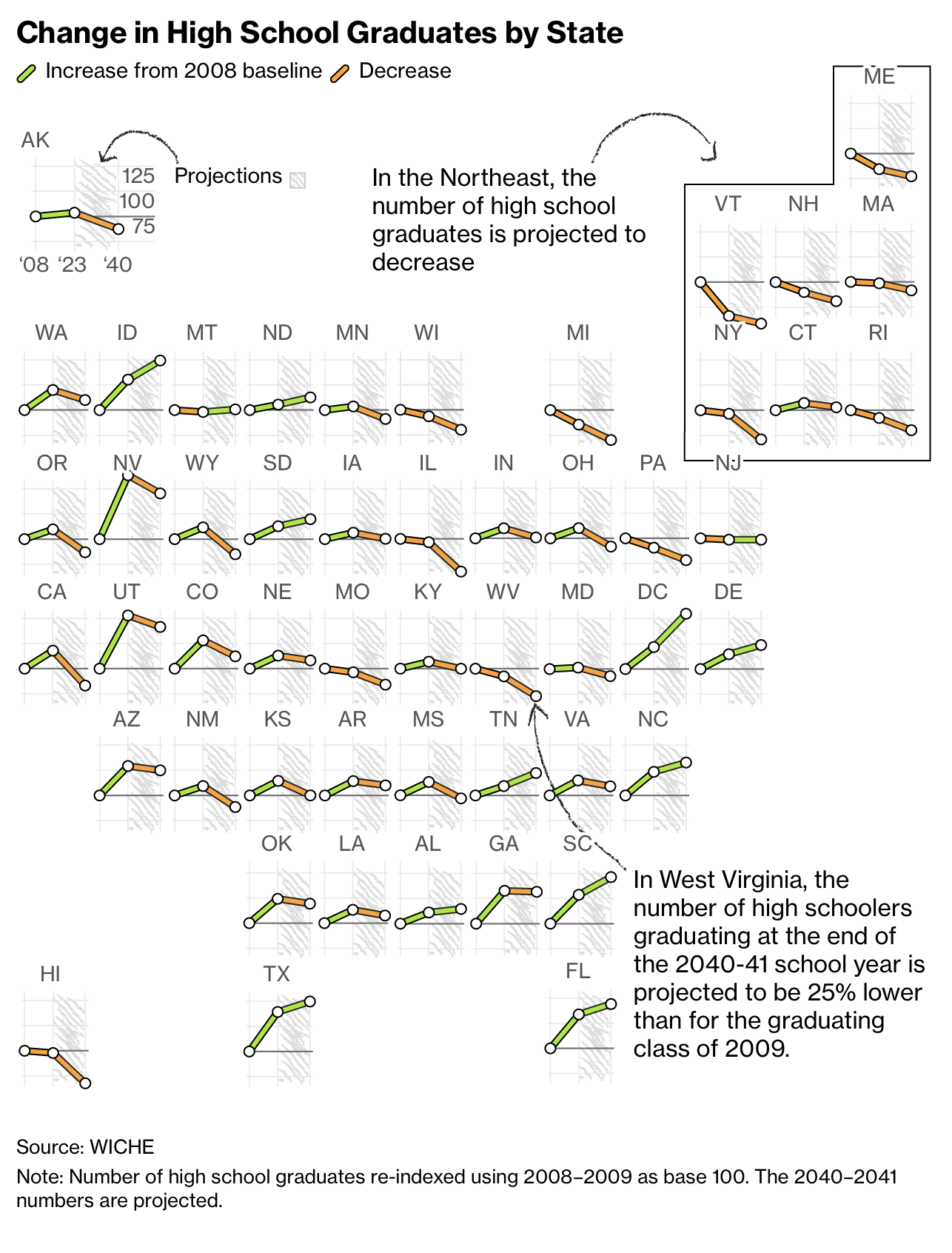
In West Virginia, the number of high schoolers graduating at the end of the 2040-41 school year is projected to be 25% lower than for the graduating class of 2009.
Note: Number of high school graduates re-indexed using 2008–2009 as base 100. The 2040–2041 numbers are projected.
“It’s essentially further shrinking the pool of traditionally-aged students,” said Cazenovia’s Bergh, who now heads up Vermont State University. “It’s just one more layer, on top of the worst-case scenario.”
Not all schools experience the demographic drought equally, with a growing split between small schools and elite, well-known institutions. The top Ivy League schools can have 20 or more applicants for every available seat and lean on their massive endowments to support expenses. (They also remain a draw for foreign applicants, with Harvard University enrolling a record number of international students this year.) Smaller colleges, often in rural areas, depend more on tuition revenue, placing them in jeopardy as soon as enrollment shrinks.
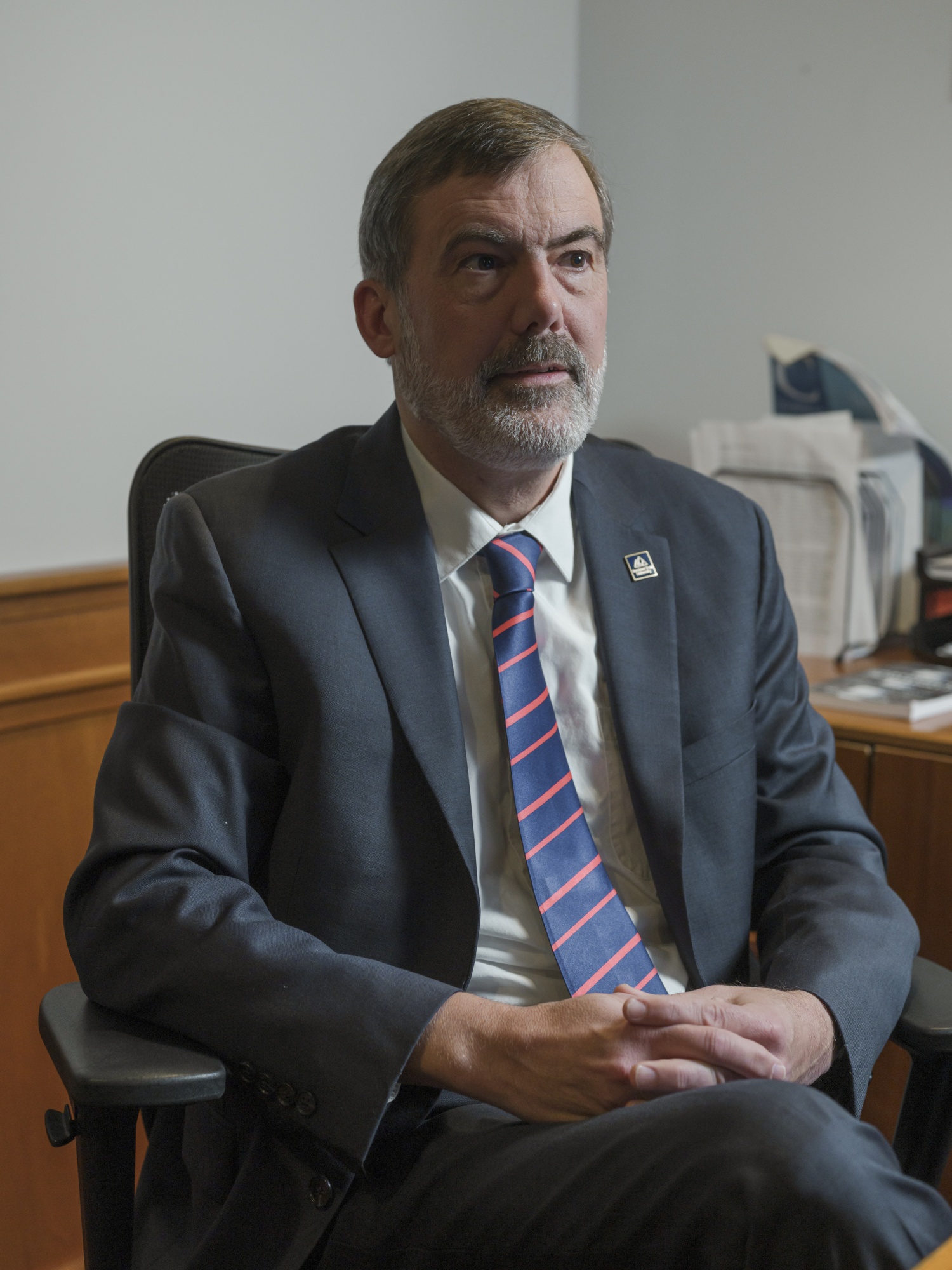
David Bergh, president of Vermont State University. Photographer: John Tully/Bloomberg
Public universities are also at risk, especially regional campuses that rely on recruiting local students. Pennsylvania State University, citing falling enrollment at many of its regional branches, plans to shutter seven of its 20 branch campuses after the spring 2027 semester.
Penn State’s decision highlights a challenge that many school administrators are loath to admit: There are a lot of colleges. And campuses in far-flung places, without brand recognition, are falling out of favor with students already questioning the value of a college degree. For example, while Penn State’s flagship University Park campus saw enrollment grow 5% from 2014 to 2024, 12 other Penn State campuses recorded a 35% drop, according to a report tasked with determining whether closures were necessary.
Penn State to Close Some Campuses
Fall enrollment change between 2013 and 2023 ?? Interact for more information
- Campus will close in 2027
- Campus will remain open
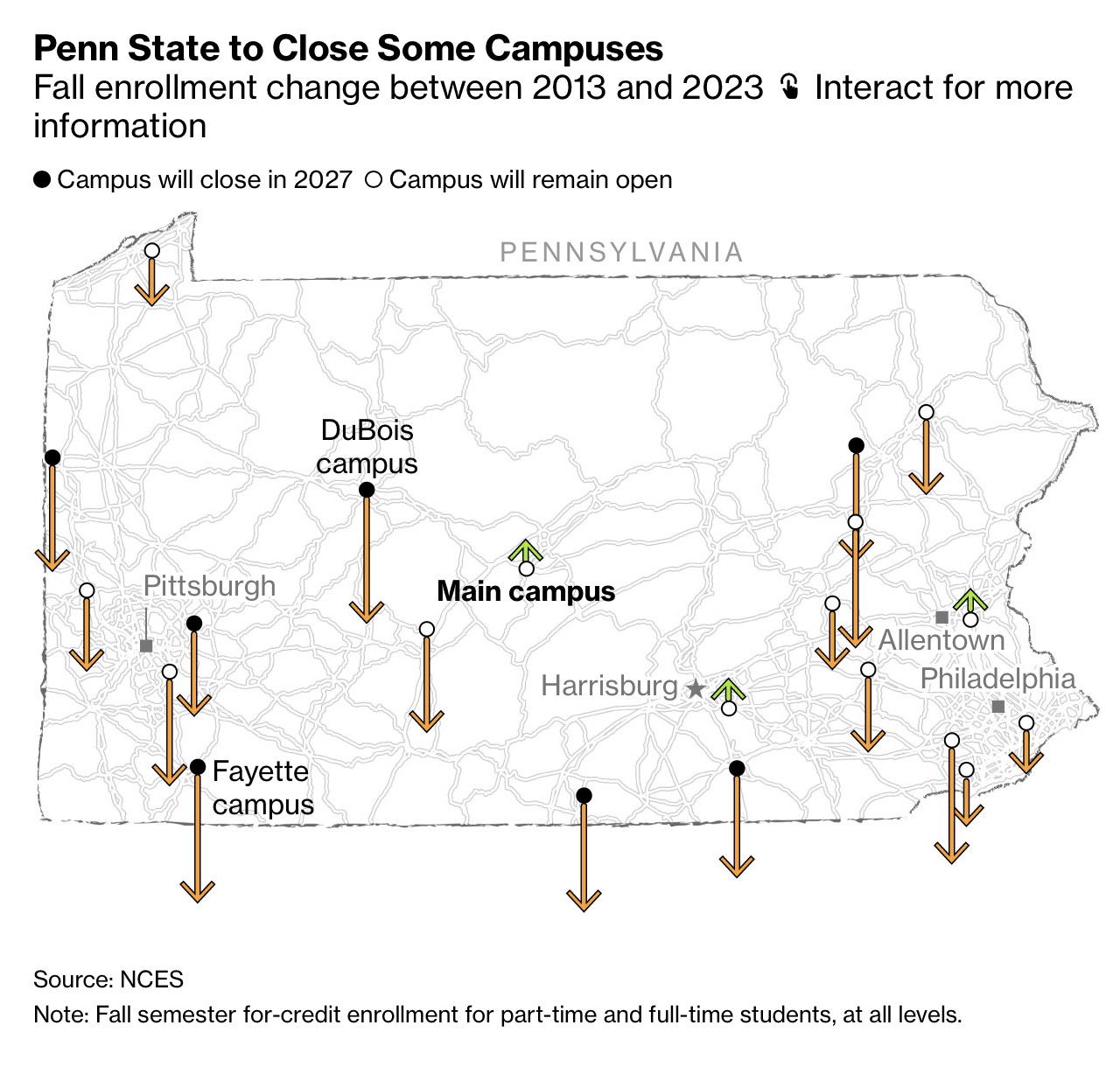
Note: Fall semester for-credit enrollment for part-time and full-time students, at all levels.
Direct-admission programs, which allow students to skip traditional applications, are one potential response. Some 15 states have them, according to Taylor Odle, assistant professor of educational policy studies at the University of Wisconsin-Madison. He found in a 2022 paper that direct admissions increased first-year undergrad enrollment by 4% to 8%.
Such programs can help reach students — including racial minorities and rural teens — not well served by traditional recruitment and enrollment practices. And they don’t require nearly as many paid staff to run, since there are no essays or letters of recommendation to read.
“??These programs are radically cheap to operate,” Odle said. “At the end of the day, you’re just sending a bunch of letters and emails, contrasted with hiring an army” of advisors or recruiters, he said.
Public universities can also benefit from infusions of state support to avoid closure. California’s Sonoma State University received a $45 million lifeline from the state after threatening to cut its athletics program. (The cash-strapped school ended up gutting the program anyway.) Private colleges don’t have that option.
Kevin Carey, vice president for education and work at the New America think tank, wants Congress to provide more support for colleges, through legislation similar to the National Historic Preservation Act. That could be a tough sell under the Trump administration, which has threatened federal funding for colleges and universities in order to exert more control over them. But losing a school, Carey said, can be devastating for host communities, as well as students, graduates and faculty.
“A college isn’t a Starbucks,” he said. “These institutions mean more than that. You lose decades of knowledge and tradition when you lose a college.”
For all the fear of the future, there are examples of schools pulling themselves back from the brink.
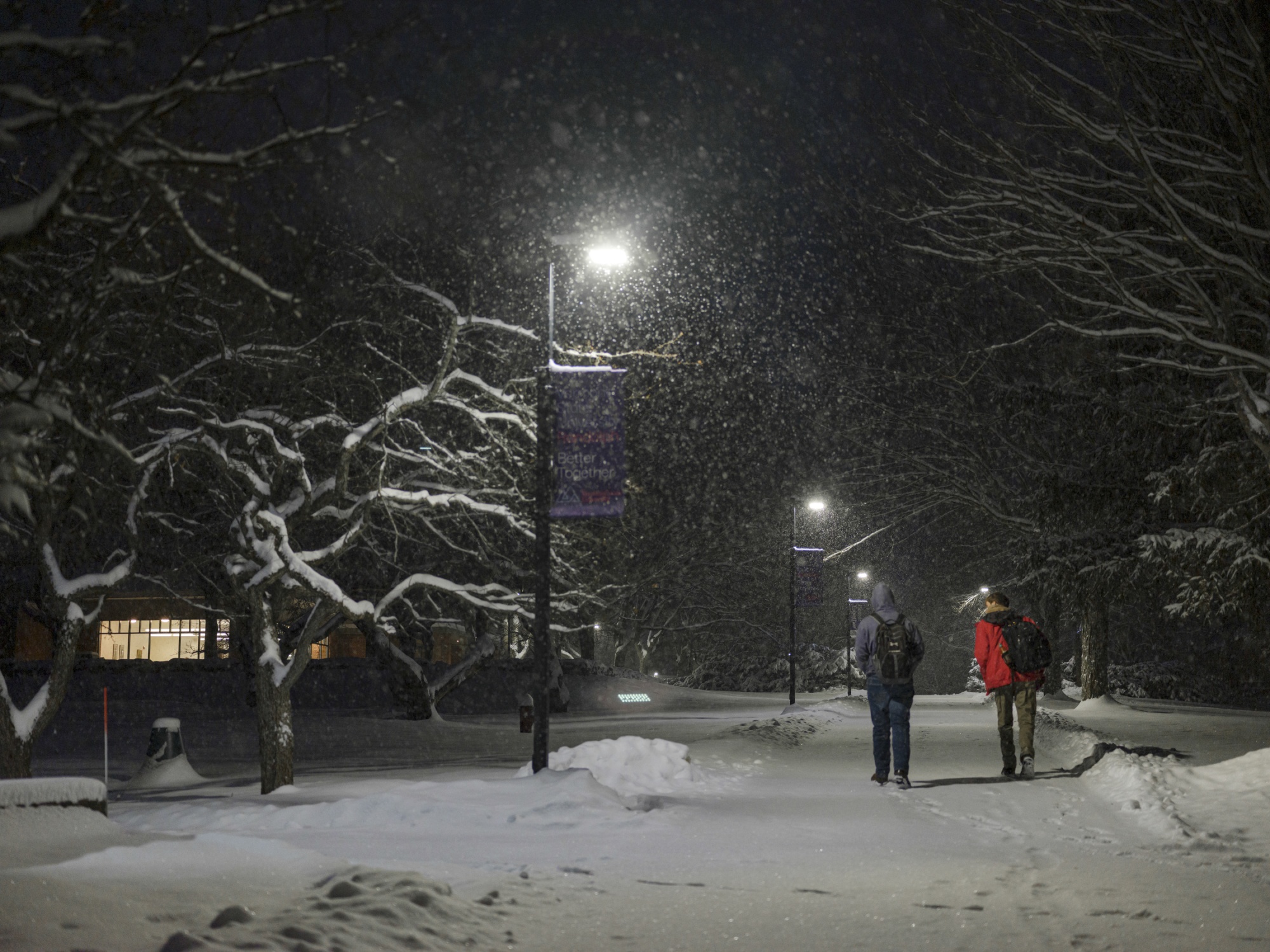
Randolph Campus of Vermont State University. Photographer: John Tully/Bloomberg News
When Jeffrey Docking joined Adrian College as its president in 2005, the private school in southeastern Michigan had fewer than 900 students and was hemorrhaging money. Morale was low, roofs were leaking and weeds covered the grounds. His chief financial officer warned that if they couldn’t raise enrollment to 1,400, bankruptcy loomed.
Docking immediately invested in new sports and extracurriculars to attract students. That included lacrosse, symphony, marching band and a bass fishing team that brought him up to 60 emails a month asking how to join. The college recently launched 40 new programs, in high-demand areas like cybersecurity and data analytics.
Adrian College’s enrollment is now 1,760, according to the most recent data from the federal government. Docking said he can feel the difference: kids stay on campus over the weekends, lounges are full and laughter echoes from the groups who gather around firepits on the grounds.
“These are the things that can preserve the Norman Rockwell picture of higher education,” Docking said. “What we’re doing saves what’s best about this experience, while making changes inside and outside the classroom that make it economically feasible for the colleges themselves and these families.”
Docking’s investments have had 20 years to bear fruit, but he said this style of turnaround is still possible even with today’s difficult demographics – and such strategies may be needed more than ever to conquer the challenging landscape.
“This is a crisis right now. When you look at how many schools have closed, when you look at the credit ratings of many of those schools, you’re looking at a broken business model,” he said.
Just a ten-minute drive from Docking’s campus is an example of that urgency. It’s the last semester of school for Siena Heights University, which announced it would shut its doors this spring after 107 years.
Alumni headed to campus for the last homecoming in the fall. School leadership said they explored other options, but falling enrollment and rising costs made it impossible to continue.
“We’re not the first college and university to close,” then-President Douglas Palmer said in a video to the Siena Heights community. “Nor will we be the last.” |



