The Great Replacement in France
Jan 29, 2026 10:00 am
By Hugh Fitzgerald
Leave a Comment
France is being swamped with new immigrants. In 2025, nearly 400,000 new residence permits were issued to these migrants who are, overwhelmingly, Muslims from North Africa. And many French people, who for a long time averted their eyes from the phenomenon, are no longer afraid to speak out and to call for a great reduction, or even for a complete halt, to immigration. More on the French alarm over what has been called the “Great Replacement” can be found here: “France: Record 384,000 first-time residence permits granted in 2025 as immigration keeps soaring higher,” Remix News, January 27, 2026:
In 2025, France is seeing a significant shift in its non-EU immigration landscape, with first-time residence permits projected to reach 384,000 — an 11.2 percent increase from the previous year. This growth is uniquely defined by a massive 65 percent surge in permits granted on humanitarian grounds, primarily to refugees and those seeking subsidiary protection.
The legal foreign population in France is expected to hit approximately 4.5 million by the end of 2025, a 3.2 percent annual increase. However, previous reports have put the total population of foreigners at much higher levels, already reaching 6 million in 2024. While humanitarian reasons are the primary driver for new arrivals, the “stock” of residents remains heavily influenced by family ties and labor needs.
The purpose of residency varies drastically depending on the country of origin, reflecting France’s diverse historical and geopolitical ties. As French news outlet Fdesouche notes, “Nationals of the three Maghreb countries are more often issued with residence permits granted for family reunification reasons.” These countries consist of Morocco, Algeria, and Tunisia. However, these groups are also now being granted work permits, with the government arguing they can be used to fill labor shortages….
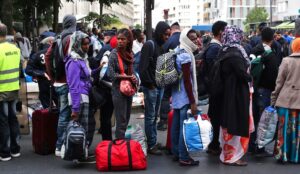
Contrary to the French government’s expectations, many of the Muslim maghrebins who are granted work permits do not, in fact, end up working. They prefer to take advantage of all of the benefits that the generous French welfare state lavishes upon them, that put them in as good a position economically as they would be doing the kind of menial jobs for which, given their lack of advanced education, they are qualified.
Meanwhile, Afghans receive residence permits almost entirely based on humanitarian reasons….
The Afghans who flee from the Taliban’s rule in Afghanistan ought not to be taken in by France, a country alien to them in every respect. Instead, it would be far better for their fellow Muslims next door in Pakistan, or the Arab oil states of the Gulf, especially Saudi Arabia, that have a need for manual labor, given all of the trillion-dollar construction projects now underway in those countries, to take in those Afghans.
That 1.2 billion euros paid for migrant housing, including 50,000 hotel rooms, is the total for only one city — Paris. How many more billions of euros does the French government spend on housing for migrants outside the capital? Five billion euros? Ten?
Last year, demographic researcher and data analyst Marc Vanguard reported that “the foreign population in France is growing FOUR times faster than the population of French nationality.”…
That “foreign population” consists overwhelmingly of Muslims from North Africa. They arrive to take advantage of the cornucopia of benefits that are lavished on migrants, including free housing, free medical care, free education (including language tuition and vocational training), unemployment benefits, family allowances, and more. Many are in no hurry to be gainfully employed; they have calculated they can receive more benefits if they remain unemployed. Besides, the Infidels owe them all those benefits, which Muslims interpret as a kind of proleptic jizyah.
In 2022, famed French author Michel Houellebecq came out and said the Great Replacement is a “fact” during a wide-ranging discussion with influential French philosopher Michel Onfray.
“The Great Replacement, I was shocked it’s called a theory. It’s not a theory, it’s a fact,” said Houellebecq. “When it comes to immigration, nobody controls anything; that’s the whole problem. Europe will be swept away by this cataclysm.”…
Those who, like Michel Houllebecq, have taken note of the ever-increasing numbers of Muslim migrants, are the most alarmed. They no longer conceal their anxiety about the changes in the population of France. If either Jordan Bardella or Marine Le Pen of the anti-immigrant National Rally party is swept into office as president, we can expect the spigot of migrants from Third-World countries (which is to say, from Muslim countries) to be turned down, or turned off entirely.
Notably, the vast majority of the French want serious immigration restrictions put in place, while a tremendous 53 percent of women want zero immigration into the country, according to polling.
More women than men in France want zero immigration because it is the women who have to endure the unwanted attentions, and even sexual assaults, of Muslim migrants who misinterpret the dress of French women, so immodest by Muslim standards, as expressing a come-hither attitude.
To put a stop to the “Great Replacement” in France — as in other countries in Western Europe — calling a halt to migration will not be sufficient. Fertility rates for French women are currently 1.7, far below the replacement level of 2.1. But the fertility rate for Muslim women already in France is 2.9. Policies need to be put in place to bring down the fertility rates of Muslim women. One possibility is to deny families on welfare — most of them Muslim migrants — any additional benefits for a third child, and to decrease by half the amount of support provided for a second child. At the same time, pro-natalist policies for French women could be introduced, by providing to women whose grandparents were French citizens extra state support for every child beyond the second. Aren’t these policies worth a try? |



