I originally went to UC Berkeley as a nuclear engineering and EE double major to do nuclear fusion. I changed when I found it was 30 to 50 yrs away and you really didn't get to do much but a few experiments a decade. You had to be a big shot to be in charge of the billion dollar experiments, so I switched to semiconductors where I could start doing design and experiments right away.
Interesting that nearly 40 yrs have passed and still not much but this comes along and perks my interest.
Does Lockheed Martin Really Have a Breakthrough Fusion Machine?
Lockheed Martin says it will have a small fusion reactor prototype in five years but offers no data.
By David Talbot on October 20, 2014
Lockheed Martin’s announcement last week that it had secretly developed a promising design for a compact nuclear fusion reactor has met with excitement but also skepticism over the basic feasibility of its approach.
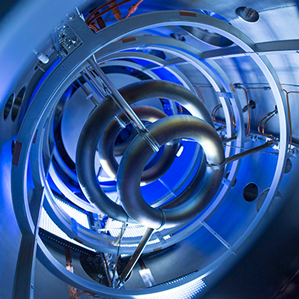
The interior of Lockheed Martin’s fusion reactor shows a series of rings used to create magnetic fields that confine plasma.
Nuclear fusion could produce far more energy, far more cleanly, than the fission reactions at the heart of today’s nuclear power plants. But there are huge obstacles and no hard evidence that Lockheed has overcome them. The so-far-insurmountable challenge is to confine hydrogen plasma at conditions under which the hydrogen nuclei fuse together at levels that release a useful amount of energy. In decades of research, nobody has yet produced more energy from fusion reaction experiments than was required to conduct the experiments in the first place.
...
Tom McGuire, project lead of the Lockheed effort, said in an interview that the company has come up with a compact design, called a high beta fusion reactor, based on principles of so-called “magnetic mirror confinement.” This approach tries to contain plasma by reflecting particles from high-density magnetic fields to low-density ones.
Lockheed said the test reactor is only two meters long by one meter wide, far smaller than existing research reactors. “In a smaller reactor you can iterate generations quicker, incorporate new knowledge, develop faster, and make riskier design choices. That is a much more powerful development paradigm and much less capital intensive,” McGuire said. If successful, the program could produce a reactor that might fit in a tractor-trailer and produce 100 megawatts of power, he said. “There are no guarantees that we can get there, but that possibility is there.”
The small team developing the reactor at the company’s skunkworks in Palmdale, California, has done 200 firings with plasma, McGuire said, but has not shown any data on the results. However, he said of the plasma, “it looks like it’s doing what it’s supposed to do.” He added that with research partners Lockheed could develop a competed prototype within five years and a commercial application within a decade. The company is even talking about how fusion reactors could one day power ships and planes.
more technologyreview.com |



