I like the sound myself but the trend is there, even the new C8 is going electric for the top end model... Also, GM just announced they are bringing the Hummer back, as a full EV... Also, if you search on Barra and EV, you can easily find articles where the GM CEO is saying they are committed to taking GM down the EV route...
jalopnik.com
What We Know About The Hybrid, All-Wheel Drive C8 Corvette From Official Documents
Recent Video
Play
Unmute
Loaded: 8.38%
Remaining Time -7:57
Fullscreen
Illustration: Jason Torchinsky
The 2020 Chevrolet Corvette just debuted with the engine in the middle for the first time ever in production form, but General Motors has wasted no time telling us there’s room for more performance. But what form could that take? Thanks to documents obtained by Jalopnik, we actually have some details on how the Corvette team might electrify its mid-engine sports car for even greater performance—and add all-wheel drive.
Rumors of a hybrid version of the mid-engine Corvette have been around since last year, and cutaways of the car have confirmed that there is space for an electric motor in the front. That this seems to be happening isn’t a surprise.
Indeed, Motor Trend reported over the weekend that a GM tipster claims the next Corvette ZR1 will be a hybrid, twin-turbo V8 with more than 900 horsepower.
But after looking through official documents, we now have technical details on the hybrid Corvette’s electric motor, battery pack, and power electronics, as well as changes that will be made to the chassis and suspension to make it all work. And what we’re looking at here could accommodate both a hybrid ZR1 and a hybrid base model Corvette.
A GM spokeswoman declined to comment on “future product speculation,” and declined to discuss the details described in this story.
Keep in mind this model is still in development, so there’s a chance some of the details could change. But given that we’re talking about vehicle architectures and long-term product plans, we think this is pretty close to reality.
A Small Electric Motor Up Front
Photo: Bozi Tatarevic
According to the documents obtained by Jalopnik, the AWD base Corvette hybrid variant will be available in coupe and convertible versions and will share its mid-mounted LT2 internal combustion engine with the standard car.
In addition, the info we have shows an electric drive unit in the front that is listed with an 85 kW peak output rating, which converts to around 114 horsepower. This electric motor is also claimed to produce 111 lb-ft of torque, with an output of over 880 lb-ft at the axle after the roughly 8:1 gear reduction. The electric motor can spin at 16,000 RPM, which corresponds to a vehicle speed of 150 mph.
The photo above, which I took earlier this year, shows where the drive unit will be packaged based on the documents we saw.
C8 cutaway showing rear strut towers and LT2 engine. Photo: Bozi Tatarevic
Power from the LT2 engine in the middle of the car will presumably be similar to that of the current vehicle, so we can expect right around 495 horsepower if it is equipped with the performance exhaust. While we can’t directly combine that with the 114 horsepower the electric motor in the front makes, since they likely peak out at different vehicle operating points, we can estimate that max combined system power will likely be in the mid-to-high 500 HP range—if not more.
This would make it a good match for the Acura NSX, which has 573 combined system horsepower from its 3.5-liter twin-turbo V6 and three electric motors. The hybrid ZR1 will presumably make a lot more power.
It is possible that GM benchmarked the NSX when they designed the Corvette Hybrid, as that would explain the battery pack being on the smaller side—it’s almost a direct match for pack in the NSX. (We’ll get to the hybrid Corvette’s batteries in a bit). This also means that the focus of the hybrid system is probably more on performance than fuel economy, as the NSX’s fully electric capabilities are limited; it can only go a few miles on all-electric power at low speeds.
The NSX only weighs around 230 pounds more than the base Corvette, which probably gives us a good idea of why Chevy didn’t place a bigger battery pack in the car, as this setup offers good performance benefits with minimal weight penalties.
Like the NSX, the Corvette hybrid should be able to use electric power alone to creep along at low speeds. In addition to the comfort advantages, the electric axle should offer performance benefits in situations where the car needs to take off from the line, as the electric motor can be used to ease into the launch instead of putting all the stress on the internal combustion system and dual-clutch gearbox. Plus, the motor should be able to provide a little on-demand boost, and fill in gaps in power delivery such as those seen during gear changes.
A Small Tunnel-Mounted Battery Pack
Illustration: Jason Torchinsky
Power from the electric motor is transmitted through the integrated gear reduction and controlled with a pawl clutch that is driven by a mechanical actuator. Pawl clutches can be used to engage or disengage a driving device such as this motor/gearbox combination and driven members like the axle shafts, which transmit torque to the wheels. The hybrid Corvette’s clutch should allow for the front wheels to be disconnected when commanded so that the car can drive only the rears and not have the drag of the electric motor/gearbox combination when it is not required.
All of the components that feed and control the electric axle are neatly packaged in a rectangular case that fits in the tunnel of the car. Included is what Chevy calls the Rechargeable Energy Storage System (RESS), which is a common industry term for a battery. In front of the RESS in the tunnel sit many of the electronics that control the motor and batteries.
Among those electronics are the inverter, battery disconnect unit, and the auxiliary power module. That auxiliary power module contains the DC-DC converter which steps down the several hundred volts that are output by the high voltage battery to the 12-volt range that is usable by standard accessories in the car such as the headlights.
The battery and these electronics are mounted on an extruded aluminum tray, and there appear to be four battery modules within. Each of the four battery modules look to be of equivalent size and are likely comprised of 20 battery cells based on the listed spec of a total of 80 cells with 1.94 kWh of total capacity.
C8 cutaway showing front suspension and center tunnel. Photo: Bozi Tatarevic
Significant Front Suspension ChangesThe addition of a front axle won’t be a surprise to those that have had an opportunity to view the cutaway of the C8 that has been displayed over the last few months, as the front knuckle showed a plate covering the area where axle shafts could enter.
Although it was readily apparent that there was a spot for the axle shafts, it wasn’t clear how they would get there as the damper was in the way, but based on the document that we saw, Chevy has come up with a solution.
C8 cutaway showing front knuckle with cover over the bearingPhoto: Bozi Tatarevic
The damper from the standard car has been replaced by what is called a split yoke damper where the single mounting point at the bottom is replaced by a fork with two mounting points that leave a space in the middle. This allows for the axle shaft to pass through the middle of the damper and has been employed on the front of other vehicles in the past. The Tesla Model 3 AWD is a good recent example.
C8 cutaway showing front strut tower with removable mountPhoto: Bozi Tatarevic
The change of damper design apparently necessitated a different upper mount, which explains why the cast aluminum piece that was shown on the cutaway appeared to be bolted on and removable as seen on the top right side of the photo above with three of the four bolts visible. The new piece appears to change the angle of the damper slightly, but more importantly, it allows it to be moved higher, likely to compensate for the change in the bottom mount.
In addition to the damper mount, we also see changes in other components on the front end of the car. There is now a custom strut brace and unique cradle as compared to the base car.
The electric motor and axle assembly has an indentation in its case that likely accommodates the steering gear and allows a portion of the drive unit to mount below a front crossmember that runs between the longitudinal frame rails. This also appears to allow the retention of the frunk, and it moves most of the weight down low in the car. The drive module case appears to show a removable fill plug so it is likely that the axle assembly will be serviceable so that the oil inside can be replaced.
Additional specs appear to show that the rear axle will contain an electronic limited-slip differential with a 3.797 final drive. Wheels are listed as 20 by 10-inch for the front with 21 by 13-inch units for the rear. They are to be wrapped in all-season 275/30R20 tires in the front and 345/25R21 in the rear.
The wheels and tires will come to a halt thanks to brakes that are marked as J57, which means that the hybrid model will likely come with carbon-ceramic brakes as that is what the J57 code has signified on previous Corvettes. This is supported by one of the documents, which appears to indicate a two-piece carbon-ceramic rotor.
Suspension is listed as a short-long-arm design with “High Mounted Damper” for the front, which appears to be the name of the custom suspension with the tall damper mount described above. Dampers are listed as FE5 with custom tuning and frequencies.
Due to frequencies being listed and FE5 usually signifying a performance variant of the Corvette suspension, along with electrical connectors visible at the tops of the dampers, it is very likely that the hybrid model described in the document is equipped with magnetic ride control.
The Hybrid Corvette Could Take Handling To The Next Level
Image: Chevrolet
While it looks like the Corvette hybrid will not have individual motors for each front wheel like the NSX, the C8's design could still offer many of the same benefits with its electric axle unit like torque vectoring, which shifts power to the wheels that will offer the best advantage in handling.
On the NSX, its SH-AWD torque vectoring system allows power to be shifted to individual wheels in order to have grip where it is most needed and get the car more quickly through a corner. The documents obtained by Jalopnik show an open differential in the Corvette hybrid’s front-drive unit, so there’s a chance GM’s primary focus for this system may not have been on its torque-vectoring advantages, but instead on short boosts to help with launch and to fill in power gaps. At the same time, it’s likely that the company has incorporated some sort of traction control strategy that allows for precise apportioning of power; We just don’t know yet.
Other than the power increase and improvement in overall efficiency, the biggest advantage of the hybrid Corvette should be traction, which should improve launch performance and handling. A big part of that has to do with weight distribution. Many early reviewers have complained that the C8 exhibits understeer out of the box, and while Chevy has put adjustments in place to dial out some of it on the base car, the concessions made for this hybrid may have been the cause.
The base car is tuned well, but the 39.4/60.6 (according to Car and Driver) weight distribution is biased more towards the rear than what we usually find on mid- and rear-engined cars. This would usually cause a car to oversteer, but I speculate that Chevy had to tune the rest of the suspension so that the car would not be dangerous, and ended up on the other end of the spectrum with a car that tends to understeer.
In fact, that’s what Motor Trend suggested after it drove the car, writing:
Which explains the understeer. Moving the engine (and thus the weight balance) to the center decreases the polar moment of inertia, making a vehicle more prone to spinning. Understeer makes it harder for the vehicle to get sideways and reduces the chance of a spin. The Corvette team is more than capable of tuning the car for a more balanced demeanor, which makes us think this was intentional.
My view is that the car was originally designed to have more weight up front from something like an electric motor, so Chevy had to compensate for this lack of weight on the base car, but went too far in the opposite direction. This resulted in a car that has 60.6 percent of its weight over the rear axle but tends to understeer.
The weight of the electric axle on the front is likely to make the handling more neutral, as this will bring the weight distribution more in line with other cars of this class such as the NSX, Ferrari 458, and McLaren 570S which all feature a 42/58 weight distribution. Distributing the weight more optimally should allow Chevrolet to tune the Corvette so that it doesn’t have to compensate for that rear bias, and if they are able to put some tuning in place like the brilliant torque vectoring on the NSX, the hybrid may end up handling better than the standard RWD car.
Additionally, according to information obtained by Jalopnik, the C8 Corvette is very unlikely to have the new 4.2-liter Cadillac “ Blackwing” twin-turbo V8 engine. Per the information, the placement of the turbochargers in that motor would not package properly into the Corvette, so the Blackwing will remain a Cadillac-exclusive motor. This seems to be corroborated by the Motor Trend report as well.
We look forward to seeing more details about the hybrid Corvette. But what we’ve seen so far leads us to believe that this might be the best Corvette yet. It combines the excellent small block V8 with a compact electric axle in the front that should make for a fast car with excellent handling characteristics.
Will the purists warm up to a hybrid Corvette? If GM can show this is the key to unlocking unprecedented levels of performance, they may have no choice.
Know anything we should know about the hybrid Corvette, or any other car in development? Hit us up securely here.
--------------------------------------------------------------------------------------------------------------------------------------------
GMC's Hummer EV will offer several powertrain optionsAll of them will be electric; don't look for a V8

RONAN GLON
Mar 26th 2020 at 3:00PM
0
comments
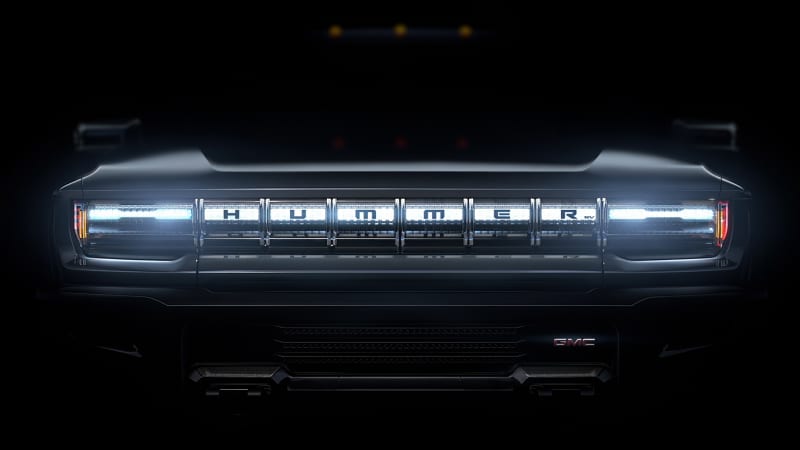
General Motors confirmed plans to resurrect the Hummer nameplate on a GMC-badged electric pickup, and it's beginning to release details about the drivetrain that will power the model. Speaking to investors, company president Mark Reuss announced buyers will have at least three drivetrains to choose from at launch.
The few specifications that have already been announced are impressive. GMC quoted a three-second sprint from zero to 60 mph, at least 1,000 horsepower, and 11,500 pound-feet of torque, though that latter figure undoubtedly corresponds to wheel torque rather than the powertrain's basic output. Most truck buyers don't need Lamborghini-rivaling acceleration, and they'd rather not pay for it, so GMC will also offer more basic versions of its Hummer.
"When we go to market, we'll have one-, two-, and three-motor versions offering different ranges, different performance, and different price points to meet customers wherever they may be. If the customer wants a basic package, we'll have that. If the customer wants true off-road capability, and towing capability, we'll have that, too," Reuss said. He stopped short of revealing additional specifications about each configuration.
While that sounds expensive to develop and certify, Reuss explained General Motors is keeping costs in check by making the Hummer's powertrain as modular as possible. He compared the platform to an ice cube tray. Its overall dimensions are fixed, but people can choose how many rows they fill with water. What he's likely alluding to is a scalable battery pack whose capacity can be increased or decreased by adding or removing cell packs.
As for the motors, we're expecting the entry-level, rear-wheel drive Hummer will come standard with a single motor mounted over the rear axle. The mid-range variant will likely gain a second motor positioned over the front axle to deliver through-the-road all-wheel drive, and the range-topping trim will receive individual rear motors (though they won't be integrated into the wheels) for jaw-dropping performance, and improved off-road capacity.
Economies of scale will come into play, too. While the Hummer is the only electric off-roader whose launch has been confirmed by General Motors, Reuss stated the company's other brands will benefit from it, too.
"We'll have a complete lineup of EVs, including the [Hummer EV] and its stablemates," he said. Nothing is official yet, but it's not too far-fetched to imagine a Chevrolet-badged model to compete against the electric variant of the next-generation Ford F-150, and rumors of a battery-powered version of Cadillac's new Escalade have swirled around the internet for the past few months. It's currently difficult to make money while selling electric cars, but Reuss made it clear the firm will take advantage of its size to profitably enter the segment.
GMC will introduce the Hummer EV on May 20, and it plans to start deliveries in the fall of 2021. "It's going to change a lot of minds about what an EV can do, and what it is," Reuss promised.
Related Video:
Sign In
LICENSE |



