SI
SI
discoversearch

We've detected that you're using an ad content blocking browser plug-in or feature. Ads provide a critical source of revenue to the continued operation of Silicon Investor.  We ask that you disable ad blocking while on Silicon Investor in the best interests of our community.  If you are not using an ad blocker but are still receiving this message, make sure your browser's tracking protection is set to the 'standard' level.
Non-Tech : Kirk's Market Thoughts
COHR 178.06+2.8%Jan 9 3:59 PM EST

 Public ReplyPrvt ReplyMark as Last ReadFilePrevious 10Next 10PreviousNext  
To: Sdgla who wrote (14286)8/9/2022 12:08:07 PM
From: Kirk ©  Read Replies (1) of 27007
 
From my last post, the height of Everest is about 5 miles... so the breathable, life supporting thickness of our tiny 60 mile atmosphere is only the bottom 8%...

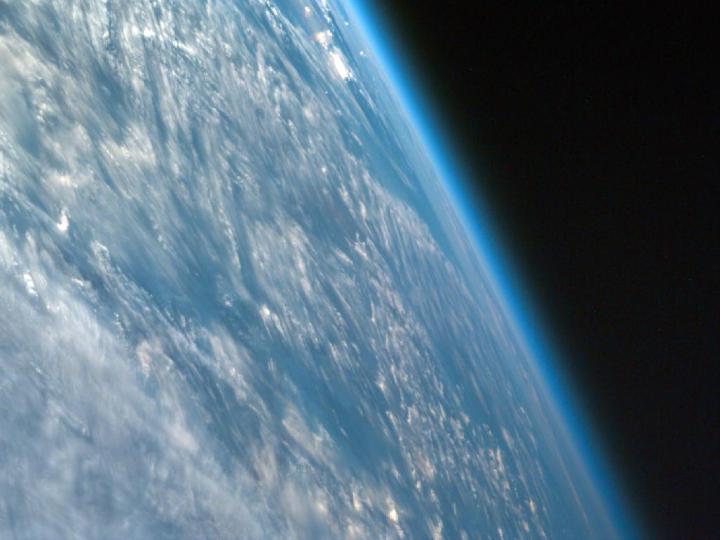
The Earth's atmosphere is an extremely thin sheet of air extending from the surface of the Earth to the edge of space. The Earth is a sphere with a roughly 8000 mile diameter; the thickness of the atmosphere is about 60 miles. In this picture, taken from a spacecraft orbiting at 200 miles above the surface, we can see the atmosphere as the thin blue band between the surface and the blackness of space. If the Earth were the size of a basketball, the thickness of the atmosphere could be modeled by a thin sheet of plastic wrapped around the ball. Gravity holds the atmosphere to the Earth's surface. Within the atmosphere, very complex chemical, thermodynamic, and fluid dynamics effects occur. The atmosphere is not uniform; fluid properties are constantly changing with time and location. We call this change the weather.

At any given location, the air properties also vary with the distance from the surface of the Earth. The sun heats the surface of the Earth, and some of this heat goes into warming the air near the surface. The heated air rises and spreads up through the atmosphere. So the air temperature is highest near the surface and decreases as altitude increases. The speed of sound depends on the temperature and also decreases with increasing altitude. The pressure of the air can be related to the weight of the air over a given location. As we increase altitude through the atmosphere, there is some air below us and some air above us. But there is always less air above us than was present at a lower altitude. Therefore, air pressure decreases as we increase altitude. The air density depends on both the temperature and the pressure through the equation of state and also decreases with increasing altitude.


grc.nasa.gov
Report TOU ViolationShare This Post
 Public ReplyPrvt ReplyMark as Last ReadFilePrevious 10Next 10PreviousNext