Thanks for the picture of your Dad's ship....My Dad was 4F'd when he went to enlist after Pearl Harbor...but his cousin did enlist, was accepted, and a sailor (fireman) on the USS Houston CA-130. He was killed when it went down in the Java Sea at Sunda Strait on Mrch 1, 1942. His family didn't know for a very long time what had happened to him....I think they went to early graves from the worry.
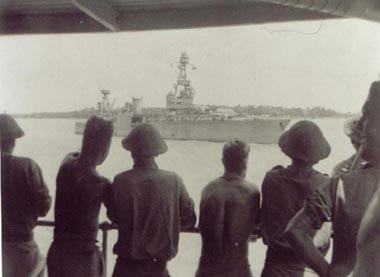
usshouston.org
upload.wikimedia.org
Battle of the Java Sea
Main article: Battle of the Java Sea
Receiving word that the major Japanese invasion force was approaching Java protected by a formidable surface unit, Admiral Doorman decided to meet and seek to destroy the main convoy. Sailing on 26 February 1942 with the cruisers Houston, HMAS Perth, HNLMS De Ruyter, HMS Exeter, HNLMS Java and 10 destroyers, he met the Japanese support force under Admiral Takeo Takagi consisting of four cruisers and 13 destroyers.
In the battle on 27 February 1942, Doorman's forces met the Japanese fleet for the first time in the late afternoon. As Japanese destroyers laid smoke, the cruisers of both fleets opened fire. After one ineffective torpedo attack, the Japanese light cruisers and destroyers launched a second and sunk the destroyer HNLMS Kortenaer. HMS Exeter and the destroyer HMS Electra were hit by gunfire, Electra sinking shortly after. At 17:30 Admiral Doorman turned south toward the Java coast, not wishing to be diverted from his main purpose: the destruction of the convoy itself.
The Allied fleet dodged another torpedo attack and followed the coastline, during which time the destroyer HMS Jupiter was sunk, either by mine or internal explosion. The destroyer HMS Encounter was detached to pick up survivors from Kortenaer, and the American destroyers, their torpedoes expended, were ordered back to Surabaya. With no destroyer protection, Doorman's four remaining ships turned north again in a last attempt to stop the invasion of Java.
At 23:00 the same night, the cruisers again encountered the Japanese surface group. On parallel courses the opposing units opened fire, and the Japanese launched a torpedo attack 30 minutes later. De Ruyter and Java, caught in a spread of 12 torpedoes, exploded and sank, carrying their captains and Admiral Doorman down with them.
This battle on 27 February 1942 was the largest surface engagement since the Battle of Jutland in World War I. By the end of the day, two cruisers and 3 destroyers of the ABDA naval force had been sunk, the remaining destroyers had been ordered back to Surabaya, the cruiser Exeter had been damaged and, before his own ship was sunk, Doorman had ordered the cruisers Perth and Houston to retire.
Battle of Sunda Strait
Captain Albert H. Rooks, commanding officer of Houston, circa 1940–1942.
Main article: Battle of Sunda Strait
On 28 February 1942, the day after the Battle of the Java Sea, the ABDA cruisers Perth and Houston steamed into Banten Bay, hoping to damage the Japanese invasion forces there. The two ships were attacked as they approached the bay, but evaded the nine torpedoes launched by destroyer Fubuki.
The cruisers then sank one transport and forced three others to beach. A Japanese destroyer squadron blocked Sunda Strait, their means of retreat, and the Japanese heavy cruisers Mogami and Mikuma stood dangerously near. The Houston and Perth could not withdraw. Perth came under fire at 23:36 and in an hour had been sunk from gunfire and torpedo hits.
Houston then fought alone until soon after midnight, when she was struck by a torpedo and began to lose headway.
Houston's gunners had scored hits on three different destroyers and sank a minesweeper, but then suffered three more torpedo explosions in quick succession. Captain Albert Rooks was killed by a bursting shell at 00:30 and as the ship came to a stop Japanese destroyers moved in, machine gunning the decks. A few minutes later, Houston rolled over and sank, her ensign still flying. Of the original crew of 1,061, 368 survived — including 24 of the 74-man USMC detachment.
Aftermath
Commander George S. Rentz, Chaplain of Houston 1940–1942.
Houston's fate was not fully known by the world for almost nine months, and the full story of her last fight was not told until after the war was over and her survivors were liberated from prison camps. Captain Rooks received posthumously the Medal of Honor for his actions. Houston Chaplain George S. Rentz was posthumously awarded the Navy Cross, the only Navy Chaplain to be so honored during World War II.
The crew of Houston is honored alongside that of Perth at the Shrine of Remembrance in Melbourne, Australia.
en.wikipedia.org
Also:
history.navy.mil |



