http://www.ncdc.noaa.gov/sotc/global/
Anomalies and Events Map Global Highlights The combined global land and ocean average surface temperature for May 2012 was 0.66°C (1.19°F) above the 20th century average of 14.8°C (58.6°F). This is the second warmest May since records began in 1880, behind only 2010.
The Northern Hemisphere land and ocean average surface temperature for May 2012 was the all-time warmest May on record, at 0.85°C (1.53°F) above average.
The globally-averaged land surface temperature for May 2012 was the all-time warmest May on record, at 1.21°C (2.18°F) above average.
ENSO-neutral conditions continued during May 2012 and sea surface temperature anomalies in the eastern equatorial Pacific Ocean continued to warm. The May worldwide ocean surface temperatures ranked as the 10th warmest May on record.
For March–May (boreal spring) 2012, the combined global land and ocean surface temperature was 0.59°C (1.06°F) above average—the seventh warmest such period on record.
The combined global land and ocean average surface temperature for January–May 2012 was the 11th warmest on record, at 0.50°C (0.90°F) above the 20th century average.
Please Note: The data presented in this report are preliminary. Ranks and anomalies may change as more complete data are received and processed. Effective with the July 2010 State of the Climate Report, NCDC transitioned to the new version (version 3b) of the extended reconstructed sea surface temperature (ERSST) dataset. ERSST.v3b is an improved extended SST reconstruction over version 2. For more information about the differences between ERSST.v3b and ERSST.v2 and to access the most current data, please visit NCDC's Global Surface Temperature Anomalies page.
Introduction Temperature anomalies for May 2012 and March – May 2012 are shown on the dot maps below. The dot maps on the left provide a spatial representation of anomalies calculated from the Global Historical Climatology Network (GHCN) dataset of land surface stations using a 1961–1990 base period. The dot maps on the right are a product of a merged land surface and sea surface temperature (SST) anomaly analysis developed by Smith et al. (2008). For the merged land surface and SST analysis, temperature anomalies with respect to the 1971–2000 average for land and ocean are analyzed separately and then merged to form the global analysis. For more information, please visit NCDC's Global Surface Temperature Anomalies page.
[ top ]
Temperatures In the atmosphere, 500-millibar height pressure anomalies correlate well with temperatures at the Earth's surface. The average position of the upper-level ridges of high pressure and troughs of low pressure—depicted by positive and negative 500-millibar height anomalies on the  May 2012 map—is generally reflected by areas of positive and negative temperature anomalies at the surface, respectively. May 2012 map—is generally reflected by areas of positive and negative temperature anomalies at the surface, respectively.
May
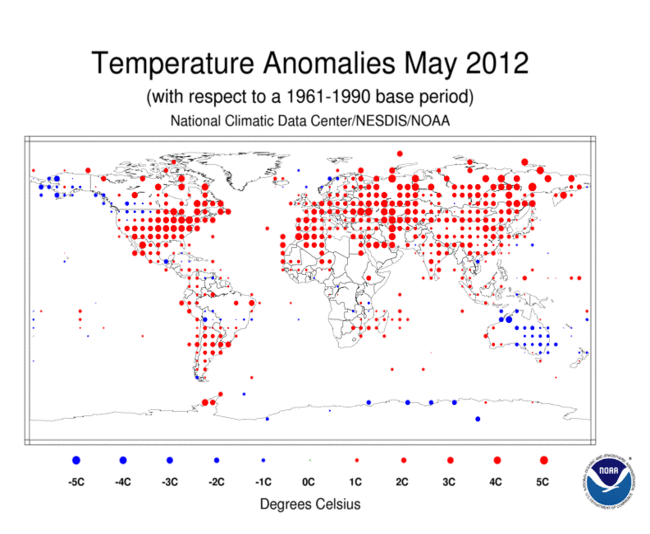
May 2012 Land Surface Temperature
Anomalies in degrees Celsius
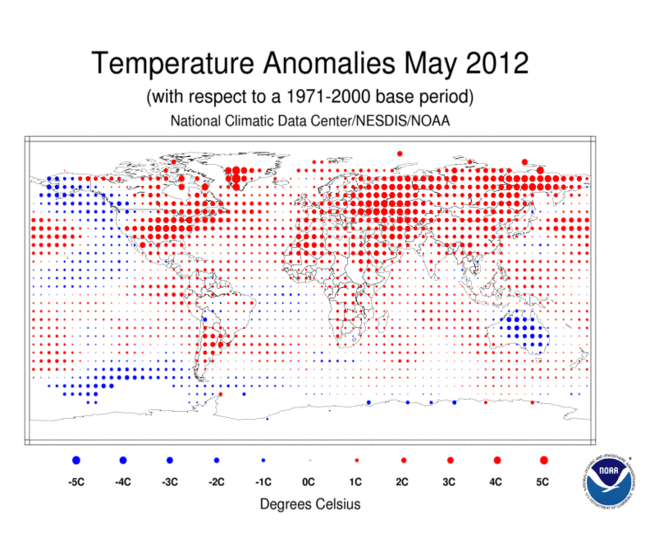
May 2012 Blended Land and Sea Surface
Temperature Anomalies in degrees Celsius
With the dissipation of La Niña during boreal spring, the May 2012 average temperature across global land and ocean surfaces climbed to 0.66°C (1.19°F) above the 20th century average. This places May 2012 as the second warmest May in the 133-year period of record, falling 0.05°C (0.09°F) short of the record warmth of 2010, a month when a nearly year-long warm phase El Niño had just ended. The Northern Hemisphere experienced its all-time warmest May on record, at 0.85°C (1.53°F) above average, breaking the record previously set in 2010. The Southern Hemisphere temperature anomaly was not quite as dramatic, but still ranked ninth warmest among all Mays on record, at 0.47°C (0.85°F) above average.
Considering land surfaces only, the average global temperature was record warm for May, at 1.21°C (2.18°F) above average, surpassing the previous record warmth set in 2010 by 0.10°C (0.18°F). The Northern Hemisphere was also record warm, at 1.47°C (2.65°F) above average, easily breaking the 2010 record by 0.27°C (0.49°F). The Southern Hemisphere land surface temperature for May was also warmer than average with a positive anomaly of 0.52°C (0.94°F), ranking as the 18th warmest such period on record. Much warmer-than-average monthly temperatures were observed across most of Europe, Asia, northern Africa, most of North America, and southern Greenland. Only Australia, Alaska, and the western U.S. / Canadian border region were notably cooler than average.
- According to Australia's Bureau of Meteorology, the nationally-averaged maximum (daytime) temperature was near average (+0.3°C / 0.5°F), while the average minimum (nighttime) temperature was well below average (-1.6°C / -2.9°F), ranking as the fifth coolest May nighttime temperature in the country's 63-year period of record. The Murray-Darling Basin and the state of New South Wales each reported their third coolest May nighttime temperatures.
- Spain experienced its fourth warmest May since national records began in 1960, with a nationally-averaged temperature that was 2.7°C (4.9°F) above average. Eleven stations across different regions of Spain—the Canary Islands, Andalusia, Murcia, Aragon and Catalonia—observed their highest May temperatures on records.
The average global ocean temperature during May was 0.45°C (0.81°F) above the long-term average, ranking as the 10th warmest May on record. This departure marks the highest monthly anomaly since June 2011 and the second warmest since August 2010, a few months after the last El Niño ended in the eastern and central equatorial Pacific Ocean. During May, the northeastern and central Pacific and parts of the Southern Ocean were cooler than average, while the northwestern Atlantic and the north central Pacific had the most extreme warmth. According to the Climate Prediction Center, there is a 50 percent chance that El Niño conditions will emerge during the second half of 2012.
May Anomaly Rank
(out of 133 years) Records °C °F Year(s) °C °F Global Land | +1.21 ± 0.14 | +2.18 ± 0.25 | 1st Warmest | Warmest: 2012 | +1.21 | +2.18 | | 133rd Coolest | Coolest: 1907 | -0.94 | -1.69 | Ocean | +0.45 ± 0.04 | +0.81 ± 0.07 | 10th Warmest | Warmest: 1998 | +0.57 | +1.03 | | 124th Coolest | Coolest: 1911 | -0.52 | -0.94 | Land and Ocean | +0.66 ± 0.07 | +1.19 ± 0.13 | 2nd Warmest | Warmest: 2010 | +0.71 | +1.28 | | 132nd Coolest | Coolest: 1907 | -0.49 | -0.88 | Northern Hemisphere Land | +1.47 ± 0.15 | +2.65 ± 0.27 | 1st Warmest | Warmest: 2012 | +1.47 | +2.65 | | 133rd Coolest | Coolest: 1907 | -1.03 | -1.85 | Ocean | +0.46 ± 0.04 | +0.83 ± 0.07 | 6th Warmest | Warmest: 2005 | +0.58 | +1.04 | | 128th Coolest | Coolest: 1910 | -0.55 | -0.99 | Land and Ocean | +0.85 ± 0.08 | +1.53 ± 0.14 | 1st Warmest | Warmest: 2012 | +0.85 | +1.53 | | 133rd Coolest | Coolest: 1907 | -0.61 | -1.10 | Southern Hemisphere Land | +0.52 ± 0.23 | +0.94 ± 0.41 | 18th Warmest | Warmest: 2002 | +1.04 | +1.87 | | 116th Coolest | Coolest: 1917 | -1.30 | -2.34 | Ocean | +0.46 ± 0.04 | +0.83 ± 0.07 | 10th Warmest | Warmest: 1998 | +0.62 | +1.12 | | 124th Coolest | Coolest: 1911 | -0.52 | -0.94 | Land and Ocean | +0.47 ± 0.06 | +0.85 ± 0.11 | 9th Warmest | Warmest: 1998 | +0.68 | +1.22 | | 125th Coolest | Coolest: 1911 | -0.51 | -0.92 |
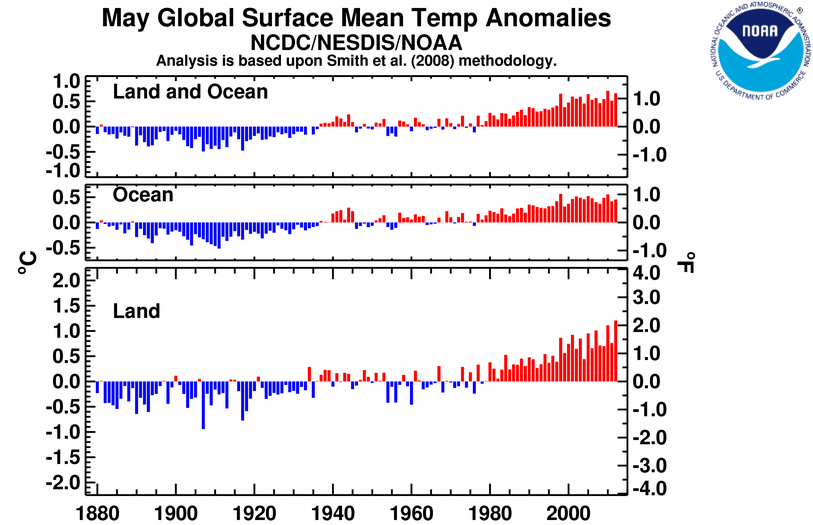
May Global Land and Ocean plot

May Global Hemisphere plot
Season (March–May)

March 2012 – May 2012 Land Surface
Temperature Anomalies in degrees Celsius

March 2012 – May 2012 Blended Land and
Sea Surface Temperature Anomalies in
degrees Celsius
The March–May period ranked as the seventh warmest on record for the seasonally-averaged global land and ocean temperature. The Northern Hemisphere spring ranked as the fourth warmest such period on record, while the Southern Hemisphere autumn was 14th warmest since records began in 1880.
Globally, the average land temperature was the fourth warmest March–May on record, at 1.12°C (2.02°F) above average. Record April and May warmth in the Northern Hemisphere led to record spring warmth over land, with a temperature anomaly of 1.38°C (2.48°F) above the long-term average. That warmth was most pronounced across central Eurasia and most of North America, except the northwest.
- Austria reported its seventh warmest spring since records began in 1767, according to ZAMG. In the east, the district of Lienz was just 0.2°C (0.4°F) short of the record warmth in May 2007.
- The United States reported its warmest spring since records began in 1895, with 31 states in the eastern two-thirds of the country observing record warmth. The national temperature was 2.9°C (5.2°F) above its long-term average, surpassing the previous record by 1.1°C (2.0°F). For additional information, please see the U.S. State of the Climate monthly report.
The Southern Hemisphere had an average land temperature that ranked as the 21st warmest March–May on record. The Southern Hemisphere has a much smaller land area than the Northern Hemisphere, thus it has a much lower impact on globally averaged land surface temperatures.
- Austral autumn was cooler than average across most of Australia, with maximum (daytime) temperatures 0.37°C (0.67°F) below average and minimum (nighttime) temperatures ranking as the fourth lowest on record (-0.93°C / -1.67°F), the lowest since 1994. Autumn nighttime temperatures were the coolest since 1995 in South Australia and coolest since 2000 in Western Australia. La Niña, which tends to have a cooling influence over the country, ended during the season.
As La Niña transitioned to ENSO-neutral conditions during March–May, waters warmed in the eastern and central Pacific Ocean. Overall, the average global ocean temperature for this period was 0.39°C (0.70°F) and ranked as the 11th warmest March–May on record.
March–May Anomaly Rank
(out of 133 years) Records °C °F Year(s) °C °F Global Land | +1.12 ± 0.14 | +2.02 ± 0.25 | 4th Warmest | Warmest: 2010 | +1.26 | +2.27 | | 130th Coolest | Coolest: 1898 | -0.81 | -1.46 | Ocean | +0.39 ± 0.04 | +0.70 ± 0.07 | 12th Warmest | Warmest: 1998, 2010 | +0.56 | +1.01 | | 122nd Coolest | Coolest: 1911 | -0.53 | -0.95 | Land and Ocean | +0.59 ± 0.08 | +1.06 ± 0.14 | 7th Warmest | Warmest: 2010 | +0.75 | +1.35 | | 127th Coolest | Coolest: 1911 | -0.50 | -0.90 | Northern Hemisphere Land | +1.38 ± 0.17 | +2.48 ± 0.31 | 1st Warmest | Warmest: 2012 | +1.38 | +2.48 | | 133rd Coolest | Coolest: 1898 | -0.87 | -1.57 | Ocean | +0.38 ± 0.05 | +0.68 ± 0.09 | 8th Warmest | Warmest: 2010 | +0.56 | +1.01 | | 126th Coolest | Coolest: 1910 | -0.51 | -0.92 | | Ties: 2001, 2009 | | | | Land and Ocean | +0.76 ± 0.10 | +1.37 ± 0.18 | 4th Warmest | Warmest: 2010 | +0.86 | +1.55 | | 130th Coolest | Coolest: 1908 | -0.54 | -0.97 | Southern Hemisphere Land | +0.44 ± 0.18 | +0.79 ± 0.32 | 21st Warmest | Warmest: 2010 | +1.04 | +1.87 | | 113rd Coolest | Coolest: 1917 | -0.99 | -1.78 | Ocean | +0.42 ± 0.04 | +0.76 ± 0.07 | 12th Warmest | Warmest: 1998 | +0.62 | +1.12 | | 122nd Coolest | Coolest: 1911 | -0.54 | -0.97 | | Ties: 1999 | | | | Land and Ocean | +0.43 ± 0.07 | +0.77 ± 0.13 | 14th Warmest | Warmest: 1998 | +0.67 | +1.21 | | 120th Coolest | Coolest: 1911 | -0.54 | -0.97 |
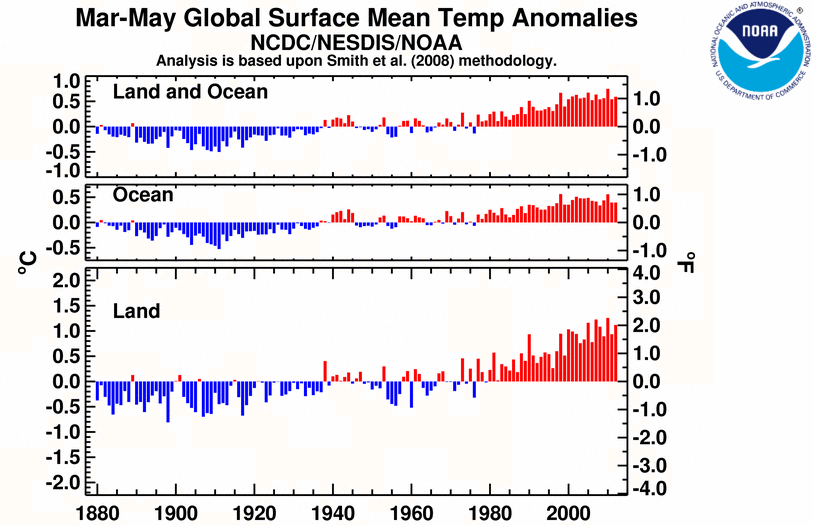
March–May Global Land and Ocean plot

March–May Global Hemisphere plot
Year-to-date (January–May)  January–May 2012 January–May 2012
The globally-averaged temperature across land and oceans for the first five months of 2012 was the 11th warmest January–May on record. Of note, the year-to-date global anomalies for 2012 have increased each month as the year has progressed and La Niña conditions waned — January: +0.35°C (+0.65°F); January–February: +0.37°C (+0.67°F); January–March: +0.39°C (+0.70°F); January–April: +0.46°C (+0.83°F); and January–May (+0.50°C (+0.90°F). The record for the warmest January–May was set in 2010, with a temperature that was 0.71°C (1.28°F) above average.

Global Year to Date Temperature Anomalies
The greatest January–May warmth was observed over southern Greenland, northern Russia, and the eastern two-thirds of North America. The coolest anomalies occurred across nearly all of Alaska, Mongolia and bordering regions, and most of Australia.
January–May Anomaly Rank
(out of 133 years) Records °C °F Year(s) °C °F Global Land | +0.85 ± 0.21 | +1.53 ± 0.38 | 10th Warmest | Warmest: 2007 | +1.31 | +2.36 | | 124th Coolest | Coolest: 1893 | -0.96 | -1.73 | Ocean | +0.37 ± 0.04 | +0.67 ± 0.07 | 12th Warmest | Warmest: 1998, 2010 | +0.56 | +1.01 | | 122nd Coolest | Coolest: 1911 | -0.51 | -0.92 | Land and Ocean | +0.50 ± 0.09 | +0.90 ± 0.16 | 11th Warmest | Warmest: 2010 | +0.71 | +1.28 | | 123rd Coolest | Coolest: 1911 | -0.51 | -0.92 | Northern Hemisphere Land | +0.99 ± 0.26 | +1.78 ± 0.47 | 9th Warmest | Warmest: 2007 | +1.49 | +2.68 | | 125th Coolest | Coolest: 1893 | -1.13 | -2.03 | | Ties: 2009 | | | | Ocean | +0.35 ± 0.05 | +0.63 ± 0.09 | 10th Warmest | Warmest: 2010 | +0.56 | +1.01 | | 124th Coolest | Coolest: 1910, 1911 | -0.47 | -0.85 | | Ties: 2001, 2011 | | | | Land and Ocean | +0.59 ± 0.13 | +1.06 ± 0.23 | 10th Warmest | Warmest: 2007 | +0.85 | +1.53 | | 124th Coolest | Coolest: 1893 | -0.67 | -1.21 | Southern Hemisphere Land | +0.48 ± 0.16 | +0.86 ± 0.29 | 21st Warmest | Warmest: 2010 | +1.03 | +1.85 | | 113rd Coolest | Coolest: 1917 | -0.91 | -1.64 | Ocean | +0.39 ± 0.04 | +0.70 ± 0.07 | 15th Warmest | Warmest: 1998 | +0.60 | +1.08 | | 119th Coolest | Coolest: 1911 | -0.53 | -0.95 | Land and Ocean | +0.41 ± 0.07 | +0.74 ± 0.13 | 16th Warmest | Warmest: 1998 | +0.66 | +1.19 | | 118th Coolest | Coolest: 1911 | -0.54 | -0.97 |

January–May Global Land and Ocean plot

|



