New signs of life arise in Las Vegas
Unemployment is down, construction projects are resuming, and tourism is back up after years of recession. Experts stop short of proclaiming a comeback, but there's guarded hope in the air.
April 21, 2013|
By John M. Glionna, Los Angeles Times
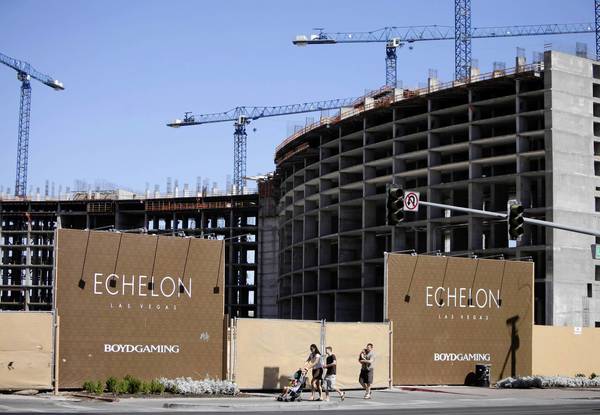
The abandoned Echelon project site in Las Vegas, shown in 2009, has been… (Jae C. Hong, Associated…)
LAS VEGAS — For nearly five years, the steel-and-concrete skeleton of the abandoned resort project has taunted this city, a glaring reminder that casino operators here can't win every economic wager they place.
The stalled Echelon project sits on hallowed gambling ground: It's where the old Stardust casino was imploded. Construction on the new $4-billion resort began in 2007 and froze a year later — a failure so embarrassing that city officials later ordered owner Boyd Gaming Corp. to build barriers to hide the remains.
But those walls will soon come down because the property has been purchased by an Asian gaming powerhouse — one indication that Las Vegas' devastated economy is on the mend. It's the kind of comeback that is giving rise to guarded hopes, while not vigorous enough yet to inspire the kind of all-in bet the city is famous for.
The Malaysia-based Genting Group bought the 87-acre ghost town last month, announcing plans to build a $2-billion, China-themed resort with a replica of the Great Wall, faux terra cotta warriors and displays for live pandas.
"The fact that a major foreign company wants to take a risk on the Strip is a pretty fair argument that things are turning around," said Jeremy Aguero, principal analyst for the Las Vegas-based research firm Applied Analysis. "You can almost hear the sigh of relief in this community."
The metropolitan area's 9.8% unemployment rate, while still above the national average of 7.6%, plummeted from 12.1% just a year ago — the fastest improvement among major cities nationwide.
As much as $2 billion is earmarked for additional hotel-casino refurbishment on the Strip, including the transformation of the old Sahara site into another upscale casino — SLS Las Vegas. The Las Vegas Global Business District, a separate $2.5-billion convention center project just off the Strip corridor, has also been given the green light.
Last month, Caesars Entertainment unveiled its $550-million Linq project, a dining-shopping-entertainment district that will feature the Vegas High Roller, a 550-foot-tall Ferris wheel that will be the world's largest. MGM Resorts International also announced plans last month to build a 20,000-seat indoor sports and events arena behind the Monte Carlo and New York-New York casinos. Meanwhile, the city's sagging downtown is being buoyed by entrepreneur Tony Hsieh's redevelopment plan to create a high-tech Internet hub.
Tourism and local population are also on the rise. Last year, a record 39.7 million visitors arrived. Gambling revenue on the Strip in February was $696 million, the largest single-month total ever. The metropolitan area's population finally topped 2 million residents, following years of minimal gain, according to U.S. Census figures.
Even home sales are soaring. The average price of an existing home in southern Nevada has reached just under $130,000, a 30% rise over this time last year, according to the Greater Las Vegas Assn. of Realtors.
Most experts still refrain from pronouncing a full comeback. "The indicators we track are all moving in the right direction — the numbers are working their way back up, but they're still not what we saw prior to the recession," said Kevin Bagger, who heads the research division at the Las Vegas Convention and Visitors Authority. "We've been in recovery mode; we're not at a full recovery," he added.

Rising home sales, for example, may have been artificially buoyed by a 2011 state law — AB284 — that helped stymie banker attempts to foreclose on Nevada homes. Analysts say that foreclosures could spike this year if lawmakers roll back the bill, allowing a free market to prevail.
"The rise in home prices can't be sustained," said Robert Noggle, a local real estate lawyer who specializes in short sales. "The backlog of delinquent properties is enormous, and those homes must be disposed of. That means prices will drop."
Six out of every 10 homes in Las Vegas remain underwater — a statistic that leads the nation — meaning homeowners owe the banks more than their properties are worth.
North Las Vegas homeowner Charles Mills, a 46-year-old father of two, bought his home on Midnight Breeze Street for $308,500 in 2006. Today, it's worth less than one-third of that. Mills is holding on, but others nearby aren't so fortunate. He said only 10 of 74 homeowners in his development are still in their houses.
And while new home building is evident, the rate pales in comparison to the past. In 2006, Las Vegas had 112,000 workers employed in construction, a rate three times the national average. Today that number is under 35,000.
After losing his job as a heavy equipment operator, Mills submitted 40 applications without a callback. He was forced to work outside the state and leave his family for weeks at a time. "That's the hardest part," he said. "I come home a couple of days a month. What kind of dad is that?"
read more................
articles.latimes.com |



