SI
SI
discoversearch

We've detected that you're using an ad content blocking browser plug-in or feature. Ads provide a critical source of revenue to the continued operation of Silicon Investor.  We ask that you disable ad blocking while on Silicon Investor in the best interests of our community.  If you are not using an ad blocker but are still receiving this message, make sure your browser's tracking protection is set to the 'standard' level.
Pastimes : vitamins herbs supplements longevity and aging -- Ignore unavailable to you. Want to Upgrade?


To: Rock_nj who wrote (12183)3/23/2015 3:30:14 PM
From: Pogeu Mahone  Read Replies (1) | Respond to of 17099
 
Rock
show me one,
just one case of D3 toxicity.
Other then my wifes who got her D3 level to 500.

4 months later she was D3 deficient with her D3 =53.


A google search of D3 overdose victims finds zero overdose victims!
Google should be able to help you.
google.com

Ask all of the police you know, call up your local police force
and ask: "How many Vitamin D3 overdose cases have you responded to?"
When they get thru laughing and trying to figure out what kind of a nut you are, they will answer they have never heard of this!

ZERO is an absolute

So please validate your statement D3 has very high toxicity levels.
If you cannot please report that also.:O)

"Unlike Vitamin D, which has very high toxicity levels, I am concerned about potential negative effects from CoQ10 supplements."


To: Rock_nj who wrote (12183)3/23/2015 3:41:47 PM
From: Pogeu Mahone  Respond to of 17099
 
Since you cannot document a D3 overdose leading to death
or any harm what so ever..


Your doctor is more likely to kill you by not washing his hands.
---------------------------------------------
The Doctor Who Championed Hand-Washing And Briefly Saved Lives

JANUARY 12, 2015 3:22 AM ET

REBECCA DAVIS


Ignaz Semmelweis washing his hands in chlorinated lime water before operating.

Bettmann/Corbis

This is the story of a man whose ideas could have saved a lot of lives and spared countless numbers of women and newborns' feverish and agonizing deaths.

You'll notice I said "could have."

The year was 1846, and our would-be hero was a Hungarian doctor named Ignaz Semmelweis.

Semmelweis was a man of his time, according to Justin Lessler, an assistant professor at Johns Hopkins School of Public Health.
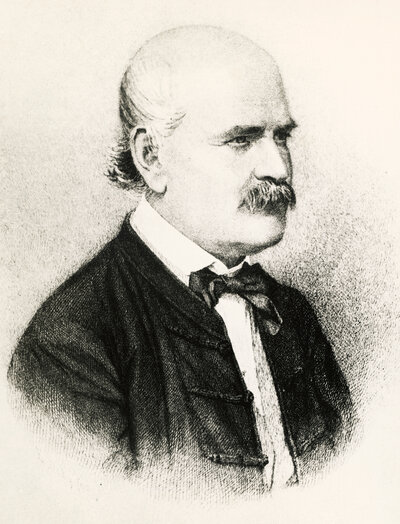
i

Semmelweis considered scientific inquiry part of his mission as a physician.

De Agostini Picture Library/Getty Images

It was a time Lessler describes as "the start of the golden age of the physician scientist," when physicians were expected to have scientific training.

So doctors like Semmelweis were no longer thinking of illness as an imbalance caused by bad air or evil spirits. They looked instead to anatomy. Autopsies became more common, and doctors got interested in numbers and collecting data.

The young Dr. Semmelweis was no exception. When he showed up for his new job in the maternity clinic at the General Hospital in Vienna, he started collecting some data of his own. Semmelweis wanted to figure out why so many women in maternity wards were dying from puerperal fever — commonly known as childbed fever.

He studied two maternity wards in the hospital. One was staffed by all male doctors and medical students, and the other was staffed by female midwives. And he counted the number of deaths on each ward.

When Semmelweis crunched the numbers, he discovered that women in the clinic staffed by doctors and medical students died at a rate nearly five times higher than women in the midwives' clinic.

But why?

i

At Vienna General Hospital, women were much more likely to die after childbirth if a male doctor attended, compared to a midwife.

Josef and Peter Schafer/Wikipedia

Semmelweis went through the differences between the two wards and started ruling out ideas.

Right away he discovered a big difference between the two clinics.

In the midwives' clinic, women gave birth on their sides. In the doctors' clinic, women gave birth on their backs. So he had women in the doctors' clinic give birth on their sides. The result, Lessler says, was "no effect."

Then Semmelweis noticed that whenever someone on the ward died of childbed fever, a priest would walk slowly through the doctors' clinic, past the women's beds with an attendant ringing a bell. This time Semmelweis theorized that the priest and the bell ringing so terrified the women after birth that they developed a fever, got sick and died.

So Semmelweis had the priest change his route and ditch the bell. Lessler says, "It had no effect."

By now, Semmelweis was frustrated. He took a leave from his hospital duties and traveled to Venice. He hoped the break and a good dose of art would clear his head.

When Semmelweis got back to the hospital, some sad but important news was waiting for him. One of his colleagues, a pathologist, had fallen ill and died. It was a common occurrence, according to Jacalyn Duffin, who teaches the history of medicine at Queen's University in Kingston, Ontario.

This was a revelation — childbed fever wasn't something only women in childbirth got sick from. It was something other people in the hospital could get sick from as well.

"This often happened to the pathologists," Duffin says. "There was nothing new about the way he died. He pricked his finger while doing an autopsy on someone who had died from childbed fever." And then he got very sick himself and died.

Semmelweis studied the pathologist's symptoms and realized the pathologist died from the same thing as the women he had autopsied. This was a revelation: Childbed fever wasn't something only women in childbirth got sick from. It was something other people in the hospital could get sick from as well.

But it still didn't answer Semmelweis' original question: "Why were more women dying from childbed fever in the doctors' clinic than in the midwives' clinic?"

Duffin says the death of the pathologist offered him a clue.

"The big difference between the doctors' ward and the midwives' ward is that the doctors were doing autopsies and the midwives weren't," she says.

So Semmelweis hypothesized that there were cadaverous particles, little pieces of corpse, that students were getting on their hands from the cadavers they dissected. And when they delivered the babies, these particles would get inside the women who would develop the disease and die.

If Semmelweis' hypothesis was correct, getting rid of those cadaverous particles should cut down on the death rate from childbed fever.

So he ordered his medical staff to start cleaning their hands and instruments not just with soap but with a chlorine solution. Chlorine, as we know today, is about the best disinfectant there is. Semmelweis didn't know anything about germs. He chose the chlorine because he thought it would be the best way to get rid of any smell left behind by those little bits of corpse.

Semmelweis didn't know anything about germs. He chose the chlorine because he thought it would be the best way to get rid of any smell left behind by those little bits of corpse.

And when he imposed this, the rate of childbed fever fell dramatically.

What Semmelweis had discovered is something that still holds true today: Hand-washing is one of the most important tools in public health. It can keep kids from getting the flu, prevent the spread of disease and keep infections at bay.

You'd think everyone would be thrilled. Semmelweis had solved the problem! But they weren't thrilled.

For one thing, doctors were upset because Semmelweis' hypothesis made it look like they were the ones giving childbed fever to the women.

And Semmelweis was not very tactful. He publicly berated people who disagreed with him and made some influential enemies.

Eventually the doctors gave up the chlorine hand-washing, and Semmelweis — he lost his job.

Even today, convincing health care providers to take hand washing seriously is a challenge.


Semmelweis kept trying to convince doctors in other parts of Europe to wash with chlorine, but no one would listen to him.

Even today, convincing health care providers to take hand-washing seriously is a challenge. Hundreds of thousands of hospital patients get infections each year, infections that can be deadly and hard to treat. The Centers for Disease Control and Prevention says hand hygiene is one of the most important ways to prevent these infections.

Over the years, Semmelweis got angrier and eventually even strange. There's been speculation he developed a mental condition brought on by possibly syphilis or even Alzheimer's. And in 1865, when he was only 47 years old, Ignaz Semmelweis was committed to a mental asylum.

The sad end to the story is that Semmelweis was probably beaten in the asylum and eventually died of sepsis, a potentially fatal complication of an infection in the bloodstream — basically, it's the same disease Semmelweis fought so hard to prevent in those women who died from childbed fever.

hand washing public health medicine infectious disease women's health


To: Rock_nj who wrote (12183)3/23/2015 3:58:35 PM
From: Pogeu Mahone  Respond to of 17099
 
Ask your doctor:O(
.
Shocking report reveals alarming rate of deadly hospital mistakes
Mar 23rd 2015 9:46AM
MANHATTAN, NY (PIX11) –Jacqueline Bimbaum is still scarred over her father's death six years ago in a Manhattan Hospital.

"It's the worst thing he ever did," a grieving daughter said. "Because it killed him."

Bimbaum's recently retired 85-year-old dad opted for a hip replacement to more fully enjoy his new life. The surgery was a snap. But what he didn't bank on was getting sickened by a hospital-acquired infection.

"He got a MRSA, a staph infection," Bimbaum said.

One after another, then antibiotic after antibiotic. He needed open heart surgery to clear of its infection, then dialysis and ultimately "no hope."

PHOTO GALLERY | 1 of 12 IMAGES

??

Photo credit: PIX11

"They said there was no hope and my sister and I had to make the decision to take him off life support," Bimbaum said.

And, sadly, the Bimbaum family is not alone.

Read the full study from Consumer ReportsDoris Peter, director of the Consumer Reports Health Ratings Center, said that about 440,000 people a year die from a preventable medical harm inside a hospital.

Consumer Reports undertook a sweeping study of why patients get sick inside hospitals.

According to the study, 1,000 people a day experience a preventable drug mistake, 29 percent of people hospitalized experience at least one medical error, and 20 percent of people felt they'd been discriminated against. Those who feel they rarely received respect are two-and-half times more likely to experience a medical error, the study found.

"When something happens like that, you get a hospital's acquired infection, the hospital staff will tell you, 'Well, there's nothing we can do,'" Peters said.

But that's not true. Hospitals also must be held accountable. In some ways, they are starting to be. And where it hurts -- in the wallet.

Medicare now reduces reimbursements when hospitals hurt patients -- by causing them to be re-admitted, frequently because mistakes were made. Private insurers are trying to do the same.

But there's a paradox: the sickest patients rack up the biggest bills, creating more profit for hospitals.

"The bills can be ten times, 50 times the bill of a regular person," Consumer Reports notes.

Locally, this is how well NY Hospitals are caring for their patients, based on how Consumer Reports scored them according to data about infections, complications and re-admissions:

St. Francis in Roslyn (64)Hudson Valley in Westchester (58)NYU Langone (55)The lowest on the list:

Glen Cove Hospital (30)Lawrence Hospital in Bronxville (29)Kings County Hospital (24)Some hospitals, though, have dramatically improved their scores by using simple but stringent protocols, for policies and practices as basic as hand-washing. Some facilities have even driven infection rates down to zero.

Yet, this still haunts Bimbaum to this day.

"The hand sanitizer outside his room was empty," she said. "Meant to keep hands clean? Right."

But patients can dramatically improve their chances of leaving the hospital alive by following these simple instructions:

Ask questionsBring friends and family with you to the doctorMake eye contact and be a personTake notesMake sure your doctor always washes their hands before working on youBimbaum wished she'd stressed that more for her own father.

"It's really a crime, that people (who) shouldn't die at this point in their lives are dying," she said.

To read more, click here to visit Consumer Reporters' website.


To: Rock_nj who wrote (12183)3/23/2015 11:23:00 PM
From: Pogeu Mahone  Respond to of 17099
 
Ask Your Doctor-S-

Exercise, Not Vitamin D, Cuts Injuries From Falls
Neither worked to cut odds for any type of falls, but exercise may help prevent injury if a tumble occurs

WebMD News from HealthDay

By Alan Mozes

HealthDay Reporter

MONDAY, March 23, 2015 (HealthDay News) -- Neither routine exercise nor vitamin D supplementation does anything to lower the overall risk for accidental falls among older women, a new Finnish study says.

However, the risk of serious injury as a result of falling was cut by more than half when elderly women engaged in regular exercise, according to the study.

"Falls are the leading cause of unintentional injuries and fractures in older adults -- head injuries and fractures being the most severe consequences," explained study lead author Kirsti Uusi-Rasi, a senior researcher and adjunct professor with the UKK Institute for Health Promotion Research in Tampere, Finland. "Therefore, falls prevention is important when trying to prevent injuries."

Uusi-Rasi and her colleagues discuss their findings in the March 23 online issue of JAMA Internal Medicine.

Vitamin D is known to help preserve bone health, but Uusi-Rasi noted that prior research exploring the relationship between vitamin D supplements and/or strength and balance training and fall risk among seniors has been inconclusive.

To explore the protective potential of both exercise and vitamin D, investigators focused on just over 400 women between the ages of 70 and 80. The women lived at home in Finland during the study period between 2010 and 2013. None were deficient in vitamin D prior to the study.

Participants were divided into four groups: a vitamin D alone group; a vitamin D with exercise group; an exercise alone group; and a group that neither exercised nor took vitamin D.

Those taking vitamin D were given a daily dosage of 800 IUs. Those who exercised did so under the supervision of physical therapists in a class setting, twice a week for the first year and once-weekly classes during the second year. Classes focused on improving balance, strength, agility, movement, and the ability to lift weight.

The result: Over the course of two years the risk for falling was found to be more or less equal across all groups.

However, supervised physical training was associated with a dramatically lower risk for serious injury when falls did happen. Serious injury was defined as experiencing a fall that results in having to seek medical care for bruising, abrasions, contusions, sprains, fractures and/or head injuries.

