Is this what I should know? Way ahead of you sport. Science guy, remember? Sometimes it is the knowing where to get the info that helps. Take a read.
Tesla's battery supplier is Panasonic Corporation (TYO:6752), providing battery packs for the Tesla Model S vehicle that contain more than 7,100 individual 18650-model cells. It is unclear if Panasonic uses synthetic or natural graphite in these batteries, or how such materials are processed.
You should also know that this is the early days for the gigafactory initiative, and a number of important details have yet to emerge. There is certainly no guarantee that Tesla will actually move forward with the project, or that it might not morph into some other form. China, in particular, has the concern of the use of acids by the industry to purify mined graphite so that it can be used in battery anodes.
Natural flake graphite should play a role in reducing the unit costs of battery production and in reducing the environmental footprint associated with production, if acid-based purification steps can be avoided.
"As with any natural resource, the quantity and grade of any given graphite deposit is important, but the type and distribution of the flake size, their purity and their amenability to processing dictate the quality of any given project.The graphite ore is mined from the deposit and is subject to standard beneficiation processes, such as crushing, milling and flotation. The higher the initial head grade, the cheaper this process will generally be, all other things being equal. The resulting graphite concentrate, known as run-of-mine, or ROM concentrate, is typically sold directly to end-users in a number of sectors. Some junior mining companies are planning to upgrade a portion of that ROM concentrate internally for specific applications, such as the high-purity graphite used in the production of battery anodes.
Battery-grade graphite requires very high purity levels, typically >99.9% carbon-as-graphite (Cg). This material also needs to be spheroidized using careful processes that convert the flat graphite flakes into potato-like shapes, which pack much more efficiently into a given space. The high purity levels and the enhanced "tapping" density (to >0.9 kg/m3) are important for producing the high electrical conductivity that is required during anode operation.
Spheroidizing the graphite flakes also reduces their size, a process known as micronization. Standard battery-grade materials require an average diameter of approximately 10-30 µm, so in theory, feedstock materials with flake sizes greater than 30 µm (+400 mesh) could be used. However, starting purity levels tend to decrease with flake size, so flake material with an average diameter of 150 µm (+150 mesh) or greater is typically used. This is, of course, a double-edged sword, since the larger the flakes used, the more energy will be required to reduce the average size of the flakes to the desired 10-30 µm. Smaller particles are preferred, as this makes it easier for the lithium ions in the electrolyte to diffuse between graphite particles.
It should be noted that it is the tendency for purity levels to increase with flake size that is the real reason for the common 'mantra' that for battery-grade materials, the bigger the flake size, the better. In fact, the ideal precursor material would have small flake size if it had sufficient purity levels for the subsequent processing to be cost-effective.
One other important factor in the production of battery-grade materials is that of wastage. The standard spheroidizing and micronizing processes used in China waste up to 60-70% of the mass of total graphite flakes present during processing. Therefore, for every one tonne of spheroidal graphite produced in China, approximately three tonnes of feedstock materials might be required (though the waste materials can be used for other purposes).
The graphite may be purified before or after spheroidizing and micronizing, depending on the manufacturer. As mentioned earlier, the low-cost approach typically used in China is to leach the impurities from the graphite with acid, with the associated environmental concerns that that brings. Alternatively (and far more acceptable in Western jurisdictions), a thermal process can be applied. This typically involves the use of halogen gases to cause chemical reactions at high temperatures with the impurities, which covert the resulting compounds into gases too and eliminate them from the bulk graphite material. The higher the starting purity levels of the graphite after initial concentration at the mine site, the lower the cost will be for purification, and this can make a substantial difference when comparing concentrate feedstocks with different starting purity levels. TMR estimates that the cost difference in purifying a 95% Cg concentrate to >99.9% Cg, versus taking a 98% Cg concentrate to >99.9% Cg could be as much as $2-3,000/t of concentrate, using thermal processes.
The final step for preparing spheroidal graphite for anode production is the application of a coating to the particles to reduce their specific surface area. This is important, as reducing the specific surface area will increase the long-term capacity of the battery cell. Intercalation of the electrolyte solvent into the graphite and its reaction with it causes expansion of the graphite, with the potential for delamination and a lowering of the life expectancy.
During the first charge of the battery cell, an initial, irreversible chemical reaction occurs between the electrolyte and the graphite in the anode, resulting in the formation of a so-called surface electrolyte interphase (SEI) layer. Once formed, this layer reduces further decomposition of the electrolyte and actually protects the graphite anode from exfoliating.
With too large a specific surface area, the formation of the SEI layer can reduce the graphite's ability to subsequently hold and to release the lithium ions in the electrolyte, thus reducing lifetime capacity for the battery. Coating the graphite prior to anode production reduces this effect and helps to maintain the maximum capacity possible for the battery. The coating can also reduce the chances of a runaway chemical reaction in the battery.
Such coatings are typically carbon- (not graphite-) based; uncoated spheroidal graphite typically sells for $3-4,000/metric tonne (t); coated spheroidal graphite sells for $9-10,000/t. The battery manufacturers typically apply these coatings, though some traders will buy uncoated materials and apply coatings before selling the finished product to the battery manufacturers."
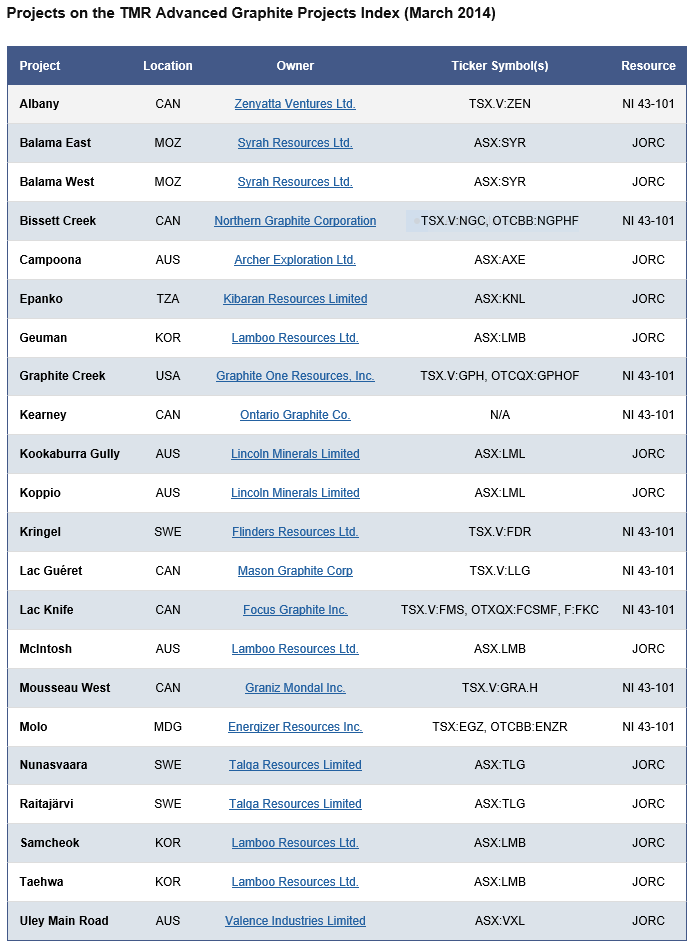
Notice TMR tracks graphite projects under development via the TMR Advanced Graphite Projects Index. The minimum requirement for a project's inclusion on the Index is for it to have an NI 43-101- or JORC Code-compliant mineral resource estimate. At present, there are 23 such mineral resources on the Index associated with 20 graphite projects being developed by 16 different companies in 8 countries. Those resources are:
ZEN not on the list
Major considerations;
The project should have as a minimum, Demonstrated mineral resources (i.e. Measured + Indicated);
- The project should have a completed Feasibility Study *FS), or have one underway;
- A purification process for getting to battery-grade (>99.9% Cg) should have been defined and successfully tested (preferably without using the wet acid method); and
- A spheroidization and micronization process should have been defined and tested.
Additional considerations relate specifically to potential costs of production, and include:
- Initial grade of in-situ graphite (relates to beneficiation costs);
- The resulting purity levels of the resulting run-of-mine (ROM) concentrates after beneficiation (relates to subsequent purification costs);
- The proportion of smaller flake materials with higher purity levels after beneficiation (related to subsequent spheroidization and micronization costs and yield levels);
- Whether or not a coating process has been developed and tested for the spheroidal graphite;
Give credit where due.
"A two-time graduate of the University of Birmingham in the UK, Gareth has a B.Eng. (Hons) in Materials Science & Technology and a Ph.D. in Metallurgy & Materials, focused on rare-earth permanent-magnet materials. He is a Fellow of the Institute of Materials, Minerals & Mining, a Fellow of the Institution of Engineering & Technology, a Chartered Engineer and a Senior Member of the IEEE. Gareth is a member of the Strategic Materials Advisory Council."
Nice to have friends. |



