good news for the free-lunch extractive / moolah mining / cloud atm protocol epi-centered around shanghai - hong kong and calibrated to hong kong trading time zone, that we should likely be getting earlier dibs on choice bites on the interim results of r&d spend and s&e findings, even as we partake in the nasdaq / nyse rush rush should we be feeling energetic in the middle of the night
copying schmopying, for it hardly matters whether a kitten is ginger or black, as long as it is adorable
bigthink.com
China is the world's new science superpower, topping the U.S. in publications
Robby Berman
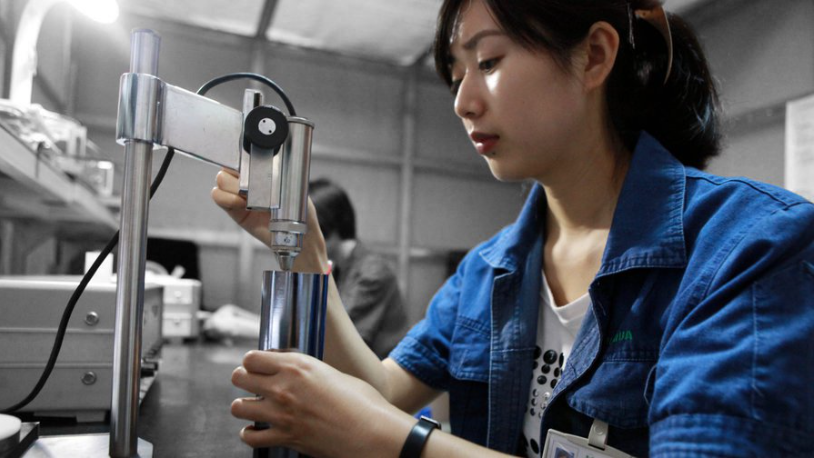
The National Science Board (NSB) of the National Science Foundation (NSF) has just released its Science & Engineering Indicators 2018, which it describes as, “Broad-based, objective information on the U.S. and international S&E enterprise” — S&E being short for science and engineering. The report shows that, for the first time, China is the world leader in the publication of scientific papers, besting the previous leader, the United States. While there are still lots of areas in which the U.S. leads China and the rest of the world, the new ranking reflects China’s increasing importance in the world of S&E.
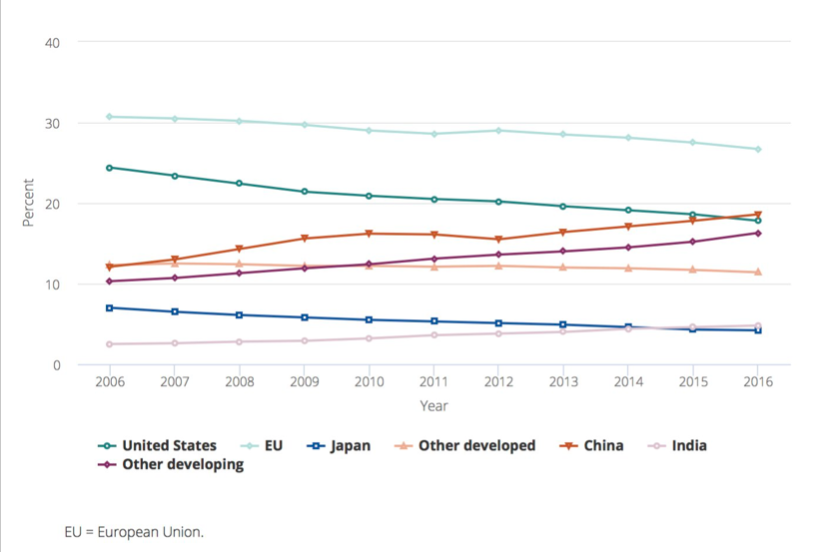
Only the E.U., a group of countries, publishes more than China alone. (NSB)
It remains true that developed economies, as a group—including the U.S.—continue to produce the lion’s share of research: about 900,000 of some 1.4 million S&E publications in 2016, which is the last year covered by the study. But the trend lines suggest that things are changing: the total output of developed nations has gone up by an anemic 1.7%, while research from developing nations increased by a robust 8.9%. The output from the U.S., having now nearly leveled off at just a .7% increase, saw its share of S&E publications drop from 24.4% in 2006 to 17.8% in 2016. Meanwhile, China rose to Number 1, with 18.6% of the world’s 2016 S&E publications. That’s 426,000 papers from China as opposed to the U.S’s 409,000.
Different countries have different specialties, of course, and China’s is engineering studies. The U.S and E.U. produce more biomedical research, and American research results in a greater number of patents. U.S. and E.U. papers are also cited more frequently than research from China. The countries generating the most citations, however, are Sweden—for research in medicine, biochemistry, genetics, molecular biology, and engineering—and Switzerland, for biochemistry, medicine, physics, and astronomy.
Economist Robert J. Samuelson writes in The Washington Post, “The actual numbers are breathtaking for the speed with which they've occurred," adding, “China has become—or is on the verge of becoming—a scientific and technical superpower. We should have expected nothing less."
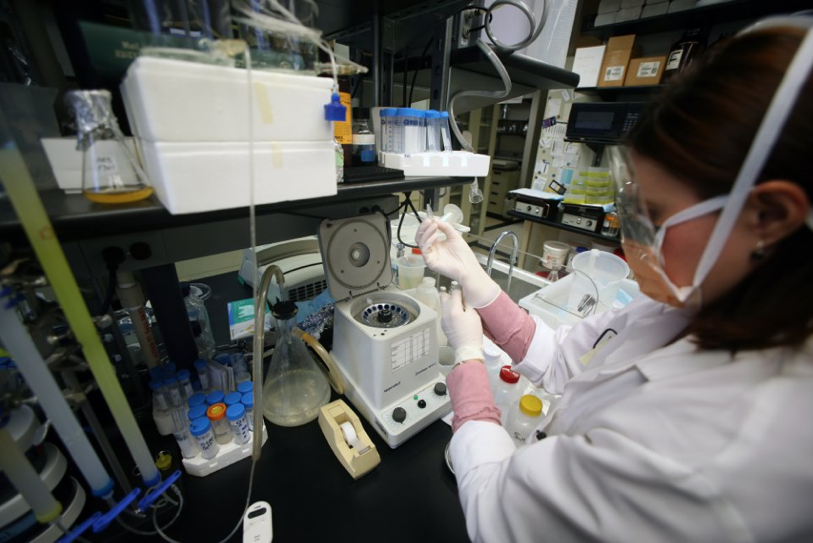
Photo: Emin Kuliyev via Shutterstock
Samuelson’s referring to China’s large, and growing, investment in S&E research and development, which has risen by 18% every year since 2000, vs. the United States’ 4%. That’s 408 billion dollars poured by China’s leaders into R&D per annum. That nation has clearly made science a major priority, seeing it as a potent economic driver, at the same time as the current administration of the U.S. government is de-emphasizing scientific research. In two years, the NSB will be updating its report, at which time the shift in American’s priorities will be more fully reflected in the publication data, and may further exacerbate the current trend.
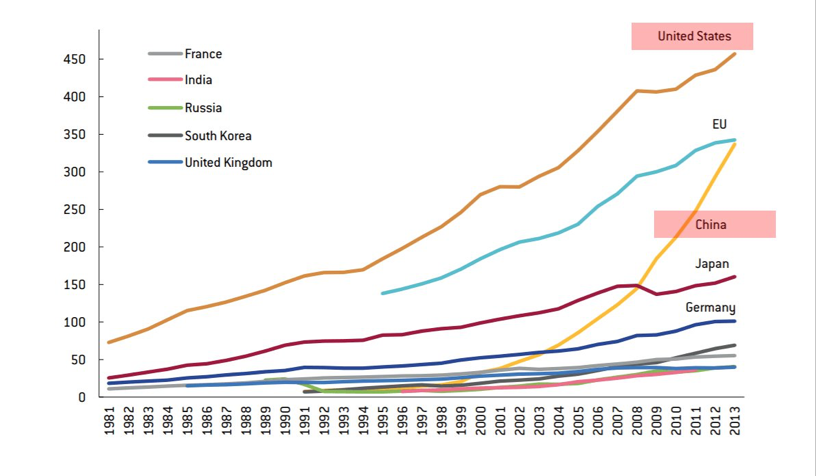
Chart shows R&D spending in billions of dollars. Source: Bruegel, based on NSF 2016 data.
Samuelson sees growing Chinese S&E capabilities as potentially threatening to the U.S., writing, “One danger is military. If China makes a breakthrough in a crucial technology—satellites, missiles, cyberwarfare, artificial intelligence, electromagnetic weapons—the result could be a major shift in the strategic balance and, possibly, war.” Another concern he cites is China gaining dominance of high-tech areas on which the U.S. currently depends for jobs and lucrative exports, AI, telecommunications, and computers among them.
NSB chair Maria Zuber told Nature, “The U.S. continues to be the global leader in science and technology, but the world is changing. We can't be asleep at the wheel." During a public briefing on the NSB’s report, head of the NSF France Córdova warned, “We are involved in a global race for knowledge. We may be the innovation leader today, but other countries are rapidly gaining ground.” |



