SI
SI
discoversearch

We've detected that you're using an ad content blocking browser plug-in or feature. Ads provide a critical source of revenue to the continued operation of Silicon Investor.  We ask that you disable ad blocking while on Silicon Investor in the best interests of our community.  If you are not using an ad blocker but are still receiving this message, make sure your browser's tracking protection is set to the 'standard' level.
Strategies & Market Trends : 2026 TeoTwawKi ... 2032 Darkest Interregnum -- Ignore unavailable to you. Want to Upgrade?


To: Maurice Winn who wrote (143930)10/18/2018 8:43:53 PM
From: TobagoJack  Respond to of 218390
 
suspect bloomberg seems conflicted

bloomberg.com

Isolating Saudi Arabia Will Be Harder Than It LooksIn a world starved for long-term finance, Riyadh represents a motherlode.
Mihir SharmaOctober 17, 2018, 5:00 PM GMT+8

Politics & Policy

By
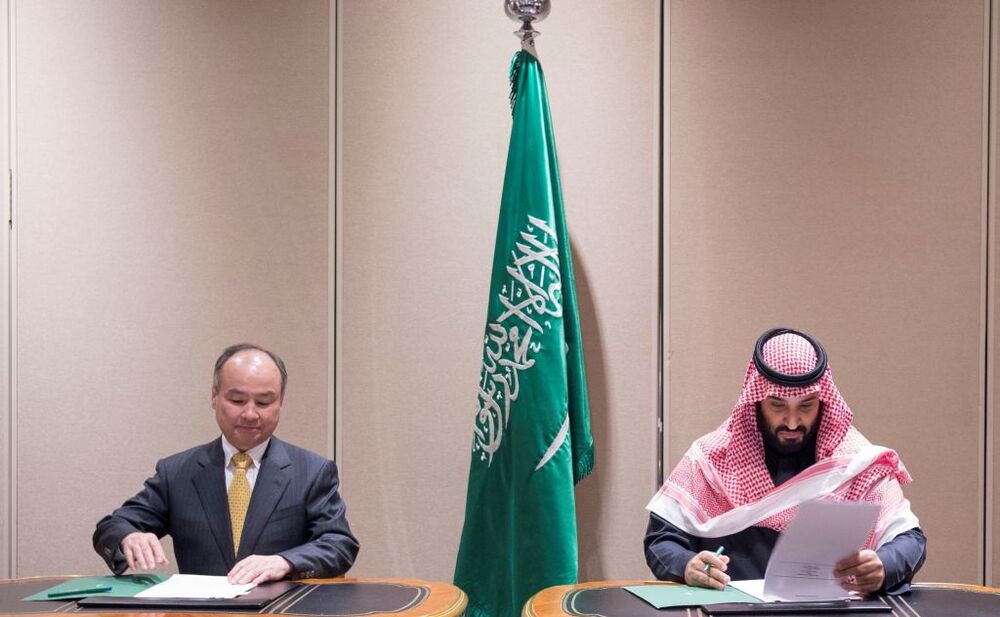


Son, left, can’t afford not to take MBS’s money.

Photographer: Bandar Algaloud /Saudi Kingdom Council/Anadolu Agency/Getty Images

If, as many believe, dissident Saudi Arabian journalist Jamal Khashoggi was murdered in the Saudis’ Istanbul consulate on the orders of Crown Prince Mohammed bin Salman, it would be an act not just of brutality but of stunning arrogance. The backlash to the murder has been (relatively) swift and (somewhat) severe. Most notably, the Saudi government’s flagship investor event -- “Davos in the Desert,” as we’re apparently supposed to call it -- seems under threat after a series of high-profile withdrawals. Saudi arrogance has, one might suppose, received its comeuppance.

I wouldn’t be so sure. Yes, nobody might want to take the risk, right now, of hanging out with the bad guy of the moment. But the larger idea behind the informal boycott of Davos in the Desert is what -- that we are going to somehow isolate Saudi Arabia from the global economy? That’s not going to work as long as the country remains is the world’s largest oil exporter.

Or is the idea to scale back other kinds of economic engagement with the kingdom, in particular financial links? Davos in the Desert is an investor conference, after all, and most attention has been focused on whether the heads of the big investment banks would attend.

Here’s the truth: At this stage, it would be as hard to cut Saudi Arabia out of global finance as would be to imagine a global oil market without it.

The Saudi government’s plans to build a post-oil economy involve two things: the rebalancing of the Saudi domestic economy, in order to help employ the 60 percent of the population under 30; and turning the proceeds of its oil wealth into steady income by deploying the kingdom’s deep cash reserves.

Saudi Arabia is a big country; any opening would create “a market opportunity similar to the liberalization of a country like Poland” after the fall of communism, according to one economist quoted in the Washington Post. Yet, while it would be hard to pass up such an opportunity, it wouldn’t be impossible.

Much tougher is the prospect of giving up on the possibility of Saudi investment. One of the reasons that “MBS” rapidly became the darling of opinion-makers everywhere is that his Vision 2030 plan for Saudi Arabia envisioned creating an investment fund that would have a humongous $2 trillion on its books. (The Saudi Public Investment Fund currently has assets of $230 billion.)

When Elon Musk famously tweeted that the Saudis would help him take Tesla private, he wasn’t the only one counting on spending their money. Every single player in the world of finance wants some of those billions. The Saudis are already the biggest investors in Silicon Valley start-ups; AI industry insiders say they will likely end up owning crucial intellectual property going forward. During MBS’ royal progress through the U.S., he didn’t just meet U.S. President Donald Trump and Oprah Winfrey, but also Apple Inc.’s Tim Cook, Snap Inc.’s Evan Spiegel, Alphabet Inc.’s Sergey Brin, and Amazon.com Inc.’s Jeff Bezos.

As with other pools of state-driven capital, such as those China has at its disposal, this money will serve strategic as well as economic purposes; it’s hard to explain the $20 billion the Saudis are pouring into U.S. infrastructure otherwise. Other old Saudi allies also seem to expect their share: When the former cricketer Imran Khan was elected prime minister of Pakistan earlier this year, his first trip was to Saudi Arabia, from where he very definitely expected to return with a handout that would help with Pakistan’s balance of payments deficit. (As it happens, he didn’t; the Saudis haven’t yet forgiven Pakistan for not joining their war in Yemen.)

India’s big renewable energy push -- 175 gigawatts of capacity by 2022, of which 100 gigawatts is meant to be solar -- depends crucially on at least $100 billion of Saudi investment in the sector. The spending would not be direct, but through Softbank’s “Vision Fund,” to the first of which the Saudis have contributed about half. This month, MBS announced that they would pick up a similar stake in the second fund Son intends to create.

Son’s 100-year plan to remake the world depends upon Saudi money; unsurprisingly, he hasn’t dropped out of Davos in the Desert yet. Nor is India alone. Across the world, long-term capital is thin on the ground and absolutely everyone wants it. The Saudis represent the motherlode. Arguably, they now derive as much influence from their fund as they do from their oil.

An optimist might argue that eventually, moral and political considerations will win out. If India has rejected China’s money for solar, after all, can it accept Saudi Arabia’s? Is Silicon Valley’s utopian culture to be built on “dirty” money?

At the same time, however, it’s risky to keep cutting bits out of the global financial system and expecting it to survive. Russian sanctions strained it. Iranian sanctions might break the SWIFT system unless Europe and America can agree on a path forward. Any attempt to isolate Saudi Arabia could be the last straw. Already there are mutters in the Gulf about “alternate” ways to ensure the flow of finance, especially if the Magnitsky Act is invoked.

Integrating global finance has been a real achievement of the past century. The question now is whether the world is willing to take the risk of balkanizing it.

This column does not necessarily reflect the opinion of the editorial board or Bloomberg LP and its owners.

To contact the author of this story:
Mihir Sharma at msharma131@bloomberg.net

To contact the editor responsible for this story:
Nisid Hajari at nhajari@bloomberg.net

Before it's here, it's on the Bloomberg Terminal.
LEARN MORE


To: Maurice Winn who wrote (143930)10/18/2018 8:50:20 PM
From: TobagoJack  Read Replies (2) | Respond to of 218390
 
even as china continues to explore permanent solutions to the saudi arabian issue ... despite latest trump sanctions of team china nuclear toils

when did obstruction to progress ever work? rhetorical question :0)

am wondering whether coal, that which i engaged and retired from trading, would ever be great again. i suppose could, if 'they' who has the imperative manage to make something more worthwhile out of coal.

thebulletin.org

The future of nuclear energy depends on ChinaBy Dawn Stover, October 2, 2018


AP1000 reactors at the Sanmen nuclear power plant in China. Credit: SNPTC

“The world nuclear industry cannot develop without China’s input,” said Jade Huang, Vice-Secretary General of the China-based international nonprofit organization International Forum for Clean Energy, last month in London. She spoke at the unveiling of the World Nuclear Industry Status Report 2018, which will be rolled out in the United States next week.

The annual publication, which offers an independent and hard-nosed assessment of the nuclear industry, reported that six of the nine reactors that started up during 2017 and the first half of 2018 were in China. (There were also two reactor startups in Russia and one in Pakistan.) China not only dominated the numbers but also led advances in technology—with the first EPR third-generation reactor to be connected to the grid, and the first AP1000 third-generation reactor to be completed.

Outside China, global nuclear power generation declined for the third year in a row. Even within China, new construction has been at a standstill since the end of 2016, and at least half of the reactors under construction are behind schedule. (Meanwhile, recent reports by the BBC, Quartz, and other media outlets suggest that construction has resumed at hundreds of Chinese coal-fired power stations, in local defiance of the central government’s attempts to cancel plants and curb greenhouse gas emissions.)

Almost a third of the countries that have nuclear power are now generating more electricity from non-hydro renewables (i.e. wind and solar) than from nuclear power. Absent the development of smaller, cheaper modular reactors—an unlikely scenario in the near future—the nuclear industry may be circling the drain.

The 2018 report takes a look, for the first time, at whether military interests serve as one of the drivers for the “odd persistence” of nuclear power. “Nuclear weapon states remain the main proponents of nuclear power programs,” the authors note.

Editor’s note: The Global Nuclear Power Database—an interactive visualization of world nuclear power reactor construction from 1951 to Jan. 1, 2017—can be found here.


To: Maurice Winn who wrote (143930)10/19/2018 11:41:22 PM
From: TobagoJack  Respond to of 218390
 
very exciting

let us see if below turns out to be of merit, and if so, how it goes

zerohedge.com

Escobar: What Sanctions On Russia And China Really Mean Authored by Pepe Escobar via The Asia Times,

The Pentagon may not be advocating total war against both Russia and China – as it has been interpreted in some quarters ...

[url=][/url]

A crucial Pentagon report on the US defense industrial base and “supply chain resiliency” bluntly accuses China of “military expansion” and “a strategy of economic aggression,” mostly because Beijing is the only source for “a number of chemical products used in munitions and missiles.”

Russia is mentioned only once, but in a crucial paragraph: as a – what else – “threat,” alongside China, for the US defense industry.

The Pentagon, in this report, may not be advocating total war against both Russia and China – as it was interpreted in some quarters. What it does is configure the trade war against China as even more incandescent, while laying bare the true motivations behind the sanctioning of Russia.

The US Department of Commerce has imposed restrictions on 12 Russian corporations that are deemed to be acting contrary to the national security or foreign policy interests of the US.” In practice, this means that American corporations cannot export dual-use products to any of the sanctioned Russian companies.

There are very clear reasons behind these sanctions – and they are not related to national security. It’s all about “free market” competition.

At the heart of the storm is the Irkut MC-21 narrow-body passenger jet – the first in the world with a capacity of more than 130 passengers to have composite-based wings.

AeroComposit is responsible for the development of these composite wings. The estimated share of composites in the overall design is 40%.

The MC-21’s PD-14 engine – which is unable to power combat jets – will be manufactured by Aviadvigatel. Until now MC-21s had Pratt & Whitney engines. The PD-14 is the first new engine 100% made in Russia since the break up of the USSR.

Aviation experts are sure that an MC-21 equipped with a PD-14 easily beats the competition; the Airbus A320 and the Boeing-737.

Then there’s the PD-35 engine – which Aviadvigatel is developing specifically to equip an already announced Russia-China wide-body twinjet airliner to be built by the joint venture China-Russia Commercial Aircraft International Corp Ltd (CRAIC), launched in May 2017 in Shanghai.

Aviation experts are convinced this is the only project anywhere in the world capable of challenging the decades-long monopoly of Boeing and Airbus.

Trending Articles

Stephen Hawking: Time Travel More Likely Than The…In there was no room for God, because the famous cosmologist came to believe that the entirety of existence was…

Will these sanctions prevent Russia from perfecting the MC-21 and investing in the new airliner? Hardly. Top military analyst Andrei Martyanov convincingly makes the case that these sanctions are at best “laughable,” considering how “makers of avionics and aggregates” for the ultra-sophisticated Su-35 and Su-57 fighter jets would have no problem replacing Western parts on commercial jets.

Oh China, you’re so ‘malign’Even before the Pentagon report, it was clear that the Trump administration’s number one goal in relation to China was to ultimately cut off extended US corporate supply chains and re-implant them – along with tens of thousands of jobs – back into the US.

This radical reorganization of global capitalism may not be exactly appealing for US multinationals because they would lose all the cost-benefit advantages that seduced them to delocalize to China in the first place. And the lost advantages won’t be offset by more corporate tax breaks.

It gets worse – from the point to view of global trade: for Trump administration hawks, the re-industrialization of the US presupposes Chinese industrial stagnation. That explains to a large extent the all-out demonization of the high-tech Made in China 2025 drive in all its aspects.

And this flows in parallel to demonizing Russia. Thus we have US Interior Secretary Ryan Zinke threatening no less than a blockade of Russian energy flows: “The United States has that ability, with our Navy, to make sure the sea lanes are open, and, if necessary, to blockade … to make sure that their energy does not go to market.”

The commercial and industrial demonization of China reached a paroxysm with Vice-President Mike Pence accusing China of “reckless harassment,” trying to “malign” Trump’s credibility and even being the top US election meddler, displacing Russia. That’s hardly attuned to a commercial strategy whose main goal should be to create US jobs.

President Xi Jinping and his advisers are not necessarily averse to making a few trade concessions. But that becomes impossible, from Beijing’s point of view, when China is sanctioned because it is buying Russian weapons systems.

Beijing also can read some extra writing on the trade wall, an inevitable consequence of Pence’s accusations; Magnitsky-style sanctioning of Russian individuals and businesses may soon be extended to the Chinese.

After all, Pence said Russia’s alleged interference in US affairs paled in comparison with China’s “malign” actions.

China’s ambassador to the US, Cui Tiankai, in his interview with Fox News, strove for his diplomatic best: “It would be hard to imagine that one-fifth of the global population could develop and prosper, not by relying mainly on their own efforts, but by stealing or forcing some transfer of technology from others … That’s impossible. The Chinese people are as hard-working and diligent as anybody on earth.”

That is something that will be validated once again in Brussels this week at the biennial ASEM – Asia Europe – summit, first held in 1996. The theme of this year’s summit is “Europe and Asia: global partners and global challenges.” At the top of the agenda is trade, investment and connectivity – at least between Europe and Asia.

Washington’s offensive on China should not be interpreted under the optics of “fair trade,” but rather as a strategy for containing China technologically, which touches upon the absolutely crucial theme: to prevent China from developing the connectivity supporting the extended supply chains which are at the heart of the Belt and Road Initiative (BRI).

We don’t need no peer competitorsA glaring giveaway that these overlapping sanctions on Russia and China are all about the good old Brzezinski fear of Eurasia being dominated by the emergence of “peer competitors” was recently offered by Wess Mitchell, the US State Department Assistant Secretary at the Bureau of European and Eurasian Affairs – the same post previously held by Victoria “F*ck the EU” Nuland.

This is the original Mitchell testimony to the Senate Foreign Relations Committee. And this is the redacted, sanitized State Department version.

A crucial phrase in the middle of the second paragraph simply disappeared: “It continues to be among the foremost national security interests of the United States to prevent the domination of the Eurasian landmass by hostile powers.”

That’s all the geopolitics Beijing and Moscow need to know. Not that they didn’t know it already.


To: Maurice Winn who wrote (143930)10/23/2018 7:15:51 PM
From: TobagoJack  Read Replies (1) | Respond to of 218390
 
paul seems to be of same opinion as you

zerohedge.com

Paul Volcker Trashes Fed, Washington Plutocrats: World's In "A Hell Of A Mess In Every Direction"While we have grown used to Alan Greenspan's flexible world views appearing regularly among US media channels, when former Fed Chair Paul Volcker speaks, it's low frequency nature tends to make on pay attention, and he is not optimistic about the state of the world... at all.

[url=][/url]

As 'Tall Paul' prepares to publish his memoir (ironically titled - given the current state of the world - "The Quest For Sound Money & Good Government"), he sat down with NYTimes' Dealbook's Andrew Ross Sorkin and was not shy about how he sees the world and where it's going:

When he looks around now, he sees "a hell of a mess in every direction," including a lack of basic respect for government institutions..

“Respect for government, respect for the Supreme Court, respect for the president, it’s all gone,” he said.

“Even respect for the Federal Reserve."

“And it’s really bad. At least the military still has all the respect. But I don’t know, how can you run a democracy when nobody believes in the leadership of the country?

...a current Fed that seems to be following a completely arbitrary benchmark...

“I puzzle at the rationale,” he wrote.

“A 2 percent target, or limit, was not in my textbook years ago. I know of no theoretical justification.”

[url=][/url]

...and a "swamp" in Washington run by plutocrats.

"There is no force on earth that can stand up effectively, year after year, against the thousands of individuals and hundreds of millions of dollars in the Washington swamp aimed at influencing the legislative and electoral process,"

[url=][/url]

Finally, Volcker dispels with the myth that presidents historically haven't tried to influence interest rates. Recounting a 1984 meeting he had with former President Ronald Reagan, then-chief of staff James Baker flatly told Volcker:

"The president is ordering you not to raise interest rates before the election."

"I was stunned," Volcker said.

“I later surmised that the library location had been chosen because, unlike the Oval Office, it probably lacked a taping system.”

Finally, Volcker returned to a bigger picture concern about America:

“The central issue is we’re developing into a plutocracy,” he told me.

We’ve got an enormous number of enormously rich people that have convinced themselves that they’re rich because they’re smart and constructive. And they don’t like government, and they don’t like to pay taxes.”

Mr. Volcker is no great fan of the president, but he acknowledged that Mr. Trump had cannily recognized the economic worries of blue-collar workers. Mr. Trump “seized upon some issues that the elite had ignored,” he said. “I don’t think there’s any question about that, in kind of an erratic way, but there it is.”

Read the full interview here...

