SI
SI
discoversearch

We've detected that you're using an ad content blocking browser plug-in or feature. Ads provide a critical source of revenue to the continued operation of Silicon Investor.  We ask that you disable ad blocking while on Silicon Investor in the best interests of our community.  If you are not using an ad blocker but are still receiving this message, make sure your browser's tracking protection is set to the 'standard' level.
Politics : Formerly About Advanced Micro Devices -- Ignore unavailable to you. Want to Upgrade?


To: IC720 who wrote (1180124)11/24/2019 10:13:18 AM
From: Wharf Rat1 Recommendation

Recommended By
sylvester80

  Read Replies (2) | Respond to of 1577842
 
"the world was going to crash because the computers would all fail when the date turned from 1999 to 2000. I remember those days well."

Do you remember when they fixed all the computers to keep it from happening? How about we fix our energy sources to prevent more extreme warning?

Jeremy Clarkson finally recognises climate crisis during Asia trip

Grand Tour host says impact of global heating on lake bed in Cambodia was ‘genuinely alarming’

Aaron Walawalkar

Sun 24 Nov 2019 08.03 ESTLast modified on Sun 24 Nov 2019 08.12 EST

Jeremy Clarkson has made what could be the biggest reversal of his 30-year career. The anti-environmental columnist has, for the first time, accepted the existence of global heating after seeing the impact for himself.

Clarkson’s epiphany came as he and his Grand Tour co-stars ran into difficulty while filming a 500-mile boat race from Siem Reap in Cambodia to Vung Tau in Vietnam.

The group’s jet boats slowed to a crawl and they were forced to wade through Tonlé Sap lake in the usually vast Mekong river system, which has been affected by water shortages.

“The irony is not lost on me,” he told the Sunday Times. “A man who hosted a car programme for 30 years, limited to 7mph by global warming.”

He described enduring “two days of absolute frustration” as the group had to be towed through the river, which had been reduced to a “puddle”.

The former Top Gear host confessed he found the “graphic demonstration” of global warming “genuinely alarming”.

However, Clarkson does not appear to have yet embraced the green movement he once dismissed as “eco-mentalists”. “But we don’t blame mankind for it,” he said. “We’ll let Greta [Thunberg] do that.”

He took yet another dig at the 16-year-old Swedish campaigner in his interview, accusing Thunberg of having no answers to the climate crisis. “‘Ooh, we’re all going to die.’ Right, tremendous. Now go back to school,” he said. “But I genuinely hope people people are working on what on earth to do about it.”

Clarkson had previously used his column in the Sun to label Thunberg a “spoilt brat”, following her speech at the United Nation’s climate action summit in September.

“How dare you,” Thunberg scolded world leaders at the New York summit. “‘You have stolen my dreams and my childhood with your empty words.”

In 2009, environmental campaigners dumped manure on Clarkson’s lawn in response to his attitude to global heating.

Grand Tour, the lavishly funded series that Clarkson started after his acrimonious departure from the BBC’s Top Gear, , returns to Amazon Prime on 13 December.

The BBC revealed on Saturday that Thunberg will guest-edit a Christmas special of Radio 4s’s Today programme. The campaigner is set to speak to leading figures in the fight against global heating and has commissioned reports from the Antarctic and Zambia.

theguardian.com


To: IC720 who wrote (1180124)11/24/2019 10:20:02 AM
From: ryanaka2 Recommendations

Recommended By
Ms. Baby Boomer
sylvester80

  Respond to of 1577842
 
Rising sea levels in a high tide will only make it worse, you idiot Blind720


To: IC720 who wrote (1180124)11/24/2019 10:34:59 AM
From: sylvester802 Recommendations

Recommended By
Land Shark
pocotrader

  Respond to of 1577842
 
Republicans, Putin's useful idiots, R PHAKED: Friday's World-Historical News Dump Is Proof the Impeachment Probe Must Continue
There is no reason to wrap the House proceedings now that Devin Nunes and Mike Pompeo were just implicated.
BY CHARLES P. PIERCE
NOV 23, 2019
esquire.com

THE WASHINGTON POSTGETTY IMAGES

Stop the news, I want to get off. Chapter Two.

This was the Friday news dump to end all news dumps, the news dump equivalent of that giant barge full of garbage from New York that couldn’t find a home back in 1987. In rough order, it was reported:

1) That Lev Parnas, one of Rudy Giuliani’s Volga Bagmen who now sits under federal indictment, has indicated that he can put Rep. Devin Nunes, the famous White House lawn ornament, in the middle of the effort to concoct the Ukrainian Fantasy about the ratfcking of the 2016 election.

2) That the inspector general of the Department of Justice will produce his report on December 9, and early reports are that, while it will be critical of sloppiness in the FBI, it will state that there was no bias against the president* in how the FBI investigation into the involvement of the Russian ratfckers was launched. Not that this will do anything to silence the screeching of the flying monkeys, but it pretty conclusively slams the door on the notion that the previous administration’s concern for the Trump campaign and Russia was the manifestation of some sort of dark manipulation based on inherent bias.

Mike Pompeo also finds himself in some hot water.

3) That The New York Times reports that the intelligence community has concluded that the entire Ukrainian Fantasy about the ratfcking of the 2016 election is an intercontinental okey-doke perpetrated by the Russian intelligence services.

In a briefing that closely aligned with Dr. Hill’s testimony, American intelligence officials informed senators and their aides in recent weeks that Russia had engaged in a yearslong campaign to essentially frame Ukraine as responsible for Moscow’s own hacking of the 2016 election, according to three American officials. The briefing came as Republicans stepped up their defenses of Mr. Trump in the Ukraine affair.4) That a massive release of State Department documents in response to a Freedom of Information Act request ropes in practically everyone, including Secretary of State Mike Pompeo, in the effort to smear former Ambassador to Ukraine Marie Yovanovich, in order to get her out of the way so that the shakedown might proceed. This, of course, involves Rudy Giuliani, because anything that’s screwed up about this administration now involves Rudy Giuliani.

You have to admit. That’s one helluva Friday.

Beyond the obvious conclusions—that the president* is guilty as hell, and he is using as his primary defense a disinformation project devised in Moscow, and, in the interest of advancing the latter, he tried to shakedown a vulnerable ally under literal siege by the military forces of the government that dreamed up the president*’s primary alibi—this sudden avalanche of information fairly screams out for the inquiry to play out as it will play out, and that short-circuiting its process is both bad detective work and bad politics.

Just on Friday, we learned that Nunes and Secretary of State Mike Pompeo were roped into this mess, too. It’s nowhere near time for the garbage barge to make port. Sail on, brothers and sisters. Sail on.


To: IC720 who wrote (1180124)11/24/2019 10:38:09 AM
From: sylvester801 Recommendation

Recommended By
Wharf Rat

  Respond to of 1577842
 
BOMBSHELL: Coal Knew, Too; A newly unearthed journal from 1966 shows the coal industry, like the oil industry, was long aware of the threat of climate change.
By Élan Young
11/22/2019 05:45 am ET Updated 1 day ago
huffpost.com
“Exxon knew.” Thanks to the work of activists and journalists, those two words have rocked the politics of climate change in recent years, as investigations revealed the extent to which giants like Exxon Mobil and Shell were aware of the danger of rising greenhouse gas emissions even as they undermined the work of scientists.

But the coal industry knew, too — as early as 1966, a newly unearthed journal shows.

In August, Chris Cherry, a professor in the Department of Civil and Environmental Engineering at the University of Tennessee, Knoxville, salvaged a large volume from a stack of vintage journals that a fellow faculty member was about to toss out. He was drawn to a 1966 copy of the industry publication Mining Congress Journal; his father-in-law had been in the industry and he thought it might be an interesting memento.

Cherry flipped it open to a passage from James R. Garvey, who was the president of Bituminous Coal Research Inc., a now-defunct coal mining and processing research organization.

“There is evidence that the amount of carbon dioxide in the earth’s atmosphere is increasing rapidly as a result of the combustion of fossil fuels,” wrote Garvey. “If the future rate of increase continues as it is at the present, it has been predicted that, because the CO2 envelope reduces radiation, the temperature of the earth’s atmosphere will increase and that vast changes in the climates of the earth will result.”

“Such changes in temperature will cause melting of the polar icecaps, which, in turn, would result in the inundation of many coastal cities, including New York and London,” he continued.

Cherry was floored.

“It pretty well described a version of what we know today as climate change,” said Cherry. “Increases in average air temperatures, melting of polar ice caps, rising of sea levels. It’s all in there.”

In a discussion piece immediately following Garvey’s article, Peabody Coal combustion engineer James R. Jones noted that the coal industry was merely “buying time” before more air pollution regulations came into effect. “We are in favor of cleaning up our air,” he wrote. “Everyone can point to examples in his own community where something should be done. Our aim is to have control that does not precede the technical knowledge for compliance.”

Climate change is not Cherry’s area of study, but he was struck by how the tone of the articles differed from the way many fossil fuel companies talk about climate change today. Rather than engage in denial, the articles offered a fairly straightforward acknowledgment of the emerging science. (This reporter is also a writer for UT’s Tickle College of Engineering, where Cherry teaches.)

As Cherry did some of his own digging, he soon realized his discovery could be the first evidence that the coal industry was aware of the impending climate crisis more than half a century ago — a finding that could open mining companies to the type of litigation that the oil industry is now facing.
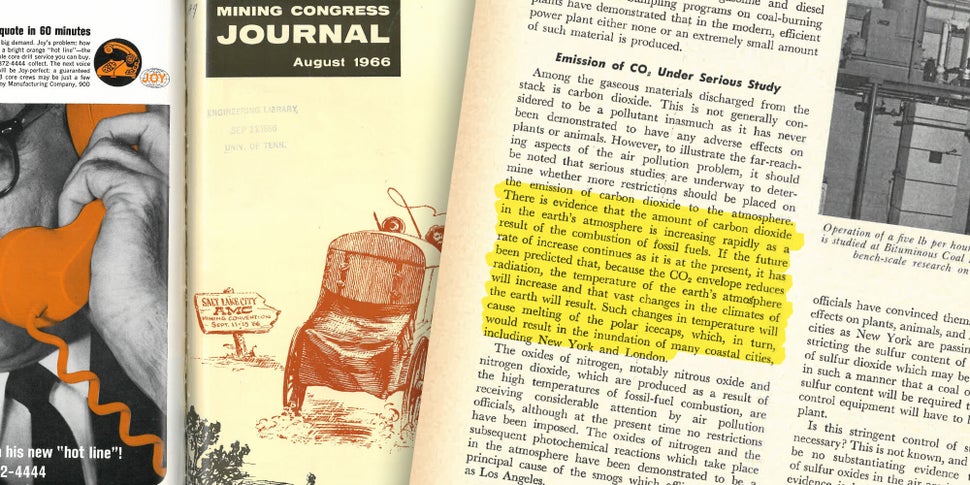

COURTESY OF CHRIS CHERRYA 1966 issue of the Mining Congress Journal suggested that rising levels of greenhouse gases could lead to “vast changes in the climates of the earth.”

Decades Of Denial
While Peabody Energy, the largest private-sector coal company in the world and the largest producer of coal in the U.S., now acknowledges climate change on its website, it has been directly and indirectly involved in obfuscating climate science for decades. It funded dozens of trade, lobbying and front groups that peddled climate misinformation, as The Guardian reported in 2016.

As recently as 2015, Peabody Energy argued that carbon dioxide was a “benign gas essential for all life.”

Increases in average air temperatures, melting of polar ice caps, rising of sea levels. It’s all in there.Chris Cherry, a professor at the University of Tennessee, Knoxville
“While the benefits of carbon dioxide are proven, the alleged risks of climate change are contrary to observed data, are based on admitted speculation, and lack adequate scientific basis,” the company wrote in a letter that year to the White House Council on Environmental Quality.

At the heart of big coal’s denial campaign was Fred Palmer, who served as Peabody’s senior vice president of government relations from 2001 to 2015. In 1997, Palmer founded the Greening Earth Society, a now-defunct industry front group that argued that burning fossil fuels was good for the planet. The group was based in the same office as the Western Fuels Association, a consortium of coal suppliers and coal-fired utilities that Palmer also ran.

“Every time you turn your car on and you burn fossil fuels and you put CO2 into the air, you’re doing the work of the Lord,” Palmer told a Danish documentary team in 1997. “That’s the ecological system we live in.”
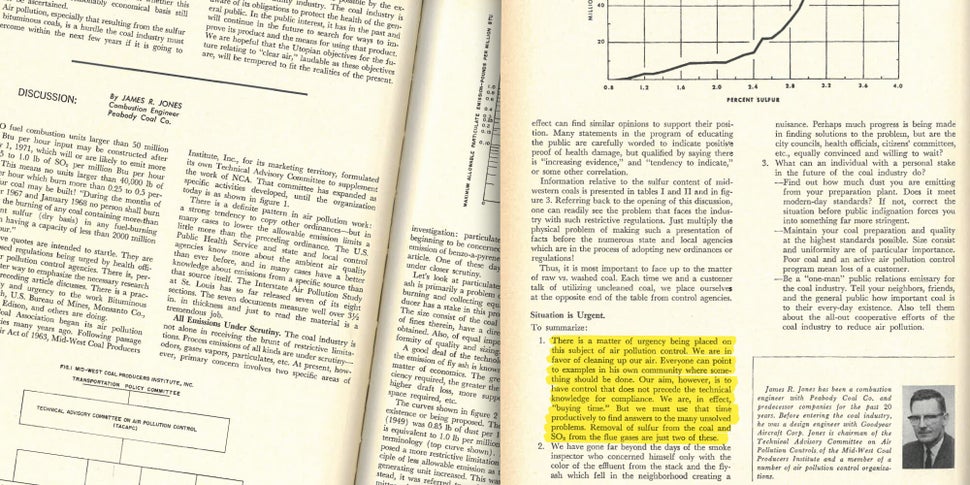

COURTESY OF CHRIS CHERRYA discussion piece in the same 1966 issue of the Mining Congress Journal said the coal industry was merely “buying time” before more air pollution regulations went into effect.

Asked for comment, a Peabody spokesperson told HuffPost: “Peabody recognizes that climate change is occurring and that human activity, including the use of fossil fuels, contributes to greenhouse gas emissions. We also recognize that coal is essential to affordable, reliable energy and will continue to play a significant role in the global energy mix for the foreseeable future. Peabody views technology as vital to advancing global climate change solutions, and the company supports advanced coal technologies to drive continuous improvement toward the ultimate goal of near-zero emissions from coal.”

Palmer, who did not respond to HuffPost’s request for comment, continues to carry the torch. He now works as an energy policy adviser to The Heartland Institute, a Chicago-based think tank whose climate denial is so severe that even Exxon Mobil abandoned funding it and its climate denial efforts a decade ago. In 2011, leaked memos showed that the institute paid contrarian scientists like Craig Idso, founder of the Center for the Study of Carbon Dioxide and Global Change, $11,600 a month to promote carbon dioxide as beneficial to the environment.

The group sits at the heart of a broader right-wing misinformation network funded in large part by hedge fund billionaire Robert Mercer and his daughter, Rebekah, both Republican mega-donors who backed President Donald Trump and financed projects such as Breitbart News and Cambridge Analytica, the data firm considered key to Trump’s 2016 win. Palmer’s daughter, Downey Magallanes, was a top policy adviser at Trump’s Interior Department before joining oil giant BP in September 2018.

All of this was taking place well after climate change had become a commonly understood idea in the scientific community. A 1965 report from President Lyndon Johnson’s Science Advisory Committee was the first from the White House to address climate change (and is likely what precipitated the Mining Congress Journal article). “The climate changes that may be produced by the increased CO2 content could be deleterious from the point of view of human beings,” it warned. In 1988, NASA scientist James Hansen testified to Congress about what was then known as the “greenhouse effect.” And in 1992, the United Nations established the Framework Convention on Climate Change, an international treaty to begin addressing the problem.

But as this consensus emerged, so too did a wave of industry-funded climate denial via vast, shadowy networks of front groups, public relations campaigns and scientists for hire.

Pulling Back The Curtain
In 2015, journalists at InsideClimate News, the Los Angeles Times and Columbia University exposed internal Exxon Mobil documents showing that the company’s scientists had a deep understanding of climate change even as Exxon worked publicly to downplay that science.

Twenty state attorneys general launched an “Exxon Knew” campaign, which eventually led to communities across the country filing at least 14 legal challenges against Exxon and other fossil fuel companies. One lawsuit, from the New York state attorney general’s office, went to trial on Oct. 22 and focuses on how the company accounted for the costs of potential future regulations on climate change. The Massachusetts attorney general filed another suit on Oct. 24, this time claiming the company had engaged in deceptive advertising and misled investors about the systemic financial risks to its business posed by fossil fuel-driven climate change. Earlier this month, two of Hawaii’s biggest municipalities sued Exxon and other big oil companies to recoup the costs of adapting to rising seas and more violent storms.

Evidence of what fossil fuel companies knew about climate change and when is critical to the legal strategy of those seeking damages for carbon dioxide emissions. If fossil fuel companies were aware of their products’ harmful effects on the planet, they could be held liable for damages.

They fought the hardest because they had the biggest existential threat.Kert Davies, founder and director of the Climate Investigations Center
Legal liability boils down to four factors, said David Bookbinder, chief counsel for the Niskanen Center, which is representing counties in Colorado that have filed suit: one, whether the defendants knew that their products would cause climate change; two, what they told or did not tell the public about the consequences of using their products; three, the extent of injuries caused by climate change; and four, whether the defendants’ actions have led to a portion of those injuries. What the plaintiffs in these suits can prove remains to be seen.

What we do know is that coal, when burned, has by far the biggest climate footprint of any fossil fuel, producing more carbon dioxide per unit than oil or gas. In the U.S. alone, coal produced 65% of the power sector’s planet-warming emissions. The 1966 article in the Mining Congress Journal certainly raises questions about what the coal industry knew at the time.

Robert Brulle, a professor emeritus of sociology and environmental science at Drexel University, authored a recent paper that suggests the coal industry must have known quite a bit, given how prominently it positioned itself in the climate denial movement.

Brulle researched 12 major groups and coalitions that argued against mandatory regulation of carbon dioxide from 1989 to 2015 — which he calls the “climate change countermovement.” That countermovement included 2,000 different businesses, political or social groups, as well as other organizations, but Brulle found that 179 core organizations belonged to multiple coalitions. Coal companies and predominantly coal-burning utilities were the most prevalent. He describes oil and gas companies as “more of a marginal player” by comparison.

“The coal mining industry — the utilities that were burning it for electricity, along with the railroads who were hauling it — and manufacturing industries like steel were the first corporate forces to become climate deniers and try to block action on climate policy,” said Kert Davies, founder and director of the Climate Investigations Center. “They fought the hardest because they had the biggest existential threat.”

Where Do We Go From Here?
In the aftermath of the 1973 oil embargo, Exxon and other oil giants leased large parcels of land for coal mining with the goal of manufacturing synthetic fuels and lowering U.S. dependence on the Middle East.

Some previously released documents show that Exxon’s scientists began advising that the world phase out coal as a fuel as early as 1979. In one scenario, the Exxon scientists concluded that non-fossil fuels would need to be substituted for coal beginning in the 1990s to keep carbon dioxide levels below atmospheric concentrations of 440 parts per million. In 1999, Exxon merged with Mobil, and by 2002, Exxon Mobil had dumped its coal assets.

Meanwhile, the coal industry tried to reinvent itself with the concept of “clean coal.” This as-yet-undelivered promise that carbon capture and other technological advances could lower coal’s environmental impact has been around for decades but resurged in the early 2000s as regulations seemed imminent.

The biggest proponent of this idea was the American Coalition for Clean Coal Electricity, a coal front group that spent $35 million on public relations campaigns in 2008 alone, seeking to influence the election. A year later, ACCCE was caught sending Congress fraudulent letters opposing federal climate legislation and pretending to be from veterans, women’s and civil rights groups. The incident led many members to leave the organization, but Peabody remains a member to this day.

“Its whole mission was to stop climate regulations but pretend that they were in favor of clean coal, which, of course, doesn’t exist,” said Davies.

Peabody Energy filed for bankruptcy protection in 2016, the same year carbon dioxide levels hit 400 parts per million. Eight other coal companies have filed for bankruptcy this year. Even as the Trump administration has promised a coal resurgence and rolled back Obama-era regulations, the industry’s profitability continues to experience a downward slide. If the slogan “Coal Knew” ever does take off, it’s unclear who’ll be left to sue.


To: IC720 who wrote (1180124)11/24/2019 10:39:18 AM
From: sylvester80  Respond to of 1577842
 
OOPS! Barcelona Is Taking Radical Steps To Ban Cars. Here's Why.
huffpost.com


To: IC720 who wrote (1180124)11/24/2019 10:40:25 AM
From: sylvester802 Recommendations

Recommended By
Ms. Baby Boomer
pocotrader

  Respond to of 1577842
 
Women And Immigrants, Demeaned By Trump, Take Center Stage At Impeachment
If the president is averse to strong women challenging him, he had a very bad week.
By Alanna Vagianos
huffpost.com

ILLUSTRATION: HUFFPOST; PHOTOS: GETTY IMAGESFrom left: Laura Cooper, Fiona Hill, Alexander Vindman and Marie Yovanovitch.

When former White House adviser Fiona Hill, who served as the National Security Council’s top official on Russian affairs, testified before the House Intelligence Committee on Thursday, she described a sharp interaction with Gordon Sondland.

Hill said it began when she had a tense disagreement with the U.S. ambassador to the European Union. “I actually said to [Sondland], ‘Who put you in charge of Ukraine?’” Hill said of the encounter. “I mean I’ll admit I was a bit rude, but that’s when he told me the president, which shut me up.”

Hill said that she was angry with the ambassador — and that Sondland dismissed her concerns because she is a woman.

“Often, when women show anger, it’s not fully appreciated,” she continued. “It’s often pushed onto emotional issues perhaps or deflected onto other people.”

Throughout his presidency, Donald Trump has routinely demeaned, degraded and attacked women and immigrants. Over the past five days of impeachment hearings, some of the most incriminating testimony has come from those very people.

Key witnesses who have testified in the public impeachment hearings, which began last week, include women like Marie Yovanovitch, the former U.S. ambassador to Ukraine, Laura Cooper, a deputy assistant secretary at the Defense Department, and Jennifer Williams, a top aide to Vice President Mike Pence, in addition to immigrants like Army Lt. Col. Alexander Vindman, the NSC’s Ukraine expert. (Hill has the distinction of being both an immigrant and a woman.) Day after day, these witnesses laid out a damning case against Trump.

Yovanovitch, who served as a foreign service officer for 33 years before Trump recalled her from her post in Ukraine in May, spoke calmly and clearly throughout hours of testimony last week. The cool-headed former ambassador even responded to smears from the president in real time during the hearing.

Her testimony was so well-received that she earned a standing ovation from the public at the hearing (and, later, at a jazz club in Washington, D.C.).

The former ambassador laid out how the Trump administration peddled a campaign of lies about her, launched jointly by a Ukrainian official, Trump’s personal attorney and a host of right-wing pundits. During his infamous July call with Ukrainian President Volodymyr Zelensky, Trump called Yovanovitch “bad news” and said she was “going to go through some things.” She testified last week that Trump’s statement “ sounded like a threat.”

Yovanovitch said that Trump opened the door for corruption by being complicit in “a campaign of disinformation against a sitting ambassador, using unofficial back channels.” Her experience, she argued, sets a dangerous precedent worldwide.

“When other countries, other actors... see that private interests, foreign interests can come together and get a U.S. ambassador removed, what’s going to stop them from doing that in the future in other countries?” she said.

Cooper, the Defense Department official, clarified a key timeline question about the withholding of military aid during her Tuesday testimony. She said that Ukraine was aware that the aid was stalled before Trump’s July 25 call with Zelensky. If true, this would make it extremely hard to argue that Trump’s push for politically beneficial investigations that day wasn’t a quid pro quo.

Vindman, who was born in Ukraine and immigrated to the U.S. as a toddler, testified as a real-time witness to that now-infamous call. He said there was an obvious “power disparity” between Zelensky and Trump on the call because of Ukraine’s reliance on the U.S. for military and other aid.

“When a senior asks you to do something, even when it’s polite and pleasant, it’s not to be taken as a request ? it’s to be taken as an order,” he told the House Intelligence Committee earlier this week.

Vindman, whose family fled the Soviet Union, is not the typical immigrant targeted by the Trump administration. Those attacks are normally reserved for Black and brown people. But his status as an immigrant was still weaponized against him. Republican lawmakers and conservative cable news hosts questioned Vindman’s loyalty to the U.S. because he was born in Ukraine.

The 44-year-old Army officer responded to these attacks in one of the more emotional moments of the impeachment hearings. He addressed his immigrant father in his opening statement.

“I also recognize that my simple act of appearing here today ... would not be tolerated in many places around the world,” Vindman said. “Dad, my sitting here today in the U.S. Capitol talking to our elected officials is proof that you made the right decision 40 years ago to leave the Soviet Union and come here to the United States of America in search of a better life for our family. Do not worry, I will be fine for telling the truth.”

Hill, an immigrant from the U.K., said the accusations of dual loyalty lobbed at Vindman were “deeply unfair.”

“This is the essence of America,” she said during her Thursday testimony. “It’s why I wanted to be here and why I wanted to stay here, and I think it’s unfair to castigate anyone.”

“I do not believe that my loyalty is to the United Kingdom. My loyalty is here, to the United States. This is my country and the country that I serve,” Hill continued. “And I know for a fact that every single one of my colleagues ? and there were many naturalized citizens in my office and across the National Security Council ? felt exactly the same way.”

During Hill’s testimony, Rep. Terri Sewell (D-Ala.) said that she was “especially disheartened” by Trump’s treatment of women throughout this process, specifically his ongoing attacks on Yovanovitch.

“She was an easy target as a woman,” Sewell said.

“The fact of the matter is that there’s a long line of strong, talented women who have been smeared and victimized by this president,” the congresswoman continued. “We can either choose to ignore it or do something about it.”

After the hearing, Rep. André Carson (D-Ind.) said, “I think for a certain pocket of society who are perpetuating harmful mythologies about immigrants and women, and who are trying to take our country back to some mythological good old days ? I think it’s important to have representation from women and those who have immigrant backgrounds to dismantle this notion of what it means to be an American.”

It’s possible that the dual-loyalty smears against Vindman are a sneak peek of what’s to come as the pressure increases on the president. Given Trump’s history, stoking fears around citizenship and gender for political gain would be nothing new.

Igor Bobic contributed reporting.

