SI
SI
discoversearch

We've detected that you're using an ad content blocking browser plug-in or feature. Ads provide a critical source of revenue to the continued operation of Silicon Investor.  We ask that you disable ad blocking while on Silicon Investor in the best interests of our community.  If you are not using an ad blocker but are still receiving this message, make sure your browser's tracking protection is set to the 'standard' level.
Strategies & Market Trends : 2026 TeoTwawKi ... 2032 Darkest Interregnum -- Ignore unavailable to you. Want to Upgrade?


To: Dr. Voodoo who wrote (156033)4/6/2020 6:24:14 AM
From: TobagoJack  Respond to of 218649
 
Scribblings like this below gives me pause

bloomberg.com

Bold Market Calls Abound as Minerd Says S&P 500 Could Drop 40%

Joanna OssingerApril 6, 2020, 11:07 AM GMT+2
The dispersion of Wall Street views on the outlook for stocks has been widening for a while, and Scott Minerd may have taken things up another notch.

The chief investment officer at Guggenheim suggested over the weekend that the S&P 500 might fall to 1,500 as the coronavirus spreads and its impact is felt in the world’s largest economy. That’s a whopping 40% slide from current levels, and a call that looks eye-catching even for a noted bear.

“We need to see the other shoe drop,” Minerd wrote in a report Sunday. “When the markets start to see some of the data on unemployment rising and economic growth and corporate earnings contracting, there will be another level of panic.”


Weighing the global spread of the coronavirus against the extreme stimulus measures designed to offset its impact is increasingly driving a wedge between various market participants. JPMorgan Chase & Co. says the worst is probably already past, and that there is potential for the S&P 500 to rallyback up to 2,850. Goldman Sachs Group Inc. has said the gauge could fall to 2,000 before recovering.

Minerd is expecting an economic contraction of well over 10% this year. He also forecasts S&P 500 earnings per share of around $100, which with a traditional market multiple would put the gauge around 1,500, he said. It closed at 2,488.65 on Friday.

Read more on the divided stocks outlook
Market Bulls From Morgan Stanley to Eaton Vance Find Their Voice
More Misery for Stocks Is One Thing Investors Can Be Certain Of

While he likes the Federal Reserve’s response to the pandemic, crediting emergency policy moves with helping restore liquidity, Minerd is less impressed by Congress and the White House. The fiscal programs put in place may be “nowhere near sufficient,” he said, and in some cases perhaps even misguided.

Still, Guggenheim is seeking opportunities amid the turmoil.

“We are opportunistically trying to move from some of our more conservative investments to securities that, in our view, look attractive,” he wrote. “We are looking at investment-grade corporate bonds and municipal bonds, and select securities in structured credit and high-yield, where prices have dropped and spreads have widened significantly, look interesting.”

Before it's here, it's on the Bloomberg Terminal.
LEARN MORE

Sent from my iPad


To: Dr. Voodoo who wrote (156033)4/6/2020 6:35:48 AM
From: TobagoJack1 Recommendation

Recommended By
Secret_Agent_Man

  Respond to of 218649
 
Two grains of salt and a dash of pepper, plus a spot of butter, required, but need to ruminate whilst pre-market-open napping

zerohedge.com

Tesla Has A "Bulging Demand Problem" That Has Nothing To Do With COVID-19: Gordon Johnson

As most people following the Tesla saga already know, the company reported 88,000 deliveries for Q1 on Thursday night, leading many people to think that the company had "beat" estimates. Tesla stock soared after hours on Thursday, at one point rising almost $90 from the prior close, before returning to some semblance of reality on Friday and closing the week out around $480, up 5% on the day.

But as analyst Gordon Johnson reminds us in his latest report, these delivery estimate numbers had already been significantly walked back. He also reminded anyone willing to listen of the drastic measures Tesla has taken to increase supply:

After walking analysts ests. down (our opinion) from ~93K on Fri. to ~80K this past Monday and ~105K for the Cons. est. just two weeks ago, TSLA reported 1Q20 deliveries yesterday (i.e., Thurs) of 88.4K, leading many to claim victory, with some even saying TSLA "crushed" the 1Q20 delivery est. ( link). While the stock is up in pre-market trading, at risk of stating the obvious, we disagree with the optimism being lauded on the car company today by many media outlets, & sell-side analysts alike.

More importantly, however, over the course of 3Q18-to-1Q20, we note that TSLA: (1) Launched a New Factory in China, which is said to be producing 3K cars/week, or ~36K cars/quarter ( link), (2) Completed rollout of Model 3 AWD/AWD-P in N. America, (3) Launched Model 3 MR (Since Discounted), (4) Launched Model 3 SR+, (5) Launched Model 3 in Europe/UK (All Variants), (6) Launched Model 3 in China/SEA (All Variants), and (7) Launched Model Y AWD/AWD-P in the United States.

Despite supply side improvements, TSLA sales were "essentially flat".He made the argument that even though the China factory was up and running for most of Q1 and even though the Model Y was available for purchase, the company still posted a lackluster number for deliveries, up just 5.5%. He notes that it is the "second lowest level of TSLA cars sold over the past 6 quarters" and says compared to VW, Tesla's valuation remains unjustified:
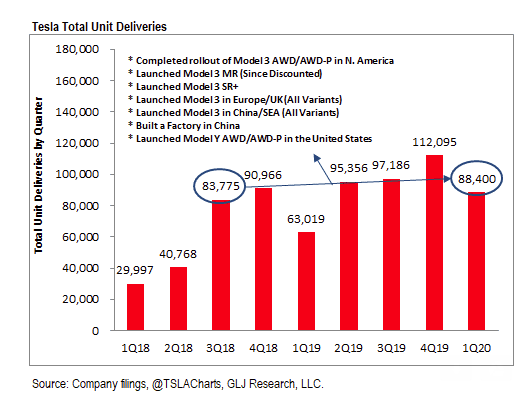
Yet, as detailed in Ex. 1 below, over this same timeframe, despite its China factory being fully functional for the lion's share of 1Q20 & its Model Y all-wheel-drive ("AWD") and Model Y all-wheel-drive-performance ("AWD-P") cars being available for purchase, as well as the introduction of >6 other new car variants 3Q18-to-1Q20, TSLA's total cars sold grew from 83.7K to just 88.4K 3Q18-to-1Q20, or up 5.5%.

In fact, 1Q20 marks the second lowest level of TSLA cars sold over the past 6 quarters.

Consequently, with TSLA currently valued at ~$98bn vs. $59.5bn for VW, despite the fact that VW sold ~10.5mn cars last year vs. 367.5K for TSLA, TSLA needs to see exponential growth to justify its valuation.

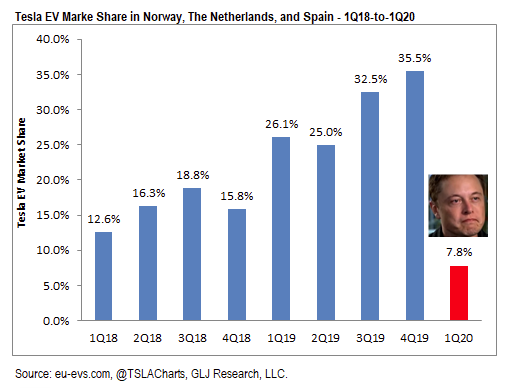
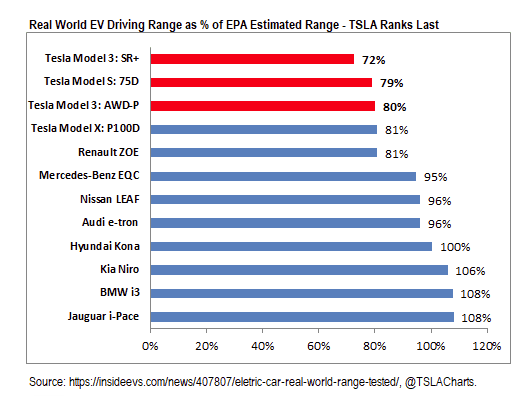
"Competition is killing TSLA in Europe..." Gordon Johnson says.??Johnson also reminded people that Tesla's battery range is "not what it seems", even sourcing pro-Tesla website InsideEVs for his data.


NEVER MISS THE NEWS THAT MATTERS MOST

ZEROHEDGE DIRECTLY TO YOUR INBOX

Receive a daily recap featuring a curated list of must-read stories.

Finally, Johnson explained that consensus estimates for 2021 have already started to come down and that the revisions have "nothing to do with COVID-19".

Based on the lion's share of TSLA pundits saying demand will surge in 4Q20/2021, we think it's fair to say any impact from COVID-19 is expected to be fully behind TSLA by 1Q21. Despite this, however, as detailed in Ex. 2 below, since 2/13/20 the Cons. 2021 adjusted EPS est. for TSLA has fallen from $15.23/shr to $12.18/shr, or -20%. When considering this is the est. professional investors use to value TSLA shares, as this figure moves lower thru 2020, we would expect TSLA's share[s] to come under more intense selling pressure.

"Numbers don't lie, and, as we've stressed, TSLA has a bulging demand problem," Johnson concluded.

Sent from my iPad


To: Dr. Voodoo who wrote (156033)4/6/2020 7:11:20 AM
From: sense  Read Replies (1) | Respond to of 218649
 
China has been there for a long time... but they've been irrelevant outside of near-China for a large part of that time. It's obviously only been since 1970's Nixon/Kissinger that China was exempted from global standards and allowed to participate anyway... and most of China's economy today was created since then...

China's hugest "internal subsidy" since the 1970's has been slave wage workers...

Those two factors... are still what energizes China interaction with the world. However, neither one of those "advantages" is sustainable... even if China's trading partners wanted them sustained... and, of course, they do not. The west "made China" on purpose... in order to exploit China's low cost labor. Without that as incentive... and when you throw in the many other annoyances... China's more of risk than its worth, and is not worth it to the west anymore anyway, on purely economic grounds.

As far as tariffs... they get back to "the point"... which is the agenda in enabling, or not, some change that is deemed useful to enable. China has been granted "special treatment" for a long time... as it suited those outside China making the decisions, that it happen. Change is coming. And not just for China. The same has has been true of Europe since the end of WW II... and change is coming there, too... no more "special deals" for no reason... other than "it suits us" ? Well, it doesn't suit us any more ? So, on trade, I think you'll see a great deal more "reciprocity" happening... or a whole lot less trade.

Technology has very little to do with it...

Kinetic war would be wildly unpopular in today’s society.

I think that's a gross misreading. We've been at war... pretty much since 2001... and people are largely either unaware or inured of it. Blow up a few Iranians caught being where they shouldn't be... every one cheers... we go back to watching the game on TV again... except... wait... there is no game on TV ? There's a lot of pent up excess in "patience" right now... looking for an outlet.

The expectation that prices are going to rise... isn't overly consistent with the virus hit to the economy... driving a need to stay out of a deflationary spiral. If jobs are going to be lost over it... they're going to be lost in China... and the impact on prices... likely to be about neutral... if with a hit to the bosses annual bonuses.

Similarly, price inflation wasn't a massive problem in 1929 - 1934 ?

There will be a repatriation of manufacturing... which was already ongoing... all recent events have done is provide more of a reason to accelerate the trend... while obliterating any resistance.

Agree on the "globalists" being demoted from "masters of the universe".

The first round of "serious shit" in the Middle East... happened last week. Anything else... will have to wait until the virus is in check... and, then ? Combine the virus... with the lack of oil revenue ? It's not a recipe for launching a new war... rather than having a constant need to continue checking six...


To: Dr. Voodoo who wrote (156033)4/6/2020 1:35:29 PM
From: TobagoJack  Read Replies (1) | Respond to of 218649
 
Did a bunch of actions post-nap but did not have time to nap, and now going into dinner, reading stuff, talking over Signal, WhatsApp, zoom and FaceTime, and exchanging texts

Wanted to short commodity crude ETF Puts in order to go long, but the options of both OIL and USO are broken when I tried, and OIL appears to have stopped trading altogether. These instruments appear dysfunctional at first sign of combat. Dangerous.

Am near term bullish-esque on crude, and given the crude ETFs are out of bounds, I added to short Puts for XOM (still considerable distance from at-the-money preferring to shy away from hand-to-hand combat).

I wanted to and did short TSLA near-term put to pick up free money, but having seen the Chanos (normally I do not care for him) appended below, I shorted the puts as I originally reckoned, but also topped up some same expiration calls, as daily TSLA Call vitamin regime


cnbc.com

Chanos says he is still ‘maximum short’ Tesla even with drop in last month
Michael Sheetz


The founder of hedge fund Kynikos Associates and well-known short seller Jim Chanos said Thursday that he is still betting against Tesla, even after the electric automaker’s stock fell dramatically in the past month.

“We are still basically maximum short Tesla. It’s still one of my favorite positions,” Chanos told CNBC’s “Halftime Report.” “Nothing’s changed in my viewpoint here. ... It will lose money this year.”

Tesla shares slipped 2% in trading from their previous close of $481.56.

Chanos said his firm warned clients that Tesla’s recent rally from about November to February wouldn’t last. The stock more than doubled during that time, surging above $950 a share and peaking in early February. Since hitting that level Tesla’s stock has fallen more than 51%.

?[That] was one of the craziest periods I’ve ever seen in my 40 years on Wall Street,” Chanos said.

‘Manic’ speculative trading at the end of the bull market
Chanos highlighted the “parabolic” moves in stocks like Tesla and Virgin Galactic as indicative of the end of the bull market cycle.

“That was the one thing that had been missing in the bull market in the 10 years, was just manic speculation by individuals,” Chanos said.

Both stocks had become favorites among retail investors by February, with trading platforms like Fidelity, TD Ameritrade Robinhood and SoFi all seeing heavy trading volume as the stocks jumped day after day. At one point Virgin Galactic’s stock had more than tripled in just three months.

“Retail for some reason came pouring into the market and individual names and individual stories in a way that we haven’t seen since ... the end of the dot-com boom” in early 2000 Chanos said.

