SI
SI
discoversearch

We've detected that you're using an ad content blocking browser plug-in or feature. Ads provide a critical source of revenue to the continued operation of Silicon Investor.  We ask that you disable ad blocking while on Silicon Investor in the best interests of our community.  If you are not using an ad blocker but are still receiving this message, make sure your browser's tracking protection is set to the 'standard' level.
Strategies & Market Trends : 2026 TeoTwawKi ... 2032 Darkest Interregnum -- Ignore unavailable to you. Want to Upgrade?


To: zamboz who wrote (160149)7/14/2020 7:59:16 PM
From: Pogeu Mahone  Read Replies (1) | Respond to of 218108
 
Subprime Auto-Loan Delinquencies, After April Fiasco, Miraculously Healed by “Forbearance” & Stimulus Money

by Wolf Richter • Jul 13, 2020 • 64 Comments

“Extend and pretend” works wonders for a little while. But with auto loans, it gets dicey in a hurry. And then what?


Nearly all current or former taxpayers below certain income levels received the $1,200 stimulus payment. For a couple, it came to $2,400. If they had kids, more money was added. These moneys arrived in bank accounts in April, May, and June. In addition, there are currently over 32 million people who claim unemployment benefits under state and federal programs. They not only get their regular unemployment benefits but also the extra $600 a week in federal funds. For many laid-off workers, this adds up to more than their wages. This money has been a godsend to people who were behind on their subprime-rated auto loans.

And there was another godsend: “Extend and Pretend.”Many lenders entered into forbearance agreements with borrowers who couldn’t pay. Much of the publicity about forbearance has been on mortgages, but this also happened with credit card loans and auto loans.

Forbearance means that the lender agrees not to pursue its legal rights to deal with a defaulted loan. With auto loans in forbearance, the lender agrees not to repossess the vehicle as long as the borrower sticks to the terms of the forbearance agreement.

Forbearance means delay in payments – the interest is normally added to the outstanding balance that is to be dealt with later.

There is another thing that happens with a loan in forbearance: It gets marked as “current” on the lender’s books, even when it was delinquent before. Forbearance agreements lower the delinquency rates. Borrowers don’t make payments. But lenders still accrue the monthly interest as income that they’re not getting paid now but hope to get paid later.

The reality is that the borrower has stopped making payments; but the accounting says that everything is hunky-dory. It is now a vast national version of the old banking scheme of “extend and pretend.”

This mix of stimulus money and forbearance has had a magical impact on subprime auto loan balances that are 60-plus days delinquent.

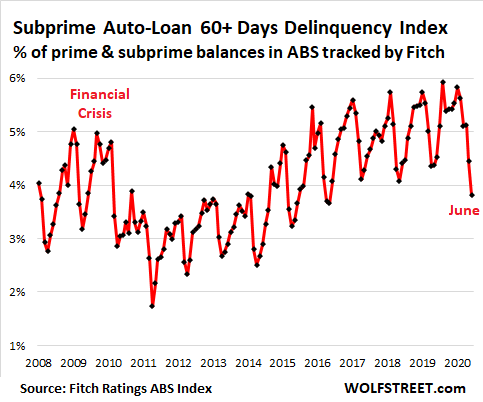
April had been a fiasco for subprime auto loans, with a historically high delinquency rate. But then, instead of seeing the further seasonal surge in delinquency rates that normally happens from April to May and June, delinquency rates dropped in May and June, according to Fitch’s Subprime Auto Loan 60-plus Day Delinquency Index, which is based on subprime auto loans packaged into asset-backed securities (ABS) that Fitch tracks and rates.

In Fitch’s update of the index for June, something very unusual cropped up. This is a highly seasonal index, where every year going back to at least 2004, April or May is the low point in the delinquency rate, and January or February the high point. And every year, June shows a significantly higher delinquency rate than April.

In April, the rate of subprime auto loans that were 60 days or more delinquent – instead of falling from March as it usually does – rose to 5.13% of total auto loan balances, the highest rate for any April going back to the 1990s.

This means that 60-plus day delinquent subprime auto loans accounted for 5.13% of the total prime and subprime auto loan balances in the ABS tracked by Fitch (delinquent prime auto loans accounted for only 0.27% of total balances):


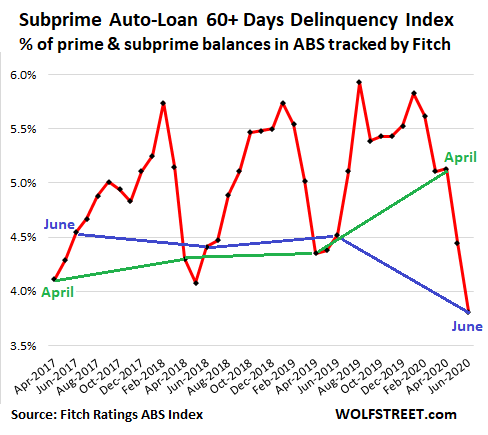
OK, let’s take a look at this phenomenon under the microscope.The chart below shows a detailed section for the period from April 2017 through June 2020. The blue line connects the four Junes. The green line connects the four Aprils. Note the year-over-year surge in delinquencies from 4.35% in April 2019 to 5.13% in April 2020, the highest for any April in the data going back to the 1990s, and then, instead of the expected seasonal rise, the miraculous drop in June to 3.81%, the lowest delinquency rate since June 2015:


“Extend and pretend” works wonders.This is the miraculous result of stimulus money, the $600 a week in extra unemployment compensation, and forbearance, none of which are permanent features of our economic landscape.

Stimulus money eventually runs out, and the extra $600 a week expires at the end of July. Extensions or different versions might get concocted in Congress. But even those, if they happen at all, will end.

And “extend and pretend” can get stretched for a while, like a rubber band, but at some point, there is a reckoning. And with auto loans, it gets dicey in a hurry. Forbearance is just a delay, and during the delay, the auto loan balances grow as interest is added to the principal. With subprime auto loans, the interest rates are high, usually into the double digits, and the interest that is added to the principal adds up quickly. But the vehicle – the collateral for the loan – just loses value. With auto loans, lenders cannot play this game for long before they’re even more deeply in the hole.

Over the next few months, during the worst unemployment crisis in a lifetime, we might well see a further miraculous decline in the subprime auto loan delinquency rates, as auto loans in forbearance are market “current.” But then, when stimulus runs out and forbearance ends, it will come unglued with a vengeance.

The time for deals on new vehicles has arrived. Read… Moving the Iron amid Sagging Demand: Tesla Cuts Price of Model Y, after Cutting Prices of Model 3, S & X, as Other Automakers Offer Record Incentives.

Enjoy reading WOLF STREET and want to support it? Using ad blockers – I totally get why – but want to support the site? You can donate. I appreciate it immensely. Click on the beer and iced-tea mug to find out how:



To: zamboz who wrote (160149)7/15/2020 6:24:50 AM
From: TobagoJack  Read Replies (1) | Respond to of 218108
 
Re <<I do remember 2009>>

I do as well, and hopefully shall not experience a comeuppance ever 2012 again

Message 25291383

Message 25291528

Message 28323504

Etc etc all the way into the gold recession

One good thing about gold is that it does not go bankrupt, and the longer one has been accumulating and remaining steadfastly true, the less likely any one particular year’s accumulation would bankrupt one. Not true of common equity.

Besides, gold is fun. It is rare to have a fun object be the focus of a delightful hobby that is not a money-sink.

And here comes all the boosters

“What you’re going to see in the next decade is this desperate effort, which is already very obvious, where banks and government just print money and borrow, and bail everyone out, whatever it takes, just to prevent the entire system from collapsing,” Parrilla said in an interview from Madrid.


bloomberg.com

Doomsday Hedge Fund Sees Gold Topping $3,000 an Ounce
Eddie van der Walt

LISTEN TO ARTICLE
A hedge fund manager who returned 47% this year by betting on gold and Treasuries says the next decade is going to be marked by inflation that central banks are powerless to control.

Diego Parrilla, who heads the $450 million Quadriga Igneo fund, says unprecedented monetary stimulus is fueling asset bubbles and corporate debt addiction -- rendering interest-rate hikes impossible without an economic crash. In the ensuing market mania, the manager whose portfolio is loaded up with cross-asset hedges says gold could rise to $3,000 to $5,000 an ounce in the next three to five years, up from the current price of $1,800.

“What you’re going to see in the next decade is this desperate effort, which is already very obvious, where banks and government just print money and borrow, and bail everyone out, whatever it takes, just to prevent the entire system from collapsing,” Parrilla said in an interview from Madrid.

While traditional funds are tasked with generating steadily positive returns over time, Parrilla’s fund is predisposed toward hedging the next big crash while generating capital over time. Managers with a tail-risk bias position for extreme market events, typically bucking mainstream views on Wall Street.


The Wall Street consensus is sanguine on the price pressures spurred by record stimulus spending, and calls for faster inflation have turned out to be wrong for years.

Federal Reserve Bank of San Francisco President Mary Daly and Richmond Fed President Thomas Barkin said earlier this month that outsize inflation isn’t a concern in the current crisis. Even if inflation emerges, the Fed has the tools to deal with it, Daly said.

From Parrilla’s perspective, the stimulus packages have exacerbated deeper issues within the financial system, such as central banks who have kept interest-rates near zero for more than a decade and are willing to re-write the policy rulebook in a crisis.

The value of his defensive portfolio has jumped as virus-fueled fear ripped through markets in February and March. The fund is about 50% invested in gold and precious metals, 25% in Treasuries and the rest in options strategies that profit from market chaos, such as calls on gold and the U.S. dollar. “This is the part that makes us super explosive,” he said.


Why Hedge Funds Buy Pet Rocks in Times of Crisis: Macro View

Parrilla, who has a background in mining engineering and previously ran the commodities department for Old Mutual Global Investors, describes his investment process as search for anti-bubbles -- a term referring to unusually cheap assets that do well when bubbles burst. The Quadriga Igneo fund was launched in 2018 and had returned 10% by the end of the year. Performance was flat in 2019.

“What we’ve seen over the last decade is the transformation from risk-free interest to interest-free risk, and what this has created is a global series of parallel synchronous bubbles,” says the fund manager, who’s also the author of a book called “ The Anti-Bubbles: Opportunities Heading into Lehman Squared and Gold’s Perfect Storm.”

“One of the key bubbles is fiat currency, and one clear anti-bubble in this system is gold,” he said, adding that other examples are volatility, correlations and inflation. “It’s a case of when, not if, they will reprice significantly higher,” he said.

Gold has captivated some of the world’s most prominent investors this year, who argue that the rapid expansion of central bank balance sheets will reduce fiat currency values and drive demand for hard assets.

But whether inflation actually materializes is still up for debate. Current U.S. or European economic data doesn’t show evidence of price pressures, and investors have poured money into bonds this year. Parrilla says the long-term will prove otherwise.

“The bubbles are too big to fail and mommy and daddy will do whatever it takes to prevent this,” says Parrilla.

Before it's here, it's on the Bloomberg Terminal.
LEARN MORE

Sent from my iPad

