SI
SI
discoversearch

We've detected that you're using an ad content blocking browser plug-in or feature. Ads provide a critical source of revenue to the continued operation of Silicon Investor.  We ask that you disable ad blocking while on Silicon Investor in the best interests of our community.  If you are not using an ad blocker but are still receiving this message, make sure your browser's tracking protection is set to the 'standard' level.
Strategies & Market Trends : 2026 TeoTwawKi ... 2032 Darkest Interregnum -- Ignore unavailable to you. Want to Upgrade?


To: marcher who wrote (161505)8/21/2020 3:43:26 PM
From: Pogeu Mahone  Read Replies (1) | Respond to of 218160
 
I find Cottonelle better

I can see the Similarities.

Here is a silver based antibiotic solution cleanser-g-

Silvadene (all serious cooks should have this in their medicine cabinet)

amateurs may need it more:O(

Burn pain goes away in nanoseconds.


To: marcher who wrote (161505)8/21/2020 6:06:39 PM
From: TobagoJack  Read Replies (2) | Respond to of 218160
 
Looks like Navarro & Co did not think through the full implications, even as they continue to failing at recognizing that they are doing serious damage to self-interest by going to where Team China wishes them to go sooner or later and better sooner

In the meantime should Apple get hit, investors would have hard time escaping unscathed, from Apple, and by second-order effects, Nasdaq

bloomberg.com

Trump Administration Reassures Apple, Other Firms on Using WeChat in China

Jennifer Jacobs
The Trump administration is privately seeking to reassure U.S. companies including Apple Inc. that they can still do business with the WeChat messaging app in China, according to several people familiar with the matter, two weeks after President Donald Trump ordered a U.S. ban on the Chinese-owned service.

In recent days, senior administration officials have been reaching out to some companies, realizing that the impact of an all-out ban on the popular app, owned by China’s Tencent Holdings Ltd., could be devastating for U.S. technology, retail, gaming, telecommunications and other industries, people familiar with the discussions said.

Apple is one of the companies that could stand to lose the most from the WeChat ban because China represents a fifth of its sales. Apple also relies on China for a large chunk of its manufacturing, which could be impacted if the Chinese government decided to retaliate.

Representatives for Apple, Treasury and the White House declined to comment. A spokesperson for Tencent, which is one of China’s biggest companies, didn’t respond to requests for comment.

The administration is still working through the technical implications of how to enforce a partial ban on the app, and a key question is whether the White House would allow Apple and Alphabet Inc.’s Google to offer the app in their global app stores outside of the U.S., and if so, where, according to the people, who spoke on condition of anonymity.

Earlier: Trump Ban on Top Messaging App Risks Snarling Global Business

Senior administration officials are deliberating over the scope of the ban ordered by Trump, one of the people said, and the president could ultimately overrule anything they decide.

The administration cited the national security risk of leaving Americans’ personal data exposed to China in announcing the ban earlier this month.

The officials expect that WeChat won’t completely vanish in the U.S., but their aim is to prohibit any downloads or updates of the app in the country, according to three of the people.

For example, travelers coming into the U.S. who have WeChat on their phones likely will be able to use the app, but they won’t be able to update it. That means that the WeChat version of a non-U.S. resident staying in the country for a longer period would probably become obsolete over time, the people said.

Trump is escalating his fight with Beijing three months before the November presidential elections and has blamed China for the Covid-19 pandemic.

In addition to Trump’s ban on WeChat and a related order barring business with the popular Chinese-owned TikTok video app, the administration has made other moves to pressure Beijing. Those include sanctions on the top official in Hong Kong and recommendations that American stock exchanges set new rules that could trigger the delisting of Chinese companies.

A partial WeChat ban could mean that companies like Apple could offer it in their China app stores and businesses like Starbucks Corp. could continue to sell coffee or accept payment via the app in China. The intention is to prohibit any downloads or updates of the WeChat app from U.S. app stores, two of the people said.

Earlier: Trump Ban on Top Messaging App Risks Snarling Global Business

High-level administration officials, including Treasury Secretary Steven Mnuchin, economic adviser Larry Kudlow, White House counsel Pat Cipollone and Deputy National Security Adviser Matt Pottinger met Tuesday to discuss the WeChat ban, said two people familiar with the matter.

The discussions follow Trump’s Aug. 6 executive order prohibiting U.S. people and companies from doing business with WeChat from mid-September, which set off alarm bells across U.S. companies with operations in China. WeChat is an indispensable part of doing business in the country and selling products to consumers there, who use the app for everything from buying coffee to airline tickets.

In recent weeks, U.S. companies and their lobbyists went into overdrive, asking staffers in the White House and the Commerce Department about the logistics and intention of the WeChat executive order, according to people familiar with the matter.

“We are talking to everyone who will listen to us,” said Craig Allen, president of the US-China Business Council, whose group represents companies including Walmart and General Motors Co. “WeChat is a little like electricity. You use it everywhere” in China, Allen said.

He didn’t confirm conversations with the administration, but said his group has been trying to illustrate the “downsides to an expansive interpretation of the order.”

Among the questions that have been raised include whether the order would ban American companies that have a presence in China or Chinese subsidiaries of those companies from accepting payment for their products through WeChat, the people said. The lobbyists also wanted a better definition of what the administration would consider a “transaction” under the order, the people said.

Earlier: Apple Faces IPhone Sales Risk in China From Trump’s WeChat Ban

Representatives from the National Retail Federation and the Retail Industry Leaders Association, which represents companies such as Best Buy Co., Target Corp. and Lowe’s Cos., are among the lobbyists who have raised questions, the people said.

WeChat is the world’s most-popular messaging app, with more than a billion users. Banning the app, even just in the U.S., could shut down personal communications between America and China. It would also disrupt operations of international companies that rely on the app for cross-border business.

“If the business community can’t use WeChat in China, from advertising to processing payments, it’s a short cut to decoupling the two economies,” said Samm Sacks, a fellow at the New America think tank in Washington. Sacks said shutting down the ability to use WeChat in the U.S. will push Americans working with Chinese colleagues and business to mimic the elaborate workarounds that Chinese use to reach the outside internet. “It creates the American version of the Great Firewall.”

Shares of Tencent plunged as much as 10% following Trump’s Aug. 6 executive order, erasing nearly $35 billion in market value as investors worried that the tech conglomerate’s gaming operations and other business interests in the U.S. would be under threat. Tencent holds a large stake in Fortnite maker Epic Games Inc., owns League of Legends developer Riot Games Inc., and has invested in Uber Technologies Inc. and Snap Inc.

The next day, the company hired its first lobbyist in Washington, former Treasury Department counsel Roberto Gonzalez, according to a federal filing.

A narrower ban would be a relief for Apple, whose iPhone sales would have taken a hit in China. The company’s investors also worried that Trump’s order could prompt China to retaliate against by restricting manufacturing in the country, where Apple makes a large chunk of its products.

— With assistance by Mark Gurman, and Naomi Nix

(Updates with administration’s thinking on how ban could work from eighth paragraph)

Before it's here, it's on the Bloomberg Terminal.
LEARN MORE

Sent from my iPad


To: marcher who wrote (161505)8/22/2020 7:37:06 AM
From: TobagoJack1 Recommendation

Recommended By
Lee Lichterman III

  Read Replies (2) | Respond to of 218160
 
Never minding the author’s comments re Team USA internal / domestic politics because am in less position to judge, bet the geopolitics sounds balanced and therefore more right than wrong possibly

zerohedge.com

China & The US: The 21st Century's "Great Game" Authored by Conn Hallinan via Counterpunch.org,

From 1830 to 1895, the British and Russian empires schemed and plotted over control of Central and South Asia. At the heart of the “Great Game” was England’s certainty that the Russians had designs on India. So wars were fought, borders drawn, and generations of young met death in desolate passes and lonely outposts.

In the end, it was all illusion. Russia never planned to challenge British rule in India and the bloody wars settled nothing, although the arbitrary borders and ethnic tensions stoked by colonialism’s strategy of divide and conquer live on today. Thus China, India, Pakistan, Afghanistan, and Nepal battle over lines drawn in London, while Beijing, Tokyo and Seoul vie for tiny uninhabited islands, remnants of Imperial Japan.

That history is important to keep in mind when one begins to unpack the rationales behind the increasingly dangerous standoff between China and the United States in the South China Sea.
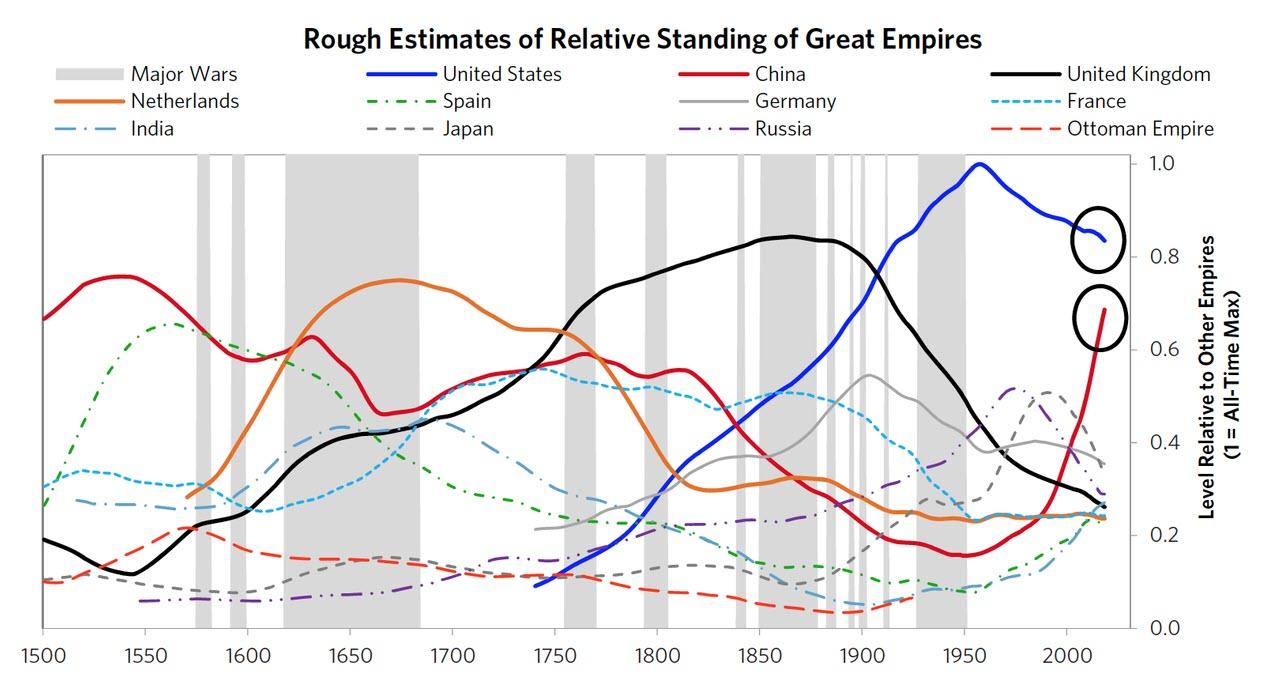


To the Americans, China is a fast rising competitor that doesn’t play by the rules and threatens one of the most important trade routes on the globe in a region long dominated by Washington. U.S. Secretary of State Mike Pompeo has essentially called for regime change.

According to Ryan Hass, former China director on the National Security Council, the Trump administration is trying to “reorient the U.S.-China relationship toward an all-encompassing systemic rivalry that cannot be reversed” by administrations that follow. In short, a cold war not unlike that between the U.S. and the Soviet Union.

To the Chinese, the last 200 years—China does tend to think in centuries, not decades—has been an anomaly in their long history. Once the richest country on the globe that introduced the world to everything from silk to gunpowder, 19th Century China became a dumping ground for British opium, incapable of even controlling its own coastlines.

China has never forgotten those years of humiliation or the damage colonialism helped inflict on its people. Those memories are an ingredient in the current crisis.

But China is not the only country with memories.

The U.S. has dominated the Pacific Ocean - sometimes called an “American lake” - since the end of World War II. Suddenly Americans have a competitor, although it is a rivalry that routinely gets overblown.

An example is conservative New York Times columnist, Bret Stephens, who recently warned that China’s Navy has more ships than the US Navy, ignoring the fact that most of China’s ships are small Coast Guard frigates and corvettes. China’s major strategic concern is the defense of its coasts, where several invasions in the 19th and 20th centuries have come.

The Chinese strategy is “area denial”: keeping American aircraft carriers at arm’s length. To this end, Beijing has illegally seized numerous small islands and reefs in the South China Sea to create a barrier to the US Navy.

But China's major thrust is economic through its massive Belt and Road Initiative (BRI), not military, and is currently targeting South Asia as an area for development.

South Asia is enormously complex, comprising Afghanistan, Pakistan, India, Bangladesh, Bhutan, Tibet, the Maldives and Sri Lanka. Its 1.6 billion people constitute almost a quarter of the world’s population, but it only accounts for 2 percent of the global GDP and 1.3 percent of world trade.

Those figures translate into a poverty level of 44 percent, just 2 percent higher than the world’s most impoverished region, sub-Saharan Africa. Close to 85 percent of South Asia’s population makes less than $2 a day.

Much of this is a result of colonialism, which derailed local economies, suppressed manufacturing, and forced countries to adopt monocrop cultures focused on export. The globalization of capital in the 1980s accelerated the economic inequality that colonialism had bequeathed the region.

Development in South Asia has been beholden to the World Bank and the International Monetary Fund (IMF), which require borrowers to open their markets to western capital and reduce debts through severe austerity measures, throttling everything from health care to transportation.

This economic strategy - sometimes called the “Washington Consensus” - generates “debt traps”: countries cut back on public spending, which depresses their economies and increases debt, which leads to yet more rounds of borrowing and austerity.

The World Bank and the IMF have been particularly stingy about lending for infrastructure development, an essential part of building a modern economy. It is “the inadequacy and rigidness of the various western monetary institutions that have driven South Asia into the arms of China,” says economist Anthony Howell in the South Asia Journal.

The Belt and Road Initiative (BRI) takes a different tack. Through a combination of infrastructure development, trade and financial aid, countries in Asia, Africa, the Middle East and Europe are linked into what is essentially a new “Silk Road.” Some 138 countries have signed up.

Using a variety of institutions—the China Development Bank, the Silk Road Fund, the Export-Import Bank of China, and the Asian Infrastructure Investment Bank–Beijing has been building roads, rail systems and ports throughout South Asia.

For decades, western lenders have either ignored South Asia—with the exception of India—or put so many restrictions on development funds that the region has stagnated economically. The Chinese Initiative has the potential to reverse this, al;arming the West and India, the only nation in the region not to join the BRI.

The European Union has also been resistant to the Initiative, although Italy has signed on. A number of Middle East countries have also joined the BRI and the China-Arab Cooperation Forum. Saudi Arabia, the United Arab Emirates and Egypt have signed on to China’s Digital Silk Road, a network of navigation satellites that compete with America’s GPS, Russia’s GLONASS and European Union’s Galileo. China also recently signed a $400 billon, 25-year trade and military partnership with Iran.

Needless to say, Washington is hardly happy about China elbowing its way into a US-dominated region that contains a significant portion of the world’s energy supplies.

In a worldwide competition for markets and influence, China is demonstrating considerable strengths. That, of course, creates friction. The US, and to a certain extent the EU, have launched a campaign to freeze China out of markets and restrict its access to advanced technology. The White House successfully lobbied Great Britain and Australia to bar the Chinese company, Huawei, from installing a 5G digital network, and is pressuring Israel and Brazil to do the same.

Not all of the current tensions are economic. The Trump administration needs a diversion from its massive failure to control the pandemic, and the Republican Party has made China bashing a centerpiece of its election strategy. There is even the possibility that the White House might pull off an “October surprise” and initiate some kind of military clash with China.

It is unlikely that Trump wants a full-scale war, but an incident in the South China Sea might rally Americans behind the White House. The danger is real, especially since polls in China and the United States show there is growing hostility between both groups of people.But the tensions go beyond President Trump’s desperate need to be re-elected. China is re-asserting itself as a regional power and a force to be reckoned with worldwide. That the US and its allies view that with enmity is hardly a surprise. Britain did its best to block the rise of Germany before World War I, and the US did much the same with Japan in the lead up to the Pacific War.

Germany and Japan were great military powers with a willingness to use violence to get their way. China is not a great military power and is more interested in creating profits than empires. In any case, a war between nuclear-armed powers is almost unimaginable (which is not to say it can’t happen).

China recently softened its language toward the US, stressing peaceful co-existence.

“We should not let nationalism and hotheadness somehow kidnap our foreign policy,” says Xu Quinduo of the state-run China Radio.

“Tough rhetoric should not replace rational diplomacy.”

The new tone suggests that China has no enthusiasm for competing with the US military, but would rather take the long view and let initiatives like the Belt and Road work for it. Unlike the Russians, the Chinese don’t want to see Trump re-elected and they clearly have decided not to give him any excuse to ratchet up the tensions as an election year ploy.

China’s recent clash with India, and its bullying of countries in the South China Sea, including Vietnam, Malaysia, the Philippines, and Brunei, have isolated Beijing, and the Chinese leadership may be waking to the fact that they need allies, not adversaries.

And patience.

Sent from my iPad


To: marcher who wrote (161505)8/22/2020 7:44:09 AM
From: TobagoJack  Read Replies (1) | Respond to of 218160
 
CNN positioning of Team USA troop pullout seems to be “it would cost money and do no good”

I am supposing keeping the troops where they are are not freebies exactly

At some juncture the costing might come to the fore of issues, but as long as money can be printed, all good

Of course the pullout might simply be recognition that Germany (and France) has chosen the path forward, Europe for Europe, to Make Europe Great Again. Certainly Macron’s choice is clear, to Make France Great Again.


edition.cnn.com

Trump's planned troop pullout from Germany has many military holes

(CNN) — When United States and Polish officials signed a deal to support more combat troops in Poland, the country's foreign minister, Jacek Czaputowicz, said the move put American troops where they needed to be.

"The presence of American troops in Poland enhances our deterrence potential because we are closer to the potential source of conflict," Czaputowicz said in a joint appearance Saturday with US Secretary of State Mike Pompeo.

Etc etc etc

