I missed this earlier
icij.org
US Treasury Department abandoned major money laundering case against Dubai gold company
The Kaloti probe offers rare insight into the illicit gold trade.
Kyra Gurney
September 21, 2020
After three years of digging, investigators in the United States had accumulated a mountain of evidence that they believed sealed the case against Kaloti Jewellery Group, one of the largest gold traders and refiners in the world.
The Dubai-based conglomerate had become a key cog in the dirty gold trade, buying the precious metal from sellers suspected of laundering money for drug traffickers and other criminal groups, a U.S. Drug Enforcement Administration-led task force determined. Kaloti often paid in cash — sometimes so much it had to be hauled in wheelbarrows — and wired money for suspect clients to other businesses, investigators believed.
In 2014, the task force recommended that the Treasury Department designate Kaloti a money laundering threat under the USA Patriot Act, a seldom-used measure known as the financial “ death penalty” because it can freeze a firm out of the international banking system.
But the Treasury Department never took action against Kaloti. Former Treasury officials said a decision on whether to move ahead was deferred for fear of angering the United Arab Emirates, a key U.S. ally in the Middle East. When attempts to convince the UAE to act on its own against Kaloti fizzled, the investigation was mothballed.
Investigators told the International Consortium of Investigative Journalists they were baffled and disappointed. Money laundering cases are extraordinarily difficult to crack and the U.S. has struggled to police the murky gold trade. With Kaloti they thought they had a rare opportunity to send a message to the entire gold industry.
“I was incredibly frustrated,” one former official said. “What’s really sad is a lot of really, really good investigators, some really talented people, put a lot more time than they got paid for into trying to uncover a huge wrong.”
The U.S. investigation of Kaloti has not been previously reported. The outcome points to challenges common to money laundering cases: Investigators must follow money across borders and through companies based in secrecy havens, like Dubai, that have shown little interest in cracking down. Bringing cases against powerful actors also requires political will and agreement among different U.S. agencies with competing priorities.
The investigation came to light in a batch of secret bank filings that describe the flow of more than $2 trillion in suspicious transactions through the global banking system. JPMorgan Chase, Deutsche Bank and other financial institutions flooded the Treasury Department’s Financial Crimes Enforcement Network with warnings about Kaloti, flagging as suspicious thousands of transactions, worth $9.3 billion, that occurred between 2007 and 2015, the reports show.
In some reports, the banks described money flows that they said had the earmarks of money laundering. Several banks launched their own investigations and severed ties with the company — or said they planned to do so.
The documents, called suspicious activity reports, or SARs, were obtained by BuzzFeed News and shared with ICIJ and 108 media partners as part of the FinCEN Files investigation. SARs reflect the concerns of bank compliance officers and are not necessarily indicative of any criminal conduct or other wrongdoing. Some of the documents in the FinCEN Files were gathered as part of U.S. Senate committee investigations into Russian interference in the 2016 U.S. presidential election while others were gathered following requests to FinCEN from law enforcement agencies.
ICIJ confirmed additional details about the government inquiry into Kaloti with nine current or former law enforcement and other officials with knowledge of the investigation, who agreed to discuss it on the condition that their names not be used. They are not authorized to speak publicly about the case and fear repercussions for discussing it.
In a statement, a Kaloti spokesperson said the company “vehemently denies any allegations of misconduct” and has never “knowingly engaged with any criminal or criminal group.” Kaloti regularly conducts “all appropriate and required” due diligence and anti-money laundering checks, including searching criminal and regulatory databases, the statement said, and these checks have “never identified any such criminality, or its likelihood, amongst any active clients of Kaloti’s.” The gold company has never been accused or questioned by any regulator or legal authority “about any material wrongdoing of the kind alleged or any other kind,” the statement said.
A spokesman for the DEA said the Kaloti case is now closed and declined to answer questions about the investigation.
There is no better mechanism in the world for laundering money than gold.— David Soud
U.S. investigators said they never questioned Kaloti directly. Because the case did not result in charges or a Treasury designation, Kaloti never had a chance to see or challenge any of the evidence investigators had gathered.
Law enforcement has long seen the gold trade as a key vulnerability in the global fight against money laundering. Drug gangs and armed militant groups use gold to launder money and fund conflicts. In the process, they have supported illegal mining operations that destroy pristine rainforest and are hubs for sex trafficking and child labor. In Peru, Latin America’s biggest gold producer and the world’s second-largest cocaine supplier, the illegal gold trade is now twice as big as drug trafficking.
“There is no better mechanism in the world for laundering money than gold,” said David Soud, head of research and analysis at I.R. Consilium, a consulting firm that specializes in analyzing resource-related crime. “It is concentrated, portable wealth, has essentially the same value anywhere in the world, and can be moved outside the global financial system.”
For these reasons, it is not unusual for a precious metal transaction to attract bank scrutiny. Gold companies are involved in roughly a quarter of all suspect transactions across the FinCEN Files.
But the FinCEN Files show that inquiries into Kaloti went beyond routine monitoring. As the U.S. investigation was gaining momentum, concerns about the company’s business practices also made headlines in the United Kingdom.
In 2014, a former partner at EY’s Dubai office reported that Kaloti had accepted gold exported from Morocco disguised as silver, with falsified paperwork. Auditors at the global accountancy firm, formerly known as Ernst & Young, also discovered that Kaloti had purchased gold from Sudan — where the precious metal has financed a militia group under investigation for genocide — without properly vetting its suppliers, according to the former EY partner. The following year, Kaloti’s refinery lost an important industry accreditation.
A spokesperson for Kaloti said the company has not been found by any regulators, international bodies or auditors to have conflict minerals, “or even the likelihood of such,” in its supply chains.
Kaloti has managed to maintain business ties with major corporations, including the Swiss refiner Valcambi, according to Global Witness, an anti-corruption advocacy group. Kaloti recently opened a new refinery in Dubai.
General Electric, Amazon, General Motors and dozens of other U.S. companies reported that Kaloti may have processed or provided gold as part of their supply chains in 2019, according to paperwork filed with the Securities and Exchange Commission.
GE and General Motors said they do not source gold directly from Kaloti. GE said it had asked the supplier who reported using Kaloti to remove the company from its supply chain. Amazon, GE and General Motors said they are committed to having an ethical supply chain.
Dubai gold rushGold courses through the global economy. Investors trade contracts pegged to future deliveries on major commodities exchanges in London, Chicago and Shanghai. Banks buy it from mining companies and other suppliers to resell to manufacturers, which turn it into wedding bands and iPhone circuits. Middlemen hawk it in late-night infomercials.
The price of gold can fluctuate greatly. It rose to $1,895 a troy ounce in 2011, fell to $1,062 in 2015 and is now hovering around $1,900. And yet it is often seen as a haven by investors spooked by volatile markets. That’s partly because the metal has staying power. Gold has underpinned world powers as distinct as 16th-century Spain, which built a global empire with gold looted from Latin America, and the 21st-century United States, which holds more than 261 million troy ounces (8,000 metric tons) worth more than $11 billion in government vaults.
For Munir Al Kaloti, the founder of the Kaloti Jewellery Group, gold was the foundation of a business empire.
Al Kaloti fled Jerusalem to what is now the UAE in the 1960s, when it was still a dusty backwater with few paved roads. He got his start scavenging scrap metal and later imported goats for the then-ruler of Dubai, he said in a 2013 interview with a local news site.
In 1988, Al Kaloti opened a jewelry shop with his son-in-law, who had trained as a jeweler in Italy. It wasn’t long before they were buying gold. “People carrying scrap gold and gold from mines in Africa and Asia were coming in more and more and they are asking who can handle this, who can buy this?” Al Kaloti recalled in the interview. “So we said: ‘Why not?’”
Over the next quarter-century, Dubai grew into a major financial and business center. It also became an important hub in the gold trade, aided by low tax rates, proximity to Africa and Asia, and a reputation for secrecy.
In 2000, the Kaloti Jewellery Group began trading gold bars. By 2008, it was making its own bars at a refinery in the neighboring city of Sharjah. It soon became one of the largest gold trading and refining conglomerates in the Middle East, with branches in Asia. Still, it remained a family business: Munir Al Kaloti’s son-in-law served as the general manager. One of his sons operated a gold buying office in a crowded Dubai souk.
Behind the scenes, Kaloti’s dealings had started to attract the attention of U.S. law enforcement.
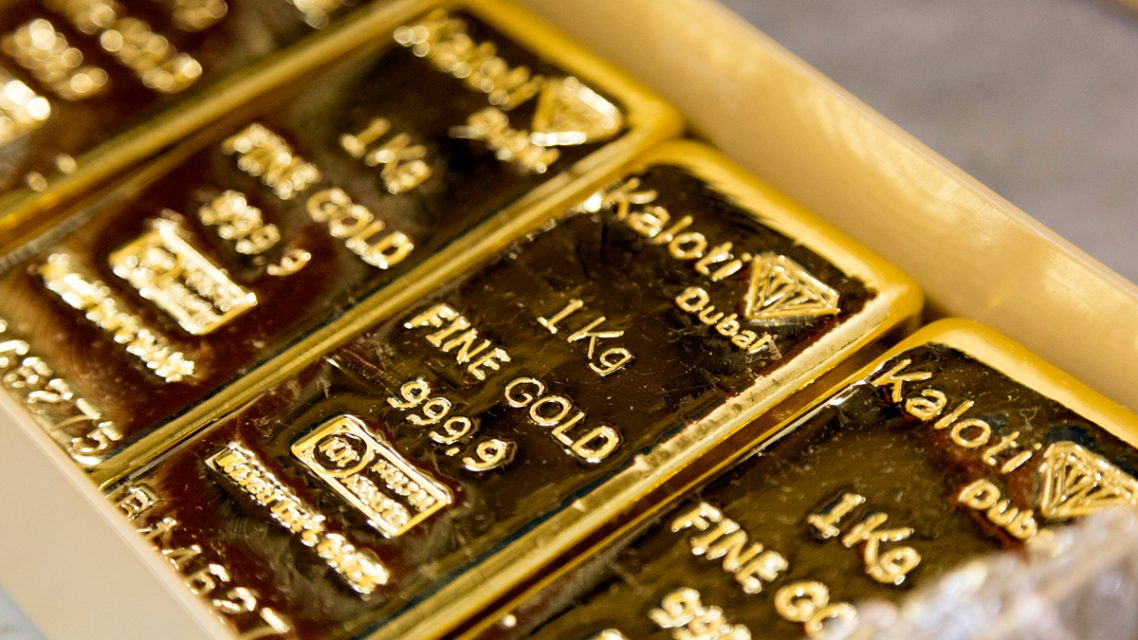 A box of 1kg refined gold bars individually stamped “Kaloti Dubai.” Image: Bloomberg via Getty Images Operation Honey BadgerIn late 2010, a DEA-led task force in central Florida started getting calls from DEA agents investigating a money laundering scheme that spanned five continents as part of a law enforcement campaign called Project Cassandra. A box of 1kg refined gold bars individually stamped “Kaloti Dubai.” Image: Bloomberg via Getty Images Operation Honey BadgerIn late 2010, a DEA-led task force in central Florida started getting calls from DEA agents investigating a money laundering scheme that spanned five continents as part of a law enforcement campaign called Project Cassandra.
An international criminal network was piping illicit cash from Colombian cocaine sales in Europe to Africa, where it was combined with proceeds from used-car sales in Benin, prosecutors later alleged. Cash couriers connected to Hezbollah, a Shiite militant group and Lebanese political party backed by Iran, allegedly moved the cash to Beirut in exchange for a cut.
The Lebanese Canadian Bank, based in Beirut, and money exchange businesses allegedly wired hundreds of millions of dollars to the U.S. for the criminal network to purchase still more used cars, completing the money laundering cycle. The network also sent funds through the bank to consumer goods companies in Asia to buy products that were shipped to South America and sold to pay cocaine suppliers.
In early 2011, the U.S. Treasury Department designated the Lebanese Canadian Bank a “primary money laundering concern” — the same financial “death penalty” that the government would later also consider for Kaloti.
A DEA-led task force scouring bank records at its central Florida office soon noticed that money sent to some of the used-car companies implicated in the Lebanese Canadian Bank case now appeared to be passing through Kaloti, a gold trader that at the time they knew little about.
“Overnight the wire transfers you saw with Lebanese Canadian Bank and these other companies switched over to Kaloti, like a light switch,” recalled one former official. “We were, like: ‘Who’s Kaloti?’”
Kaloti soon became one of the targets of a new probe, code-named Operation Honey Badger after the fierce mammal known for hunting pythons and cobras.
Investigators were especially interested in two Kaloti clients that they suspected were involved in laundering drug money through gold: Salor DMCC, based in Dubai, and a business in Benin called Trading Track Company.
Scouring financial records, investigators noticed large wire transfers, sometimes more than once a day, from Kaloti to Salor. In payment details, Kaloti referenced gold trading and Trading Track.
Salor often wired money to used-car dealers the same day, according to law enforcement records viewed by ICIJ.
“Kaloti was used to mask the source of a lot of those funds,” a former investigator said. “You had to follow the bouncing ball.”
Also a red flag for investigators: Kaloti made cash payments worth millions of dollars to suppliers. Cash is difficult to trace, making it a preferred payment method for criminal groups. Documents viewed by ICIJ show that Kaloti paid Salor $414 million in cash for gold in 2012. It paid Trading Track $28 million in cash for the precious metal that same year.
Kaloti said it couldn’t comment on its relationship with Trading Track and Salor due to confidentiality obligations. The company said it only accepts customers after conducting “robust due diligence” and that any cash transactions “were not in any way improper.”
Kaloti added that while cash is “a common method of payment” in the UAE, it made a commercial decision to stop conducting cash transactions and had stopped dealing in cash by August 2013.
Salor and Trading Track have the same owner, a lawyer for the companies said. He would not reveal who it is. Neither company has ever taken part in money laundering or other illegal or unethical conduct, the lawyer said. The companies were not informed of the U.S. investigation and have not been charged with wrongdoing in the United States or elsewhere, the lawyer added. Salor said that all of its activities in Dubai were subject to regulatory oversight and approval.
In a July interview, Trading Track manager Nemer Talj told ICIJ media partner Banouto in Benin that Trading Track transports gold for Salor that is then entrusted to Kaloti for refining.
What the banks sawThe United States is the top global enforcer of anti-money-laundering laws. The reason has a lot to do with the primacy of the U.S. dollar in global financial transactions and with the leading role major Wall Street banks play in processing payments that zip around the world.
The upshot: To do business in the U.S., a financial institution must play by U.S. rules, which means alerting the Treasury Department’s Financial Crimes Enforcement Network when it “knows, suspects, or has reason to suspect” that a transaction moving through its accounts could be part of a scheme to launder money, violate sanctions or fund a terrorist group or has no apparent business purpose.
The DEA-led task force began subpoenaing bank records, apparently putting the institutions on high alert.
The FinCEN Files show a flurry of activity in 2012 and 2013 as banks rushed to tell authorities what they’d seen.
In 2012, Kaloti began transferring large sums from its Deutsche Bank accounts to its Emirates NBD bank account in Dubai. Agents for the company then began withdrawing so much cash from Emirates NBD that the money had to be moved in wheelbarrows, a former Deutsche Bank employee later claimed.
Deutsche Bank reported the withdrawals to U.S. authorities the next year, FinCEN Files show. The bank wrote that some traders on the London commodities exchange “seemed to be backing away” from Kaloti and that Deutsche Bank planned to do the same.
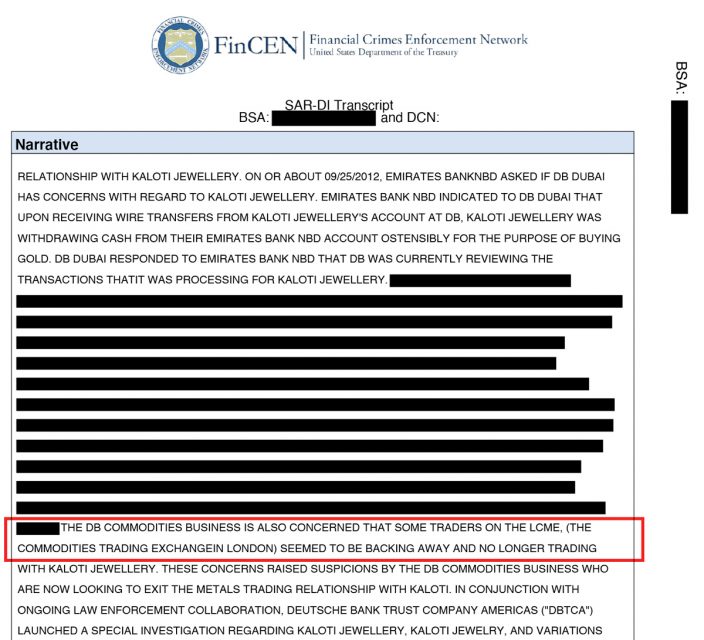
Deutsche Bank also reported its concerns to authorities in the UAE, including the fact that the bank had learned U.S. authorities were investigating Kaloti. One of the UAE authorities, the Dubai Financial Services Authority, told ICIJ it did not have jurisdiction to investigate the allegations against Kaloti. The other, the UAE Central Bank, did not respond to requests for comment.
Around the same time, JPMorgan Chase said it had suspended commodities trading with Kaloti because the company had “attracted interest” from law enforcement and appeared to be engaging in “high-risk” transactions.
Emirates NBD kept Kaloti’s account open until at least August 2014, the filings show.
Deutsche Bank, JPMorgan Chase and Emirates NBD declined to comment on ICIJ’s findings, citing confidentiality laws. A spokesperson for Kaloti said the company would not comment on its banking relationships. Kaloti said that in general, some major banks have decided to exit or reduce their exposure to the gold market or certain trading locations as part of an overall effort to minimize risks.
Kaloti added that it had engaged in roughly 75,000 transactions between 2012 and 2016 and said the number of SARs naming the company in the FinCEN Files was “statistically insignificant.”
The whistleblowerOn a visit to a Kaloti office in Dubai’s gold market in 2013, inspectors from the auditing firm EY noticed a stack of what appeared to be silver bars. Munir Al Kaloti’s son scraped off the shiny coating to reveal gold. A Moroccan supplier had disguised the bars to evade export restrictions, according to an internal EY report later shared with the media by a whistleblower.
The EY inspectors were shocked. Buying gold from suppliers Kaloti knew had falsified paperwork could cost the company an industry accreditation known as “Dubai Good Delivery,” scaring away major international customers.
The auditors determined that Kaloti had knowingly accepted as much as four metric tons of gold exported from Morocco with falsified paperwork. The shipments included gold from a criminal group that laundered $146 million in drug money through Kaloti, a later investigation by BBC Panorama and documentary production company Premières Lignes found. Kaloti said in a statement in response to the auditors’ findings that it had properly vetted its suppliers before buying gold from them and “swiftly rectified” any “shortcomings.” The company told BBC Panorama it had conducted anti-money-laundering checks, had not bought gold coated in silver and would “never knowingly” do business with an entity engaged in criminal activity.
The auditors shared their concerns with the Dubai Multi Commodities Centre, which runs the accreditation program and was set up in 2002 as part of a grand plan to make the emirate a world-leading hub for gold trading.
International standards call for gold buyers to scrutinize suppliers to ensure that they aren’t fueling conflicts or contributing to human rights abuses, but in many countries, including the UAE, the standards are not codified into law, leaving enforcement largely to voluntary industry accreditation programs like the one run by the DMCC.
Yet instead of taking away Kaloti’s accreditation, the DMCC in 2013 changed its rules to allow the company to keep secret the specifics of what the auditors had uncovered, Amjad Rihan, a partner at EY’s Dubai office, later alleged. The DMCC disputes these allegations.
The DMCC would eventually remove Kaloti’s Sharjah refinery from its “Good Delivery” list in April 2015. It did not give a specific reason, stating only that the refinery had failed to meet “Good Delivery” standards. The move was largely symbolic as Kaloti continued to find buyers for its gold. A spokesperson for Kaloti said there were no “valid grounds” to justify the removal of its refinery from the “Good Delivery” list and that the decision “had nothing to do with Kaloti’s sourcing policy.” Kaloti said that “significant regulatory changes” have occured in the gold industry in recent years. “Kaloti’s business has evolved to comply with those changes and has consistently met or exceeded all applicable regulatory requirements, consistent with industry best practices,” the company said.
In interviews with The Guardian and Global Witness, Rihan accused EY of participating in a cover-up of Kaloti’s failings and pushing him out of the firm. Earlier this year, a London High Court judge sided with Rihan and ordered EY to pay the whistleblower $11 million. The firm has denied any wrongdoing and is appealing the decision.
‘Tremendous amounts of illicit value’In August 2014, the DEA-led task force submitted a report to the U.S. Treasury Department detailing why investigators believed that Kaloti and others, including Salor and Trading Track, were money laundering threats. The report listed Kaloti Jewellery International DMCC — the company responsible for managing Kaloti’s physical gold business in the UAE — as the main target within Kaloti Jewellery Group.
Kaloti and the other companies, investigators wrote, were “providing financial services for a variety of criminal organizations based throughout the world” and facilitating the conversion of dirty cash into gold. “Together, they have established a significant capability to transport or otherwise transfer tremendous amounts of illicit value through the use of gold as a commodity, as well as bulk cash transfers and third party wire payments,” the report said, according to an excerpt seen by ICIJ. The report alleged that Salor and Trading Track were among several “core entities” involved in laundering drug money.
The findings, according to investigators, were based on an extensive examination of the companies’ operations: The Operation Honey Badger team had reviewed more than 230,000 wire transfers and obtained warrants to search email accounts that contained over 450,000 conversations. They had traveled to Europe to interview sources. The U.S. military’s Special Operations Command and investigators from other agencies had also pitched in.
A lawyer for Salor and Trading Track said the companies deny any allegations of wrongdoing and that “investigations that result in no finding of wrongdoing happen all the time, and the mere fact of an investigation is not probative of anything.”
A spokesperson for Kaloti said the company “categorically denies that it could have ever properly or reasonably been deemed a money laundering ‘threat’ or ‘concern’” and is “wholly unaware of alleged criminal connections” to Salor and Trading Track. Kaloti said that if it had been provided with evidence that any of its customers were knowingly facilitating criminal activity, it would have “immediately disengaged from those relationships.”
The spokesperson added that third-party payments “were neither illegal nor generally uncommon prior to 2013,” that any payments it conducted were “fully transparent,” only on behalf of vetted customers, and clearly identified the source, remitter and recipient, and that it had stopped making such payments by the end of 2012. Kaloti said it has “never provided any services other than those for which it was fully licensed to provide” and “has been fully compliant with all legal and regulatory requirements relating to its business and all transactions to which it has been a party.”
The Treasury Department conducted its own investigation of Kaloti. Before freezing Kaloti out of the financial system, U.S. authorities felt it was important for diplomatic reasons to talk to officials in the UAE to see if they would handle the issue internally, according to interviews with former Treasury officials with knowledge of the investigation.
Kaloti is a major player in Dubai’s economy and the UAE is an important ally on a number of issues including terrorism. In 2015 and 2016, Treasury officials met with local authorities in the UAE to discuss Kaloti. But the DEA-led task force didn’t trust the Emirati authorities, and wouldn’t let Treasury share the evidence it had obtained, according to former investigators.
Former U.S. officials say it isn’t totally clear why the “money laundering concern” designation wasn’t deployed. Along with diplomatic concerns, the Treasury Department has seldomly used the designation, which was created after the Sept. 11, 2001, terrorist attacks to keep dirty money from flowing through the global financial system. In two decades, 26 foreign jurisdictions and financial institutions have been targeted. It has never been applied to a precious metals dealer.
“Should we have taken action? Yes, we should have,” said one former Treasury official. But because of the novelty of applying the action to a precious metals company and other factors that made designating Kaloti complicated, the case was “never a slam-dunk,” the official said.
It’s unclear whether the Treasury Department also investigated Salor and Trading Track.
A spokesperson for Kaloti said that “had the US Treasury Department really harbored concerns that Kaloti was in any way involved in money laundering, upon proper investigation, either by liaison with UAE authorities, or Kaloti or both, we are confident their concerns could have been easily allayed.”
Although the Treasury Department didn’t take action, by 2013 three major banks had told authorities they had closed or planned to close accounts associated with Kaloti, the FinCEN Files and other records show.
One of those banks, Deutsche Bank, had actually kept its Kaloti accounts open longer than it likely would have otherwise; the Justice Department wanted them open for monitoring purposes, according to a witness in the Rihan lawsuit.
A fourth bank, HSBC Hong Kong, waited until early 2016 to close Kaloti’s account, the filings show — two years after Rihan went public with his findings. HSBC declined to comment.
The Treasury Department, the Department of Justice and the UAE did not respond to questions about the Kaloti investigation. A spokesperson for the Special Operations Command said it could not comment on specific investigations. The DEA would only say that the case is now closed.
In a Sept. 1 public statement that alluded to ICIJ’s questions, the Treasury Department said that the “unauthorized disclosure” of suspicious activity reports was a crime and that it had “referred this matter” to its Office of Inspector General and the Department of Justice.
‘Lip service’ to the rulesKaloti had been a target of a multiyear U.S. investigation into alleged money laundering. EY was embroiled in a public relations crisis, accused of helping Kaloti cover up its alleged misdeeds. Major banks had closed company accounts. And an influential Dubai industry group revoked its seal of approval.
Yet the company moved ahead with a plan to open a refinery in a new base of operations: Suriname, a tiny South American country and former Dutch colony that the U.S. State Department warns is a transit hub for the continent’s cocaine.
The refinery was a joint venture with the government of Dési Bouterse, who was convicted of drug trafficking by a Dutch court in 1999. After a national security consultant visited Suriname in 2016, he said he “found no evidence that the refinery exists.”
“Under these circumstances, the government can certify the exports of any amount of gold, real and fictitious, from a refinery that exists only on paper,” the consultant, Douglas Farah, wrote in a report for the Center for a Secure Free Society, a national security think tank. Kaloti and Suriname’s government have disputed the consultant’s findings. Kaloti published a letter from an auditor on its website certifying that the Kaloti Suriname Mint House was operating between 2015 and 2017.
Kaloti appears to be thriving. Despite removing Kaloti’s original UAE refinery, which has since closed, from its “Good Delivery” list in 2015, the DMCC allowed the company to open a new refinery — MTM&O Gold Refinery DMCC — in 2017, according to the recent Global Witness report. The DMCC told ICIJ that all applications for company registration are subjected to a “robust compliance process.”
Global Witness, citing confidential sources, said that in 2018 and 2019, Kaloti bought Sudanese gold that may have funded armed groups. Those same years, the company sold roughly 20 metric tons of gold to Valcambi, the Swiss refining company, which is on both the Dubai and London Bullion Market Association “Good Delivery” lists, Global Witness said.
Valcambi told ICIJ it would not confirm or deny buying gold from Kaloti. The company said it only purchases gold from its suppliers “where the company can fully ensure the identification of the origin of the gold” and does not accept gold from countries on sanctions lists, such as Sudan.
Kaloti told ICIJ that Global Witness’ findings were “not accurate” but said it would not respond to questions “about any customers it may have” for confidentiality reasons. The company said it sourced gold in Sudan directly from artisanal and small-scale mines producing “non-conflict gold”. A spokesman for the LBMA said Valcambi had undergone two audits, including a “special audit” that was required because the company had obtained recycled gold from the UAE, a high-risk jurisdiction, in 2018.
As of January 2015, Kaloti was a member of the U.S.-based commodities exchange COMEX. A spokesperson for the exchange would not say whether Kaloti remained a member in 2020, citing “confidentiality reasons.” Kaloti is also a member of the Shanghai Gold Exchange’s international board and its branch in Turkey is listed as a member of the Turkish stock exchange Borsa Istanbul. Neither exchange responded to requests for comment.
Meanwhile, experts say the UAE appears to have little interest in confronting the illicit gold trade. Billions of dollars’ worth of gold is smuggled out of Africa through the UAE each year, according to a recent Reuters investigation, depriving poor countries of much-needed tax revenue and allowing gold from conflict regions to enter the global economic system.
The Financial Action Task Force, an international anti-money-laundering watchdog, recently criticized the UAE for not doing enough to prevent money laundering.
“The ruling family pays lip service to following the rules, but it’s basically laissez-faire, anything goes,” said John Cassara, a former U.S. Treasury special agent who has written books on trade-based money laundering. “Money goes in, money goes out and nobody enforces anything.”
In a statement, the UAE Embassy in Washington, D.C., said the country “is continually improving its own security—and those of its allies—by limiting and preventing illegal transshipments and money flows” and recently updated its anti-money laundering laws.
Current and former officials familiar with the U.S. investigation into Kaloti said the failure to take action against the company set a bad precedent.
“In my opinion, what is the risk factor? Being exposed?” one official said. “If you’re not being prosecuted or shut down, then what would stop you?”
Contributors: Simon Bowers, Agustin Armendariz, Emilia Díaz-Struck, Will Fitzgibbon, Yao Hervé Kingbêwé, Emmanuel K. Dogbevi, Alloycious David, Sylvain Besson, Lisseth Boon, Delphine Reuter, Andrew Lehren, Emily Siegel, Miguel Gutiérrez. |



