SI
SI
discoversearch

We've detected that you're using an ad content blocking browser plug-in or feature. Ads provide a critical source of revenue to the continued operation of Silicon Investor.  We ask that you disable ad blocking while on Silicon Investor in the best interests of our community.  If you are not using an ad blocker but are still receiving this message, make sure your browser's tracking protection is set to the 'standard' level.
Strategies & Market Trends : 2026 TeoTwawKi ... 2032 Darkest Interregnum -- Ignore unavailable to you. Want to Upgrade?


To: Julius Wong who wrote (165429)11/25/2020 8:51:14 AM
From: TobagoJack  Read Replies (2) | Respond to of 220252
 
Do fuel cells absolutely require PGM ?


To: Julius Wong who wrote (165429)11/25/2020 9:58:07 AM
From: gg cox  Read Replies (1) | Respond to of 220252
 
Hydrogen delivery

energy.gov

Presently,, problems with hydrogen as above,, and of course many others as well.

Presently.. no problems with wind power ,, solar power directly into the grid ,, the only problem is surplus

amounts at unpredictable times,, which Musk has solved, and proven ,,huge batteries in Australia for example.

Renewables ,, into grid,, if to much ,,into batteries and out ,, when needed. Think of it,,just wires and a large

brick... ;+) Green enough! Without,, step ,, step,, step “”not so green hydrogen.”

Still early days in the drama,,, and which side will truly win? The side with less steps in the process,,

batteries,, and Musk. Efficiency rules over time.


To: Julius Wong who wrote (165429)6/10/2021 3:51:14 AM
From: TobagoJack  Read Replies (1) | Respond to of 220252
 
Re <<10 Countries Moving Toward a Green Hydrogen Economy>>

Green turning green

bloomberg.com

Tesla Battery Supplier Jumps to Record as Green Stocks Rally
Abhishek Vishnoi
10 June 2021, 14:54 GMT+8
Shares of the world’s largest electric-vehicle battery maker hit an all-time high Thursday in the wake of a flurry of news that spurred bullish prospects for the industry.

Contemporary Amperex Technology Co., a Tesla Inc. supplier, jumped as much as 8.6% in Shenzhen, taking its gains from a low in March to more than 50%. CATL led advances in not just in EVs but green energy-related stocks as well. A BloombergNEF outlook report and China’s moves to boost the sector including People’s Bank of China Governor Yi Gang pledging increased support spurred the gains.


Investor appetite is growing for the Chinese company that’s been a beneficiary of a worldwide push toward curbing carbon emissions. BloombergNEF analysts expect global annual passenger EV sales rising to 14 million in 2025 from 3.1 million in 2020 and lithium-battery demand growing rapidly to approach 4.5TWh annually by 2035.


Vehicle batteries at the CATL headquarters in Ningde, China, in 2020.

Photographer: Qilai Shen/Bloomberg

This year “marks the first major increase to our EV adoption outlook in the last five years,” driven by factors like rising policy support, accelerated investments and rising consumer adoption, BloombergNEF analysts wrote in a report. “Meeting this demand requires unprecedented but achievable increases in materials, components and cell production.”

Chinese firms reported better-than-expected EV sales last month. Reuters reported that Apple Inc. is in early talks with CATL and BYD Co. about battery supply for its electric vehicle.

Electric vehicle maker BYD, which traded Thursday without the right to receive the next dividend, jumped about 6% in Hong Kong, while solar module maker LONGi Green Energy Technology Co. rose as much as 7.8%.

Battery material suppliers, Guangzhou Tinci Materials Technology Co. gained as much as 7.1% and Tianqi Lithium Corp. surged 3.6%.

Before it's here, it's on the Bloomberg Terminal.
LEARN MORE


To: Julius Wong who wrote (165429)6/10/2021 3:55:45 AM
From: TobagoJack  Respond to of 220252
 
Re <<10 Countries Moving Toward a Green Hydrogen Economy>>

People are looking forward to green, stuff and jobs, either making, and / or installing and maintaining

bloomberg.com

Renewable Energy Boom Unleashes a War Over Talent for Green Jobs

Candidates with the right skills are sometimes hired while they're still in school, or as soon as they graduate


Laura Millan Lombrana
8 June 2021, 12:00 GMT+8

Clean energy giants are finding a shortage of workers with the skills needed to support their ambitious growth plans.

The renewables jobs market is heating up and candidates with the right abilities are becoming harder to find, according to Miguel Stilwell, chief executive officer at Portuguese clean-energy firm EDP Renovaveis SA. The company is one of the world’s top installers of green power and plans to hire 1,300 employees over the next two years.

“There’s a war over talent globally,” Stilwell said in an interview on May 28. “The renewable sector, given the massive amount of growth that is expected, doesn’t have enough people.”


As countries funnel billions of dollars into developing renewable power, policymakers are banking on the sector to create new jobs that are crucial for the post-pandemic economic recovery. Solar generation capacity is expected to triple by the end of the decade, while wind capacity is expected to more than double over the same period, according to clean energy research group BloombergNEF.

Green supermajors such as NextEra Energy Inc, Iberdrola SA, Enel SpA and EDP are leading the race to electrify the global economy. But some large oil companies are starting to get into the sector too, with BP Plc announcing last month it’s looking to fill 100 offshore-wind jobs in the U.K. and the U.S., a figure that could double by the end of the year.

Engineering skills such as energy assessment, project management and project design are in high demand, EDP’s Stilwell said. Good business developers who understand clean energy technologies are also a scarce resource. Other roles, such as managing mergers and acquisitions, or back office tasks, can easily be hired from other industries.

“We’re having to bring in people from other sectors, whether it’s oil and gas or other parts of the energy industry, or recruiting directly from universities," Stilwell said. "There’s a lot of competition out there.”

Engineering and chemistry graduates working on a masters degrees in renewables at the Universitat Politecnica de Catalunya in Barcelona are often hired while they’re still in school, or right after they finish, according to Professor Jordi Llorca. The university has partnerships with other colleges in Europe and students often get hired to work in other countries like the U.K. or Denmark, said Llorca, who is also the director of an engineering research center at the university.

“We need to be fast to adapt the contents of our programs on the energy transition and renewable energies to make sure our graduates are competitive in the market,” Llorca said. “We’re constantly looking at the contracts and agreements we have with different industries to see what's needed.”

The university launched a masters in hydrogen energy last year after professors realized very few people have the skills in mechanics and chemistry that the fast-growing sector will need very soon. “There’s always a moment of vacuum whenever a new technology comes in, but we’re able to put together new programs in just a few months.”

What on Earth?The Bloomberg Green newsletter is your guide to the latest in climate news, zero-emission tech and green finance.

Offshore wind farms are another growth area. The projects involve erecting and maintaining wind turbines the size of skyscrapers miles out to sea. A single turn of one of the massive blades could power a house for two days. The industry was pioneered in Europe, but is now rapidly expanding to Asia and the east coast of the U.S.

Those new markets don’t have people with experience. That means that developers are often sending British and European employees to lead the way, according to Clint Harrison, director at renewable energy-focused recruitment firm Taylor Hopkinson. But as business takes off there’s pressure to hire locally.

The limits of a well-trained workforce could end up being a bottleneck in an industry that is key to slashing emissions.

“There’s a sense of urgency,” Harrison said. “The market is growing very, very quickly and we need to ensure we have the right people across various projects and regions to ensure projects move forward and aren’t delayed.”

In the U.K. alone, around 200,000 skilled workers will be needed in the offshore energy sector by 2030, up from 160,000 today, according to a recent report by the Robert Gordon University in Aberdeen. About half the jobs are expected to be filled by people transferring from the oil and gas sector and about 90% of current workers in the fossil-fuel sector can be retrained for renewables, said author Paul de Leeuw.

“Demand for courses on renewable energy and the energy transition is ramping up rapidly and at the same time we see demand for oil courses declining,” he said. “It’s a societal and industry shift mirroring in the education system.”

Before it's here, it's on the Bloomberg Terminal.
LEARN MORE


To: Julius Wong who wrote (165429)6/10/2021 3:59:09 AM
From: TobagoJack  Respond to of 220252
 
Re <<10 Countries Moving Toward a Green Hydrogen Economy>>

Makers of green in China are looking to make more

bloomberg.com

Renewables Giant Jumps in Debut After Biggest 2021 China IPO
Krystal Chia
10 June 2021, 15:40 GMT+8


China Three Gorges Renewables Group Co. surged 44%, the daily limit, in its trading debut as investors sought to gain from the country’s push toward cleaner energy.

The unit of China Three Gorges Corp. saw its shares climb to 3.82 yuan apiece in trading Thursday on the Shanghai stock exchange, from its IPO price of 2.65 yuan.

The company’s listing, the year’s biggest in China, has been eagerly awaited. It raised 22.7 billion yuan ($3.6 billion) in a May offering that was 78 times oversubscribed. China Three Gorges said proceeds from the offering would be used to help fund offshore wind power projects and replenish liquidity.

The parent is the world’s largest hydropower company, and its renewables unit’s total assets are valued at more than 140 billion yuan, according to the company website.

The listing comes amid a concerted push for renewable energy in Asia’s largest economy. China’s aim to reach peak carbon emissions by 2030 and carbon neutrality by 2060 has fueled a surge in installations of wind and solar capacity. Still, challenges in the wind sector include rising domestic competition and the lapsing of subsides that have helped accelerate the industry’s growth.

‘Main Trend’“The open reflects the investor appetite that we are seeing for new energy stocks such as hydropower and wind power, which have a very positive outlook,” Emperor Securities research director Stanley Chan said by phone. “ESG, social and environment stocks will be the main trend for the next decade.”

China Three Gorges Renewables joins a spate of other energy companies going public recently. Among them was Shanghai Electric Wind Power Group’s 2.9 billion yuan offering last month. The stock is now trading 68% above its IPO price.

The unit’s listing also has implications for its parent company. The IPO indicates China Three Gorges’ capacity to diversify financing channels, and the company should be able to improve its debt situation, according to Ada Li, a vice president at Moody’s Investors Service.

“CTG renewables’ importance to the group will grow as the group shifts its focus on non-hydro renewables,” said Li. “Technological synergy” is also expected from investments by the parent company and unit in wind turbine makers such as Xinjiang Goldwind Science & Technology Co. and Germany’s WindMW GmbH.

China Three Gorges announced this week that it had completed the construction of China’s first floating offshore wind project. While the country’s wind installations doubled to a record in 2020, the focus has been on onshore projects.

(Adds analyst quote beginning in eighth paragraph.)

Before it's here, it's on the Bloomberg Terminal.
LEARN MORE


To: Julius Wong who wrote (165429)6/10/2021 4:05:46 AM
From: TobagoJack  Respond to of 220252
 
Re <<10 Countries Moving Toward a Green Hydrogen Economy>>

Team India wants in, and if can get organised and put in the effort I once witnessed, can, but I remember it was a major effort Message 33346866

Unclear to me where Team India starts, whether to start from the middle and cut wafers and assemble cells, buying everything from Team China, or

start from the beginning and reverse engineer the purification of polysilicon stuff and rush into the storm of China price, quality and quantity

bloomberg.com

India’s Wind Power Sector Wants Rival Solar To Help Drive Growth
Rajesh Kumar Singh
10 June 2021, 12:00 GMT+8

Prices are surging on global recovery and supply constraints

Environmental pressures are changing normal market dynamics
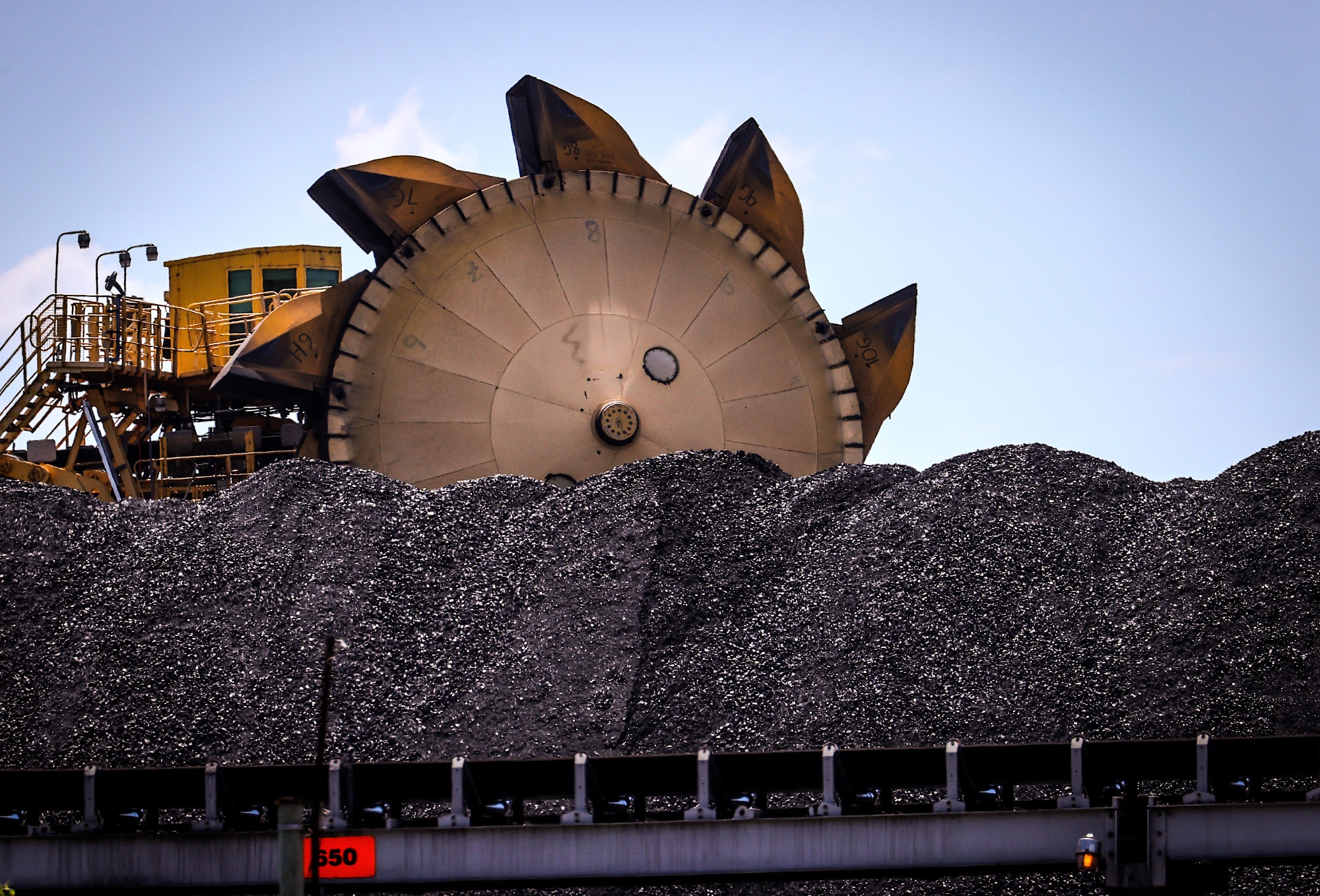


A pile of coal at the Port of Newcastle in Newcastle, Australia.

Photographer: David Gray/Bloomberg

The highest coal prices in years aren’t enough to spur investment in new mines in the face of heightened efforts by governments and financial institutions to get the world to abandon the dirtiest fossil fuel.

Prices are surging from China to Europe as demand for coal rebounds from a virus-induced hit, and temporary mine outages curtail supply. Yet companies remain hesitant to invest in new projects with financing difficult to come by and question marks over long-term demand.
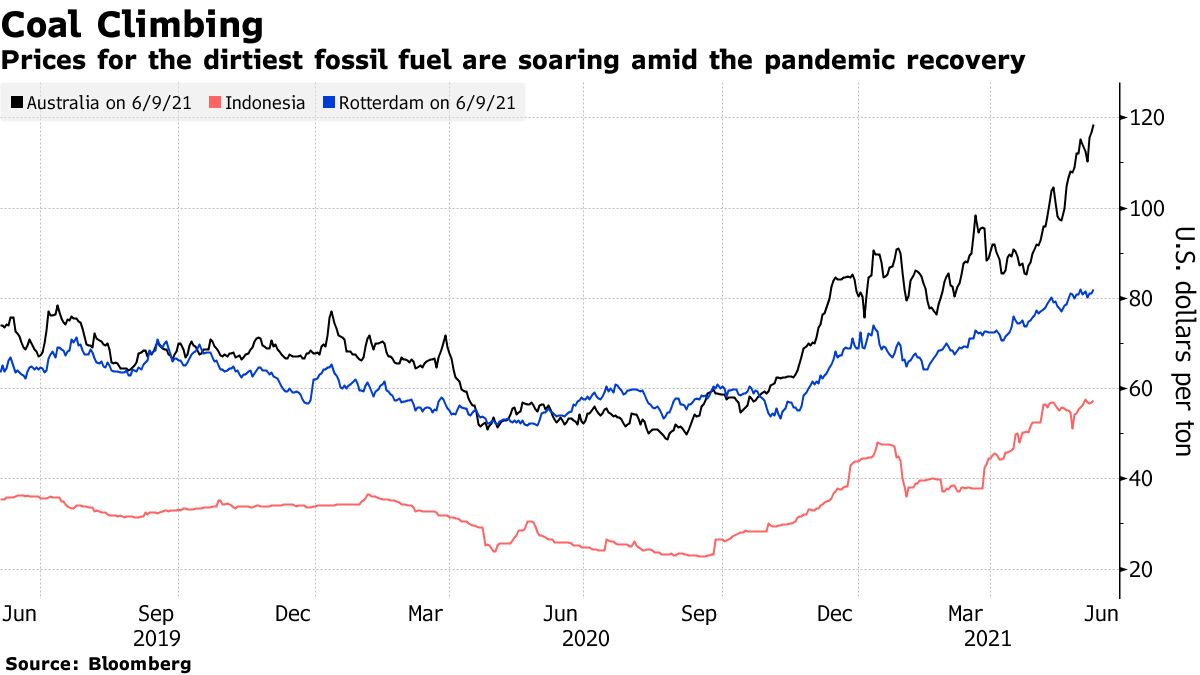


That’s a boon for miners’ bottom lines but goes against the grain of the typical commodity cycle, where high prices are a signal to increase production and eventually bring the market back into balance. The disruption to normal dynamics underscores how broader environmental goals are changing investment patterns for fossil fuels.

“We expect most coal miners exporting into the seaborne market will seek to absorb the current increase in coal prices to bolster balance sheets, rather than commit to new supply,” said Viktor Tanevski, a principal analyst at Wood Mackenzie Ltd. “There remains a void of projects that are under construction or construction-ready that can be fast-tracked to alleviate price pressures.”

Strong industrial activity in major economies is aiding coal consumption, while supply is being constrained by myriad issues including heavy rains in Indonesia, China’s mine safety push and strikes in Colombia. In Europe, demand has increased 10% to 15% this year after a colder-than-usual winter left gas storage depleted, according to Axpo Solutions AG.
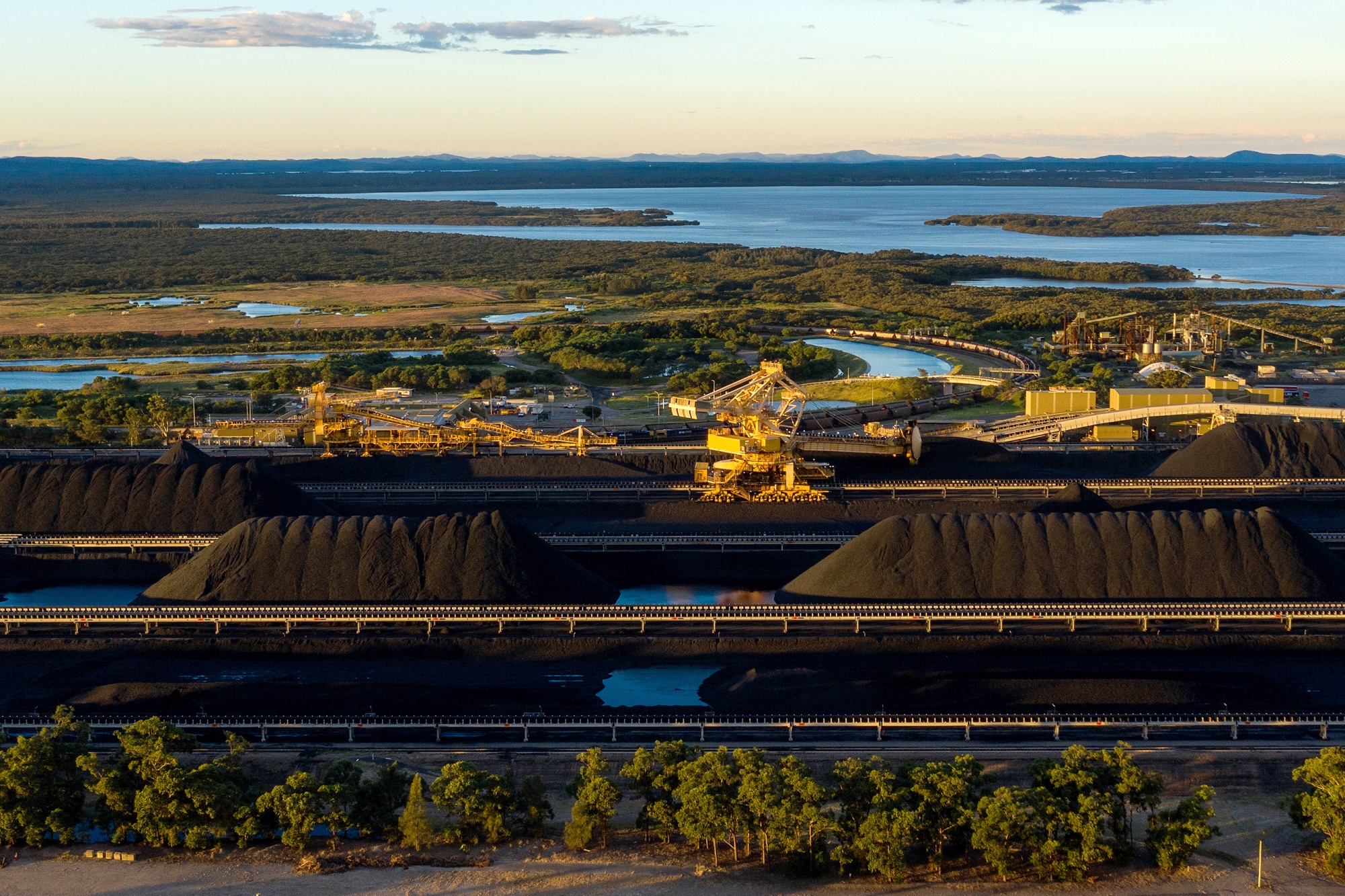


Stockpiles of coal at the Newcastle Coal Terminal in Australia in March.

Photographer: Brendon Thorne/Bloomberg

Futures for high-quality coal at Newcastle port in Australia rose to $118.50 a ton on Wednesday, the highest since 2012. Prices in China, the world’s largest coal consumer, are up 34% since the end of February and have risen so high the government is considering putting a cap on them.

Read more: China Mulls Price Caps on Coal in Campaign to Tame Inflation

Companies are doing what they can to boost output from existing mines. Indonesia’s PT Bukit Asam said it’s seeking to increase production this year with sales showing positive signals. In the U.S., the world’s third-biggest producer, some assets are underutilized, especially after output slumped during the pandemic, so miners can add more shifts or hire back some workers, said Lucas Pipes, an analyst at B. Riley Securities.
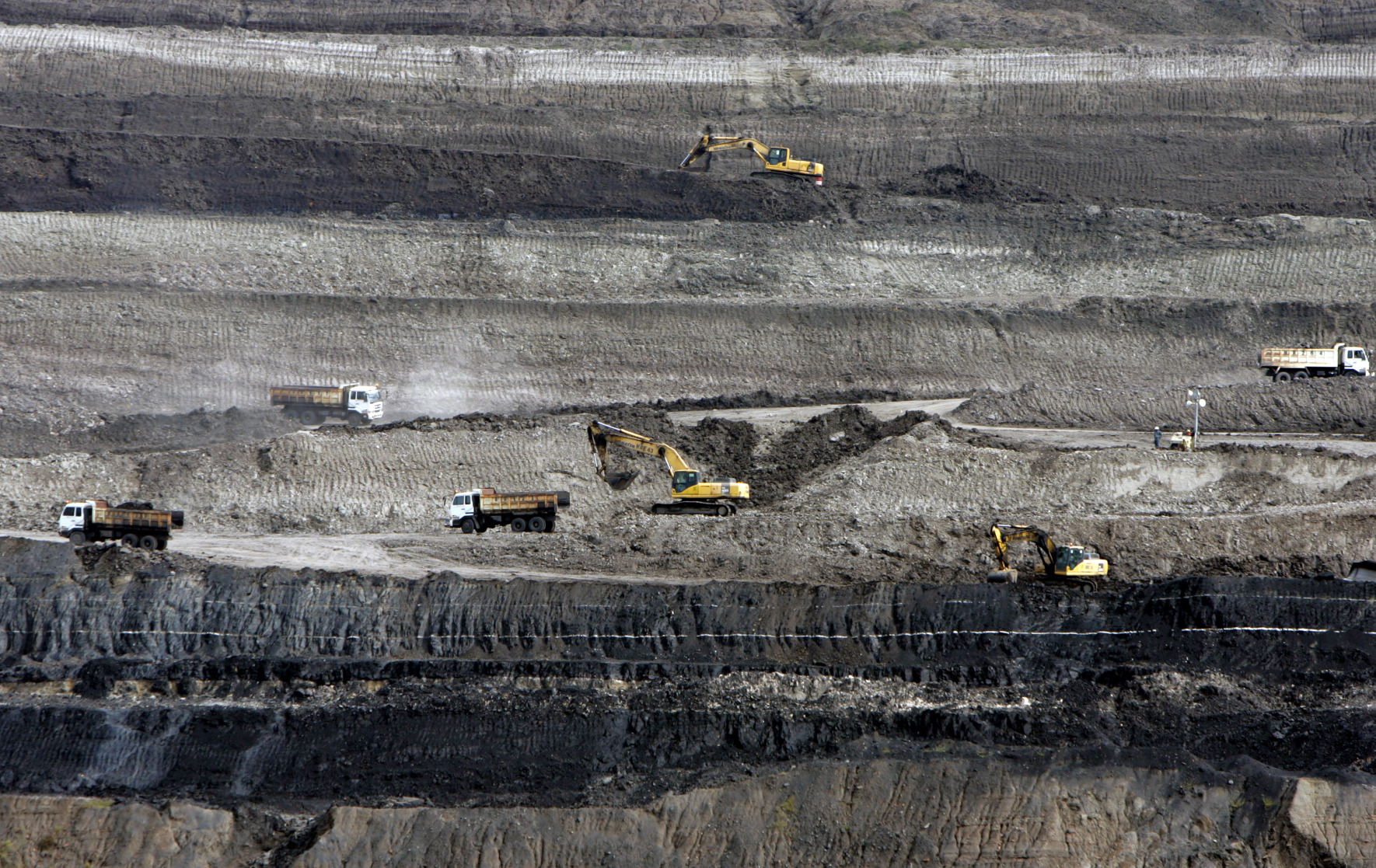


Heavy machinery operates at the PT Bukit Asam open pit coal mine in Tanjung Enim in Indonesia

Photographer: Dadang Tri/Bloomberg

“You won’t find many producers out there who expect we’ll be in a multi-year recovery for coal demand,” Pipes said. “Coal is facing long-term headwinds.”

Even in China, which produces half the world’s coal, giant state-owned miners are shrinking capital spending budgets, said Michelle Leung, a Bloomberg Intelligence analyst. Older, smaller mines across the country are being shut down, and companies are replacing them with larger assets, keeping production capacity relatively steady, she said.

Read more: China Coal Price Yet to Hit Peak Despite Short-Term Policy Risks

High carbon prices in Europe are making some operations unprofitable, and others are closing as governments seek to speed up the energy transition. German energy supplier Eins Energie in Sachsen GmbH & Co. KG, based in the eastern city of Chemnitz, plans to shut down all its coal-based power and heat generation activities as early as 2023.

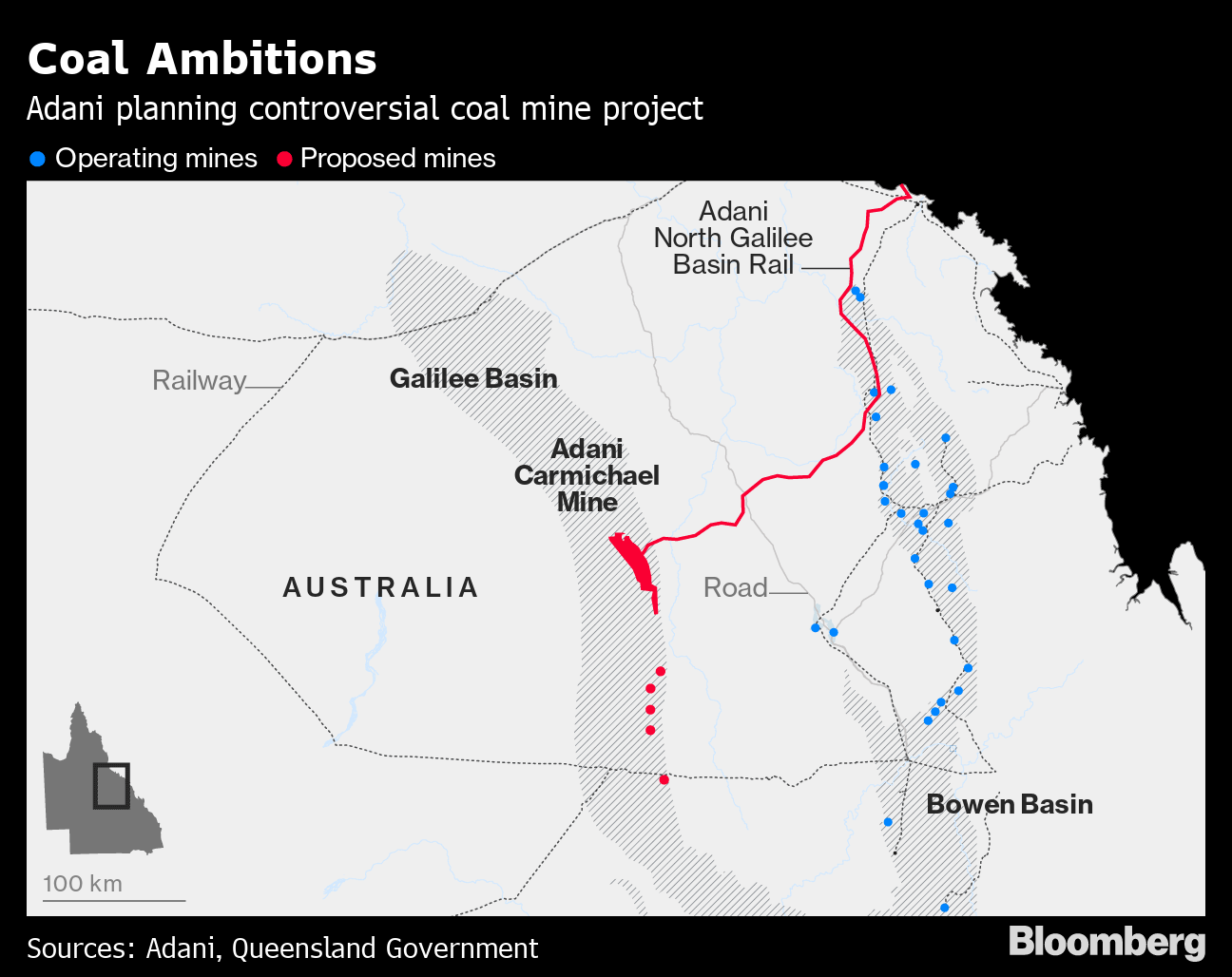
One company that is investing in new coal capacity is India’s Adani Group. The conglomerate, which is also one of the biggest renewable power operators in the country, is digging up soil and laying railroad tracks in northeast Australia in order to produce its first coal this year from the Carmichael mine, which will eventually supply 10 million tons a year.



Photographer: Brendon Thorne/Bloomberg

“We have long been confident that population growth and rising living standards in the Asia-Pacific region will drive ongoing growth in electricity generation capacity, especially in India,” said Adani Australia Chief Executive Officer Lucas Dow. “Both coal and renewables will be needed to provide affordable, reliable power while at the same time reducing emissions intensity.”

Adani’s experience developing the project may be one reason why entirely new projects, outside of existing mine sites, are such a rarity. It took nine years from when the operation was first proposed to secure final approvals, and faced scathing public criticism along the way.

At the same time that permitting and building new mines has become more difficult, financing is also increasingly tough, as banks withdraw from the sector to boost their green credentials. That leaves more expensive borrowing via private equity as the only route for the majority of miners who can’t fund new projects from their own balance sheet, said James Stevenson, lead researcher for coal, metals and mining at IHS Markit Ltd.

Even as the world moves away from coal, demand will remain strong through the 2030s and, without new supply, prices are likely to stay high, he said. When the market is squeezed, like now, price spikes won’t incentivize new supply, but will set off mini-waves of coal power plant closures that will kill off consumption until the market rebalances, Stevenson said.

— With assistance by Randy Thanthong-Knight, Krystal Chia, Vanessa Dezem, and Jesper Starn

(Updates prices in 6th paragraph.)

Before it's here, it's on the Bloomberg Terminal.
LEARN MORE


To: Julius Wong who wrote (165429)6/10/2021 4:09:59 AM
From: TobagoJack  Respond to of 220252
 
Re <<10 Countries Moving Toward a Green Hydrogen Economy>>

Team China gearing up even more, and / but in Xinjiang

bloomberg.com

Xinjiang Eyed as Home for a Massive New Solar Polysilicon Plant
Dan Murtaugh
10 June 2021, 12:20 GMT+8
Xinjiang, the western Chinese region scrutinized by human rights activists, is being eyed for a massive new solar polysilicon plant that would extend its grip on the industry.

Xinjiang Jingnuo New Energy Industry Development Co. has submitted an environmental impact assessment seeking approval to build a 100,000-ton-a-year polysilicon plant in the city of Huyanghe, according to a post on the municipal government website.

Four factories in the region currently produce about half the world’s polysilicon, an ultra-conductive material used in solar panels to convert photons of light into electricity. The largest is Xinte Energy Co.’s 72,000-ton-a-year plant, which is currently being expanded.


Xinjiang offers some of the cheapest electricity in China, a draw for the power-hungry business of refining polysilicon. It’s also a lightning rod for international criticism over allegations of forced labor and human rights abuses against the ethnic Uyghur minority population.

Read more: A Xinjiang Solar Giant Breaks Ranks to Try and Woo the West

China has denied the claims, which have ensnared the polysilicon industry, and says they’re the work of foreign governments trying to undermine the nation’s successful industries.

Several companies have announced massive new polysilicon factories this year, as clean energy ambitions have caused demand to surge and prices to more than quadruple in the past year. Xinte has announced plans for a 200,000-ton-a-year facility in Inner Mongolia, while East Hope Group signed an agreement with officials in Ningxia to build a 250,000-ton-a-year plant.

— With assistance by Krystal Chia

Before it's here, it's on the Bloomberg Terminal.
LEARN MORE


To: Julius Wong who wrote (165429)6/10/2021 4:14:53 AM
From: TobagoJack  Respond to of 220252
 
Re <<10 Countries Moving Toward a Green Hydrogen Economy>>

... but unclear to me how the like-minded indo-pacific-atlantic is going to fitness the take of Xinjiang genocide and growing prosperity of folks resident in Xinjiang, and green Xinjiang products

There cannot and must be give or take on issue of genocide. Should such be happening, must be stopped, by use of force if necessary, and certainly not fed by trade and commerce and investment, and should such not be happening, then what of MSM spin?

Something must give.

Let's watch.

bloomberg.com

China and the U.S. Agree to Push Forward Trade, Investment Ties

10 June 2021, 15:56 GMT+8

Commerce ministers from China and the U.S. agreed to push forward trade and investment links in their first call since the start of the Biden administration.

Chinese Commerce Minister Wang Wentao and his counterpart Gina Raimondo “agreed to promote the healthy development of pragmatic cooperation in trade and investment,” in a phone call Thursday morning China time. The two “exchanged views frankly and pragmatically on relevant issues and mutual concerns,” according to a Chinese government statement.

The two nations are slowly resuming official contact after the January change of administration in the U.S. Some parts of U.S. policy toward China are becoming clearer, but it’s still not publicly clear what the U.S. plans to do with the ‘Phase One’ trade deal signed last year or tariffs on Chinese goods.

The call was the third between senior officials in recent weeks, after Vice Premier Liu He spoke with U.S. Trade Representative Katherine Tai and Treasury Secretary Janet Yellen. The U.S. Commerce Department did not respond to a request for more details on the call.

Read more
U.S.-China Trade Relationship Significantly Imbalanced, Tai Says Yellen, China’s Liu Talk ‘Frankly’ on Issues of Concern U.S., China Trade Chiefs Hold ‘Candid’ Talks in First Call Biden’s Asia Czar Says Era of Engagement With China Is Over

Stocks rose across Asian markets and the region’s currencies posted modest gains versus the dollar after the news. The CSI 300 Index gained about 1.1% in the morning trading session.

China last week stated that normal communications between the two countries have started, according to Commerce Ministry Spokesman Gao Feng. The two sides have agreed to pragmatically solve some issues for producers and consumers, and promote healthy, stable economic and trade ties, he said.

However, U.S. statements on the relationship with China aren’t so positive. The trade relationship with China has “ significant imbalance” and the Biden administration is committed to leveling it, Trade Representative Katherine Tai said on the weekend before a meeting of Asia-Pacific trade ministers.

Increasing ImbalanceChina's trade surplus with the U.S. continues to increase

Source: China's General Administration of Customs

Note: Shows 12-month trailing average

There are parts of the U.S.-China relationship “that are unhealthy and have over time been damaging in some very important ways to the U.S. economy,” she said.

In contrast, China has consistently emphasized a much more positive view of the relationship.

While there are issues, “the essence of trade and economic relations is mutually beneficial and win-win,” Commerce Ministry Spokesman Gao Feng told reporters in Beijing Thursday, repeating a common description. “Problems can be resolved through discussions conducted on the basis of mutual respect and equality.”

“I won’t get overly excited” about the call, said Alvin Tan, head of Asia currency strategy at RBC Capital Markets LLC. “It’s positive in the sense that both countries are stepping up” economic and trade communication, but no game-changing decisions or announcements have come out, he said.

Tai will talk with her Taiwanese counterpart, as soon as today, the Wall Street Journal reported earlier. The two sides will soon discuss “some kind of framework agreement,” Secretary of State Tony Blinken said earlier this week.

However, China opposes any official contact between the U.S. and Taiwan, which it regards as part of its territory, and any negotiations or discussions will inevitably be linked with U.S.-China relations, and could increase the tensions between the two.

— With assistance by James Mayger, Lin Zhu, and Livia Yap

(Updates with Chinese Ministry of Commerce comment from ninth paragraph.)

Before it's here, it's on the Bloomberg Terminal.
LEARN MORE


To: Julius Wong who wrote (165429)6/10/2021 4:19:36 AM
From: TobagoJack  Respond to of 220252
 
Re <<10 Countries Moving Toward a Green Hydrogen Economy>>

Team Australia postponing green future by necessity of war against Team China

What is the point of issuing green bonds if cannot get at the green products?

bloomberg.com

Australia Is in No Rush To Join Global Stampede To Green Bonds
Emily Barrett
10 June 2021, 10:58 GMT+8
Don’t expect Australia to join the growing ranks of countries issuing debt to fund environmental objectives any time soon.

Sustainable finance is one of the hottest parts of global markets, with green bond issuance above $200 billion so far this year. But that surge is from a low base, said Rob Nicholl, chief executive officer at the Australian Office of Financial Management. And the agency isn’t yet convinced that the cost of raising green debt would be easily offset by a lower interest rate, he said in a speech at an event this week.

“We’ve had lot of people say, we wish you’d issue green bonds because we’d buy lots of them,” Nicholl said in a subsequent phone interview. “It’s not our role to create new markets just for the satisfaction of investors. We’ve got to do this because it delivers some outcome for government.”

Read more: Summer of Love for ESG Predicted by World’s Top Arranger

The debt management office has come under criticism for the distance it’s maintained from climate risks in its program. In the absence of a strong economic case, however, the AOFM says any move to issue green bonds would be a government policy decision.

Australian Prime Minister Scott Morrison still refuses to commit to a deadline for net-zero emissions, despite the country’s susceptibility to climate change as a dry continent beset by increasingly savage bushfires. It’s a stance that may set Morrison apart from the Group of Seven leaders he encounters in Cornwall this weekend.

Holding BackThe nation isn’t alone in its reticence toward green sovereign bonds. In the U.S., green bonds haven’t worked their way into the Treasury’s list of products to explore, at least publicly, although the Biden administration does aim to boost spending to achieve sustainability goals.

Australia, for its part, is focusing its issuance plans on the existing suite of notes and bonds. AOFM isn’t looking to extend its borrowing term any more, despite some of the best financing conditions for long-term debt in history. It’s more inclined to rely on short-term bills as a nimbler option in this crisis recovery, when spending plans and revenues can take sharp and unpredictable turns, Nicholl said.

Quickening inflation and a major equities rout are the most credible risks for markets, along with another bout of extended shutdowns related to the pandemic, said Nicholl, who’s also on the steering committee for the OECD’s debt management working party. While these aren’t necessarily likely, “there’s some pretty big faultlines out there,” he said.

Australia is an outlier though, with more and more countries working on sustainable financing plans to tackle climate change. A total of 16 governments had issued green bonds as of end-September, according to the Organisation for Economic Co-operation and Development. Since then Italy has debuted, and the U.K., Canada and Ghana have deals in the pipeline.

Green bonds are just a tiny part of the total pool of global assets right now, Nicholl said. At some point it’s possible, though maybe not for years, that these securities “will become a much bigger proportion of the market, in which case we’ll be forced to acknowledge that.”

Before it's here, it's on the Bloomberg Terminal.
LEARN MORE


To: Julius Wong who wrote (165429)6/10/2021 4:23:18 AM
From: TobagoJack  Respond to of 220252
 
Re <<10 Countries Moving Toward a Green Hydrogen Economy>>

Australia already sacrificed much for bupkis and only has iron ore to let go

At some point shall have to spin a tale about what happened to green future and business and commerce

Perhaps the election can settle it, either the coming round or a future round

bloomberg.com

Australia Stays Sidelined as West Unites to Sanction China
10 June 2021, 08:00 GMT+8


For a fresh perspective on the stories that matter for Australian business and politics, sign up for our weekly newsletter.

Last December, Australian lawmakers from across the aisle called on Prime Minister Scott Morrison to join the U.S. and other countries in passing its own version of the Magnitsky law to “take the lead in developing a best practice targeted sanctions regime.”

Yet six months later, with Australia-China ties only getting worse, Morrison has still yet to pull the trigger on legislation that would allow his government to join allies in imposing coordinated sanctions against officials from the country’s largest trading partner.

When asked last week why the administration hadn’t introduced the bill, Foreign Affairs Minister Marise Payne remained non-commital. “The government will continue to determine the path forward and respond when it’s able to do so,” she told a parliamentary hearing.

Morrison has been outspoken in calling for multilateral coordinated action by “like-minded democracies” to push back against China, saying Wednesday that Australia was urging liberalized nations to support a “world order that favors freedom over autocracy and authoritarianism.”

He is set to attend the Group of Seven summit in the U.K. starting Friday, where leaders are expected to flesh out plans to counter China’s growing influence. On his way, he will visit Singapore on Thursday for talks with Prime Minister Lee Hsien Loong on bilateral cooperation.

But the delay in passing the Magnitsky law left Australia cheering from the sidelines in March when the U.S., the European Union, the U.K. and Canada used similar laws to sanction Chinese officials involved in alleged human rights abuses in Xinjiang. And with an election due by May 2022, it’s unlikely he’ll want to anger China even more over the next year.


The grave of Russian lawyer Sergei Magnitsky in Moscow.

Photographer: Andrey Smirnov/AFP/Getty Images

“Perhaps the Australian government is concerned about causing even more friction to a relationship that seems to get described at a new rock-bottom on a monthly basis,” said Natasha Kassam, a former Australian diplomat who is the director of the Lowy Institute’s public opinion and foreign policy program.

The government is likely to pass the law eventually but “it seems it’s not at the top of the priority list and probably won’t be for some time,” she said. “If the legislation passes, there will be pressure within the government to use it.”

Further ComplicationsThe main Labor opposition has urged the government to speed up the legislative process, with Shadow Foreign Affairs Minister Penny Wong saying this week the delay passing the bill was “sending precisely the wrong message.”

Still, the government is wary about provoking a Chinese response that could hit the economy just as growth starts to gain momentum. Beijing imposed its own sanctions on individuals and organizations from Europe, the U.K., Canada and the U.S. after their actions in March, and would probably do the same in response to a similar decision by Australia.

The latest in global politicsGet insight from reporters around the world in the Balance of Power newsletter.

Ties between Canberra and Beijing, which started to become strained in 2018, nosedived last year when Morrison’s government called for independent investigators to probe the origins of the pandemic and also repeatedly criticized Chinese actions in Hong Kong and Xinjiang. Beijing responded with a range of trade reprisals, including massive tariffs on wine and barley imports and a block on most shipments of Australian coal.

Lost TradeExports of these goods slumped since 2020, although some went elsewhere

Source: Australia's Department of Foreign Affairs and Trade, Bloomberg

*Comprises alcoholic beverages, barley, beef, coal, copper ore & concentrates, cotton, crustaceans, wheat, and wood

Australia should “avoid these kinds of harsh new measures” that will cause further tensions, said Henry Wang Huiyao, president and founder of the Center for China & Globalization policy research group in Beijing.

“The Europeans sanctioned China, China sanctioned back, and that put all their achievements back to square one,” Wang said last week. He described current Australia-China ties as a “wound,” warning that “if you put more salt on that, you’re going to cause more pain.”

Sanctions LawAustralia currently has sanctions on about 20 nations and entities under laws that allow the government to implement both United Nations Security Council-approved measures as well as against certain individuals. But the scope of that is limited, preventing Australia from joining the coordinated Xinjiang sanctions in March.

Instead, Australia issued a separate statement with New Zealand saying there was “clear evidence of severe human rights abuses that include restrictions on freedom of religion, mass surveillance, large-scale extra-judicial detentions” in the region.

Establishing a Magnitsky-style law would mean “sanctions could be applied more quickly in response to egregious or systematic human rights abuses, without the need to establish or amend a specific country-based regime,” the Department of Foreign Affairs wrote in a submission to the parliamentary committee, which last year recommended passing the law.

The original U.S. Magnitsky law was passed in 2012 to punish Russian officials involved in the death of Sergei Magnitsky, a Russian lawyer who died in prison after accusing officials of corruption. It was expanded in 2016 to punish foreign individuals or entities globally for human rights violations or corruption.

Among the 160 submissions delivered to the inquiry was a February 2020 statement from Peter Hass, then principal deputy assistant secretary of state, who said the U.S. applauded “your government for its effort to develop this sanctions program.”

Long-armed JurisdictionDon Rothwell, a professor of international law at the Australian National University, said such laws wouldn’t be a natural fit for Australia -- a relatively small nation without a history of long-armed jurisdiction.

“Once this type of legislation has been enacted, the drivers for it to be used may well come from within government,” Rothwell said. “This is not a small step for Australia.”

Still, it’s likely a question of when -- not if -- Australia passes its own Magnitsky legislation, according to Richard Maude, a former head of the nation’s peak intelligence analysis department and now executive director for policy at the Asia Society.

“Given how many other incredibly difficult issues are on the plate at the moment with China, they could be forgiven for walking towards this rather than running,” he said.

— With assistance by Jason Scott, and James Mayger

(Updates with Morrison’s Singapore visit in 5th paragraph.)

Before it's here, it's on the Bloomberg Terminal.
LEARN MORE


To: Julius Wong who wrote (165429)6/10/2021 4:26:50 AM
From: TobagoJack  Respond to of 220252
 
Re <<10 Countries Moving Toward a Green Hydrogen Economy>>

and so we shall either have hyper inflationary ESG, or no ESG, or something in between

zerohedge.com

Why One Bank Thinks ESG Could Trigger Hyperinflation

In a recent blog post from DB's Francis Yared, the credit strategist looks at one of the lesser discussed drivers of inflation and points out that supply shocks to oil prices have historically been relevant for inflation expectations.

As Yared writes, "supply shock to oil prices have had a significant impact on inflation expectations on three occasions over the past half century: in the mid 70s, the mid 80s and the mid 10s." However, unlike the infamous price explosions of the 70s and 80s, in the latest episode the "shale oil revolution" resulted in a significant positive supply shock to oil markets which led OPEC in 2014 to defend its market share rather than oil prices. The downward pressure on oil prices, Yared writes, resulted in a shift to a lower inflation regime, which was reflected in both consumer and market inflation expectations (University of Michigan 5-10y and 5y5y breakevens) as well as monetary policy expectations and the term premium.

[url=][/url]

Well not anymore, because ESG is unwinding the shale oil revolution. As recent events at Exxon and Shell have shown, the pressure on oil companies to reduce oil and gas exploration and adapt their business models has increased significantly over the past few months. This is reflected in crude rig counts that have lagged the recovery in oil prices and stand at 1/3rd of the 2014 peak.

[url=][/url]

Similarly, carbon emission future prices in Europe have risen considerably: as the WSJ reported recently, the price of carbon credits traded in Europe has jumped 135% over the past 12 months and recently hit a series of records as economic activity rebounded from pandemic lockdowns. Only lumber, driven higher by the housing boom, has proved a better commodities investment.

As Yared summarizes, "ESG is a negative supply shock that internalizes the climate cost of the production of goods and services." This negative supply shock will be inflationary until technological progress absorbs these costs. That could take years. Moreover in Europe, it could garner enough of political support to justify a more aggressive fiscal policy despite the constraints at the German or EU levels.

To be sure, the global economy has still to contend with the disinflationary impact of ecommerce. However, as DB concludes, "ESG, the Fed's Average Inflation Targeting regime and a significantly more pro-active fiscal policy (at least until the US mid-term elections) constitute a new powerful combination that should be supportive of a higher inflation environment than experienced over the last 10 years."

Commenting on his colleague's observations, DB credit strategist Jim Reid agrees, and writes that "maybe in the fullness of time this surge in mining between 2010-2015 will be the exception rather than the norm and that, in a rapidly changing and ever more ESG sensitive world, it will be harder to get oil out of the ground. Pricing climate-change externalities more generally could make things more expensive over time. Are we on the verge of another change in inflation expectations due to oil and energy, one that is in large part due to ESG."

So in case there was still any confusion why the establishment has adopted ESG as gospel - and as a reminder, ESG is nothing new, and many years ago used to be called Corporate Social Responsibility, or CSR and even Nobel economist Milton Friedman warned against its subversive nature 50 years ago when he said that taking on externally dictated “social responsibilities” beyond those directly related to a company’s business opened the floodgates to endless pressure and interferenc - at a time when the same establishment is also desperate to inflate away the nearly $300 trillion in global debt, now you know: ESG looks like the catalyst that will unleash runaway inflation. And if central banks fail to contain it in time, the entire developed world may soon descend into hyperinflation.

Which in turn should also answer the other pressing question: why are central banks so desperate to issue their own digital, programmable currencies? Well, the ability to turn money on and off with the literal flip of a switch will come in extremely useful in a world where authorities have lost control over all other monetary pathways...


To: Julius Wong who wrote (165429)6/10/2021 4:33:14 AM
From: TobagoJack  Respond to of 220252
 
Re <<10 Countries Moving Toward a Green Hydrogen Economy>>

Let's see how many sign on to what they would find difficult to sign off of

now that the Afghanistan adventure is nearly done

zerohedge.com

G7 Calls For Fresh Probe Into Covid Origin, Targets China's Use Of Forced Labor

The Group of Seven leaders, whose UK conclave will shortly be joined by Joe Biden, appears set to infuriate China, and in its draft communique seen by Bloomberg News, the world's most developed nations not only call for a fresh, "transparent" (which suggests the previous study was anything but), WHO-convened study into the origins of the coronavirus (although since the China-controlled WHO, which is run by the " prevaricating" Tedros, is in charge it naturally won't find anything new) but also pledge to tackle "forced labor in global supply chains", including in the solar and garment sectors and involving state-sponsored forced labor of minorities. While that section does not mention China by name, it clearly targets China's treatment of Uyghur Muslims in Xinjiang.

Separately, the G7 vowed to deliver at least 1 billion extra doses of vaccines - courtesy of taxpayer funding of course - over the next year to help cover 80% of the world’s adult population. This is core part of the of the G-7 agenda that outlines a plan to end the pandemic by December 2022. The document has yet to be finalized but will form the basis of final-stage talks at the summit of leaders in Cornwall, southwestern England, starting Friday.

Here are the other highlights, as per Bloomberg:

G-7 pledge to better tackle forced labor in global supply chains, including in the solar and garment sectors and involving state-sponsored forced labor of minorities. While that section does not mention China by name, it follows global criticism of its treatment of Uyghur Muslims in Xinjiang.Calls for a fresh, transparent, WHO-convened study into the origins of the coronavirus.There is a call for Russia to hold to account groups within its borders who conduct ransomware attacks, use virtual currencies to launder ransoms, and carry out other cybercrimes.The group welcomes the recent talks toward a full resumption of the 2015 Iran nuclear deal, while condemning its use of proxy forces and non-state armed actors.On fiscal policy, trade and travel:

A commitment to end unnecessary trade restrictions on vaccine exportsG-7 stress need to ensure long-term sustainability of public finances once the recovery is firmly established.G-7 support common standards for international travel, including recognizing vaccine status certificates across countries.On climate change, the draft agreement includes:

There is a commitment to accelerating the shift to zero-emission vehiclesLeaders haggling over climate funding but vow to step up and to try and meet a $100 billion target, without giving details of how to get there. They will pledge new funding to support green transitions in developing countries.G-7 recognizes the potential of carbon markets and carbon pricing to drive emission reductions.Late on Wedensday, Joe Biden arrived in the UK as part of his first trip abroad since taking office, where he will take place in the G7 summit in St Ives in Cornwall. Biden is expected to underscore America's unwavering commitment to NATO and warn Russia it faced "robust and meaningful" consequences if it engaged in harmful activities, by which of course he means the CIA, the FBI and various other deep state tentacles.

Biden, speaking to about 1,000 troops and their families at a British air base, said he would deliver a clear message to Russian President Vladimir Putin when they meet next week after separate summits with NATO, G7 and European leaders.

"This is my first overseas trip as president of the United States. I'm heading to the G7, then the NATO ministerial and then to meet with Mr. Putin to let him know what I want him to know," Biden said, drawing cheers from the troops, who will be amazed if Biden remembers what it is he wants Putin to know.

"We're not seeking conflict with Russia," the Democrat said at the start of his eight-day visit to Europe. "We want a stable and predictable relationship ... but I've been clear: The United States will respond in a robust and meaningful way if the Russian government engages in harmful activities."

Biden told reporters as he left for Europe that his goals were "strengthening the alliance, making it clear to Putin and to China that Europe and the United States are tight."

His summit with Putin on June 16 in Geneva is the capstone of the trip. President-in-waiting Harris is surely hoping for some "unexpected" twist in the narrative to take place, so she can finally get her promotion.


To: Julius Wong who wrote (165429)6/10/2021 4:35:23 AM
From: TobagoJack  Respond to of 220252
 
Re <<10 Countries Moving Toward a Green Hydrogen Economy>>

Team China signing on

Thunder Dome arena

scmp.com

Developing | China passes anti-sanctions law, providing means to counter foreign measures

Legislation passed at the closing session of the National People’s Congress Standing Committee

There have been concerns over the potential impact on businesses, with details of the law yet to be released


To: Julius Wong who wrote (165429)6/10/2021 4:43:58 AM
From: TobagoJack  Read Replies (1) | Respond to of 220252
 
Re <<10 Countries Moving Toward a Green Hydrogen Economy>>

Hydrogen works better if one has either and or of modular nuclear, inexpensive wind, and worthy solar

thehill.com

Hydrogen may be the 'fuel of the future' — but geopolitics could look a lot like gas

U.S. Secretary of Energy Jennifer Granholm is just back from her first trip to Houston, where she toured a hydrogen facility in La Porte Industrial Complex. For the government, hydrogen will help Houston remain the “Energy Capital of the World” by producing (and maybe one day exporting) the fuel of the future.

Globally, policymakers are touting the nascent hydrogen economy as the best hope to conduct an orderly energy transition, reach ambitious carbon neutrality goals, provide tomorrow’s jobs and grow the economy. But there is little reflection on what hydrogen trade will look like. After all it may not be so different from current trade flows.

A geopolitical map of hydrogen is emerging that is not so different from the one of global gas markets. Some importing countries will replace one dependence with another, while some exporting nations will substitute one commodity with another. There will be some new entrants though, notably the ones with record-low renewables prices, which will be able to alter some balance of power.

Several countries have announced a hydrogen strategy over the past four years, which has accelerated the emergence of future trade routes such as Japan-Australia and Germany-Chile. Countries are positioning themselves to produce hydrogen domestically, but also to import or export it depending on their national assets. Nations and companies are signing agreements and kickstarting demonstration projects to be part of the “hydrogen” trade game. The pioneers will set up the industry’s standards to their advantages. For instance, the European Union is trying to establish the Euro as the reference currency for hydrogen trades.

At first, hydrogen will remain a localized industry, at best regional. Hydrogen trade is at its infancy and achieving an organized market remains a long shot for technical and economic reasons. Indeed, hydrogen transportation is complicated and expensive.

There is not a best way to transport hydrogen yet, but several technologies and carriers are being explored. Beyond 2030, we could see the co-existence of various ways to transport hydrogen, including pipeline and seaborne transport. Hydrogen can be blended with other gases or converted into carriers such as ammonia, liquid organic hydrogen (LOHC) or methanol. Similar to natural gas, hydrogen can be transported in its gaseous or liquid forms.

Renewables-constrained countries will become hydrogen importers. The European Union expects a hydrogen deficit in Europe’s industrial heartlands. Importing low-cost hydrogen from sunny or windy regions will be an attractive proposition for these countries. Germany has already signed agreements to secure its procurements, including a deal with Morocco to make use of its “ ideal” conditions for renewable hydrogen production.

Security of hydrogen supply will become a priority, similar to today’s quest for gas supply security. Resource-hungry and import-dependent Japan, which was the first country to roll out a hydrogen strategy in 2017, is eager to secure its hydrogen supply in the long-term, similar to how Tokyo did for its LNG strategy. Australia and Japan have been consolidating their ties, anticipating strong bilateral hydrogen trade. Japan and Brunei have recently demonstrated the feasibility of the “ world’s firstshipment of LOHC over more than 4,000 km.

Some countries will manage to become less import-dependent by developing their own hydrogen production. China, which is already leading the world in fossil fuel-reliant hydrogen production, could lower its import dependence if it manages to produce enough renewable and low-carbon hydrogen on its own soil.

The profile of exporting countries will be a mix of old and new, but some trade relationships will remain unchanged. Established producers of natural gas will continue to be relevant in the hydrogen economy by exporting pure hydrogen through their repurposed gas infrastructures (e.g. pipelines from Russia and Norway).

Historical exporters could convert their fossil fuel resources by producing hydrogen from natural gas and investing in new technologies such as carbon capture and sequestration (CCS) to make it low-carbon. Saudi Arabia wants to keep its export leadership by using its production of low-cost gas to export ammonia and hydrogen, while working on a renewable hydrogen strategy. Russia’s Novatek is also rethinking its LNG export strategy to produce and ship ammonia.

The U.S. and Canada could also capitalize on their natural gas production and large geological potential to develop their own domestic hydrogen markets with heavy investments in CCS, while developing in parallel a renewable hydrogen value chain. Their ports, such as Texas’s Corpus Christi, could over time become renewable energy and clean fuel hubs facilitating hydrogen exports.

The new winners will be the ones with record low renewables prices (e.g. solar power from Saudi Arabia, Chile and Portugal). Stable Morocco could displace politically troubled Algeria as go-to exporter to Europe, replacing natural gas with hydrogen produced from renewables.

Colonial Pipeline may use recovered ransomware attack funds to boost... Misguided bill kills jobs and sets America back

The longevity of the trade in natural gas-based hydrogen will depend on the commerciality and acceptability of new technologies such as CCS and direct air capture. Meanwhile, renewable hydrogen will rely on a formidable amount of renewable energies which will also be used for the “electrification of everything” and will require sizable investments and R&D (e.g. large electrolyzers).

This is an exciting time to predict trade flows of various gases because they will be multiform and coexist for a while.

Leslie Palti-Guzman is the president and co-founder of Gas Vista, a market intelligence and AI technology provider focused on energy trade flows and predictions. Palti-Guzman is also the producer and host of the Energy Vista podcast and a NYU SPS Center for Global Affairs senior fellow.

