Re <<'guerrilla-type tactics' reminds me of circa 1776:>>
Shocking
Smart fighting should be made illegal
In the meantime, imagine how much busy-body counterparties must spend to prepare for a day that would not come, but match in counter-strategies and money?
(Strangely written but thoughtful …)
illinoisnewstoday.com
Is the Chinese DF-100 missile a true anti-ship missile weapon?
amberlamitie
5 days ago
Here are some things to keep in mind: At a radius of 1,800 miles from the mainland coastline, the waters include vast waters that the Navy considers to be the “blue waters” of the high seas that the Navy roams around. In a sense, a family of missiles equipped with PLA weapons, including the DF-100, has made it available to China in the Pacific Ocean and, to a lesser extent, the Indian Ocean in recent decades.
Therefore, the Chinese People’s Liberation Army (PLA) announced new weapons in the meantime. October 1, 2019 Military Parade?? The rugged color of me. If China’s rise in martial arts excellence shows one thing, it is that PLA commanders and their political overseers are pleased to surprise and vandalize western observers. .. They are good at secretly developing new hardware, spreading it around the world, and watching subsequent gabfests consume the Chinese surveillance community.
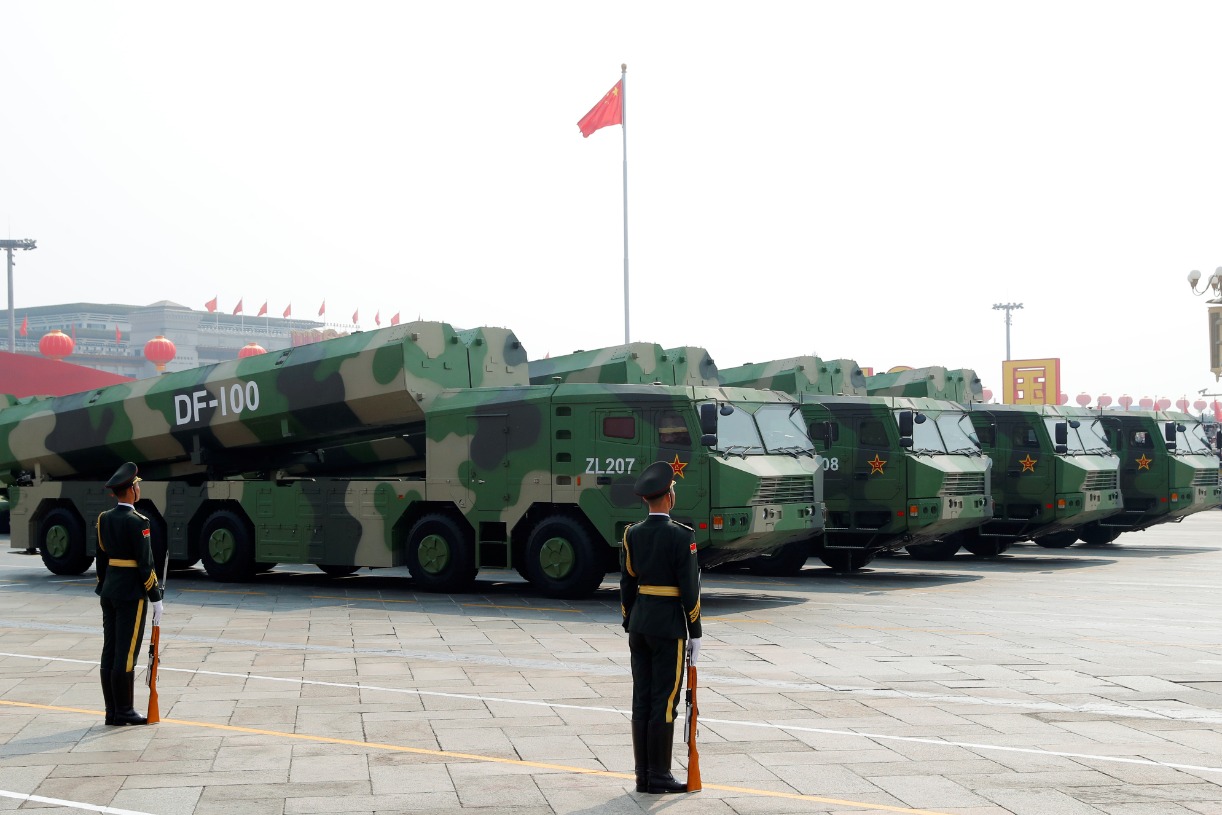
And certainly, the launchers with the “DF-17” and “DF-100” missiles are both weapons that seem to be capable of ultra-high speeds. Until now unknown To outsiders — We ran around Tiananmen Square to commemorate the 70th anniversary of the founding of the People’s Republic of China. (The DF-41 intercontinental ballistic missile also made its public debut on October 1, but Westerners I know about thatAlternatively, foreign intelligence agencies knew about these “birds” but chose not to disclose them in open source, fearing that the information would reveal how they came.
It is unknown whether the DF-100 is a cruise missile or a ballistic missile. The “DF” nomenclature seems to indicate flying a trajectory, Jane’s draw A bird as a supersonic cruise missile. It can straddle the difference between ballistic missiles and sea skimming missiles, forming a high arc towards the atmosphere, but following a flatter trajectory than ballistic missiles. It will come from yet another axis to the US Navy’s MTF, augmenting anti-ship cruises and ballistic missiles, as well as undersea ammunition such as torpedoes and mines. In any case, new anti-ship missiles are said to reach hypersonic speeds, or more than five times the speed of sound, at least in part of their flight. This increases the likelihood of passing through the defenses of the US Navy. Defenders have little more time than snapshots.
be careful South China Morning Post In the parade reportage, the DF-100 boasts an estimated range of 2,000 to 3,000 km (approximately 1,200 to 1,800 statutory miles) and is “designed primarily for large targets at sea.”NS Big target NS SCMP Chronicles probably mean US or Alliance aircraft carriers. However, such weapons are likewise amphibious transport vessels, cruisers and destroyers that emit steam with flat tops, or logistics vessels that carry critical fuel, ammunition, and depots to the fleet when navigating the sea. May be targeted.
So don’t assume too much about the purpose PLA rocket players have in mind for new toys. “Access prevention” defenses can defeat American objectives by attacking targets that are softer than aircraft carriers and naval combatants. If PLA advocates have that option, why not exercise it? The bravest fleet produces little success without logistical support. When you attack the US Combat Logistics Fleet, you starve the Combat Fleet stores. Starving the store’s fleet, it eventually disappears. The PLA may follow the path of least resistance to tactical, operational, and strategic success.
I would.
Three guidelines on how to interpret the latest revelation.First, the armed forces is the basic of the “Chinese Dream”, Xi Jinping President Statement of national purpose.. Chinese watchers sometimes mistake China’s dream for an economic program, and accumulating wealth is certainly part of it. But wealth is a means to end a great power, not itself. Communist China realized that dream and said, “ Century of humiliationBy putting “in the hands of the maritime conquerors” and achieving “a great renewal of the Chinese nation.”
Tightening national power sources, including military power, is part of Xi’s fantasy. Therefore, the martial arts pageantry will be more prominent on anniversaries such as October 1st.
Second, China’s guilt and deception tendencies, as well as all such occasions, were on display at the military parade. Note the Center for Strategic and International Studies: “The People’s Republic of China is in the process of constructing and deploying a sophisticated modern missile arsenal, but keeps it secret because of intentional ambiguity and unwillingness to participate in arms control or other transparency agreements. It’s rare. ”The approach is faithful to shape. China’s diplomatic and war practices are, to the extent, fraudulent. in the meantime China.
Strategic grandmasters from Sun Tzu to Mao Zedong need to prolong the struggle if China is a stronger competitor, as a way to reduce costs, dangers, and duration of war, or if China has fewer competitors. It is the equipment of China’s national craft, regardless of situation or power correlation. Sun Tzu encourages commanders and rulers to continue driving their enemies, and Mao declares that all wars are based on deception. It’s no wonder Beijing has made it a habit to defeat once secret military projects when the time comes. This is a way to form a perception of Chinese martial arts, making China look purposeful and powerful, while at the same time keeping enemies guessing.
And third, military planners think in terms of “operational factors,” namely space, time, and power. To win in a given theater, the commander will perform sufficient power in a particular geospatial space for long enough to achieve the goals entrusted to them by senior military and political leaders. Must be. That may mean gathering enough power to defeat the hostile forces in the field. That may mean deploying enough power to thwart the enemy’s strategy and stop defeat. Rejecting the enemy’s leisure and elbow room limits the ability of the army to withstand and fulfills its mission. This provides operational and strategic benefits to competitors who have control over these operational factors.
It was always the case. The captain was afraid to venture within the reach of coastal fortresses in the age of sails and steam. Due to the short range of fire, the operational space was narrow. The gun projectile passed through the operating space within seconds. This means that the warning time was short before the hostile fire hit the warship’s hull. Worst of all, the fortress had a larger gun than the ship, had more firepower, and had a large stockpile of ammunition to reload and continue firing. To achieve their goals, the fleet usually had to operate within a zone where space, time, and power were all allies of the enemy.Therefore, the maxim By Sir Horatio Nelson, British naval god: “Ship is foolish to fight a fort.”
Anti-ship ballistic missiles and cruise missiles (the equivalent of cannons launched from land) have reproduced this dynamic since the days of short-range artillery. Accurate, high-flying long-range missiles like the DF-100 compress the space and time of China’s offshore adversaries. PLA’s firepower can rain instantly if a fleet of the United States or its allies adventures within hundreds of miles from the coast of Asia. It’s as if the fleet isn’t operating in vast ocean spaces, but wandering a few miles offshore. Therefore, the efforts and resources that Beijing has devoted to defense prevention and defense. It is an operational sound method of maritime warfare.
We often argue whether Communist China thinks of it as the US Navy, the Royal Navy in its heyday, or the blue-water navy of the Dutch, Spanish, or Portuguese navy deep in the era of sailing. Think of it as a coastal defense force from the inauguration of the People’s Republic 70 years ago. That is an important topic. The answer may reveal whether Beijing will entertain defensive or aggressive ambitions, and therefore whether it will keep the PLA Navy close to home or operate as a Free Navy across the Seven Seas. ..
But as anti-ship and anti-aircraft weapons and sensor technology mature, bringing more and more marine space within the reach of “coastal” defense, the problem is becoming less and less important. At a radius of 1,800 miles from the mainland coastline, the waters include vast waters that the Navy considers to be the “blue waters” of the high seas that the Navy roams around. In a sense, a family of missiles equipped with PLA weapons, including the DF-100, has made it available to China in the Pacific Ocean and, to a lesser extent, the Indian Ocean in recent decades. The PLA can deploy the Blue-Water Navy while remaining true to the tradition of coastal defense.
If so, Beijing may settle into a new position as a global sea force rather than undergoing a disastrous transition. Westerners may recognize the separation in China’s naval strategy, where nothing exists. It’s a cool idea.
James Holmes is JC Wiley Chairman of Naval Strategy at the Navy War University. He is the only view expressed here. It first appeared in 2019.
Image: Reuters.
Is the Chinese DF-100 missile a true anti-ship missile weapon?
Source link Is the Chinese DF-100 missile a true anti-ship missile weapon?
Sent from my iPad |



