Re <<Russia’s Central Bank to Explore Crypto Settlements Amid Financial Sanctions>>
... another brick in the wall ...
zerohedge.com
The Benefits Of A Savings Culture & The Future Role Of China's Yuan
Authored by Alasdair Macleod via GoldMoney.com,
Savings are a vital component of any successful economy, and the foolishness behind the paradox of thrift is exposed in this article. It has been a huge error for Keynesian policy makers to discourage savings in the interests of temporary boosts to consumerism.
It is probably too late now but encouraging people to save by removing all taxation from savings makes an enormous contribution to reducing price inflation and trade deficits, while enhancing national wealth. This is evidenced empirically and demonstrated by reasoned theory.
Furthermore, there is an error in assuming that there is no alternative to Triffin’s dilemma, which posited that for a nation to produce a meaningful level of reserve currency for external circulation it must run trade deficits. Triffin was describing the problems the United States gave itself under the Bretton Woods agreement, leading to the failure of the London gold pool in the late sixties. It still informs US policy makers today, and wrongly leads American commentators to believe that the dollar cannot be toppled from its pre-eminent position.
But Triffin’s dilemma assumes that central banks must accumulate currency reserves. Unless a government has foolishly indebted itself in a foreign currency, there is no need for them to do so. Currency reserves add nothing to a domestic currency’s stability. Gold fulfilled this role successfully, and likely to do so again in future.
It is a savings ratio of 45% which is at the root of China’s power. The lack of savings in America and its western alliance is their Achilles heel.
[url=]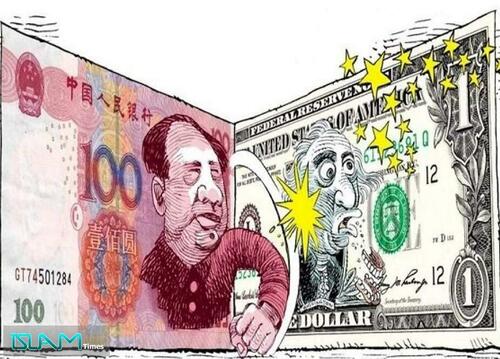 [/url] [/url]
Empirical evidence
If there was one taxation policy which would reduce consumer price inflation, stabilise a fiat currency, encourage capital allocation for productive purposes, and improve government finances for the longer-term, what would it be?
Remove all taxes from savings.
This is the lesson from past-war West Germany and Japan, both of which suffered absolute defeat and economic destruction in the Second World War. Their currencies were worthless. But they recovered to become economic powerhouses in Europe and Asia respectively in little more than two decades. Both implemented savings-friendly taxation policies, which made capital available at stable interest rates for new industries to invest in production. Germany developed its Mittelstand, and Japan built on her vertically integrated Zaibatsu.
Germany was fortunate in its Economy Minister, Ludwig Erhard. A free marketeer who on 20 June 1948 took the bull by the horns, Erhard unilaterally ended rationing on the same day as the new mark was introduced, presenting it as a fait accompli to the military governors in the British and American zones. In a week, shops had begun to reopen, and goods became widely available.
In negotiations with the military governors, Erhard managed to obtain income tax concessions for savings, which through the banking system were invested making capital available for private sector reconstruction. While he struggled against both military governments in the two zones to retain lower taxes and for favourable treatment for savings into the 1950s, Erhard had laid the foundations for a savings driven, free market economy. By the 1980s, the only tax on savings was a 10% withholding tax on bank interest and bond coupons, which was not generally pursued by the German tax authorities in the knowledge that attempts to do so would simply drive savings beyond their reach into Luxembourg and Zurich.
For this reason, Germany remained a savings driven economy with a strong currency right up to the mark’s incorporation in the new euro. Much to the confusion of British and American neo-Keynesians subscribing to their cherished savings paradox, Germany became the wealthiest of the European nations, other than perhaps Switzerland. In both cases, hard currencies accompanied wealth creation.
Erhard’s post-war opposition was principally from General Sir Brian Robertson, the head of the British occupation government, and from the French. The commander of the American occupation zone, General Lucius Clay was more sympathetic with free market solutions. The Americans had promoted A Plan for the Liquidation of War Finance and Financial Rehabilitation of Germany (1946), written at Clay’s behest, one of the co-authors being Joseph Dodge. In 1949, Dodge was then appointed to advise the Japanese government on its post-war reconstruction as an aide to General MacArthur. And Dodge was instrumental in ensuring that up to a certain level, post office savings accounts were entirely tax free. It was probably a deliberate oversight on his part, but the tax law didn’t stop an account holder merely opening another savings account when the tax-free limit on an existing account was reached.
Dodge implemented what became known as “The Dodge Line”. By insisting on a balanced national budget and shutting down the printing presses, he ended hyperinflation. The exchange rate between the yen and the dollar stabilised. Government economic intervention and interference was slashed across the board. Echoing John Cowperthwaite’s free market policies in Hong Kong, Dodge realised that the best economic progress was obtained by eliminating state interference, leaving it to Japan’s businessmen and entrepreneurs who, despite the war, retained the skills and connections to run their businesses. With MacArthur’s support, he ruthlessly eliminated subsidies and price controls. Dodge was eventually recalled to America, becoming Truman’s Director of the Budget where in the space of only a year he had cut the US federal deficit in half.
Dodge’s free market approach was supplemented by the assistance of another American adviser, W Edwards Denning. Denning introduced quality control techniques to Japanese manufacturing which revolutionised production. As a consequence of Denning’s contribution, Japan rapidly evolved from a source of shoddy goods into a producer of the best consumer technology and the manufacture of world-beating high quality consumer goods.
Behind this revolution was the tax incentive to save – a simple approach of assuming that taxed earnings put aside should not be taxed again. In both Germany and Japan, these were not the only factors that led to a successful emergence from total desolation, but they are the elements that ensured that both nations continued to flourish. And in Japan, despite the government fully embracing Keynesian philosophy in the wake of the late-eighties speculative bubble, the savings culture of “Mrs Watanabe, the Japanese housewife” persists to this day.
After his stint in Japan and while Joe Dodge worked his budget magic for Truman, the British were going in the opposite direction, eschewing free markets, embracing Keynesianism, persisting with rationing until 1954, and imposing punitive taxes on savings. The decline of post-war Britain and much of Europe need not enter our narrative, but it was a feature of all nations which implemented economic policies of taxing savings.
The theory behind savings
The empirical evidence is clear. Since the Second World War, economies that embraced free markets and the role of personal savings outperformed those which saw savings as an easy source of tax revenue. Furthermore, we can easily explain why free markets succeed in creating wealth for all, while a state directed economy is anti-progress. It was demonstrated by the Austrian economist, Ludwig von Mises, who in an essay written in 1920 explained the futility of central planning due to a lack of the ability to perform economic calculation. Admittedly, he compared the full-blown socialism which Russia had embraced with free markets. But his conclusions, that the state is unable to allocate economic resources including capital as efficiently as profit-seeking capitalists applies equally to less aggressive forms of socialism.
In a free market economy, individuals are compelled to make provision for the unknown vagaries of the future. Often through the medium of insurance policies and pension plans, they put aside a portion of their income to protect themselves from the financial consequences of ill-health and incapacity, provide for their old age, and to ensure there is something to pass on to their heirs. If the circulating medium is sound, no financial skill is required to preserve the value of savings in these arrangements and in the form of bank deposits. Within the limits of their acumen, those with some financial knowledge can venture into other forms of savings, such as bonds issued by their government agencies and corporations and even to acquire equity interests in ventures.
As always, investors with skill and knowledge will improve their position relative to those less financially literate, which is anathema to redistributors of wealth. But the corruption of the value of credit that goes with monetary intervention by the state impoverishes those who lack investing skills most, always the poorest in society. It stands to reason therefore, that an economy that benefits most from the savings of the masses must protect the value of credit.
The Keynesian revolution rode roughshod over this issue. Keynes dismissed capitalist savers as rentiers, a term with emotive connotations suggesting that they are workshy and greedy only for interest on their capital. His academic environment at Cambridge and afterwards the Bloomsbury set in London was certainly populated with these flaneurs. But this was not representative of the wider population which was to be deprived by his desire for the euthanasia of the rentier expressed openly in his General Theory.
So it was that Keynes came up with the paradox of thrift, while he was working his way towards discarding Say’s law to justify his General Theory. In Chapter 23, he takes preceding crackpot theories on the subject as evidence of the destruction wrought by saving. Earlier in Chapter 3, on Observations of the Nature of Capital, he claimed that excess savings could lead to “the fate of Midas… assuming that the propensity to consume and the rate of interest are not deliberately controlled in the social interest but are left mainly to the influences of laissez-faire”. In working his way towards a role for the state, which appears to be his objective here, Keynes makes a number of errors, the principal ones being glossing over the role of bank credit (there is only one indexed reference to credit, commercial bank or otherwise in the whole book!), and whether it is the borrower or lender who sets the rate of interest. To be absolutely certain of the role of savings in an economy, and as to whether there can be an excess leading to the fate of Midas, we must explore Keynes’s errors further.
Variations in the rate of interest are not due to the ephemeral dispositions of rentiers but in large part to fluctuations in the supply of bank credit. It is the expansion of bank credit which leads to an economic boom, which when it leads to excessive demand and speculation by driving up prices engenders caution in the banker’s mind. Naturally, he then restricts the supply of credit, which raises the interest cost. This is why the cycle of bank credit would never permit “the fate of Midas” to occur. Clearly, Keynes’s conclusion that there can be a savings glut is based on his wilful ignorance of the nature of money and credit. [iii]
Furthermore, Keynes’s basic assumption, that it is the greed of the rentier which forces an unnecessary and arguably immoral cost onto production is also incorrect. It is the same error that leads monetary policy makers today to assume that by manipulating the interest rate the general level of prices can be controlled. It was Keynes himself who earlier noted this error, which he named Gibson’s paradox after Arthur Gibson, who pointed out the lack of correlation between the two. Because Keynes was unable to explain the paradox, he simply proceeded as if it did not exist, and so has every monetary policy committee ever since.
The paradox is real, and the explanation is simple, falling into two elements. The first is that savers are generally reluctant to save, because it means a deferment of consumption, an immediate satisfaction being exchanged for one in the future of less certain value. Therefore, a business requiring capital for production must bid up the rate of interest it is prepared to pay to a level where the consumer is willing to defer his enjoyment. It is this marginal rate that balances the demands for capital with the availability of savings in an economy. And it is not just a question of setting the rate of interest for recycling credit through the banks’ balance sheets. It sets the rates of return for all financial assets as well and the cost of funding for their issuers.
The second element is the time-preference for which savers will naturally expect compensation. Time preference describes the value of possession of money or money substitutes. A saver loses the value of possession until his money or credit for money is returned. For simplicity’s sake, we must ignore counterparty risk but include expectations of changes in the purchasing power in the circulating media for the time that possession is lost.
It becomes clear that if a potential saver is to part with possession of money or credit when the evidence points to its debasement, he will reasonably seek compensation. Therefore, for the saver interest rates are not the cost of money which he demands, except in a strictly minimally additional and marginal sense. For a central bank to assume that by varying the underlying rate of interest it can control the economy is therefore incorrect. Central banks have it the wrong way round, which explains why there is no correlation between their interest rate setting and the rate of price inflation.
Furthermore, Gibson pointed out that the correlation was between interest rates and the general level of wholesale prices, and not their rate of change. This correlation is consistent with a businessman’s economic calculation: in order to calculate the profitability of an investment, he must consider the price he will expect for his production, by necessity always referring to current levels. He can then calculate the interest cost he is prepared to pay to secure the capital necessary for his project, and therefore assess its profitability.
The hope harboured by Keynes, that the state can stimulate the economy at the expense of savings beyond the very short term is incorrect. His paradox of thrift, which Keynes used to try to dissuade a propensity to save, was a conclusion drawn from these errors. They are in large part responsible for the plight in which the US, the UK, and various member states of the EU now find themselves.
Savings in the context of national finances
More than any other factor, the propensity to save is a major influence on national finances, being a “swing factor” between a government’s budget and the national trade position.
There is an important question most analysts ignore. It is the twin deficit hypothesis, whereby if the savings rate doesn’t change, a budget deficit leads to a matching trade deficit. The reason the two deficits are linked in this way is because of the following national accounting identity:
(Imports - Exports) = (Investment - Savings) + (Government spending - Taxes)
In other words, a trade deficit is the result of a budget deficit not funded by savings but by additional credit. This can be confirmed by following the money. For a budget deficit, there are only two sources of funding. Consumers put aside some of their spending to increase their savings in order to subscribe for government bonds. Otherwise, the banking system comes up with funding in the form of credit issued by the central bank or by commercial banks, putting additional credit into circulation which didn’t exist before.
The financing of a budget deficit by credit expansion leads to excess credit in an economy without matching production. This is the point behind Say’s law, which defines the division of labour. We produce to consume, and the function of money and credit is one of intermediation between the two. Injecting extra credit into an economy does nothing to raise production, but it does increase overall demand, at least until it is absorbed into the economy in accordance with the Cantillon effect.
Directly or indirectly, this excess demand can only be satisfied by imported consumer goods, because an increase in domestic production is unavailable.
The role of savings in the context of national finances is very important. An increase in savings is at the expense of consumption, which is why economists often refer to savings as consumption deferred. For consumption to remain deferred requires it to be invested, either into production or government debt usually through the banks, pension funds, insurance companies or other financial channels acting on the savers’ behalf.
If the destination of additional savings is investment in government debt, they are turned into consumption by the government. By not being spent on additional consumer goods, the trade deficit falls relative to the budget deficit.
As noted above, despite the destructive Keynesian policies of its government, Japanese savers habitually respond to an increase in credit by retaining it in their savings accounts. Consequently, consumer price inflation is subdued, relative to that in other countries. While the Eurozone has employed similar interest rate policies and is suffering CPI-recorded debasement of over 10%, in Japan it is about 4%. As we note below, in China whose savings ratio is 45%, CPI measured inflation is currently less than 2%.
The deployment of capital by Japan’s corporations, which is the counterpart of increased savings, is invested in improvements in technology and production methods, keeping consumer prices lower than they would otherwise be. Because Japanese savers are so consistent in their savings culture, Japanese corporations have benefitted from a relatively low and stable cost of capital, making business calculation more reliable. For Japan, savings are the positive swing factor in the twin deficit hypothesis.
The same is true of any economy where there is a government deficit while at the same time there is a propensity in the population to save rather than spend. It is the driving force behind China’s export surpluses, because with the sole exception of Singapore, the Chinese are the biggest savers on the planet. The position of nations whose economic policies have been to tax savings and to encourage immediate consumption is diametrically different. It is consumption funded by the expansion of money and credit without increases in savings which has led to persistent US trade deficits, twinned with budget deficits.
The evidence confirms that a savings driven economy is more successful than a consumption driven economy. Not only does the former protect the currency’s purchasing power by reducing the need for reliance on foreign capital inflows to finance internal deficits, but empirical evidence clearly shows savings-driven economies are more successful at creating wealth for their citizens. Importantly, a currency backed by a savings culture can weather a greater level of credit expansion by its central bank without adverse consequences for prices.
The condition which must apply is that fiat currencies continue to operate as media of exchange. The moment a major currency such as the US dollar fails, then all fiat currencies are likely to be destabilised. The cure for that risk is to tie currencies to legal money, which is gold. In the absence of that link, even the strongest fiat currency loses purchasing power over time. The Japanese yen has lost 95% of its purchasing power relative to gold since 1970, an average of 1.83% every year. But including tax-free bank interest, the Japanese housewife has probably just about retained the value of her post office savings account, unlike her taxed equivalents in the other major currencies.
Supplying a reserve currency
As Robert Triffin, the Belgian-American economist put it, for a currency to be available internationally to act as the reserve currency requires irresponsible short-term domestic economic and monetary policies. Triffin originally described why this is the case in evidence before the US Congress in 1959. It was a dilemma, which would eventually lead to an erosion of confidence in the currency. He was proved right eight years later when the London gold pool failed, leading to the abandonment of the Bretton Woods agreement in 1971.
In a twist of Triffin’s earlier warning whereby his predicted outcome is ignored, in recent years the dilemma has been taken to justify continual trade deficits, the counterpart of which is the accumulation of dollars in foreign hands. The eventual consequences are ignored. Currently, these dollars and the US financial assets in which they are invested total over $30 trillion, significantly more than US GDP. This total has fallen by over $3 trillion in the year to September, mainly due to a fall in market valuations. But there has been net foreign selling of existing US dollar assets as well, while the US trade deficit has added to the outflow by an additional trillion dollars.
The US now appears to be in a similar position to that described by Triffin as the inevitable outcome of providing the world with its reserve currency. Furthermore, the scale of dollar and dollar denominated financial asset accumulation has been encouraged by a bond bull market on the back of a declining interest rate trend which has lasted forty years. Crucially, domestic funding of budget deficits as recorded by the savings rate has failed to match this foreign interest.
However, domestic investors have made substantial portfolio gains along with foreign holders of dollars. Driving these gains has been the inflation of credit directed into financial activities thereby sustaining the bubble, while the Fed goosed valuations by suppressing interest rates to the zero bound.
When the rate of consumer price inflation unexpectedly broke the bounds of statistical management — independent analysts had it far higher than official figures for many years citing changes in methodology — it became clear that the bull market in US asset values was over. Being in the early stages of a bear market, this fundamental change is yet to be widely recognised, but with official interest rates well below the CPI rate of increase, foreign investors are certain of yet more portfolio and currency losses. Domestic investors and bulls of their own currency assume foreigners will still demand dollars, when the evidence from the continuing trade deficit and the US Treasury’s TIC figures confirm they are already turning sellers.
This dichotomy between foreigner and domestic users of a currency is not unusual. An examination of previous episodes of currencies in trouble confirms that the foreign exchanges are usually first to recognise they should be sold, while domestic users usually continue to believe that they will retain their value.
If it is not too late, the solution to stabilising today’s fiat currencies is to remove all obstacles to savers, in an attempt to increase the savings ratio. But when a currency is already on its way to eventual extinction, removing tax disincentives may not be enough, and other measures to reduce the budget deficit must be taken in order to reduce the trade deficit. But then we run into Keynes’s savings paradox: discouraging consumption in favour of savings is viewed by neo-Keynesians as recessionary when economic growth is already stalling.
The Saudi’s decision to ditch dollars in favour of yuan — turning from petrodollars to petroyuan — couldn’t have come at a worse time for the dollar. In addition to facing a bear market for their dollar assets, foreign holders now find its mainstay justification is distinctly frayed. Almost certainly, the dollar is on the verge of a Triffin crisis.
The future role of China’s yuan
This time, it appears that the dollar has nowhere to turn. Asia is now the most important geopolitical region, with some 3.8bn people rapidly industrialising. Member states of the Shanghai Cooperation Organisation, the Eurasian Economic Union, and BRICS are increasingly determined to move away from dollars, its hegemony, and influence. As the Saudis and the whole Gulf Cooperation Council of oil exporters are demonstrating, China’s yuan is being seen as the dollar’s replacement for inter-Asian payments. The roles of the euro, yen, and sterling in foreign reserves are also likely to diminish with the dollar as well.
At this stage the new global currency reserve position is still unclear, with the Eurasian Economic Union planning a trade settlement currency, and the Russians sending vague signals but yet to prognosticate. But in the context of Triffin and savings rates, China could hardly be more different from the US.
China has a savings rate of about 45% of its GDP. With this propensity to save, it is unsurprising that consumer price inflation is under two per cent. Moreover, government finances have taken a hit from China’s covid lockdown policies and a property development crisis, leaving a deficit of over $1 trillion equivalent for 2022. But even so, with such a high savings rate the surplus on the balance of trade for 2022 was still positive at $890bn.
The Triffin dilemma suggests that for the yuan to become a replacement reserve currency the Chinese government will have to start spending like drunken sailors while taxing domestic savings to the hilt. Only then can a trade deficit be expected to arise. But such a volte face in economic policy would surely destroy the yuan’s credibility. After all, it took ten years from the suspension of the Bretton Woods agreement and interest rates rising to 20% for the dollar to then assume the role of a reserve currency in gold’s stead.
We must question the need for central banks to maintain currency reserves in the future. Not only did the western alliance send a signal that they could be made worthless by its cartel at the stroke of a pen, but the shift from the petrodollar to the petroyuan is symbolic of a currency regime that has had its time. The possession of reserves originated with the requirement for central banks to back their currencies with legal money — gold. It is the abandonment of this link with money that led to possession of currency reserves, with dollar holdings at their core. But other than for limited international intervention purposes there seems to be little reason to hold them, particularly for those central banks who have become aware of the western alliance’s declining influence.
China with its trade surplus while maintaining a balance in its payments by exporting capital has no need for other currency reserves beyond some minor liquidity. The capital being exported is in yuan in the form of bank credit, and it suits China with her plans for the industrialisation of Greater Asia and its suppliers in Africa and South America to make substantial investments for her greater good. The Chinese government controls its major banks and can direct the application of this surplus credit. There is no need therefore for China to destroy its finances to provide yuan as a reserve currency, as Triffin originally suggested.
Clearly, there must be a revolution in central bank thinking underway in the broader Asian camp. Central banks are beginning to replace the major currencies in their reserves with yuan and even roubles. But these currencies are not available in sufficient quantities to replace their dollars, euros, yen, and sterling. This is why they are turning the clock back and beginning to accumulate physical gold.
In a few words, it is China’s high savings rate which gives its government the resources, the power, and the opportunity to displace the American dollar and its hegemony from Greater Asia and much of the developing world. Our mistake leading to our relative decline was to listen to Keynes and his paradox of thrift. |



