a BTW, as issue off of radar of many if not-most
Operation for liberation / de-militarization / uphold of post WWII rule-based order might be close to being underway, and starting by salami fashion supplementing trade sanctions
up to Japan to decide whether or not to call Potus Trump, or to send navy out of harbours
thediplomat.com
China Coast Guard Presence Near Senkaku/Diaoyu Islands Reaches Record High in 2025
Japan’s Coast Guard is on high alert as China seeks to irreversibly alter the status quo.
By Takahashi Kosuke
January 06, 2026
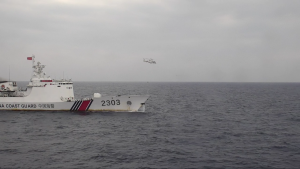
This handout photo, provided by the Japan Coast Guard, shows a China Coast Guard vessel and a helicopter within the territorial waters of the Senkaku/Diaoyu Islands on May 3 2025.
Credit: Japan Coast Guard
The number of days China Coast Guard (CCG) vessels were spotted in the contiguous zone around disputed islands in the East China Sea hit a record high in 2025 for the fourth consecutive year. The islands are controlled by Japan but claimed by China, known as the Senkaku Islands in Japan and the Diaoyu Islands in China.
According to data released by the Japan Coast Guard (JCG), Chinese government vessels entered the contiguous zone – defined as 12 to 24 nautical miles (22 to 44 kilometers) from the coast – on 357 of 365 days last year. This was the highest figure since 2008, when official Chinese vessels were first confirmed operating in the area, and two days more than the previous record of 355 days set in 2024.
The CCG also set a record for the scale of its operations. In 2025, a total of 1,380 Chinese government vessels operated in the contiguous zone over those 357 days, marking the third consecutive year the CCG has broken its own record.
In addition, Chinese government vessels maintained an uninterrupted presence in the contiguous zone for 335 successive days between November 19, 2024 and October 19, 2025, their longest ever continued presence in these waters. This marked a significant increase over the previous longest streak of 215 consecutive daysbetween December 22, 2023 and July 23, 2024.
The latest data suggests that Chinese government ships have been keeping up repeated incursions into waters around the contested, uninhabited islets, resulting in a presence that was maintained for almost the entire year.
In the past, CCG vessels were seen sailing almost every day, except during bad weather such as typhoons. But in recent years, their vessels have become larger and are able to sail regardless of the weather. China is apparently trying to take control of the islands by having its government vessels permanently stationed around there.
The data also shows that last year CCG ships intruded into Japanese territorial waters on 32 days, which was 12 days fewer than in 2024. However, in March last year, two CCG vessels remained continuously in Japan’s territorial waters for 92 hours and 8 minutes, significantly surpassing the previous record of 80 hours and 36 minutes in 2023. Territorial waters are the areas within 12 nautical miles (22 kilometers) of island coasts.
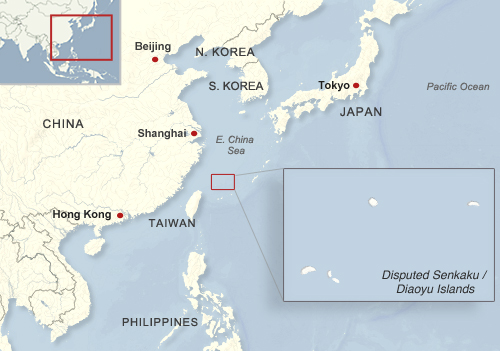
A map showing the location of the Senkakuk/Diaoyu Islands.
Map by Voice of America.
The Senkaku Islands consist of five uninhabited islands and three rock reefs.
The territorial waters surrounding the Senkaku Islands span about 4,740 square kilometers, which is equivalent to six times the land area of ??New York City in the United States. To patrol this vast sea area, the JCG has stationed 12 1,000-ton patrol vessels on Ishigaki Island, which is located about 170 kilometers south of the Senkaku Islands. It also has deployed one large 6,500-ton patrol vessel capable of carrying a helicopter on Ishigaki Island and three 3,100-ton-class helicopter-carrying patrol vessels on Okinawa’s main island. About 650 members of the JCG are dedicated to duty around the clock to patrol the territorial waters around the Senkaku Islands.
Meanwhile, the CCG has been rapidly increasing its fleet size and capabilities, making its ships larger and more armed. According to the JCG’s 2025 annual report, the CCG operated 161 vessels with full-load displacement of 1,000 tons or more as of the end of December 2024. That is more than twice the JCG’s 78 vessels in the same category.
Chinese government vessels’ approaches to the Senkaku Islands have increased sharply since 2012 when the Japanese government nationalized the islands by purchasing three of them from a private owner.
According to the JCG, the CCG initially sent one vessel at a time into waters around the Senkaku Islands, later increasing deployments to two vessels per incursion. It now routinely dispatches four vessels at a time. In addition, since around June 2024, all four of those vessels have been equipped with deck-mounted autocannons such as 76 mm guns.
A spokesperson at the JCG’s 11th Regional Coast Guard Headquarters in Naha, Okinawa, told The Diplomat on January 6 that the CCG could increase the number of vessels it deploys in the future, potentially sending six or even eight ships at a time, and that the JCG is prepared to maintain a patrol vessel posture that always outnumbers opposing forces.
The spokesperson also said that even when Japanese fishing boats are not operating near the Senkaku Islands, four CCG vessels have routinely entered the islands’ territorial waters in what he described as “ritualized intrusions,” occurring about once a month. The moves are seen as a way for China to demonstrate its own law enforcement authority and reinforce its claim to the islands.
Asked whether the trend changed specifically after Prime Minister Takaichi Sanae’s comments on a Taiwan contingency on November 7 last year, the spokesperson said there has been no noticeable change.
However, what has become increasingly noticeable recently is that many Japanese media outlets have grown accustomed to Chinese government vessels approaching the Senkaku Islands and have largely stopped reporting on the incidents. Even when they do cover them, the reports tend to be brief. The pattern mirrors Japan’s media response to North Korea’s ballistic missile launches, which once drew heavy attention but are now reported less frequently as they have become routine.
This “new normalization” is precisely what China seeks through its so-called “salami-slicing” strategy – the gradual erosion of the status quo through incremental actions that attract diminishing attention. Allowing such developments to become the “new normal” risks blunting public awareness and policy vigilance.
In the worst case, by the time the Japanese public realizes that the “salami” is gone, the status quo may already have been irreversibly altered. To prevent that outcome, Japan must heighten its vigilance and resist treating record-breaking incursions as an acceptable “new normal,” maintaining close scrutiny of Chinese activities around the disputed islands. |



